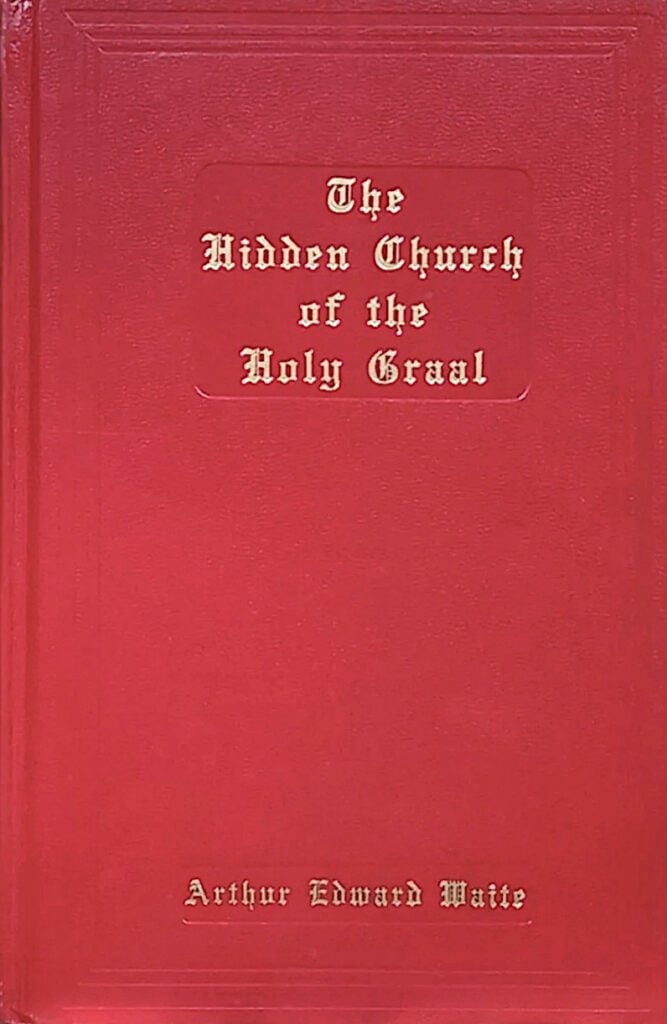
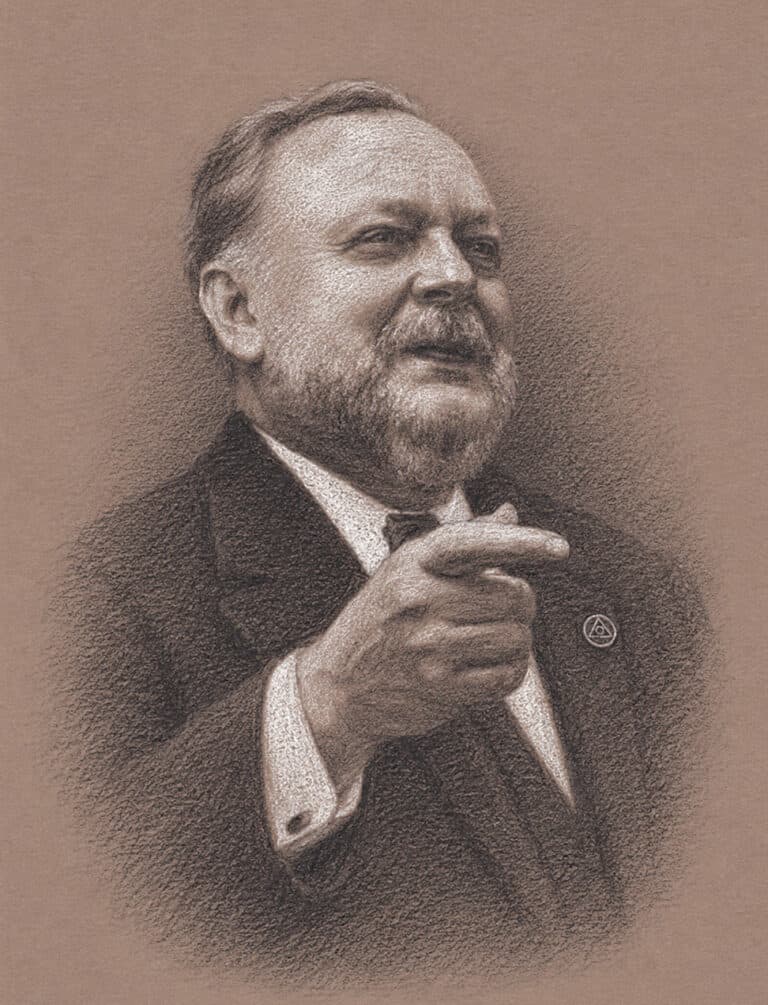
Arthur Edward Waite’s The Hidden Church of the Holy Graal: Its Legends and Symbolism Considered in their Affinity with Certain Mysteries of Initiation and other Traces of a Secret Tradition in Christian Times was first published in London by Rebman Limited in 1909 and was later issued by the Yogi Publication Society in 1975. The book is one of Waite’s most extensive studies of the Holy Graal tradition and a major work on Christian mysticism, initiation, Hermeticism, and Western esotericism.
Waite examines the medieval Graal romances and the traditions surrounding the sacred Vessel, the Graal Castle, the wounded king, Joseph of Arimathea, Perceval, Galahad, the Knights Templar, Freemasonry, Rosicrucian traditions, alchemy, and the idea of a secret spiritual tradition existing within Christianity. His purpose goes far beyond determining the historical origin of the Graal legend. He wants to understand what the Graal came to represent as a spiritual symbol and why medieval literature surrounds it with a hidden sanctuary, sacred relics, secret words, mysterious rites, wounded guardians, failed quests, spiritual qualifications, and the promise of transformative revelation.
Waite follows the Graal through its major literary forms while asking whether the legends preserve traces of a deeper mystery tradition. He accepts that some of the material behind the romances originated in pre-Christian folklore, but argues that it was transformed through Christian symbolism until the Graal became inseparable from Christ, the Eucharist, the Precious Blood, spiritual nourishment, initiation, and the search for union with God. This leads to the central idea announced in the title: the Hidden Church. Waite does not identify this Hidden Church with the Knights Templar, Freemasonry, the Rosicrucians, or any single historical organization. He presents it as an interior spiritual fellowship composed of those who have passed beyond religious symbolism into conscious experience of divine life. The Graal Quest becomes his great symbolic image of that passage, making The Hidden Church of the Holy Graal both a detailed study of medieval Graal literature and an exploration of the mystical path within Christian mysticism.
What Is The Hidden Church of the Holy Graal About?
At the center of The Hidden Church of the Holy Graal is a question: what kind of mystery lies behind the medieval stories of knights searching for the Holy Graal? Waite believes the answer cannot be reached by identifying a Celtic legend, reconstructing a lost folktale, locating a physical chalice, or discovering a historical secret society. Those investigations have value, and he spends a large portion of the book examining them, but they do not exhaust what the Graal literature became. Once the legends entered Christian Europe, the Graal acquired a sacramental and mystical character. The Vessel became associated with Christ, the Eucharist, the Precious Blood, Joseph of Arimathea, secret forms of consecration, sacred succession, spiritual healing, and access to a sanctuary concealed from the ordinary world.
Waite’s method combines literary criticism, comparative symbolism, religious history, and the interpretive methods that became important within Western esotericism. He repeatedly warns against careless claims of hidden meanings. Coincidences and symbolic similarities are not enough by themselves. A convincing interpretation requires correspondences across several bodies of symbolic literature and support from the internal structure of the texts. This caution is important because Waite is willing to investigate connections with Hermeticism, alchemy, Qabalah, Rosicrucian traditions, Freemasonry, the Knights Templar, Tarot symbolism, Christian mysticism, and traditions of initiation, while rejecting attractive theories when he decides the evidence cannot sustain them.
The Graal is not one completely consistent object throughout medieval literature. Different romances describe it differently, and Waite treats those differences as indispensable evidence. In the Christianized French traditions it becomes closely connected with the sacred Vessel, the Eucharist, Christ’s Passion, and the blood of Christ. In Wolfram von Eschenbach’s Parzival, the Graal is a mysterious stone called Lapis exilis. It sustains those around it, preserves youth, and receives a renewal of its power each Good Friday when a dove descends from heaven bearing a Sacred Host.
The changing physical description matters less to Waite than the spiritual function performed by the Graal. It is a center of sacred power and divine communication. It provides nourishment, confers or preserves life, belongs within a sanctuary, is guarded by specially appointed custodians, and can be approached successfully only under certain conditions. The Graal mystery repeatedly places something of immense spiritual value within reach of humanity while showing why humanity cannot easily possess it. The Graal Castle may be found and then lost. A knight may enter the sanctuary yet fail to ask the necessary question. A guardian may possess the sacred object while suffering from a wound that he cannot heal. The mystery is present, yet complete participation in it requires a corresponding condition within the seeker.
The Four Graal Hallows
Waite gives sustained attention to the sacred objects, or Hallows, that accompany the Graal mystery. Their exact arrangement changes across the romances, but four symbols dominate the tradition:
The Graal or sacred Vessel, associated in the Christian cycle with divine nourishment, the Eucharist, the Precious Blood, and supernatural life.
The Lance, commonly connected with the spear that pierced the side of Christ and frequently represented as bleeding.
The Sword, which appears in several forms and carries associations with judgment, danger, brokenness, restoration, and the qualifications of the knight who can wield it.
The Dish or Platter, another ceremonial object whose significance varies between versions of the legend.
These objects form a symbolic complex. They belong to a mystery enacted through procession, guardianship, loss, restoration, suffering, and quest. Waite is interested in their possible origins, but he is even more concerned with what happened after older legendary material was drawn into Christian sacramental symbolism.
The Graal Castle and the Hidden Sanctuary
One of the strongest recurring ideas in the book is the concealed sanctuary. The Graal is associated with a place removed from ordinary life: the Graal Castle, the House of the Graal, Corbenic, Mont Salvatch, or another sacred center depending upon the romance. The seeker cannot simply travel to it by following an ordinary map. Entrance depends upon conditions that belong as much to spiritual state as geography.
Waite describes several recurring ideas that he believes lie beneath the stories. There is a clouded sanctuary containing a great mystery. Communication with that mystery is possible, but only under special circumstances. Something has gone wrong within the sanctuary: a king is wounded, a land is barren, a sacred power has become inaccessible, or the mystery itself is threatened with removal. A person from outside the sanctuary must enter and accomplish something that those already within cannot accomplish. The result may be healing and restoration, but in several major versions the Graal itself is then withdrawn from the world.
This structure allows Waite to treat the Graal Castle as a spiritual symbol. The sanctuary corresponds to an interior center of divine knowledge. Its concealment expresses the distance between ordinary consciousness and the experience represented by initiation. The quest is a movement toward that center.
Why Is the Wounded King So Important?
The wounded or suffering Graal King is one of the central mysteries of the cycle. Depending upon the text he appears under different names and genealogies, including the Fisher King, Rich Fisherman, King Pelles, Amfortas, and related figures. His condition is linked with the state of the Graal kingdom. The guardian of the sacred mystery possesses extraordinary treasure but remains unable to heal himself.
Waite follows these changing identities across the different Graal cycles because they reveal how radically the tradition developed between authors. In the Greater Chronicles, a succession of Graal custodians stretches from Joseph of Arimathea and the Second Joseph through later guardians until the age of King Pelles and Galahad. In another line Brons is succeeded by Perceval. In Wolfram’s German cycle the succession runs through Titurel, Frimutel, and Amfortas before passing to Parzival.
The spiritual pattern remains recognizable despite these differences. Possession of sacred knowledge does not automatically equal realization. The wounded keeper is near the mystery and may even be its appointed guardian, yet something remains incomplete. The outsider who arrives at the Graal Castle carries the possibility of restoration.
Perceval and the Question That Must Be Asked
Perceval embodies one of the oldest and most important forms of the Graal Quest. He reaches the mysterious castle and witnesses extraordinary events but initially fails to perform the action expected of him. In several versions this failure centers on a question he should have asked. The exact wording and consequences vary, yet the motif becomes one of the most powerful symbols in Graal literature: the seeker can stand in the presence of the mystery and still fail to understand what the moment requires.
For Waite, this is part of the distinction between proximity to sacred things and conscious participation in them. Perceval’s journey becomes a process of preparation. The quester has encountered the mystery before he possesses the capacity to fulfill it. He must continue searching, learning, suffering, and changing.
This makes the Graal Quest an interior drama as well as an adventure. The road back to the Castle corresponds to the search for a lost state of consciousness. The knight’s task is not simply to relocate a building he once visited. He must become the person capable of completing what was left unfinished during the first encounter.
Galahad and the Perfected Graal Quest
The Galahad tradition gives Waite another model of the Quest. Galahad is conceived as the predestined Graal knight and enters the story already marked by an extraordinary spiritual vocation. His quest belongs to a much more explicitly Christian and ascetic atmosphere than many of the earlier Perceval stories. Purity, virginity, divine election, sacramental symbolism, and supernatural intervention dominate his journey.
Galahad reaches the Graal mystery, participates in its highest revelation, and becomes its final custodian in the Greater Chronicles. His success leads to withdrawal. After Galahad’s completion of the Quest, the sacred Vessel is removed, and his own earthly life comes to an end. Waite treats this disappearance as one of the major clues to the meaning of the literature. The completed quest does not establish the Graal publicly in ordinary society. The mystery recedes from the visible world.
The pattern reinforces Waite’s idea of the Hidden Church. Spiritual realization cannot simply be institutionalized through possession of a relic. The Graal belongs to a level of experience that the romance can symbolize but cannot make universally available by external means.
Joseph of Arimathea and the Christianization of the Graal
Joseph of Arimathea occupies a major place in Waite’s reconstruction because the Joseph legends connect the Graal directly with the beginnings of Christianity. Through these traditions, the Vessel is linked with Christ and the Passion and is carried westward until its mystery becomes established in Britain. A succession of guardians develops from this sacred transmission.
Waite pays close attention to claims that accompany this history because some versions imply an extraordinary religious authority. The Graal tradition can suggest a succession possessing privileges or mysteries beyond ordinary apostolic transmission. It also contains secret words associated with the Graal and the Eucharistic mystery. These features raise the possibility of what Waite calls a “super-apostolical succession”: a concealed transmission of Christian mystery existing alongside the familiar history of the Church.
He does not declare this fictional genealogy to be literal history. The value of the claim lies in what the romances are attempting to express. They imagine a Christianity in possession of an interior mystery transmitted from the earliest sacred events and preserved by chosen custodians. That idea becomes one of the bridges from medieval Graal romance to Waite’s concept of a Secret Church.
The Eucharist at the Center of the Graal Mystery
The Eucharist is the theological center of Waite’s interpretation. The Graal feeds, sustains, heals, preserves, and communicates supernatural life. Its processions resemble sacred rites, its Christian legends connect it with Christ’s body and blood, and some romances associate it directly with consecrated bread. Waite repeatedly compares the mysteries of the Graal literature with Catholic sacramental doctrine because he believes both are concerned with divine life communicated through visible signs.
Waite’s interpretation remains deeply Christian. He believes the Graal literature reaches its highest meaning when understood as a mystery of union with God. The Eucharistic symbolism gives literary form to the possibility that divine life can be received, interiorized, and realized.
The secret words of the Graal legends fascinate him for the same reason. If there is a hidden formula connected with the Vessel, what does it signify? Waite compares the idea with historical forms of Eucharistic consecration and gives attention to the Greek Epiclesis, the invocation of the Holy Spirit upon the Eucharistic elements. Yet he refuses to reduce the Graal secret to a simple lost liturgical formula. The hidden word becomes another symbol of a communication whose full reality exceeds the external form.
Is the Graal Tradition Celtic?
Waite devotes an entire major division of the book to the possibility that the mysteries of the Graal could be explained through the Celtic Church. The theory has considerable initial appeal. The legends developed in a Celtic environment, Britain occupies a central place in the Christian Graal histories, Glastonbury became associated with Joseph of Arimathea, and the Celtic Church possessed distinctive traditions concerning relics, sacred vessels, liturgy, saints, and early British Christianity. Waite examines St. David’s miraculous altar, chalices, fish symbolism, hereditary custodians of relics, the dove, the Celtic Mass, the Epiclesis, and traditions of an independent British Christianity.
For a time, the Celtic hypothesis seems capable of explaining an impressive amount of the Graal material. Waite then subjects it to the same criticism he applies to competing theories. The supposed correspondences do not account adequately for the secret words, the Passion relics, the special succession, the differences between Galahad and Celtic heroic figures, or several other defining features of the romances. He concludes that the Celtic Church supplied an important environment for the literature but cannot serve as the historical Hidden Church behind the Graal.
The Knights Templar provide another tempting candidate. Medieval chronology, the Temple, the Holy Land, chivalric initiation, secrecy, later legends surrounding the Order, and the possibility of heterodox traditions have encouraged attempts to connect Templarism with the Graal. Waite investigates the theory at length.
Once again, he rejects the identification. The alleged Templar symbolism does not provide enough evidence to make the Order the source or custodian of the Graal mystery. He distinguishes romantic reconstructions of Templar history from what can reasonably be established and finds the theory unable to explain the literature as a whole.
His rejection is important because Waite himself belonged to the world of occult and initiatory studies and had every opportunity to embrace an attractive secret-society genealogy. Instead, he repeatedly strips away claims of direct historical descent. The secret tradition he seeks is deeper than an institutional pedigree.
The Graal, Freemasonry, and the Lost Word
Waite’s discussion of Freemasonry introduces another major set of parallels. Masonic symbolism revolves around a temple, builders, loss, recovery, concealed knowledge, sacred words, death, restoration, and initiation. These themes naturally invite comparison with the Graal Castle, the lost or inaccessible mystery, the wounded kingdom, and the quest for restoration.
Waite sees real symbolic correspondences but again refuses to turn correspondence into a simple genealogy. The value of Freemasonry for his inquiry lies in its preservation of another form of the “House of Doctrine.” The physical Temple becomes the image of a spiritual temple, and the search for a lost secret becomes an image of interior recovery. He is interested in the temple “in the heart,” the lost word, the voided house, the vacant sepulchre, and the way certain Masonic high degrees place Christian symbols inside an initiatory framework.
This places the book firmly within the history of Western esotericism. Waite is tracing families of symbols across Christian mysticism, initiation, Masonry, Rosicrucian traditions, alchemy, and related currents. Similar symbols may testify to related spiritual concerns even when no historical chain of transmission can be proved.
Alchemy and the Transformation of the Seeker
Alchemy becomes significant when Waite turns from external history to the language of transformation. In the spiritual interpretation of alchemy, transmutation describes a change in the human person. The alchemical work, like the Graal Quest, becomes a symbolic account of regeneration and union.
This comparison helps clarify what Waite means by initiation. Initiation at its highest level is not membership in an organization or possession of ceremonial secrets. It is a change in consciousness. A person passes from ordinary spiritual life into realized participation in the divine mystery. This is why Waite can compare Graal symbolism with initiatory traditions without claiming that the medieval knights belonged to a historical occult order.
His later description of members of the Secret Church as “transmuted and tingeing stones” deliberately employs alchemical language. The successful adept has undergone the work represented by the symbols. The person has become what the quest sought.
The Graal and the Mysteries of Initiation
The subtitle of Waite’s book identifies initiation as one of its main concerns. His argument is that the completed Graal tradition resembles the structure of initiation because both concern entrance into a mystery through preparation and transformation.
Several recurring elements make this connection possible:
There is a mystery hidden from ordinary awareness.
The seeker feels called to search for it.
Access requires qualification.
Trials expose the seeker’s limitations.
The sanctuary can be approached without being fully understood.
A decisive revelation or communication marks successful attainment.
The true end of the quest is spiritual transformation and union.
Waite calls the Graal a “rumour of the Mystic Quest.” That phrase captures much of his argument. The romances are imperfect literary reflections of a spiritual pattern found elsewhere in mystical and initiatory traditions. Their knights, castles, relics, swords, questions, wounds, journeys, and supernatural events externalize experiences that belong to the interior life.
What Does Waite Mean by the Hidden Church?
The Hidden Church is the central idea toward which the entire book moves. Waite does not finally identify it with the Celtic Church, Knights Templar, Freemasonry, Rosicrucians, an occult fraternity, or any other single historical organization. His Hidden Church exists through spiritual realization.
He describes it as a community of consciousness: the fellowship of those who have attained regeneration and conscious union with divine life. Its members need not belong to one visible institution. There are no ordinary ceremonial admissions to this Holy Assembly because, in Waite’s formulation, the candidate finally “inducts himself.” Its presence is known through influence, mystical literature, spiritual attainment, and recurring testimonies to the interior life.
This is one of the most important distinctions in the book. A reader looking for Waite to reveal the name of a secret organization behind medieval Christianity will be disappointed. His investigation ends with something more elusive. The Hidden Church is the interior dimension of Christianity realized in human consciousness.
The Visible Church and the Secret Church
Waite does not construct the Secret Church simply as an enemy or replacement for institutional Christianity. He explicitly rejects the image of the visible Church as a body secretly controlled by an invisible esoteric head. Christ is the head of both. The difference concerns the degree to which divine union has become conscious experience.
The visible Church preserves doctrine, sacraments, worship, scripture, and the communal Christian life. The Secret Church represents the realization toward which those symbols point. Waite speaks of the official Eucharist and the interior communication of divine life as different levels of the same mystery. The hidden tradition carries what he regards as deeper intimations of Church doctrine and the life of sanctity.
This gives his esotericism a distinctly Christian character. The secret is hidden less because a fraternity has deliberately concealed information than because spiritual experience cannot be transferred merely through words.
The Holy Assembly and Higher Consciousness
Waite eventually gives the inhabitants of this interior Church a name: the Holy Assembly. He describes it as a union of illuminated spirits in Christ, a fellowship constituted by consciousness instead of institutional membership. The idea comes close to what other esoteric traditions have called the invisible college, hidden masters, inner church, or fraternity of adepts, though Waite is careful about the implications of such comparisons.
He rejects the idea of an unseen headquarters directing world events. The Holy Assembly is not a secret government. Its operation is described as influence. Its members are those who have undergone regeneration, entered the higher consciousness, and realized the divine communication symbolized by the sacraments.
Here the long investigation of medieval romance becomes a theology of mystical consciousness. The Castle becomes the interior sanctuary. The Quest becomes the spiritual path. The Graal becomes divine communication. The successful knight becomes the regenerated person. The hidden fellowship becomes the communion of those who have completed the work.
Why Does the Graal Disappear?
The repeated withdrawal of the Graal is one of the most important patterns Waite discovers. The sacred object appears, a quest takes place, the mystery reaches fulfillment, and then the Graal is removed, concealed, or carried away.
On the literal level this provides an ending for the romances. On Waite’s symbolic level it explains the very idea of a secret tradition. The mystery cannot remain an external possession. If it did, people could simply travel to the Castle, inspect the Vessel, learn its words, and inherit its power. Graal literature repeatedly denies that possibility.
The disappearance turns the reader inward. What vanished from history must be sought through the Mystic Quest. The hidden sanctuary is no longer a medieval castle waiting to be excavated. Its counterpart is within the spiritual life.
The Graal, Christian Mysticism, and Union with God
Waite makes a crucial distinction in the preface when he says that the Graal literature in its final development is mystical because it concerns the path of union. This places the book securely within Christian mysticism and explains why its extensive treatment of occult and initiatory subjects never abandons its Christian center.
The highest goal is union with God. Purification, initiation, secret knowledge, symbolism, sacrament, and quest all receive their value from that goal. A symbol is useful because it directs consciousness toward spiritual reality. A sacrament is meaningful because it communicates divine life. An initiation has meaning because it marks or facilitates transformation. A secret tradition matters because it preserves testimony concerning attainment.
Waite’s Graal is inseparable from the Great Work, a phrase with strong associations in alchemy and Hermeticism that he places within a Christian mystical framework. He closes his preface by declaring that the glory of God is the purpose of his study and that he undertakes the Quest as part of the Great Work.
How Does the Book Relate to Western Esotericism?
The Hidden Church of the Holy Graal occupies an important position in the literature of Western esotericism because Waite brings together bodies of symbolism that are often studied separately. Medieval Graal romance, Catholic sacramentalism, Christian mysticism, Rosicrucian ideas, alchemy, Qabalah, Freemasonry, Tarot, Templar legends, and traditions of initiation all enter his investigation.
His purpose is not to declare them identical. He searches for correspondences while preserving distinctions. A Graal symbol can resemble an alchemical symbol without proving that an alchemist wrote the Graal romances. Masonic ideas of a lost word and a spiritual temple can illuminate aspects of the Graal without establishing medieval Freemasonry. Templar legends can echo the imagery of a hidden Christian tradition without proving that the Templars created the Graal cycle.
This careful use of correspondence is one of the book’s defining features. Waite believes separate symbolic systems can preserve reflections of the same spiritual realities. The historical pathways may differ while the mystical destination remains recognizable.
What Is the Central Teaching of The Hidden Church of the Holy Graal?
The central teaching of The Hidden Church of the Holy Graal is that the Graal Quest can be read as a symbolic expression of humanity’s search for conscious participation in divine life. Medieval writers inherited older legendary materials and transformed them through Christian symbolism until the Graal became connected with the Eucharist, Christ, sacred blood, spiritual nourishment, healing, secret transmission, and the search for a hidden sanctuary. Waite believes these stories preserve distant intimations of the same interior mystery described by Christian mystics and by several traditions of initiation.
His Hidden Church is the final key. It is not a building that has disappeared, a secret order waiting to be exposed, or an alternative church with an undiscovered institutional history. It is the spiritual communion formed by those who have passed from symbolic knowledge to experience. The Graal Castle is hidden because the reality it represents belongs to an interior order. The sacred Vessel nourishes because it represents participation in divine life. The wounded keeper shows that proximity to sacred knowledge does not guarantee realization. Perceval’s unanswered question shows that a person may encounter the mystery before becoming capable of receiving it. Galahad represents fulfillment, and the withdrawal of the Graal reminds the reader that the mystery cannot be possessed as an ordinary object.
Waite began with medieval stories of a mysterious Vessel and ended with a theory of spiritual attainment. The historical Graal legends remain important, and much of his enormous book is devoted to distinguishing their texts, genealogies, symbols, competing cycles, and possible sources. Yet his final concern is the living meaning behind them. Scholarship can reconstruct the road by which the legends reached us; mysticism asks where that road points. For Waite, every true form of the Graal Quest leads toward the same hidden sanctuary: the point at which religious symbol becomes spiritual experience, the seeker becomes participant, and the distant rumor of the Holy Graal becomes the interior reality of the Mystic Quest.
.
Philosophic Seal of the Society of Rosicrucians by Waite