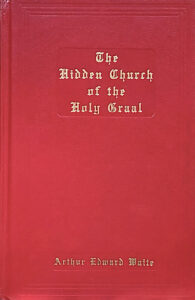
Arthur Edward Waite (October 2, 1857 – May 19, 1942) was an American-born British mystic, poet, author, translator, and historian of Western esotericism. Best known today as the co-creator of the Rider-Waite-Smith Tarot, Waite devoted much of his life to the study of Rosicrucianism, alchemy, Qabalah, Freemasonry, ceremonial magic, Christian mysticism, and Hermetic traditions. Unlike many occult writers of his generation, he approached these subjects not simply as systems of magical practice but as parts of a larger spiritual tradition concerned with inner transformation and direct experience of the Divine.
Through his extensive historical writings, translations, and involvement with initiatory organizations, Waite became one of the most important figures in the development and preservation of Western esoteric philosophy during the late nineteenth and early twentieth centuries.
Early Life
Waite was born in Brooklyn, New York, in 1857 to an American father and English mother. Following his father’s death, his family returned to England while Waite was still young, and he spent most of his life in Britain.

His early interests centered on poetry, literature, religion, and mysticism. Following the death of his sister in the 1870s, he became increasingly interested in spiritualism and psychical research before turning toward the deeper study of occult philosophy, ceremonial magic, alchemy, Rosicrucianism, and Christian mysticism. These interests eventually developed into a lifelong attempt to trace the hidden spiritual tradition he believed existed beneath the outward forms of Western religion and esotericism.
Western Esotericism
Waite became one of the earliest serious historians of the Western esoteric tradition. He collected, translated, edited, and analyzed obscure works dealing with alchemy, Qabalah, Rosicrucianism, ceremonial magic, Freemasonry, and mystical Christianity.
Although he participated personally in occult organizations, Waite was frequently critical of sensational claims about supernatural powers and magical practices. He believed the true purpose of esotericism was not the acquisition of psychic abilities or control over external forces but the spiritual transformation of the individual.
For Waite, the symbols of alchemy, Qabalah, the Grail legends, Rosicrucianism, and ceremonial initiation represented different expressions of a deeper mystical tradition concerned ultimately with humanity’s reunion with the Divine.
The Hermetic Order of the Golden Dawn
Waite joined the Hermetic Order of the Golden Dawn in 1891, placing him within one of the most influential occult organizations of the modern era. The Golden Dawn combined Hermeticism, Qabalah, Rosicrucianism, astrology, alchemy, Tarot, Egyptian symbolism, and ceremonial magic into an elaborate initiatory system.
Waite eventually became an important figure within the organization’s Isis-Urania Temple. However, his increasing emphasis on Christian mysticism and spiritual initiation placed him at odds with members who were more interested in practical ceremonial magic.
Following divisions within the Golden Dawn, Waite reorganized his branch around a more explicitly mystical interpretation of the tradition. His approach increasingly emphasized inner spiritual realization rather than magical operations.
The Rider-Waite-Smith Tarot
Waite’s most enduring contribution came through his collaboration with artist and fellow Golden Dawn member Pamela Colman Smith. Under Waite’s direction, Smith created the illustrations for a new Tarot deck published in 1909, now generally known as the Rider-Waite-Smith Tarot.

The deck represented an important transformation in the history of Tarot. Earlier decks generally depicted the numbered Minor Arcana cards with arrangements of suit symbols, while Smith created elaborate symbolic scenes for all seventy-eight cards. These illustrations allowed the Minor Arcana to communicate ideas through visual symbolism in much the same manner as the Major Arcana.
Waite subsequently published The Pictorial Key to the Tarot, explaining the symbolism and meanings of the cards and describing methods of divination. He also helped popularize the Celtic Cross spread, which became one of the most widely used Tarot layouts.
The Rider-Waite-Smith system became the foundation for a large portion of modern Tarot and inspired countless later decks.
Rosicrucianism and the Fellowship of the Rosy Cross
Rosicrucianism occupied a particularly important place in Waite’s spiritual philosophy. He spent decades researching the original Rosicrucian manifestos, later Rosicrucian organizations, and their relationship to Freemasonry, alchemy, and Christian mysticism.
In 1915, Waite established the Fellowship of the Rosy Cross, an independent initiatory organization reflecting his mature understanding of the Western mystery tradition. Rather than emphasizing practical magic, the Fellowship concentrated upon mystical symbolism, spiritual initiation, contemplation, and the inner meaning of the Rosicrucian tradition. Waite was also deeply involved in Freemasonry and the Societas Rosicruciana in Anglia, allowing him access to a wide range of initiatory traditions and historical materials that informed his writings.
Principal Works
Waite produced an enormous body of literature dealing with nearly every major branch of Western esotericism. Among his best-known works were The Book of Black Magic and of Pacts, an extensive examination of historical grimoires and ceremonial magic, The Book of Ceremonial Magic, his revised study of magical traditions, and The Pictorial Key to the Tarot, his explanation of the Tarot system developed with Pamela Colman Smith.
He also produced important studies and editions concerning alchemy, Qabalah, Rosicrucianism, Freemasonry, the Holy Grail, mystical Christianity, and ceremonial initiation. Through these works, Waite helped preserve and interpret texts that might otherwise have remained inaccessible to twentieth-century readers.
The Secret Tradition
Underlying Waite’s enormous body of work was his belief in what he called a Secret Tradition within Western spirituality. He believed that beneath the outward institutions of Christianity, Freemasonry, Rosicrucianism, alchemy, Qabalah, and the mystery schools existed a deeper current of mystical knowledge concerned with direct spiritual realization.
The symbols and ceremonies of these traditions were not ends in themselves. They were outward representations of an inward process through which the individual gradually awakened to a higher spiritual reality. This distinguished Waite from occultists primarily concerned with magical power. For him, the true mysteries concerned the transformation of consciousness and the individual’s relationship with God.
Legacy
Arthur Edward Waite became one of the most influential interpreters of Western esotericism of the modern era. His historical studies helped preserve the literature of Rosicrucianism, alchemy, Qabalah, Freemasonry, ceremonial magic, and Christian mysticism, while his writings encouraged later generations to study these traditions as interconnected expressions of Western spiritual history.
His greatest popular legacy remains the Rider-Waite-Smith Tarot. The imagery created by Pamela Colman Smith under Waite’s direction fundamentally reshaped modern Tarot and remains the model upon which much contemporary Tarot symbolism is based.
.