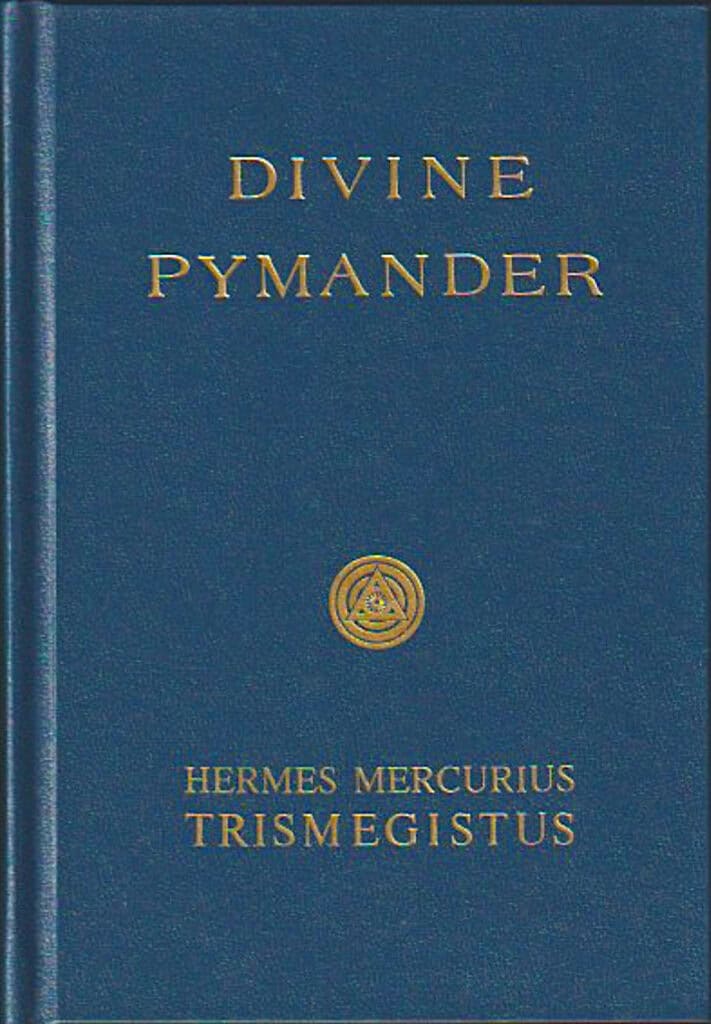
Divine Pymander, also known as Poimandres, is an ancient text that is the opening tractate of the Corpus Hermeticum, a collection of mystical writings attributed to Hermes Trismegistus. Serving as the foundation of Hermetic philosophy, the text presents a visionary account of creation, the nature of God, the origin of humanity, and the soul’s journey toward spiritual enlightenment. Through a symbolic dialogue between Hermes and the Divine Mind, it establishes many of the central themes that would shape later Hermetic, Rosicrucian, and esoteric traditions.
The work begins with Hermes entering a profound state of meditation, during which he encounters Pymander, the Divine Mind or Supreme Intelligence. Pymander reveals to him the hidden mysteries of the universe, explaining that all creation originates from the Divine Mind, which brings order to primordial chaos through the creative Word, or Logos. From this process emerge the celestial spheres and the seven planetary governors that oversee the material universe and influence human existence.
The book teaches that humanity was created in the image of God as a divine and immortal being. Drawn by the beauty of the material world, however, the original Human descended into creation, joining the immortal soul with the mortal body. As a result, every person possesses a dual nature, simultaneously belonging to both the spiritual and material worlds. According to The Divine Pymander, the greatest obstacle to human fulfillment is ignorance of the Divine. Salvation is achieved not through external rituals but through inner awakening, self-knowledge, and spiritual rebirth. By turning away from the illusions of the material world and recognizing the divine spark within, the soul gradually frees itself from the influence of the planetary spheres and ascends once more toward its eternal source.
“An Earthly Man is a mortal God, …the Heavenly God is an immortal Man.”
The text presents the goal of human life as reunion with the Divine Mind. Through wisdom, virtue, and contemplation, the individual overcomes the limitations of the physical world and returns to the state of unity from which all creation originally emerged.
Hermes Trismegistus, meaning “Hermes the Thrice-Greatest” (Ancient Greek: Ἑρμῆς ὁ Τρισμέγιστος), is the legendary sage traditionally regarded as the founder of Hermetic philosophy and one of the central figures in the history of Western esotericism. He emerged in Hellenistic Egypt during the first centuries CE as a fusion of the Greek god Hermes and the Egyptian god Thoth. Hermes was the divine messenger, patron of language, learning, and commerce, while Thoth was revered as the god of wisdom, writing, mathematics, science, magic, and sacred knowledge. Credited with inventing writing, recording the judgments of the dead, and preserving the wisdom of the gods, Thoth was regarded by the ancient Egyptians as the divine source of all knowledge. The title Trismegistus, meaning “Thrice-Greatest,” derives from an Egyptian epithet long associated with Thoth, emphasizing his supreme mastery of wisdom, knowledge, and magical power.
Hermes Trismegistus was traditionally credited as the author of the Hermetica, a body of philosophical, mystical, and practical writings that became the foundation of the Hermetic tradition. Among the most important are the Corpus Hermeticum, a collection of dialogues exploring the nature of God, creation, and spiritual enlightenment, and the Emerald Tablet, the brief but enormously influential work that introduced the Hermetic maxim, “As above, so below.” These writings teach the unity of the cosmos, the divine nature of the human soul, and the pursuit of gnosis—direct spiritual knowledge attained through inner transformation and rebirth.
The Hermetic writings profoundly influenced the development of Western alchemy, astrology, ceremonial magic, Rosicrucianism, Freemasonry, and Renaissance philosophy. During the Renaissance, scholars such as Marsilio Ficino regarded Hermes Trismegistus as a pre-Christian prophet who preserved an ancient universal wisdom revealed by God before the time of Moses. Although the Swiss scholar Isaac Casaubon demonstrated in 1614 that the Hermetic writings were composed during the early centuries of the Roman Empire rather than in remote Egyptian antiquity, their philosophical and spiritual influence continued to grow.
Related Research Articles
The Sacred Geometry of the Yogi Publication Society Logo
This article examines the Yogi Publication Society logo and its sacred geometry meaning, comparing it with Hindu, Hermetic, Rosicrucian, Masonic, and Theosophical traditions to show the intention behind the publishing network.