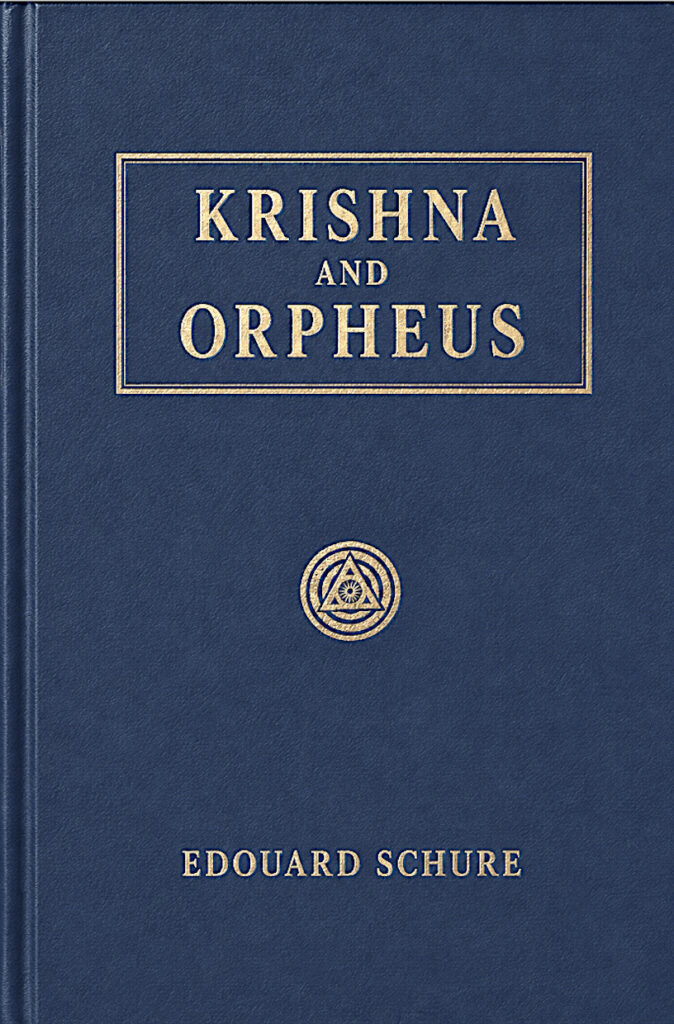
Krishna and Orpheus: The Great Initiates of the East and West by Édouard Schuré, translated by F. Rothwell, and published by the Yogi Publication Society at the Masonic Temple in Chicago in 1908. The book combines two studies from Schuré’s previous work on the great initiates: “Krishna (India and the Brahmanic Initiation)” and “Orpheus (The Mysteries of Dionysos).” Krishna represents the spiritual tradition of ancient India and the formation of Brahmanic initiation; Orpheus represents the transmission of sacred knowledge into ancient Greece and the formation of the Greek mysteries. Schuré treats both figures as initiates who penetrate beyond ordinary religious forms to a universal divine reality, then organize teachings, symbols, rites, and communities through which that knowledge can be transmitted to others.
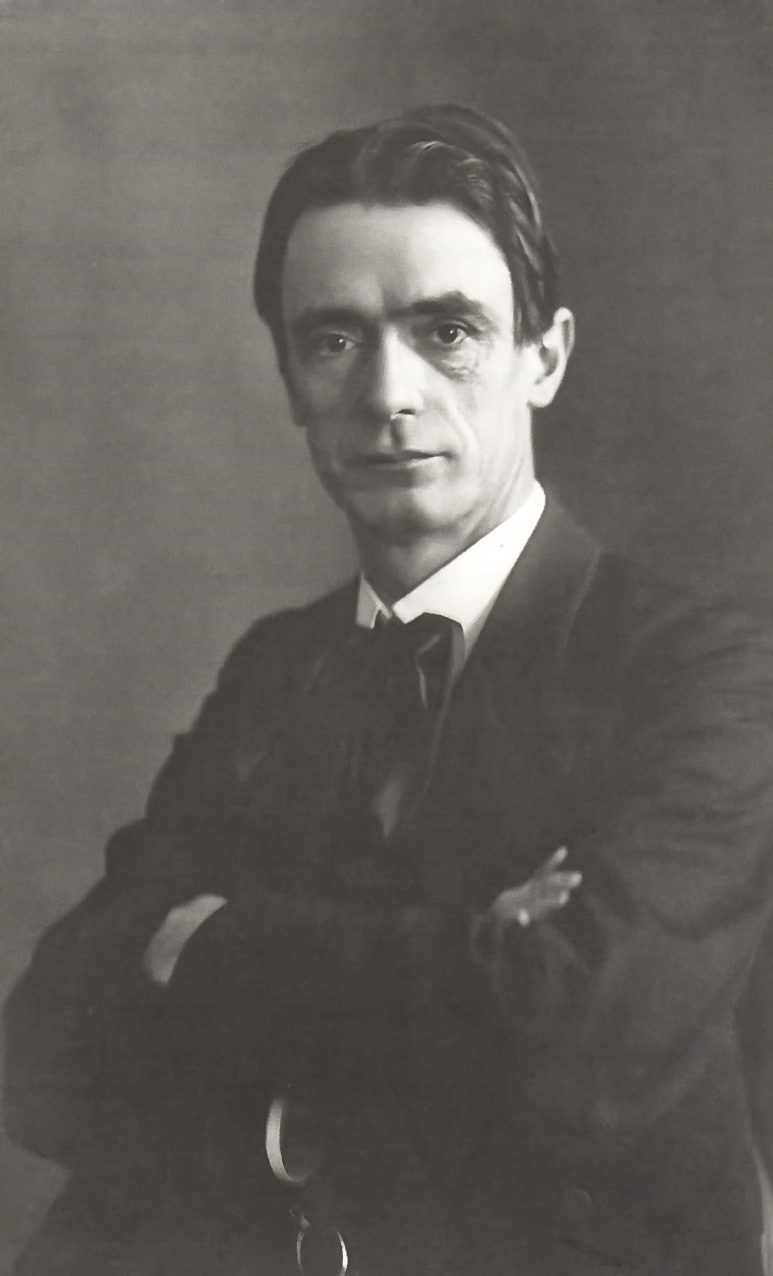
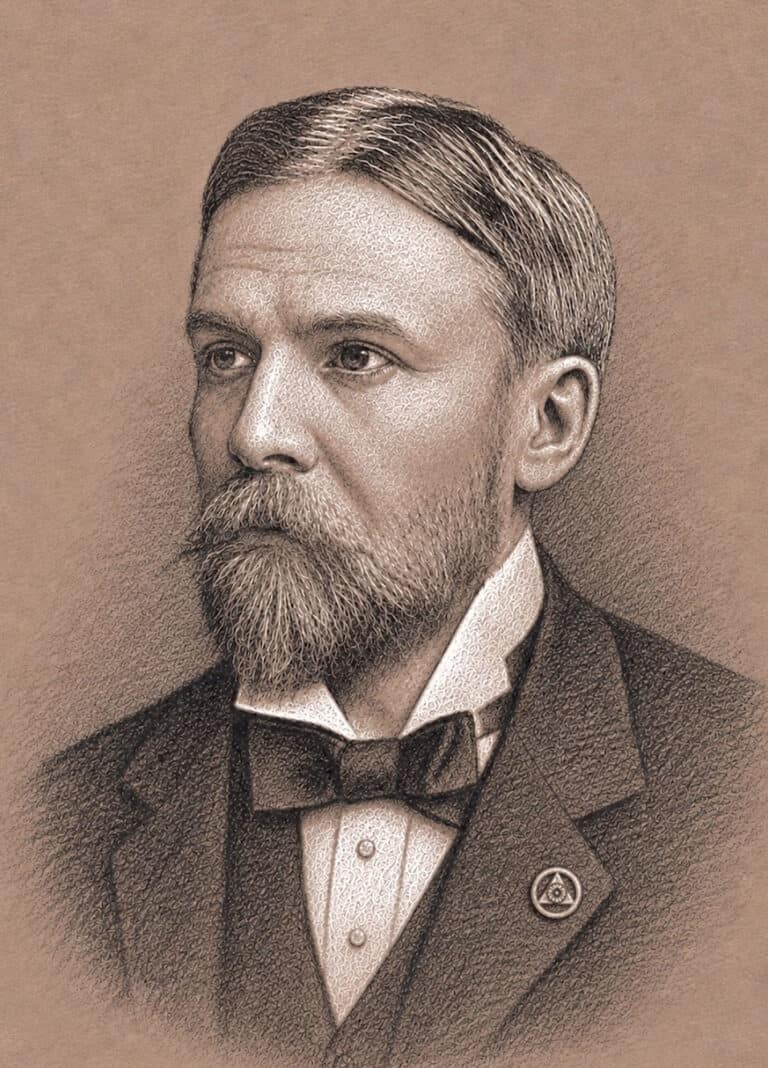
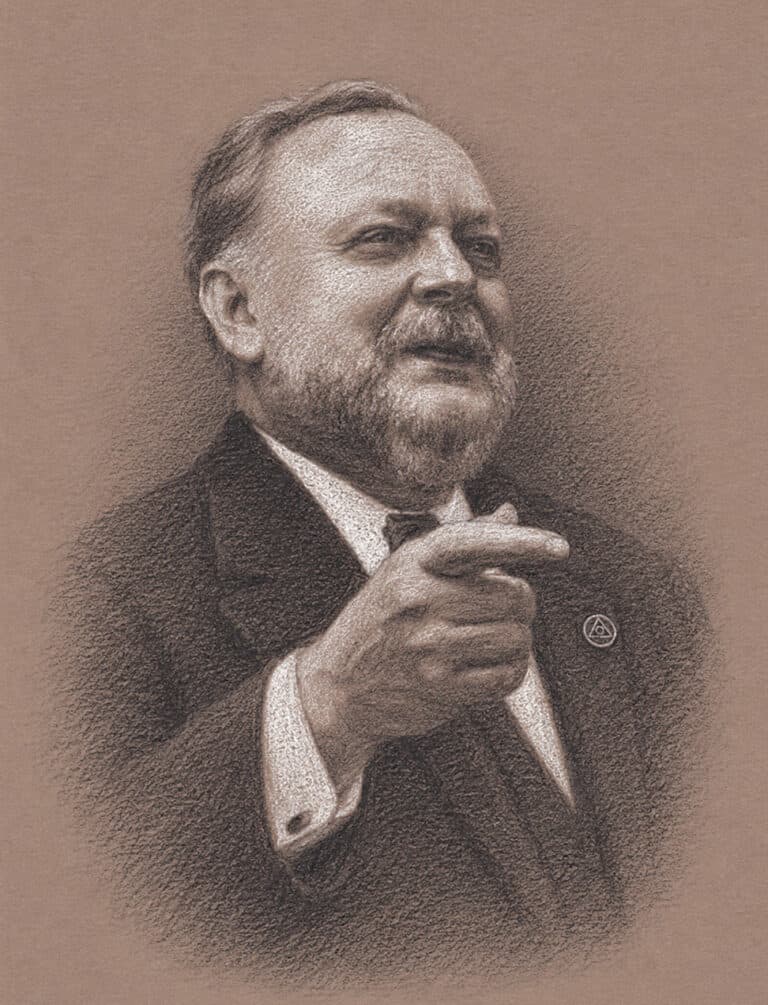
Édouard Schuré
The book is a work of esoteric religious history as Schuré understood it, mixing mythology, scripture, legend, comparative religion, occult philosophy, and imaginative historical reconstruction into a continuous narrative. He reads myths as repositories of spiritual history and sacred symbols as veiled descriptions of realities experienced by initiates. The opening page of the Krishna section states the metaphysical framework immediately: Brahma, Maya, and Vishnou represent Essence, Substance, and Life, three aspects contained within a single ineffable divine reality. Alongside this Schuré places the teaching that God dwells within humanity, that desire binds the soul, that selfless action leads toward spiritual perfection, and that the soul which discovers God within itself can escape rebirth, old age, suffering, and death. These ideas govern the entire book. Krishna and Orpheus are presented as two expressions of a perennial initiatory tradition in which human consciousness can awaken to its divine source, the soul passes through repeated lives, visible nature conceals invisible spiritual worlds, and the highest religious knowledge comes through direct inner experience.
For the Yogi Publication Society, Krishna and Orpheus fit closely with a catalog already exploring Yogi philosophy, comparative religion, reincarnation, psychic development, Hermeticism, Western esotericism, Qabalah, Rosicrucian teachings, alchemy, and Christian mysticism. Its pairing of India and Greece also gives the book a special place beside the works published under the name Yogi Ramacharaka. Schuré is pursuing his own system and historical narrative, yet the central premise is highly compatible with the comparative approach found throughout the YPS catalog: different civilizations can preserve different outward forms of a spiritual knowledge whose deepest principles are universal.
What Is Krishna and Orpheus About?
Krishna and Orpheus is about the origin, preservation, and transmission of initiatory knowledge in the ancient world. Schuré divides his study geographically and spiritually between East and West. The Krishna section contains eight chapters moving from heroic India and the conflict between the solar and lunar races through the birth, youth, initiation, teaching, triumph, and death of Krishna, ending with the continuing influence of what Schuré calls the “Solar Word.” The five chapters devoted to Orpheus move from prehistoric Greece and the Bacchantes through the Temple of Jupiter, the Dionysiac mysteries, the evocation of the dead, and the death of Orpheus.
Beneath these narratives lies Schuré’s larger theory of civilization. Humanity periodically receives spiritual impulses through exceptional individuals capable of conscious contact with the divine world. These initiates understand truths that ordinary religion expresses through gods, myths, ceremonies, and symbols. Their task is to translate spiritual knowledge into forms suitable for a people and an age. Krishna accomplishes this in India by reconciling spiritual insight, religious authority, moral action, and the doctrine of the divine soul. Orpheus performs a comparable work in Greece by bringing order to ecstatic Dionysian religion, teaching the unity behind the gods, and establishing mysteries through which selected disciples can learn about the soul, the cosmos, death, rebirth, and the divine world.
Schuré is interested in more than the teachings themselves. He repeatedly asks how esoteric knowledge becomes a civilization. Religion, kingship, poetry, music, philosophy, morality, ritual, and social organization all become vehicles for spiritual principles. The initiate stands between invisible and visible worlds, receiving from one and shaping the other. This concept forms the bridge between Krishna and Orpheus.
Schuré begins with an idealized reconstruction of ancient Aryan India. He describes great kingdoms, heroic warriors, sacred kingship, powerful priesthoods, and the civilization reflected in the Mahabharata and the Puranas. The early warrior ideal centers on courage, loyalty, filial duty, protection of the weak, and willingness to die honorably in battle. Women appear through the epic ideal of the faithful and spiritually powerful wife, represented by figures such as Sita and Damayanti. Behind this heroic society, however, Schuré sees a deeper transformation taking place through the interaction of peoples, religious ideas, priesthoods, and competing forms of spiritual authority.
The conflict between the solar and lunar races becomes one of Schuré’s organizing symbols. These dynastic struggles are political, racial, religious, and metaphysical at the same time. The solar principle becomes associated with higher spiritual consciousness and the transmission of divine wisdom, while the lunar current becomes connected with forces that can descend toward sensuality, domination, magic, and disorder. Schuré uses these opposing tendencies to create the historical setting for Krishna. India needs a spiritual reformer capable of restoring harmony between religious knowledge and social power.
This treatment reveals Schuré’s method throughout the book. Epic and mythology are read as encoded spiritual history. A battle between dynasties can signify a conflict between principles of consciousness; a god can represent a cosmic force; a heroic birth can indicate the appearance of a new spiritual impulse; and a political revolution can mark the establishment of a new religious order. His Krishna must be understood inside this symbolic history.
The King of Mathura and the Prophecy of Krishna
King Kansa of Mathura represents the forces opposing the coming spiritual order. Schuré depicts him as a ruler driven by ambition, fear, sensuality, and a desire to dominate both political and religious life. Around him gathers an atmosphere of intrigue and destructive magical influence. The struggle is sharpened by prophecy: a child is destined to overthrow the tyrant and restore a higher order.
The prophecy changes Kansa’s fear into persecution. Devaki, connected with the royal house and destined to become Krishna’s mother, occupies the center of the unfolding drama. Schuré builds the story around the ancient religious motif of the divinely appointed child threatened before birth by an earthly ruler. The physical danger surrounding Devaki is paired with a spiritual expectation that a great soul is preparing to enter the world.
The pattern is important to Schuré because the birth of an initiate has cosmic significance. Krishna is not presented merely as a prince who later becomes a religious teacher. His appearance corresponds to a need within the spiritual history of India. The coming child carries a mission that reaches far beyond the overthrow of Kansa.
Devaki and the Birth of Krishna
Devaki is portrayed as possessing the purity and receptivity required for the birth of an exceptional spiritual being. Her motherhood becomes part of the sacred drama. Schuré surrounds the conception and birth of Krishna with visions, prophecies, dreams, and signs through which the invisible world announces what ordinary human beings cannot yet understand.
Krishna’s birth also introduces a theme that will reappear in Schuré’s treatment of Orpheus and in his interpretation of other initiates: the great spiritual teacher belongs simultaneously to human history and to a higher order of reality. His earthly personality develops through experience, yet the soul entering that personality carries a spiritual power and mission established before the public life begins.
The infant must be protected from Kansa, setting in motion the familiar cycle of concealment, escape, and hidden childhood. Krishna grows away from the royal center where he is most endangered. Schuré turns this separation into a period of natural spiritual formation in which the future initiate develops before confronting the world he has come to transform.
Krishna’s Youth and the Awakening of His Mission
The youthful Krishna is deeply connected with nature, beauty, music, love, and intuitive spiritual experience. Schuré draws heavily on the pastoral Krishna tradition, but he reads its imagery esoterically. The forests, shepherds, young women, music, and ecstatic attraction surrounding Krishna indicate the awakening of a spiritual force whose presence harmonizes and transforms those who encounter it.
Love has a major role in this development. Krishna discovers that personal attachment, however beautiful, cannot contain the force awakening within him. Human love becomes an entrance into a greater experience of divine love. This pattern is central to Schuré’s understanding of initiation: ordinary emotions are not simply destroyed; their energy is transformed and directed toward higher consciousness.
Krishna gradually senses that his life belongs to a mission extending beyond personal happiness. The movement from pastoral youth toward initiation is a movement from spontaneous spiritual feeling toward conscious spiritual knowledge. To fulfill his role, Krishna must understand the powers he has intuitively experienced and learn the laws governing the invisible world.
What Does Initiation Mean in the Krishna Section?
Krishna’s encounter with the sage Vasishta is the decisive turning point. Vasishta has withdrawn from ordinary sensory life and attained an inward vision through contemplation. Though physically blind, he possesses what Schuré describes as the vision of the soul. He lives in meditation, perceives people approaching from great distances, and exists in conscious unity with the supreme spirit. When Krishna reaches him, he immediately recognizes the spiritual authority of the old initiate and kneels before him. Vasishta blesses him while pronouncing AUM, which Schuré identifies with the supreme God or God-Spirit in Brahmanic initiation.
Initiation now becomes a transformation of consciousness. Krishna must pass beyond ordinary perception and experience the spiritual realities represented by religious doctrines. What had existed as intuition becomes knowledge. The visible world is revealed as one level within a much greater universe populated by spiritual forces, souls, and divine intelligences. Human identity is also enlarged. The individual is not confined to the physical personality of one lifetime; the soul has a history and destiny extending through successive incarnations.
Vasishta’s role is crucial because the master does not merely provide information. He prepares Krishna for direct perception. Schuré repeatedly makes this distinction between ordinary learning and initiation. Books, doctrines, rituals, and spoken instruction can guide the seeker, while the decisive knowledge comes when consciousness itself changes sufficiently to experience the truth represented by those teachings.
The Doctrine of the Initiates
After his initiation, Krishna becomes a teacher. The sixth chapter, “The Doctrine of the Initiates,” contains the philosophical center of the Krishna section. Schuré draws directly upon the Bhagavad Gita and related Hindu traditions to explain the relationship between God, the universe, the human soul, action, desire, rebirth, and liberation. The opening principles of the book now become a complete spiritual doctrine.
The supreme reality manifests through a threefold divine principle: Brahma, Maya, and Vishnou, described as Essence, Substance, and Life. These are distinct aspects of manifestation while remaining one in the ineffable source. Humanity participates in this divine reality because God dwells within the human being. The spiritual quest is an inward discovery of a presence already concealed within consciousness.
The practical consequences of this doctrine are equally important. Desire attaches the soul to transient experience and perpetuates suffering. Action driven by attachment to its rewards binds the individual to the cycle of consequences and rebirth. Krishna teaches a different way of acting: perform the action fully, but surrender personal claim upon its fruit. Work becomes an offering to the supreme Being. Schuré’s text states the principle with unusual clarity: the motive is to reside in the action itself and not in its fruits. The person who finds happiness, joy, and light within becomes one with God and is released from rebirth, death, old age, and grief.
The major principles can be summarized as:
One divine reality stands behind the multiplicity of creation.
God is present within the human soul.
The soul passes through successive lives.
Desire and attachment bind consciousness to suffering and rebirth.
Action should be performed without attachment to personal reward.
Self-mastery opens consciousness to spiritual knowledge.
Initiation turns intellectual doctrine into direct experience.
Union with the divine frees the soul from the cycle of rebirth and death.
These teachings make the Krishna section much more than Schuré’s retelling of a religious legend. The narrative exists to dramatize a philosophy of spiritual development. Krishna’s life illustrates the movement from instinctive divine awareness through initiation to conscious mastery, teaching, service, sacrifice, and liberation.
What Is Krishna’s Vision of the Divine?
One of the most striking episodes occurs when Arjuna asks Krishna to reveal Mahadeva in divine form. Krishna describes the supreme Being as present within all beings, possessing innumerable forms, eyes, and faces, while exceeding every form through infinity. The moving universe exists within this limitless divine body. Schuré follows the imagery of the Bhagavad Gita and describes a radiance beyond ordinary human perception, using the image of a thousand suns appearing simultaneously in the heavens.
This vision expresses one of the book’s deepest metaphysical ideas. Multiplicity exists within unity. Gods, souls, worlds, forms, and forces do not constitute independent realities separated from the divine source. They are manifestations within a living cosmic order. The initiate learns to perceive unity behind apparent separation.
For Schuré, this is the knowledge hidden behind the polytheistic forms of ancient religion. The ordinary worshipper sees many gods. The initiate understands the divine powers represented by those gods and, beyond them, the one source from which they proceed. This same structure will appear again in the Orpheus section, where the many Greek gods are explained as manifestations within a universe governed by one eternal God.
Krishna, Arjuna, and the Spiritual Meaning of Action
The relationship between Krishna and Arjuna allows Schuré to connect mystical knowledge with human duty. Arjuna is a warrior faced with the horror of conflict and the possibility of killing people bound to him by blood, memory, and affection. His crisis raises a fundamental problem: if spiritual development requires detachment from desire, does it also require withdrawal from action?
Krishna’s answer is no. A person must fulfill the work demanded by his nature and position without allowing fear, selfish desire, personal reward, or attachment to govern the action. Spirituality is tested within action. The warrior must act as a warrior when justice and duty require it, just as the initiate must teach and the ruler must govern. The inner motive determines the spiritual character of the act.
This doctrine brings together contemplation and action. The initiate does not simply escape the world. Krishna returns from spiritual illumination to political conflict, religious reform, teaching, and social organization. His inner freedom allows him to act with greater force because his purpose is no longer centered upon personal gain.
Krishna’s Triumph and the Establishment of a Spiritual Order
Krishna eventually confronts the political and religious disorder represented by Kansa. His triumph leads to a reorganization of authority. Arjuna, described by Schuré as an illustrious descendant of the solar race, is consecrated King of Mathura, while the Brahmans receive authority as teachers of kings. Krishna remains chief of the anchorites forming the upper council of the Brahmans.
Schuré’s ideal society depends upon a relationship between spiritual knowledge and temporal power. Kings possess political authority, but initiates preserve the knowledge by which power should be directed. When rulers reject spiritual law, tyranny follows. When priests lose true initiation and preserve only external forms, religion decays. The health of civilization requires people who have direct knowledge of spiritual principles and can transmit them to those responsible for governing society.
Krishna establishes Dwarka as a protected center for this initiatory tradition. At its heart stands a temple whose most important portion is hidden underground. Schuré interprets the legendary Parajata tree of Dwarka, whose presence awakens memories of former lives, as a symbol of divine science and initiation. He even compares the symbol with the sacred tree found in Chaldean and Hebrew traditions. Once again, separate religious traditions become witnesses to a common esoteric knowledge.
Why Does Krishna Choose Death?
Schuré gives Krishna’s death the character of a final initiation and voluntary sacrifice. Once his public mission has been fulfilled, Krishna understands that another kind of victory is required. He has defeated enemies and established his teaching, but the spiritual force of that teaching must be sealed through sacrifice.
Krishna knows that enemies continue to seek his death. Schuré says that he has previously protected himself through the power of his will. When he recognizes that his work is complete, he ceases using this occult defense and allows the fatal attack to reach him. His decision echoes the earlier death of Vasishta, whose sacrifice revealed a supreme truth to Krishna. Krishna now becomes for others what his master had once been for him.
Death is thus integrated into Schuré’s doctrine of initiation. The initiate who knows the immortality of the soul does not interpret physical death as annihilation. A consciously accepted death can become the final testimony to a teaching centered upon the soul’s independence from the body. Krishna’s sacrifice completes his movement from disciple to master and from master to spiritual archetype.
What Is the “Radiance of the Solar World”?
The final Krishna chapter moves from the individual life into historical influence. Krishna’s physical death does not end his work. His spiritual image expands through Indian religious consciousness until he becomes one of the great divine figures of Hindu philosophy. The teacher becomes identified with Vishnou and understood as a divine incarnation.
Schuré uses the image of the solar world to describe a spiritual current associated with light, divine consciousness, heroic action, wisdom, and liberation. Krishna belongs to this solar tradition because he awakens people to the divine source within themselves and reconnects human action with cosmic law. His influence radiates through later Indian religion, scripture, philosophy, and initiation.
This is also why Krishna held obvious relevance for readers of Yogi Ramacharaka and the Yogi Publication Society’s books on Indian religion. YPS readers encountered many of these same subjects through works dealing with the Bhagavad Gita, Upanishads, reincarnation, Raja Yoga, Gnani Yoga, and the spiritual constitution of humanity. Schuré offered those readers a dramatic esoteric history in which the doctrines were embodied in the life of one of India’s greatest sacred figures.
The second half of the book moves westward to Greece. The subtitle changes from “India and the Brahmanic Initiation” to “The Mysteries of Dionysos,” signaling a different cultural form of the same initiatory problem. Schuré’s Orpheus is poet, musician, prophet, theologian, civilizer, and founder of mysteries. He appears in a Greece still dominated by violent religious passions and ecstatic cults, and his mission is to transform those forces into an ordered spiritual religion.
Music becomes especially important. Orpheus does not rule through military power. His lyre symbolizes the capacity to harmonize forces that are otherwise divided and destructive. The legendary ability of Orpheus to charm animals, trees, and stones is treated as an image of spiritual mastery: chaos becomes order through harmony.
Prehistoric Greece and the Bacchantes
Schuré reconstructs prehistoric Greece as a meeting ground of peoples, cults, and religious forces. Dionysian religion contains a genuine spiritual power, but in its uncontrolled forms ecstasy can descend into frenzy. The Bacchantes embody this dangerous border between divine enthusiasm and uncontrolled passion.
Orpheus enters as the reformer of Dionysian religion. He does not destroy its ecstatic power. He gives it direction, meaning, discipline, and spiritual purpose. The force symbolized by Dionysos becomes connected with regeneration, the soul’s journey, death, rebirth, and divine life.
This transformation is central to Schuré’s portrait of the initiate. Spiritual reform does not always create something wholly new. It can take existing symbols and rites, reveal their inner meaning, purify their practice, and organize them around a higher conception of divinity.
What Did Orpheus Teach About the Greek Gods?
Orpheus teaches that the many gods are expressions of divine powers within one cosmic order. Zeus, Apollo, Dionysos, and the other gods possess real spiritual significance, but the initiate understands them at a level inaccessible to ordinary polytheistic worship. Behind divine multiplicity stands unity.
This becomes explicit during the higher teaching of the mysteries. Schuré’s Orpheus tells his disciple that God is one and eternally unchangeable while the gods are numerous because divinity is infinite in its manifestations. The great celestial beings are associated with constellations and spiritual hierarchies. Radiant souls that have completed the cycle of earthly generations participate in the government of the universe, while lower spiritual beings administer elemental forces. God acts through this immense hierarchy as the living source of the whole.
Schuré is describing an esoteric monotheism hidden within polytheistic religion. The people can worship Zeus, Apollo, Dionysos, and other divine forms; initiates learn the relationships among those forms; the highest initiate recognizes the unity from which all proceed.
The Temple of Jupiter and the School of Initiation
The Temple of Jupiter represents the institutional center of Orpheus’s religious work. Sacred architecture, ritual, symbolism, poetry, music, astronomy, cosmology, and spiritual instruction are brought together into an initiatory system. The temple functions as an image of the cosmos and as a school for transforming consciousness.
Degrees of knowledge separate ordinary worship from higher initiation. Public religion gives the people myths, ceremonies, festivals, moral instruction, and symbols. Initiates receive explanations of what those symbols conceal. A still smaller group advances toward direct knowledge of the invisible world.
This division between outer and inner teaching runs through both halves of Krishna and Orpheus. Schuré believes the great religions possess an exoteric form adapted to society and an esoteric doctrine preserved by trained initiates. The distinction is based on preparation: spiritual truths that concern invisible worlds, the destiny of souls, and the divine structure of the universe require a consciousness capable of receiving them.
What Happens During the Dionysiac Mysteries?
The Dionysiac festival in the Valley of Tempe allows Schuré to dramatize initiation as a living communal experience. Music, procession, sacred cries, symbolism, teaching, and ecstatic emotion combine to lead participants from ordinary awareness toward a sense of divine life.
Love occupies the center of the teaching. The initiate is instructed to recognize love throughout creation, from earthly experience to the highest divine realities. Schuré links love with the journey of souls. Souls return from earthly life bearing the marks created by their actions and desires; purification requires expiation and further incarnation, while souls that have become pure and strong can enter the solar world of Dionysos.
The sacred cry “Evohé” becomes a proclamation of rebirth and life. Schuré interprets its sounds through a highly esoteric comparison with the sacred divine name represented by the letters Iod-Hê-Vau-Hê. He connects these letters with masculine and feminine principles, God and Nature, creative intelligence and manifestation, and he claims that related sacred formulas belonged to the initiatory traditions of Egypt, Judea, Phoenicia, Asia Minor, and Greece. This passage shows Schuré’s comparative method at its most ambitious: Greek mystery religion, Hebrew sacred language, Egyptian symbolism, sexuality, cosmology, and initiation are treated as parts of a single ancient science.
Reincarnation and the Journey of the Soul
The doctrine of reincarnation connects Krishna and Orpheus more strongly than almost any other teaching in the book. In the Indian section, the soul passes through rebirth until spiritual realization frees it from the cycle. In the Orphic section, souls also move through successive earthly existences, carrying the consequences of previous lives and undergoing purification.
Earthly life is one stage in a much longer spiritual journey. Death separates consciousness from the physical body without ending individual existence. The soul enters other conditions, experiences the consequences of its development, and can return to incarnation. Repeated lives become a school in which consciousness learns through experience.
The goal is liberation from compulsory return. A soul purified of the forces binding it to lower existence can ascend into higher spiritual worlds. This is why initiation is so important. It gives the individual conscious knowledge of a process through which humanity ordinarily passes without understanding.
What Is the Meaning of the Evocation?
The chapter titled “Evocation” takes the reader into the most secret level of Orphic initiation. A disciple who has already received spiritual preparation is led deeper into the mysteries and confronted with the reality of the invisible world. Orpheus tells him that those who have not penetrated the veil concealing invisible wonders have not yet become “sons of the Gods.” He then reveals teachings withheld from ordinary people concerning God, the gods, cosmic hierarchies, souls, stars, and the spiritual government of the universe.
Evocation demonstrates that the mysteries are intended to produce experience. The initiate is expected to encounter realities that ordinary consciousness cannot perceive. Death, invisible beings, and the spiritual destiny of the soul cease to be matters accepted only through belief.
The story of Eurydice enters this initiatory framework. Schuré uses the famous relationship between Orpheus and Eurydice to explore love extending across the boundary of death. The later myth of Orpheus descending into the underworld to recover his wife becomes, in Schuré’s reconstruction, a symbolic memory of initiatory teachings and experiences involving communication with the invisible world.
Orpheus and Eurydice
Eurydice is more than a romantic figure in Schuré’s narrative. She represents the link between personal love and spiritual perception. Her death forces Orpheus to confront the boundary separating embodied and disembodied existence, while his continued connection with her becomes part of his knowledge of the soul.
This gives the traditional descent into Hades a different meaning. The underworld can be read as the invisible world entered through initiation, death, or altered spiritual consciousness. Orpheus’s journey is a journey of the initiate who has learned to cross the threshold while retaining conscious awareness.
Love again becomes a bridge. The same force that binds human beings emotionally can, when purified, become a means of spiritual recognition. Schuré repeatedly elevates love from personal attachment toward a cosmic principle connecting souls, worlds, and divine life.
Why Is Music So Important to Orpheus?
The lyre of Orpheus is one of the clearest symbols in the book. Music represents harmony, vibration, proportion, rhythm, and the power of spirit to organize matter and emotion. The legendary Orpheus who charms nature with his music becomes the initiate who understands the hidden correspondences binding the universe together.
This makes Orpheus both musician and theologian. His religious teaching works through beauty because beauty can awaken spiritual perception before the intellect fully understands what has happened. Poetry and music become methods of initiation.
The Greek religious achievement, in Schuré’s account, lies partly in this union of truth and beauty. The spiritual science of older initiatory traditions enters Greece and is clothed in mythology, poetry, sculpture, music, and drama. Orpheus stands near the beginning of that transformation.
The Death of Orpheus
Like Krishna, Orpheus ends his mission through violent death. The forces he has attempted to discipline and transform turn against him. The Bacchantes, stirred into frenzy and manipulated by his enemies, attack the master. His death dramatizes the conflict between conscious initiation and uncontrolled religious passion.
The final scene is deliberately tragic. Orpheus dies while his disciple remains beside him, and the world itself seems to mourn through an immense invisible lyre. His body is burned by the priests, and his ashes are carried to a sanctuary of Apollo, where they receive sacred veneration. His enemies have destroyed the man but fail to destroy the tradition. Schuré says that the science and mysteries of Orpheus continue at the temple of Kaoukaion and spread through the temples of Jupiter and Apollo. Later initiates invoke the soul of Orpheus as a spiritual power connected with salvation and divination.
The myth then takes over from history. Later Thracian tradition tells of Orpheus descending into hell to seek Eurydice and of his destruction by the Bacchantes. For Schuré, such legends preserve the memory of real initiatory truths after the historical circumstances surrounding them have disappeared.
Why Does Schuré Pair Krishna and Orpheus?
The pairing makes the argument of the book visible. Krishna and Orpheus belong to different civilizations, but Schuré sees them performing parallel spiritual functions. Each receives higher knowledge, each becomes an initiator, each teaches the divine origin and immortality of the soul, each connects human life with an invisible spiritual universe, each establishes a tradition that survives his physical life, and each completes his mission through sacrifice.
Their methods reflect their civilizations. Krishna expresses the contemplative and metaphysical genius Schuré associates with India. His teaching moves toward inward realization, divine unity, liberation from rebirth, and the discovery of God within consciousness. Orpheus expresses the artistic and religious genius of Greece. He communicates through music, poetry, mythology, ritual, sacred festivals, and mysteries.
East and West are thus presented as two expressions of one spiritual history. India develops the science of inner consciousness to extraordinary depth; Greece transforms sacred knowledge into beauty, mythology, philosophy, and art. The same initiatory current changes its language as it passes from one civilization to another.
What Does the Book Teach About Initiation?
Initiation is the central concept connecting every major subject in Krishna and Orpheus. It is a progressive awakening through which a person moves from ordinary sensory consciousness toward direct awareness of the spiritual structure of existence.
Several stages repeatedly appear in Schuré’s descriptions. The seeker first experiences dissatisfaction with ordinary existence or a call toward a higher purpose. A teacher or spiritual tradition provides discipline and doctrine. The student learns self-control and detachment from uncontrolled desire. Symbolic teachings are gradually explained. Inner perception develops. The invisible world becomes experiential. The initiate learns the origin and destiny of the soul and eventually recognizes the divine unity behind nature and religion. Knowledge then carries responsibility: the initiate must teach, serve, guide, create, or organize according to his mission.
Initiation is thus both knowledge and transformation. A person can memorize doctrines about immortality without knowing immortality. Schuré reserves the word initiate for someone who has crossed that distance between belief and spiritual experience.
The Universal Religion Behind the Gods
One of the strongest ideas in Krishna and Orpheus is that religious diversity conceals spiritual unity. Brahma, Vishnou, Zeus, Apollo, Dionysos, and other divine figures belong to different religious languages, but Schuré interprets them as expressions of universal spiritual principles.
The highest initiates understand this unity while adapting their teaching to the culture in which they live. This explains why esoteric doctrine can remain stable while myths and gods change. Sacred forms are vehicles through which civilizations apprehend realities that exceed ordinary language.
This concept would become central to the kind of Western esotericism represented in the Yogi Publication Society catalog. It also helps explain why books on Hindu philosophy, Hermeticism, Rosicrucianism, Qabalah, psychic phenomena, Christian mysticism, and mental science could appear under the same publishing roof. They could be approached as different paths toward common laws of mind, soul, nature, and spirit.
Krishna and Orpheus in the Yogi Publication Society Catalog
The decision to publish Krishna and Orpheus in 1908 becomes especially interesting when placed beside the religious books YPS was issuing during the same period. Readers had already encountered Indian philosophy through Yogi Ramacharaka, while other publications were moving through occultism, comparative religion, mental science, psychic phenomena, and Western mystery traditions. Schuré supplied a historical and mythological framework capable of connecting many of these subjects.
The Krishna half was closely aligned with themes already developed through YPS books on yoga, the Bhagavad Gita, the Upanishads, reincarnation, Karma, and the spiritual constitution of humanity. The Orpheus half moved toward subjects that would become increasingly prominent in the publisher’s Western esoteric literature: mystery schools, secret initiation, sacred symbolism, spiritual hierarchies, occult cosmology, reincarnation, psychic perception, and the hidden unity behind religious systems.
The year 1908 is especially notable in the YPS catalog because it was also the year of The Kybalion, issued under the name Three Initiates. Schuré’s book and The Kybalion are very different works, but both present the visible religions and philosophies of civilization as expressions of deeper principles available to initiates. The Kybalion frames its teaching through Hermes Trismegistus and Hermetic principles; Schuré constructs a spiritual history through Krishna and Orpheus. In both cases, the reader is encouraged to search beneath religious forms for universal laws.
How Does the Book Relate to Yogi Philosophy?
Krishna and Orpheus is not a Yogi Ramacharaka book, yet the Krishna half overlaps directly with many subjects developed in YPS works on Yogi philosophy. The divine Self within humanity, reincarnation, liberation, mastery of desire, inner consciousness, spiritual perception, selfless action, and the unity underlying existence all appear prominently.
Schuré’s treatment of Krishna also helps illuminate why Indian religion attracted Western esoteric publishers during this period. Figures such as Swami Vivekananda had helped make Vedanta and yoga major subjects of Western religious discussion, and the Yogi Publication Society built a substantial part of its identity around presenting Indian philosophy to Western readers. Schuré approached India through his theory of the great initiates, but his portrayal reinforced the idea that ancient Indian religion contained a sophisticated psychology and metaphysics of consciousness.
The Orpheus half then gives the Western reader a corresponding tradition. India has its Brahmanic initiation; Greece has its Orphic and Dionysiac mysteries. The juxtaposition allows Schuré to argue that initiation belongs to neither East nor West exclusively.
From Krishna and Orpheus to Jesus
Krishna and Orpheus also provides important background for Schuré’s Jesus, the Last Great Initiate. The spiritual history developed in the Jesus volume assumes the initiatory tradition explained here. Orpheus becomes one of the great transmitters of esoteric knowledge into Greece, and the Orphic doctrines of the soul, rebirth, purification, and immortality pass into later mystery and philosophical traditions. Schuré then traces related ideas through Pythagoreanism, Platonism, Judaism, the Essenes, and Christianity.
Seen across Schuré’s sequence, Jesus does not appear in isolation. He enters a spiritual history already populated by initiates who have revealed different dimensions of a common wisdom. Krishna represents one of its great Eastern expressions; Orpheus carries the initiatory current into Greek civilization; later figures develop it further; Jesus becomes Schuré’s culminating religious figure.
This makes the two YPS Schuré volumes valuable companion works. Krishna and Orpheus explains much of the initiatory worldview that Jesus, the Last Great Initiate assumes.
How Does Krishna and Orpheus Connect with the Wider YPS Intellectual World?
The book also helps explain the unusually wide range of subjects gathered around the Yogi Publication Society. The common denominator was not simply “occultism.” Questions about consciousness, hidden laws, spiritual development, psychic faculties, ancient wisdom, comparative religion, and the relationship between visible effects and invisible causes could connect fields that looked unrelated on the surface.
The psychological work associated with Herbert A. Parkyn, the Chicago School of Psychology, the Special Mail Course in Hypnotism and Suggestive Therapeutics, and the study of suggestion approached mental influence through psychology and therapeutic practice. The New Thought literature surrounding this Chicago network extended mental principles into health, self-development, and success. The psychical work associated with figures such as J. C. F. Grumbine investigated clairvoyance, mediumship, and invisible aspects of consciousness. Yogi philosophy approached mind and consciousness through Indian traditions. Schuré approached the same vast territory through initiation and comparative religious history.
William Walker Atkinson and the writings appearing under identities such as Theron Q. Dumont, Swami Panchadasi, and Swami Bhakta Vishita allowed YPS and its related publishing world to address mental force, personal development, psychic phenomena, yoga, occultism, and spiritual philosophy through different voices. Schuré supplied something different: a grand historical mythology explaining how hidden knowledge might have passed through civilizations by means of initiates and mystery schools.
What Is the Central Message of Krishna and Orpheus?
The central message of Krishna and Orpheus is that humanity possesses a spiritual history beneath its conventional political and religious history. Civilizations are shaped by visible events, but Schuré believes their deepest transformations begin with changes in consciousness introduced by initiates. These figures discover or recover knowledge of the divine order, translate it into forms their civilizations can understand, and establish traditions capable of preserving that knowledge after their deaths.
Krishna embodies the discovery of God within, the immortality and reincarnation of the soul, freedom from attachment, selfless action, spiritual illumination, and liberation from the cycle of rebirth. Orpheus embodies divine harmony, sacred music, the transformation of religious ecstasy into initiation, the hidden unity behind the gods, communication between visible and invisible worlds, reincarnation, purification, and the organization of mystery schools. Their lives follow different paths, but their spiritual function is parallel.
The book’s conception of religion rests upon several connected ideas: one divine reality exists behind the many forms of worship; the human soul belongs to a spiritual order extending beyond a single physical life; actions and desires shape the soul’s future; reincarnation provides successive opportunities for development and purification; higher states of consciousness reveal realities hidden from ordinary perception; and initiation provides a disciplined path toward conscious knowledge of those realities. The initiate who attains this knowledge carries a responsibility to transmit it in a form suited to humanity.
Krishna and Orpheus is thus Schuré’s account of two great bridges in the history of spiritual knowledge. Krishna joins divine consciousness with the religious and philosophical life of India. Orpheus joins divine knowledge with the artistic, mythological, and initiatory life of Greece. East and West become two expressions of a single human search for the source of consciousness, the destiny of the soul, and the divine unity hidden behind the visible universe. In the 1908 Yogi Publication Society catalog, that vision placed Schuré’s work directly alongside the publisher’s larger exploration of yoga, comparative religion, reincarnation, psychic science, ancient mysteries, and the hidden spiritual traditions of the world.
Édouard Schuré (1841–1929) was a French philosopher, poet, playwright, music critic, and one of the leading figures in the nineteenth-century revival of Western esotericism. Best remembered for his influential work The Great Initiates (1889), Schuré sought to demonstrate that the world’s great religions and philosophical traditions originated from a common source of ancient spiritual wisdom. His writings became foundational to the study of comparative religion, Theosophy, Anthroposophy, and modern esoteric philosophy.
Born in Strasbourg, the son of a physician, Schuré was educated in both French and German culture and studied law at the University of Strasbourg before devoting himself entirely to literature and philosophy. Early in his career he gained recognition as a music critic and became one of France’s foremost champions of Richard Wagner, publishing several important studies of the composer and his music dramas. Through Wagner he also became acquainted with Friedrich Nietzsche, although his admiration for Wagner eventually gave way to a deeper interest in mysticism and occult philosophy.
During the 1880s Schuré increasingly immersed himself in esoteric studies under the influence of French occultist Fabre d’Olivet. His introduction to Helena Petrovna Blavatsky in 1884 further strengthened his interest in Theosophy and the ancient wisdom traditions. These influences culminated in the publication of The Great Initiates, in which he portrayed figures such as Rama, Krishna, Hermes Trismegistus, Moses, Orpheus, Pythagoras, Plato, and Jesus as members of a continuous lineage of enlightened teachers who transmitted universal spiritual truths across civilizations. Schuré believed that the world’s religions were outward expressions of a single perennial wisdom tradition and that true spiritual progress required recognizing the unity underlying all faiths.
Schuré’s relationship with Rudolf Steiner became one of the most important collaborations of his later life. Introduced through Marie von Sivers in 1906, Schuré immediately regarded Steiner as an authentic initiate in the tradition described in The Great Initiates. After attending Steiner’s lectures in Paris, Schuré was so impressed that he reconstructed the lectures entirely from memory, later publishing them as Esoteric Cosmology. Steiner and von Sivers subsequently staged several of Schuré’s esoteric dramas at Theosophical congresses, while Schuré translated Steiner’s Christianity as Mystical Fact into French, helping introduce Anthroposophical ideas to a wider audience. Although the First World War temporarily strained their friendship, the two men later reconciled and remained important figures within the European esoteric movement.
In addition to The Great Initiates, Schuré authored Jesus, the Last Great Initiate, From Sphinx to Christ, numerous philosophical essays, historical studies, and dramatic works exploring the relationship between ancient mystery traditions and modern spirituality. His writings profoundly influenced Rudolf Steiner, the early Anthroposophical movement, and countless students of Western esotericism. By presenting history as the unfolding transmission of a universal spiritual wisdom, Schuré helped shape the modern understanding of Hermeticism, Theosophy, Rosicrucianism, and comparative religion throughout the twentieth century.