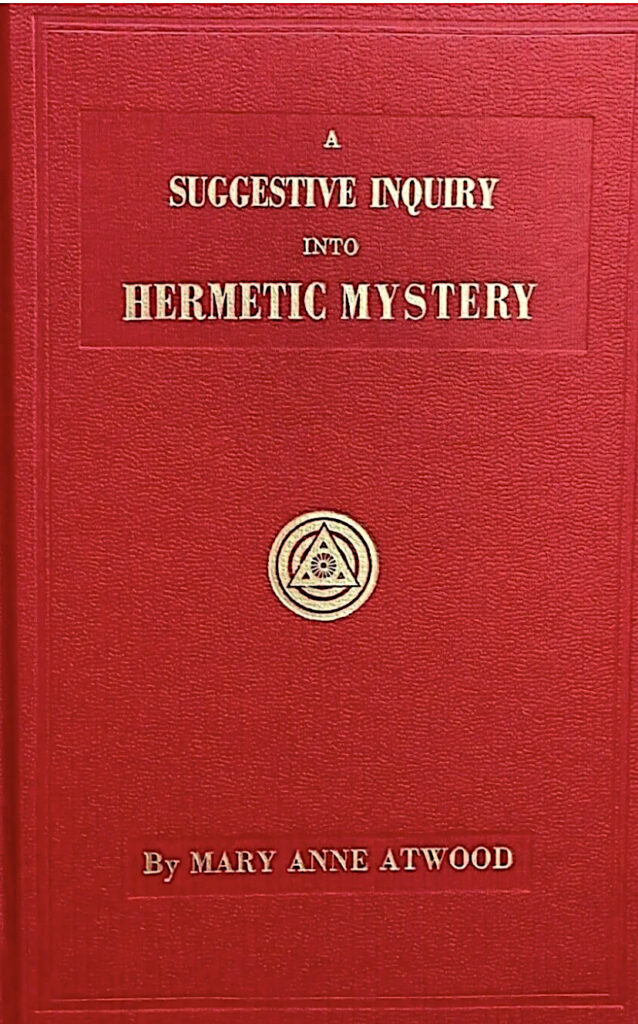
A Suggestive Inquiry into the Hermetic Mystery was first published anonymously in 1850 by Mary Anne Atwood, an English mystic and philosopher. The book is considered one of the most important works to understand modern Hermeticism and spiritual alchemy. Atwood challenged the idea that medieval alchemists were only interested in turning metals into gold. Instead, she believed that the real goal of Hermetic Art was to transform human consciousness. She saw the philosophers’ stone, the prima materia, and the Great Work as symbols for an inner journey through which the soul is purified, renewed, and brought back to the Divine.
The book explores the history and philosophy of alchemy, starting with ancient mystery schools and continuing through the Hermetic thinkers of the Middle Ages and Renaissance. Atwood described these symbols as part of an ongoing tradition of spiritual initiation. She believed that the symbols in alchemical texts actually described a practical path of inner growth focused on self-knowledge, purification, and awakening higher consciousness. Atwood also suggested that advanced practitioners used deep meditation and altered states of awareness to experience the unity behind all things.
In her book, Atwood looks at the symbols of Hermetic philosophy, the connections between alchemy and the mysteries of ancient Greece and Egypt, the meaning of the prima materia, and the moral and spiritual practices needed by seekers. She does not see alchemical operations as actual lab experiments. Instead, she explains them as examples of improving the mind and soul, stressing that real transformation happens within a person, not in physical materials.
The story behind the book is almost as interesting as what is inside it. After helping to publish the book anonymously, Atwood’s father, Thomas South, began to believe that it revealed sacred Hermetic secrets that should not be shared. He bought nearly all the remaining copies from the publisher, and he and Atwood destroyed most of them, along with his own unpublished manuscript. Because of this, only a few first editions survived, and Atwood did not publish another major book during her life.
After Atwood died, A Suggestive Inquiry into the Hermetic Mystery was published again in 1918, this time with a long biographical introduction by Masonic scholar Walter Leslie Wilmshurst. This new edition helped the book reach many more readers. It soon became a classic in modern Hermetic literature and influenced many students of alchemy, Theosophy, Rosicrucianism, Jungian psychology, and Western esotericism. In 1976, the Yogi Publication Society released its own edition, continuing its work of sharing important Hermetic and esoteric texts.
Mary Anne Atwood
Mary Anne Atwood (1817–1910) was one of the most influential figures in the nineteenth-century revival of Hermetic philosophy and spiritual alchemy. Born Mary Anne South in Dieppe, France, she was raised in Gosport, Hampshire, where she spent her childhood immersed in her father Thomas South’s extensive library of classical, philosophical, and esoteric works. Although she received no formal education, she was privately trained in Latin, Greek, classical literature, and philosophy, developing an intellectual foundation that was unusual for a woman of her era. Under her father’s guidance she became his closest collaborator, sharing his fascination with spirituality, mysticism, mesmerism, and the hidden traditions of antiquity.
Together, father and daughter explored the growing nineteenth-century interest in magnetism, psychical phenomena, and the ancient wisdom traditions. Their first major publication appeared in 1846 under the pseudonym Thuos Mathos, an anagram of Thomas South. Entitled Early Magnetism in its Higher Relations to Humanity as Veiled in the Poets and the Prophets, the book examined the spiritual dimensions of magnetism and its connections to mythology, religion, and prophecy. Its favorable reception encouraged them to undertake a far more ambitious project: a comprehensive investigation into the true meaning of alchemy.
At a time when most people regarded alchemy as a failed attempt to transform base metals into gold, Atwood argued that the great alchemical writings concealed an entirely different purpose. In her view, the alchemists were not primarily concerned with physical substances but with the transformation of human consciousness. The symbols of furnaces, metals, tinctures, and the Philosopher’s Stone represented stages in the purification and regeneration of the soul. Drawing upon Hermetic, Platonic, Christian mystical, and Kabbalistic traditions, she presented alchemy as a spiritual science whose ultimate goal was the restoration of humanity’s original divine nature.
These ideas reached their fullest expression in her landmark work, A Suggestive Inquiry into the Hermetic Mystery, published anonymously in 1850. The book was intended to appear alongside a companion work by her father entitled The Enigma of Alchemy. However, shortly after publication, Thomas South finally read his daughter’s manuscript in its entirety and became convinced that it revealed secrets that had traditionally been hidden beneath allegory and symbolism. Fearing that such knowledge might be dangerous in the wrong hands, father and daughter withdrew the book from circulation, purchased as many remaining copies as possible, and destroyed them. They also burned Thomas South’s unpublished manuscript. Only a handful of copies survived, turning the work into one of the great rarities of occult literature.
The destruction of the book marked a turning point in Atwood’s life. In 1859 she married the Reverend Alban Thomas Atwood, vicar of Leake near Thirsk in Yorkshire, and settled at Knayton Lodge. The marriage was reportedly a happy one, and although her husband shared an interest in science and psychical research, he did not participate in her alchemical studies. The couple had no children. After her husband’s death in 1883, Atwood remained in Yorkshire, living a largely secluded life devoted to reading, correspondence, gardening, and continued reflection on spiritual subjects.
Despite her withdrawal from public authorship, she remained connected to important figures within the late Victorian occult revival. She corresponded with members of the Theosophical movement and maintained friendships with Arthur Edward Waite, Charles Carleton Massey, A. P. Sinnett, Walter Moseley, and the artist and occultist Isabelle de Steiger. Through these relationships her ideas continued to circulate privately among influential esoteric circles. She also helped introduce important mystical works to English readers, including Karl von Eckartshausen’s The Cloud Upon the Sanctuary.
Throughout her life Atwood maintained that alchemy was neither primitive chemistry nor mere symbolism. She believed it preserved an authentic spiritual tradition concerned with the regeneration of the soul and humanity’s reunion with the divine source. The famous Hermetic principle “As above, so below” was, for her, a statement of the correspondence between the inner life of the individual and the greater universe. The Philosopher’s Stone represented spiritual perfection, while the stages of alchemical transformation symbolized the soul’s journey from fragmentation and ignorance toward unity, wisdom, and enlightenment.
Near the end of her life, Atwood reluctantly allowed a small number of trusted friends access to copies of her suppressed work and made minor revisions to the text. After her death, Isabelle de Steiger arranged for A Suggestive Inquiry into the Hermetic Mystery to be republished in 1918, nearly seventy years after its original appearance. The new edition included an extensive introduction by the Freemason and mystic Walter Leslie Wilmshurst, who regarded Atwood as one of the most remarkable interpreters of the Hermetic tradition. He believed that the spiritual disillusionment following the First World War had created a climate in which her ideas could finally be appreciated.
The republication transformed Atwood’s reputation. What had once been an obscure and nearly lost work became recognized as one of the foundational texts of modern spiritual alchemy. Historians of esotericism have since identified A Suggestive Inquiry as one of the key works responsible for shifting the interpretation of alchemy away from laboratory experiments and toward a spiritual and psychological understanding. Her ideas influenced members of the Hermetic Order of the Golden Dawn, Theosophists, Rosicrucians, the Alchemical Society, and later twentieth-century occult thinkers. Through her writings, alchemy was reimagined not as the search for material gold, but as a path of inner transformation leading toward wisdom, self-knowledge, and union with the divine.
Mary Anne Atwood died peacefully at Knayton Lodge on April 13, 1910, at the age of ninety-two. Her final reported words, “I cannot find my centre of gravity,” have often been interpreted as a fitting reflection of a life devoted to exploring the relationship between the soul, consciousness, and the unseen realities that lie beyond the material world. She was buried beside her husband at Leake Church in Yorkshire.
Related Research Articles
The Sacred Geometry of the Yogi Publication Society Logo
This article examines the Yogi Publication Society logo and its sacred geometry meaning, comparing it with Hindu, Hermetic, Rosicrucian, Masonic, and Theosophical traditions to show the intention behind the publishing network.
The True Meaning of the Name and Back Story of Yogi Ramacharaka
This article breaks down the hidden symbolism and meaning behind "Yogi Ramacharaka", the pen name that was created by the Yogi Publication Society and shows the allegory that reflected the ideas the books were…