Karma,, written by Alfred Percy Sinnett and first published in 1885, was among the first English novels to introduce the Theosophical ideas of karma and reincarnation to Western audiences. The story blends spiritual fiction, romance, and occult philosophy, using a compelling plot to show how cause and effect work across many lifetimes, shaping people’s relationships, character, and fate. Instead of seeing karma as a form of reward or punishment from a higher power, Sinnett describes it as a fair and universal law in which every thought, action, and motive leads to corresponding results.
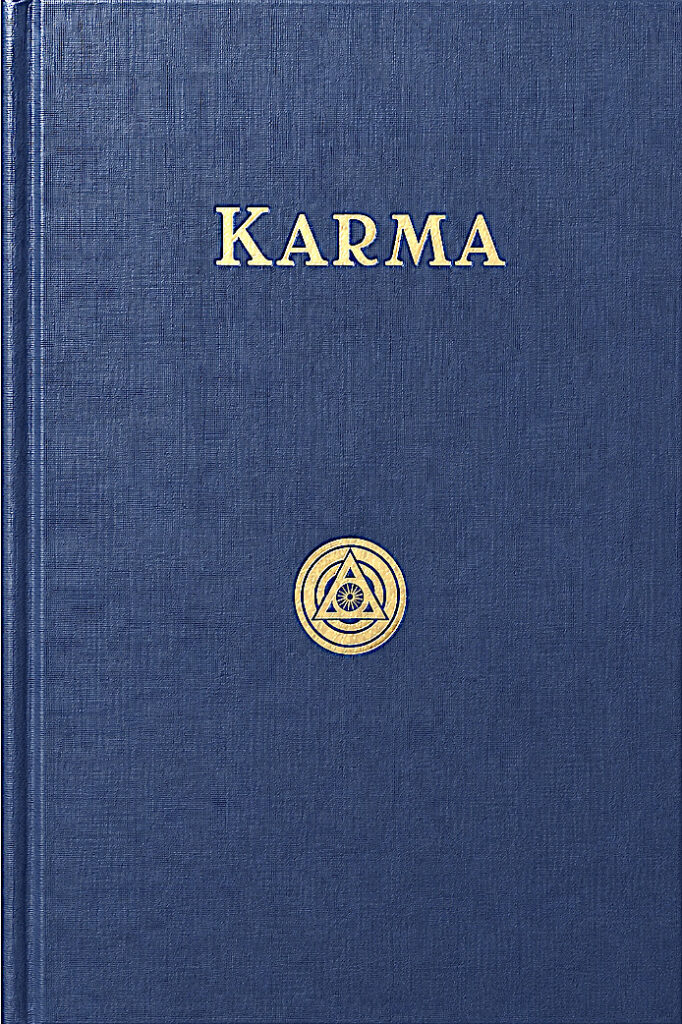
The Theosophical Society seal
The novel follows a group of spiritually curious people whose lives connect through psychic investigations and clairvoyant experiences. As they uncover hidden links from their past lives, they realize that their current friendships, rivalries, loves, and conflicts continue relationships from earlier existences. Through these discoveries, Sinnett shows that every experience is connected, and that the events of one life make more sense when seen as part of the soul’s longer journey of spiritual growth.
Throughout the book, Sinnett explains many key ideas from the Theosophical movement. He describes reincarnation as the natural way the soul returns to earth again and again, learning and slowly moving toward spiritual perfection. Karma is shown as the main law guiding this process, making sure everyone faces the results of their past choices while also giving them chances to grow, make amends, and improve themselves.
The novel also looks at clairvoyance, the astral plane, and psychic abilities. Sinnett presents these skills as natural but mostly untapped human abilities that can reveal past lives and the deeper spiritual reasons behind current events. The idea of astral records, where every thought and action is permanently stored, forms the basis for many of the story’s psychic investigations.
At the heart of the story is the Theosophical belief that human life goes far beyond just one lifetime. What seem like random events, strange attractions, repeated struggles, and moral tests are shown as parts of a bigger pattern of spiritual growth, all guided by unchanging universal laws. When the characters see these deeper links and take responsibility for their actions, they start to change their own future.
Karma is more than just an occult novel. It was one of the first popular books to introduce Theosophical ideas to English-speaking readers. By mixing storytelling with spiritual teachings, Sinnett helped Western audiences learn about Eastern ideas like karma, reincarnation, and the growth of the soul—ideas that later became important in modern esoteric, New Thought, and New Age movements.
Alfred Percy Sinnett
Alfred Percy Sinnett (1840–1921) was an English journalist, editor, and author who became a key figure in the early Theosophical movement. Through his writing and editorial work, he helped introduce Western readers to ideas such as karma, reincarnation, cosmic evolution, and Eastern esoteric philosophy. Sinnett played a major part in the intellectual and spiritual movement in the late nineteenth century.
Sinnett was born in London and started his journalism career as a sub-editor for The Globe. He later became editor of the Hong Kong Daily Press. In 1872, he moved to India to edit The Pioneer, the main English-language newspaper in British India. This role put him at the heart of colonial intellectual life and led him to meet Helena Petrovna Blavatsky and Colonel Henry Steel Olcott after the Theosophical Society was founded.
In 1879, Sinnett and his wife Patience invited Blavatsky and Olcott to stay at their home in Allahabad. This meeting started a relationship that had a big impact on modern esotericism. Interested in Blavatsky’s stories about the Himalayan Mahatmas, Sinnett began the well-known Mahatma Letters correspondence. These letters became the basis for much of his later writing and introduced Western readers to Theosophical ideas about karma, reincarnation, spiritual evolution, and a hidden group of enlightened Masters.
Sinnett wrote some of the first and most influential books on Theosophy in English. The Occult World (1881) introduced readers to Blavatsky’s reported psychic events and the Mahatmas. Esoteric Buddhism (1883) explained Theosophical ideas about the universe, human evolution, and the laws of karma and reincarnation. Later books, such as Karma and Incidents in the Life of Madame Blavatsky, continued to share these ideas with readers worldwide.
Sinnett was one of Blavatsky’s earliest and most important supporters, but they often disagreed. As a journalist, Sinnett tried to organize Theosophical ideas into a clear system for Western readers. Blavatsky often criticized him for this, thinking he was forcing Eastern teachings into a Western way of thinking and missing important parts of the tradition. Their many letters show years of debate, disagreements about the Mahatma teachings, and arguments about the leadership and future of the Theosophical Society. Even with these issues, Sinnett always supported Blavatsky and later wrote one of the first biographies defending her and her work.
When Sinnett returned to England in 1884, he became President of the London Lodge of the Theosophical Society and helped make London a main center for the movement. He worked with many leading occult figures of the time, such as Charles Webster Leadbeater, George Arundale, and William Scott-Elliot, and helped develop and publish many important Theosophical works. In the 1890s, he also spent time with members of the Hermetic Order of the Golden Dawn, including W. B. Yeats.
Throughout his career, Alfred Percy Sinnett was one of the main interpreters of Theosophy for English-speaking readers. His books introduced thousands of people to Eastern philosophy, occult science, and the ideas of karma and reincarnation. His work helped build the foundation for later movements like New Thought, New Age, and Western esotericism in the twentieth century. Link
Related Research Articles
The Sacred Geometry of the Yogi Publication Society Logo
This article examines the Yogi Publication Society logo and its sacred geometry meaning, comparing it with Hindu, Hermetic, Rosicrucian, Masonic, and Theosophical traditions to show the intention behind the publishing network.
The True Meaning of the Name and Back Story of Yogi Ramacharaka
This article breaks down the hidden symbolism and meaning behind "Yogi Ramacharaka", the pen name that was created by the Yogi Publication Society and shows the allegory that reflected the ideas the books were…