Segno was a palmist, mentalist, author, and publisher who developed the Law of Mentalism, founded the Success Club, and built an international organization closely connected with Parkyn, Atkinson, and E. Virgil Neal. The following information is based on original research conducted by the Yogi Publication Society History Project and was first published here in Oct. 2026.
A. Victor Segno (1870–1933), born William James Hall in Ontario, Canada, became one of the most successful figures to emerge from the mental-science movement at the turn of the twentieth century. Beginning as a traveling “scientific palmist” in the 1890s, he later became a student of the system of Suggestion developed by Herbert A. Parkyn at the Chicago School of Psychology, and his writing career began in 1900 in Parkyn’s magazine Suggestion. Segno was also connected with E. Virgil Neal and the New York Institute of Science, another important branch of the network surrounding Parkyn’s teachings. By 1902, he promoted a system of Mentalism and established the American Institute of Mentalism in Los Angeles, followed by his book The Law of Mentalism, the Segno Success Club, and his magazine The Segnogram.
His career continued to intersect with people from the same network, including William Walker Atkinson, Parkyn’s proteges, who wrote for The Segnogram and was closely associated with the Yogi Publication Society. These connections place Segno within the circle of writers, teachers, publishers, and correspondence schools that carried the methods of Suggestion and mental training into some of the most successful mental-science and New Thought enterprises of the early twentieth century.
Early Life in Ontario
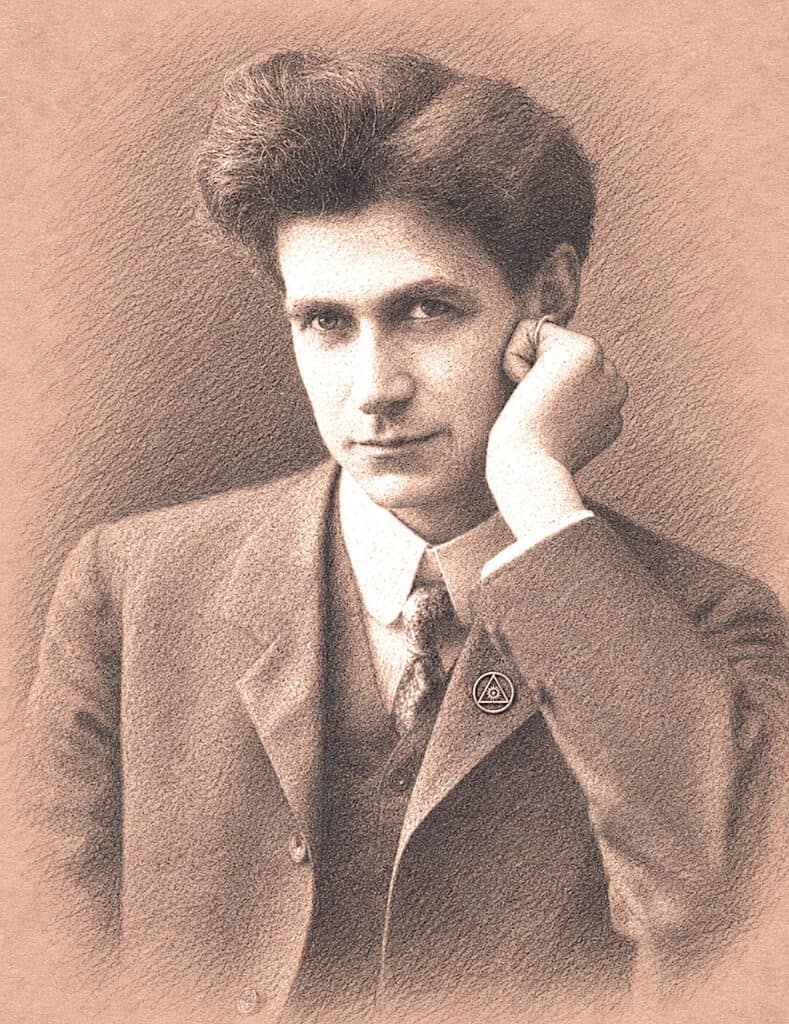
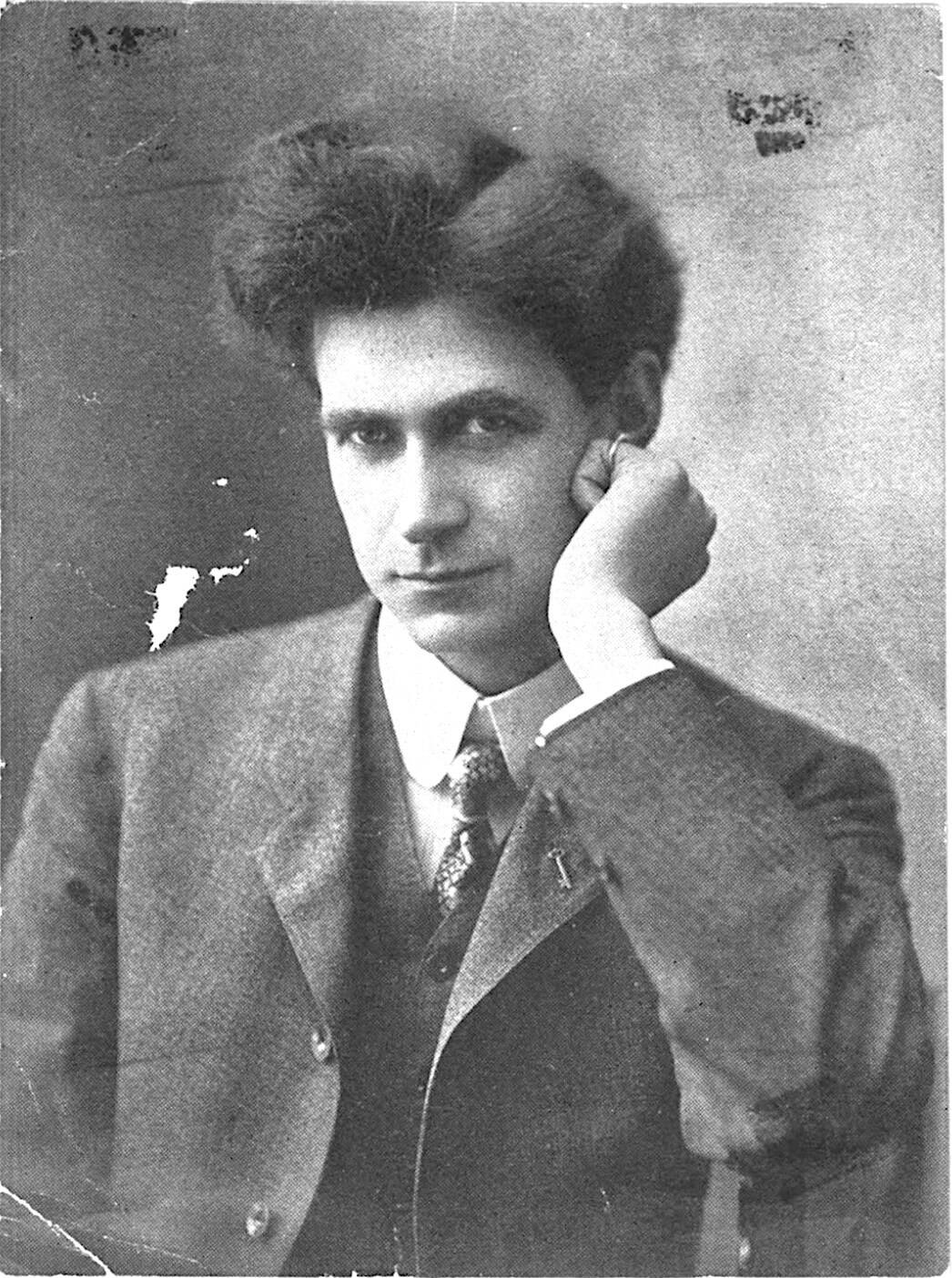
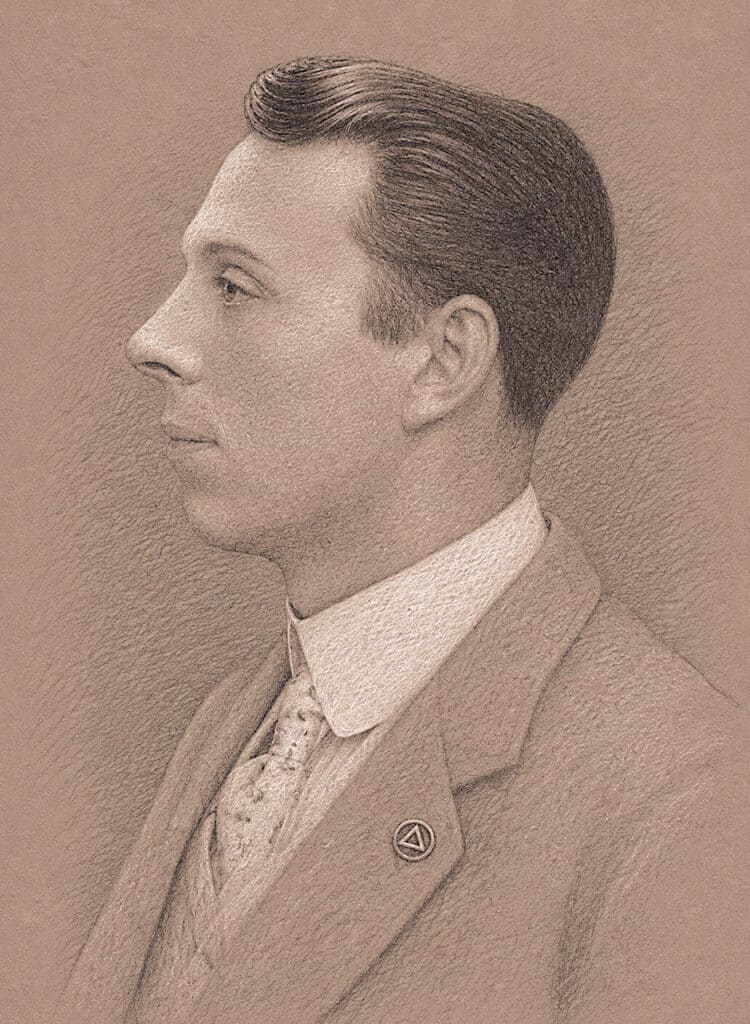
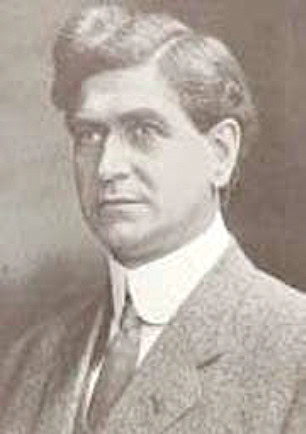
Prof. A. Victor Segno (William James Hall)
A. Victor Segno (William James Hall ) was born on February 9, 1870, in Newcastle, Ontario, a small community east of Toronto along the route connecting Toronto with Kingston. Little has yet been discovered about Hall’s childhood or formal education, although his later writing, teaching, and publishing career make clear that he received a substantial education. While no record of where he attended school has yet been located, his proximity to Toronto makes the University of Toronto one possibility, especially in light of the remarkable parallels between his early life and that of Dr. Parkyn.
Parkyn was born on December 24, 1870, at Goderich, Ontario, making Hall and Parkyn the same age. Their early lives also unfolded within the same relatively compact region of southern Ontario. Parkyn attended post-graduate studies at the University of Toronto in 1892, and from 1892 through 1894 he also maintained a medical practice in Toronto devoted to psycho-therapeutics. He became well known in the area for his experiments with hypnotism, treating more than 240 cases during this period as he developed the ideas that would lead to his later work with suggestion and the founding of the Chicago School of Psychology.
The geographical overlap went beyond Toronto. Hall’s family also lived in Napanee, immediately west of Kingston, while Parkyn was living in Kingston during the same period. This placed the two young men, born in the same year, repeatedly within the same Toronto–Kingston region at the very time both were developing interests that would lead them into the study of the mind and human behavior. Hall would soon appear professionally as Prof. A. Victor Segno, in 1895, promoting the scientific interpretation of character and the human mind through palmistry, while Parkyn, at the same exact time, was gaining attention through hypnotism and psycho-therapeutics.
Whether Hall and Parkyn personally knew one another during these Ontario years has not yet been established, but their later relationship makes the overlap difficult to dismiss as an incidental detail. They were the same age, came from the same part of Ontario, lived within the same Toronto and Kingston geographical sphere, and entered closely related fields during the same exact period. Segno would later become a student of Parkyn’s system and begin his writing career in Parkyn’s Suggestion magazine. In light of that later documented relationship, it is highly possible that Hall and Parkyn already knew one another before their careers became connected in the United States.
Chicago and the Study of Palmistry
In mid-1895, William James Hall traveled to Chicago, where he studied palmistry under Vicomte Edgar de Valcourt-Vermont, who would later go by the professional name Comte C. de Saint-Germain. The Vicomte had not yet established himself publicly as a professional teacher of palmistry, but he was already deeply involved in the subject and appears to have taught Hall privately during this period. When Edgar de Valcourt-Vermont later established the American Chirological Society and the National School of Palmistry in Chicago in 1897, Hall would identify himself publicly as a graduate of the school, making his earlier study an important part of the training behind his career.
Vicomte Edgar de Valcourt-Vermont used the name Comte C. de Saint-Germain, the legendary Ascended Master who worked behind the scenes of history to guide human evolution.
Edgar de Valcourt-Vermont was born into French nobility in 1846 and held the title of Viscomte. He came to the United States during the late nineteenth century, settling in Chicago, where he started as a journalist and author with a strong interest in the occult sciences. He eventually developed a system of palmistry that attempted to place the subject upon a scientific and physiological foundation. He studied the shape of the hand, fingers, nails, mounts, and lines as physical indications of health, temperament, character, and individual tendencies. By 1897, he was teaching palmistry professionally in Chicago and described it as a branch of physiology.
Hall’s study with Edgar de Valcourt-Vermont helps explain the form of palmistry he began practicing immediately afterward. When he returned to Ontario in October 1895 and appeared professionally as Professor A. Victor Segno, he called himself a “Scientific Palmist” and treated the hand as a physical record of health, character, temperament, vocation, and human behavior. He would later advertise that he was a colleague of the internationally famous palmist Cheiro. His time with the Viscomte in Chicago would lay the foundation for the profession through which Hall would create a new identity as Prof. A. Victor Segno.
From William James Hall to Prof. A. Victor Segno the Palmist
In 1895, William James Hall started touring Ontario with the newly created professional identity of Prof. Albert Victor Segno, the palmist. The choice of Albert Victor came from Prince Albert Victor, Duke of Clarence and Avondale, the eldest son of King Edward VII and grandson of Queen Victoria. The prince had been one of the most recognizable members of the British royal family when he died unexpectedly in January 1892 at only twenty-eight years old, producing widespread mourning throughout Canada. There was also a noticeable physical resemblance between Hall and the Prince, which may have contributed to Hall’s choice of the name. After adopting it, however, he generally reduced Albert to its initial, making Prof. A. Victor Segno the recognizable identity attached to his career.
Prince Albert Victor, Duke of Clarence and Avondale.
The surname of Segno was equally suited to the profession he was entering. Segno derives from the Latin signum, meaning “sign” or “mark.” For a palmist, the choice could hardly have been more fitting. Segno’s work was based upon interpreting the signs and marks of the human hand. The lines of the palm, shape of the fingers, development of the mounts, color and texture of the skin, and even the formation of the fingernails were treated as visible signs through which character, health, temperament, abilities, and future tendencies could be read. His adopted identity effectively described what he did. Professor A. Victor Segno was the man who interpreted the “signs.”
There may also have been a professional reason for William James Hall to create a more distinctive name. By 1895, William James of Harvard was already one of the best-known American psychologists and philosophers, and his name was closely associated with psychology and the study of the mind. For a young man named William James Hall who was beginning a career centered on human character and would soon move deeper into questions of mental influence, “William James” was already strongly identified with someone else. Albert Victor Segno gave Hall a distinctive identity that could become entirely his own. Whether William James himself influenced the decision has not been established, but the possibility fits both the timing of the change and the field Hall was entering.
Prof. Segno the Palmist
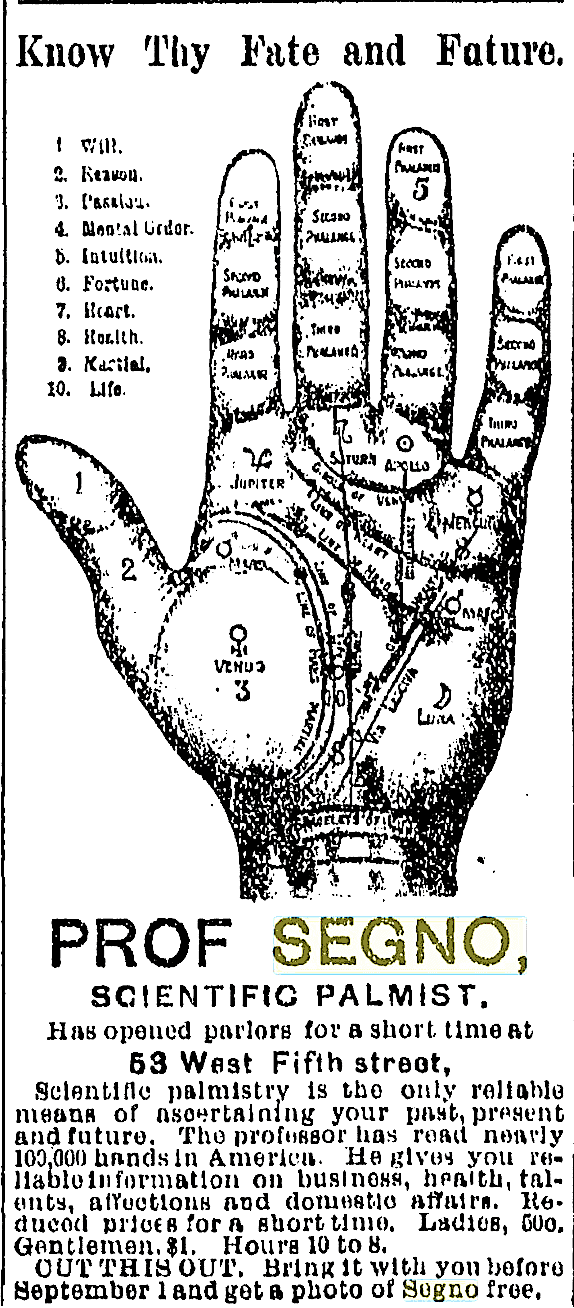
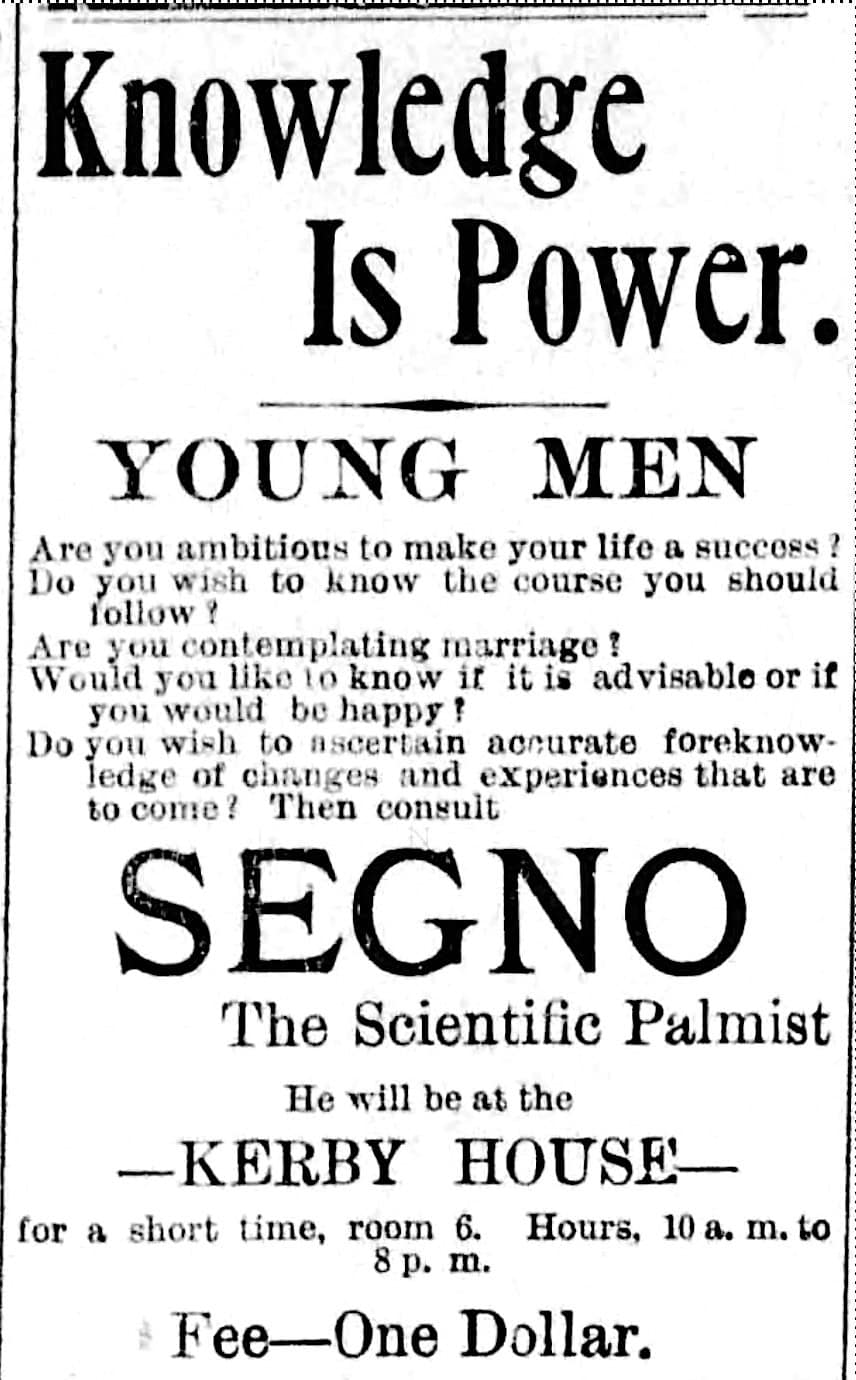
Segno began his professional career as a palmist in Ontario in late 1895. He traveled through the same Toronto and Kingston region in which he had grown up, appearing in Kingston, Lindsay, Peterborough, Belleville, Napanee, Hamilton, and Brantford. He claimed that God had placed “signs or seals in the hands of men that all men might know their works,” and that the hand revealed character, health, temperament, business prospects, marriage, personal abilities, and the occupation for which a person was best suited. “Know Thyself and Thy Future Prospects,” “Knowledge Is Power,” and “What Is in My Hand?” were among the phrases he used to describe what he offered.
Ads by Segno while touring Ontario in 1895 and 1896
Segno quickly became something of a sensation, especially among women. At twenty-five years old he was youthful in appearance, self-assured, and possessed what was described as a quiet nerve and a winning manner. His voice was soft and musical, and women flocked to see him. Many wanted information about their husbands, prospective marriages, or the young men in their lives, and women from some of the leading families sought his readings. His personal appeal became one of the most noticeable features of his early career. Segno had already learned how to combine an unusual system of character analysis with a carefully cultivated personality, presenting his conclusions with the confidence of someone possessing specialized knowledge about the person sitting before him.
His method centered upon a detailed examination of the right hand. Segno studied the shape and color of its lines, the fingernails, and the mounts associated with Venus, Jupiter, Saturn, the Sun, Mercury, the Moon, and Mars. The life, heart, head, and liver lines were used to interpret physical condition and temperament, while other formations were connected with courage, happiness, melancholy, longevity, relationships, and future experiences. Segno consistently called his system “scientific palmistry,” language that would become increasingly important as he developed from a traveling reader into a teacher of the subject.
His claims also attracted scrutiny. During his Hamilton engagement, Segno was tested without being given the identity of the person whose hand he was reading. His description of the person’s past proved inaccurate. A second test involving another man produced a similar result. The challenge did little to slow his career, and large numbers of people continued to seek him out. From the beginning, Segno inspired both fascination and skepticism, a combination that would follow him as his claims became considerably more ambitious.
Marriage to Evelyn Rose Allan
On March 17, 1896, Segno married Evelyn Rose Allan in London, Ontario. Evelyn was already a well-known violinist in the region, giving Segno a wife who had her own experience before audiences and a public reputation independent of his developing career as a palmist. The marriage took place in London, and Segno was identified at the time as “Prof. A. Segno, of Chicago.” The description shows how quickly his period of study in Chicago had become part of his professional identity.
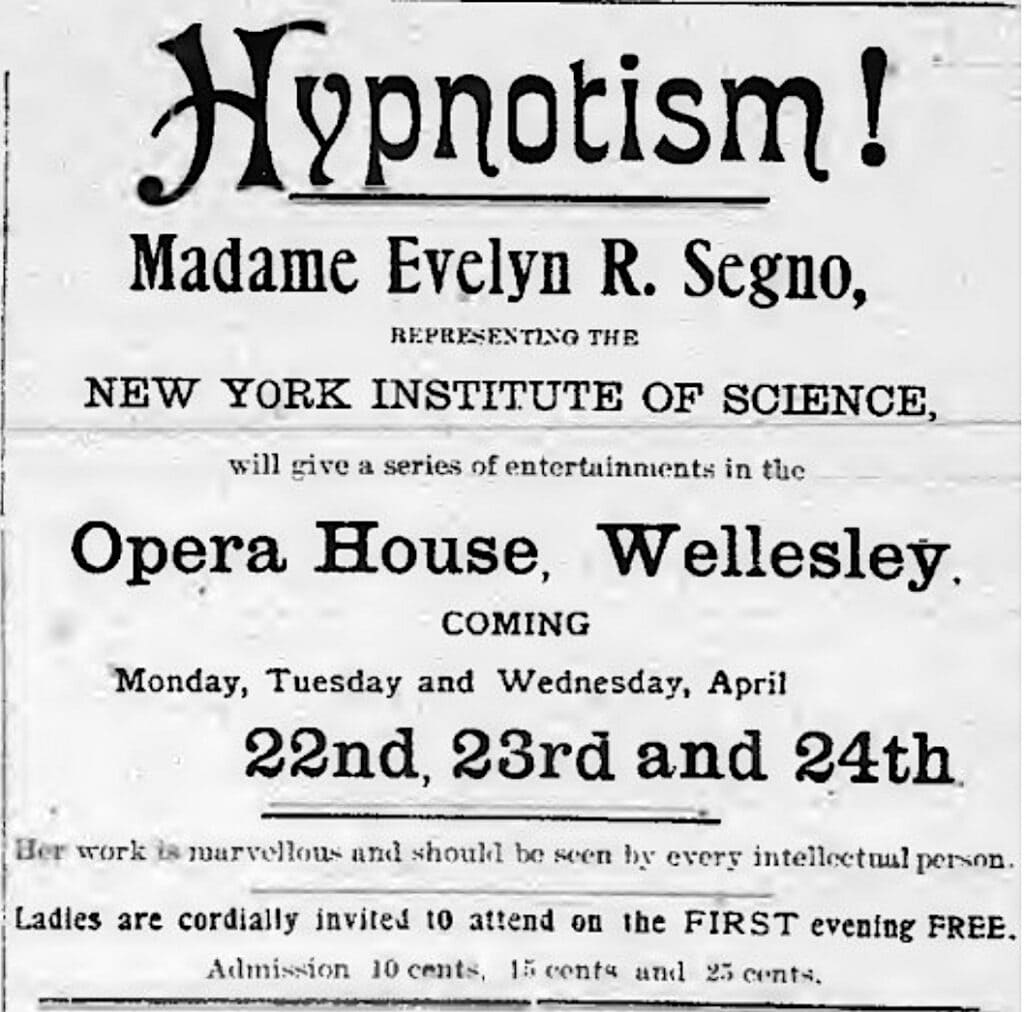
Evelyn soon became part of Segno’s traveling career. The couple left Ontario and appeared together as Professor and Mrs. Segno as they toured through the United States. Evelyn’s background as a professional musician made her well suited to the public side of their work, which increasingly included lectures and demonstrations alongside Segno’s private consultations. She later became involved in hypnotism and toured professionally as Madame Evelyn R. Segno, representing the New York Institute of Science. Her growing commitment to this career eventually contributed to the breakdown of the marriage, and the couple divorced in early 1901 on the grounds of desertion after she left him to pursue her work as a traveling hypnotist.
Madame Evelyn R. Segno touring as a Hypnotist and representing the New York Institute of Science.
London provides another possible early connection between Segno and Parkyn. Parkyn’s medical-school classmate and longtime friend Dr. Hugh A. Stevenson was also born in 1870 and came from one of London’s most prominent families. He later became a leading physician and mayor of the city. Segno’s marriage to the already well-known Evelyn Allan placed him within the same London social environment closely connected to Parkyn through Stevenson.
Segno, Parkyn, and Stevenson were all born in Ontario in 1870. Segno and Parkyn shared connections to the Toronto–Kingston corridor and would later work together, while Parkyn and Stevenson attended medical school and postgraduate studies at the University of Toronto together. Where Segno received his earlier education remains unknown, leaving open the possibility that the three men encountered one another during these years at the University of Toronto.
Touring the United States
Following Segno’s marriage to Evelyn Rose Allan in March 1896, they moved to the United States. By April, they were in Pittsburgh, where he continued working as “Prof. Segno, Scientific Palmist.” During this period, his interests were already beginning to extend beyond palmistry into ideas of personal development and success. In a letter to the editor of The World newspaper, Segno wrote on the power of hope and described it as one of the great forces behind human action. Hope inspired aspiration and ambition, encouraged work, investigation, and enterprise, and allowed people to endure difficulties because they anticipated eventual success. These ideas would become increasingly important as Segno moved from reading character through the hand toward teaching people how they could influence the direction of their own lives with their minds.
By July 1896 Segno and Evelyn had moved on to Akron, Ohio, where they appeared together as “Prof. and Mrs. Segno.” Evelyn’s experience as a professional violinist made her a natural part of the traveling operation, which now included public and private lectures alongside Segno’s individual readings.
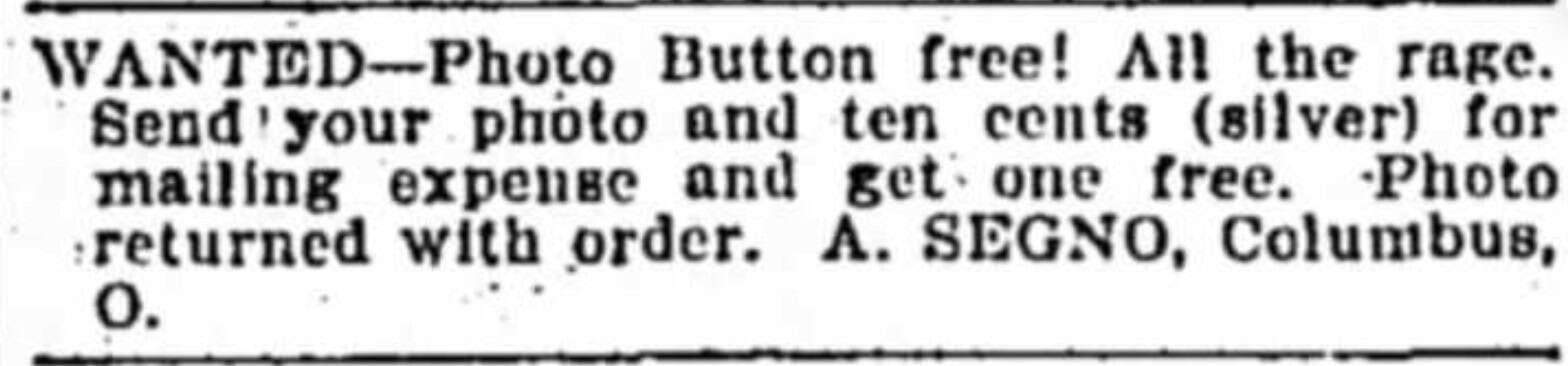
By 1897 Segno was established for a time in Columbus, Ohio, where his activities show that palmistry was only one part of his developing business interests. He advertised photographic buttons that customers could order through the mail by sending him a photograph and payment for postage. He was also involved in a business selling art needlework and stamped linens, for which he advertised for a woman to take customer orders. These were small ventures, but they show Segno experimenting early with advertising, mail orders, customer fulfillment, and multiple lines of business.
A. Victor Segno making photo buttons
The Segno School of Palmistry in Los Angeles
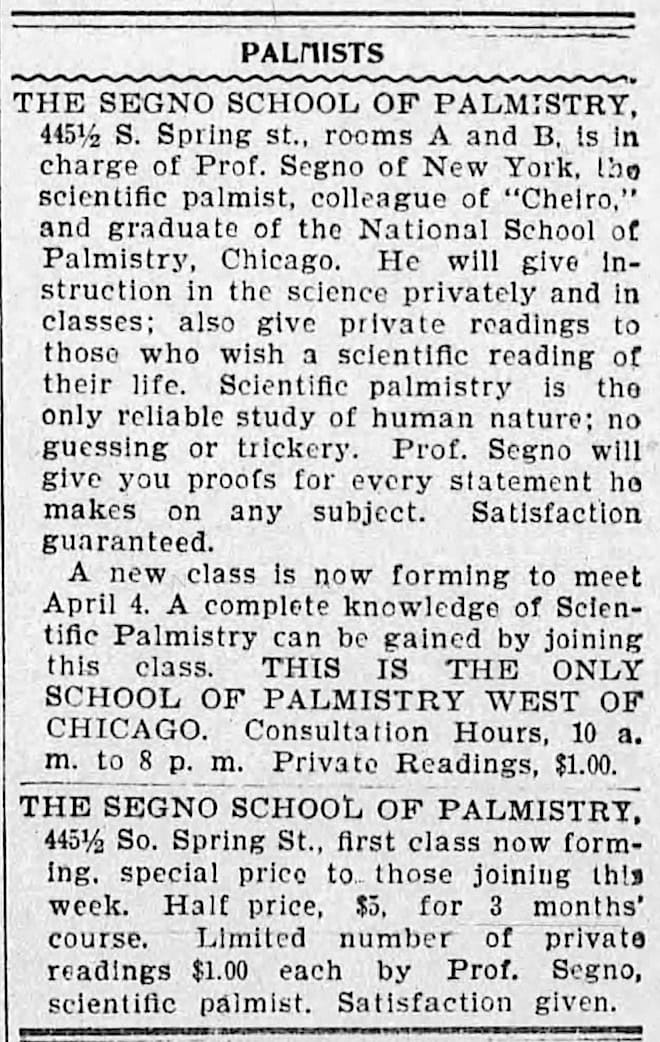
By February 1899, A. Victor Segno had reached Los Angeles and established the Segno School of Palmistry. His arrival in California followed their movement from Pittsburgh to Akron, and then to Columbus, with each stage taking them farther west. The last known record of Segno in Columbus dates from late December 1897, and by February 1899 he was in Los Angeles opening his own school. What happened during the entire year of 1898 remains unknown. The change during this missing period was substantial. Segno went from practicing palmistry and pursuing several smaller business ventures in Columbus to arriving in California prepared to operate his own school, and he was now publicly identifying himself as a graduate of Chicago’s National School of Palmistry.
The Segno School of Palmistry
Chicago provides the strongest possibility for at least part of this missing year. Segno had already studied there under Edgar de Valcourt-Vermont in 1895, and Valcourt-Vermont’s palmistry work became much more formally organized during the years that followed. With 1898 presently missing from Segno’s known movements, it is highly probable that he spent time in Chicago renewing his association with Valcourt-Vermont and the National School before continuing west to California. This would help explain the striking change of Segno suddenly becoming a trained school operator.
There is also a strong possibility that Segno’s connection or reconnection with Herbert A. Parkyn developed during this same missing period. The two men had already followed remarkably close paths in Ontario, making it quite possible that they knew one another. By 1898 Parkyn’s Chicago School of Psychology was teaching its system of Suggestion, through classroom instruction and the Special Mail Course in Hypnotism and Suggestive Therapeutics. Segno would soon become closely connected with Parkyn’s system, and in January 1900 his first known published writing would appear in Parkyn’s Suggestion, specifically written for the magazine. It is quite possible that Segno was studying with Parkyn during his missing 1898 period in Chicago, although the precise beginning of their professional relationship remains unknown.
The Segno School of Palmistry offered private readings along with private and class instruction. Segno also began giving public lectures on palmistry, and by March was advertising a three-month course and describing his institution as the “only school of palmistry west of Chicago.” The scientific presentation of palmistry that had characterized his work since Ontario was now being organized into a formal system that could be taught to students.
The Chirological College of California
Segno’s Los Angeles school soon became the center of a more formally organized educational enterprise. In June 1899, only a few months after he had opened the Segno School of Palmistry, Segno and his wife, Evelyn, joined Ida S. Hatch*, Adelaide Dennison, and Addie B. Vansciever in incorporating the Chirological College of California in Los Angeles. The organization was established as an educational institution with the authority to admit students and award credentials.
*Ida S. Hatch was the wife of David Patterson Hatch, who was a well-known judge in Southern California, as well as an author of several occult books and a Knights Templar mason. More information on him will be coming soon.*
The college subsequently expanded to San Francisco, where Geneva Baldwin became its principal instructor, while Segno served as its President. Baldwin had already been conducting the College of Scientific Palmistry in the city and was well established as a teacher of scientific palmistry and character reading who deliberately separated her work from supernatural or occult claims.
The New York Institute of Science
Baldwin also had an important connection with the New York Institute of Science operated by E. Virgil Neal. She promoted the Institute while conducting her San Francisco work, creating a direct institutional link between Segno’s Chirological College and Neal’s organization. Neal was himself a student of Parkyn’s system of Suggestion, adding another Parkyn-trained figure to the circle in which Segno was now operating. Baldwin explained that she had learned character reading through a correspondence book sent to her by the New York Institute of Science. She had studied the Institute’s methods for reading character and the lives of individuals from their hands, faces, heads, and handwriting, and was now applying that instruction in her own work. She also actively promoted the same course to others, directing those interested in learning character reading to write to the Institute in Rochester, New York, for its free instructional book.
The Columbia Scientific Academy
The connection between Segno and Neal’s organizations became even closer in August 1901, when Segno started identified himself with the Columbia Scientific Academy of New York City. This was another correspondence school Neal was involved with that offered instruction in palmistry, hypnosis, personal magnetism, and occult science, under a system it called “Ki-Magi.”
Segno Contributes to Parkyn’s Suggestion Magazine
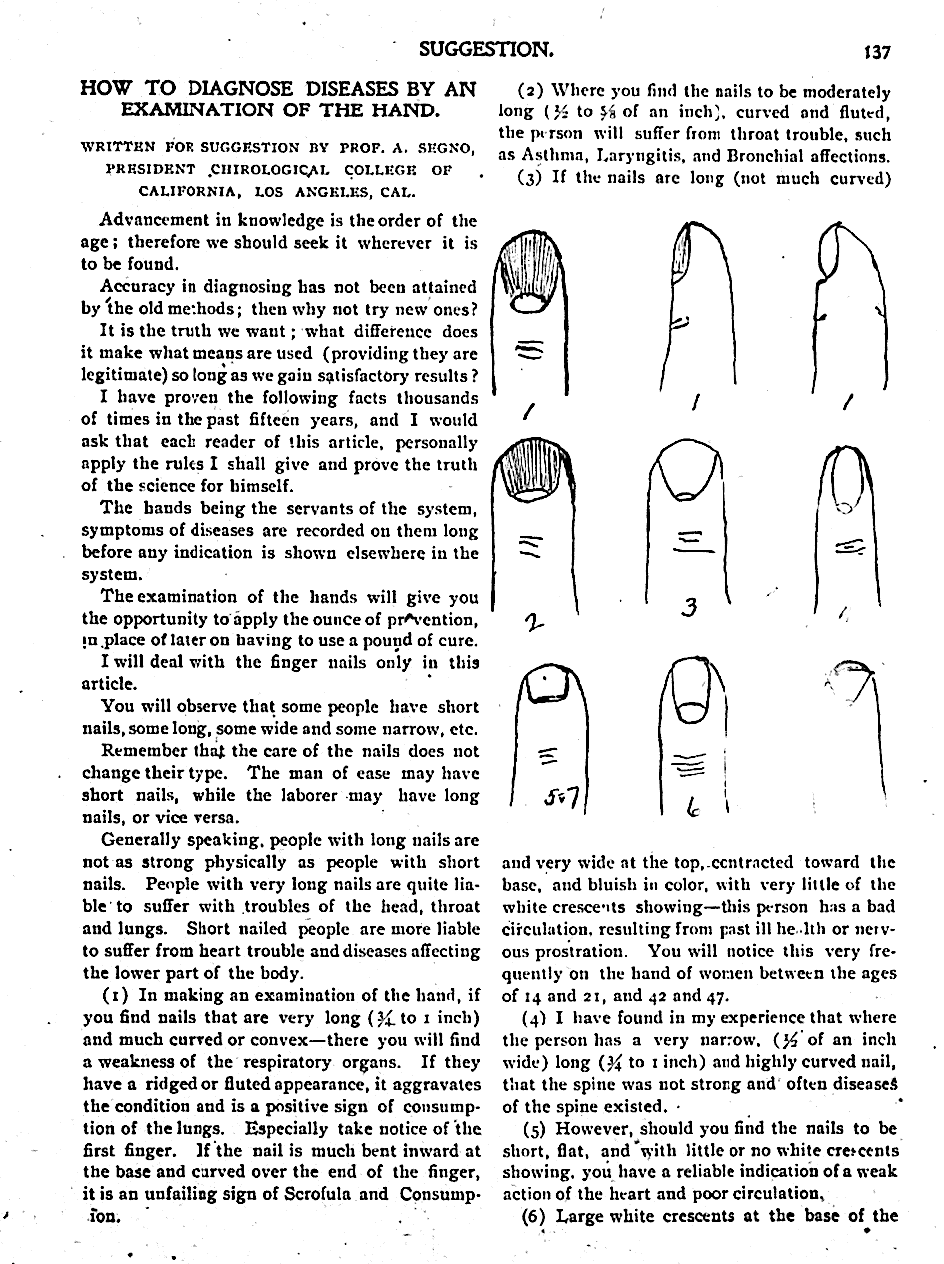
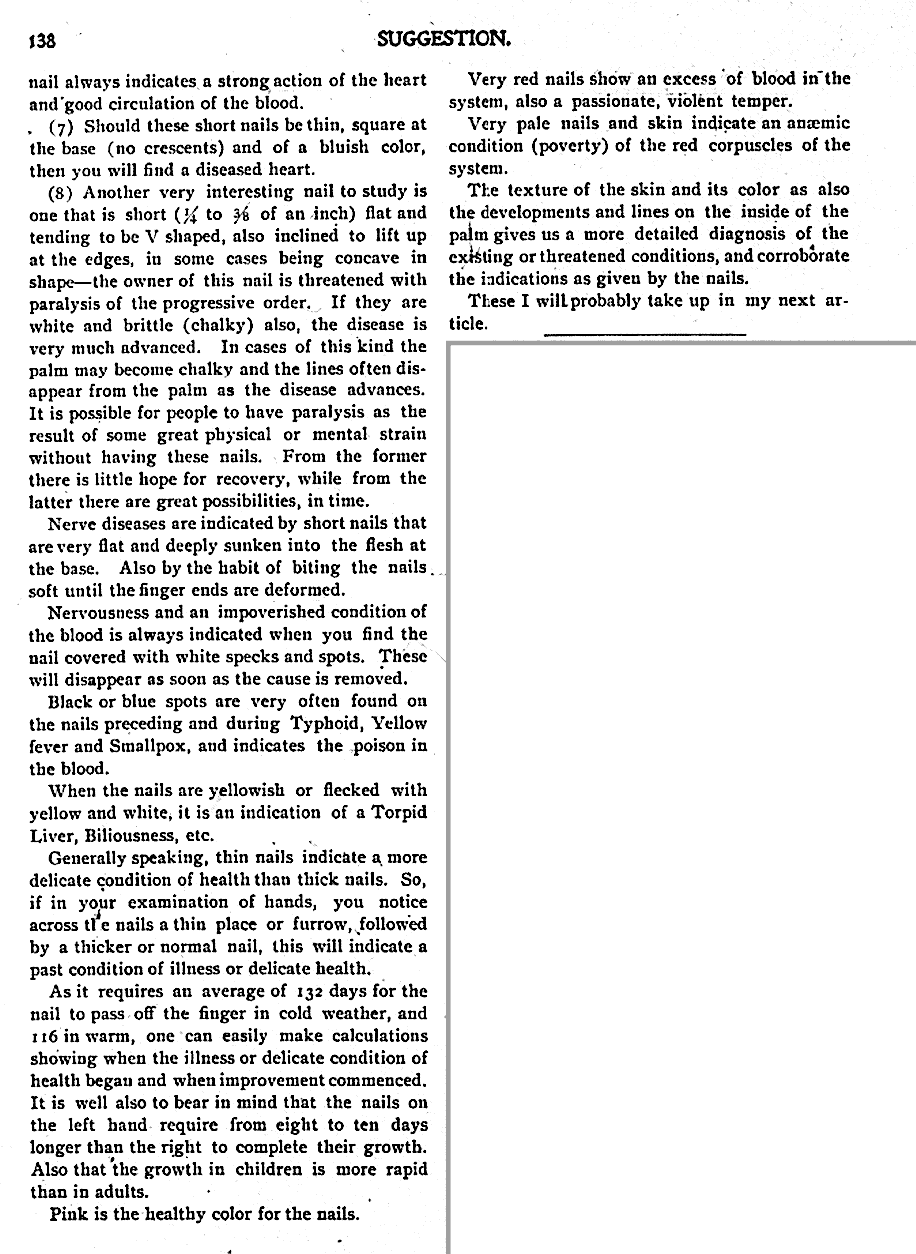
“How to Diagnose Diseases by an Examination of the Hand” 1900
While the Chirological College of California was developing, Segno also began a new phase of his career as a published writer. In January 1900, his first known published article appeared in Suggestion, the Chicago magazine founded and edited by Dr. Parkyn. The article was called “How to Diagnose Diseases by an Examination of the Hand,” and was expressly written for the magazine. Its appearance provides the first direct documentary evidence of a professional relationship between Segno and Parkyn and came only a couple of years after Segno’s missing year of 1898.
The article also shows that Segno’s conception of chirology had moved well beyond conventional fortune-telling. He presented examination of the hand as a method of physical diagnosis and argued that changes in the body could become visible in the hands before their effects were apparent elsewhere. Much of the article concentrated on the fingernails, whose shape, color, texture, and development Segno associated with different physical conditions. He described signs that he believed could indicate weaknesses of the respiratory system, poor circulation, heart disease, nervous disorders, spinal problems, anemia, liver disorders, paralysis, and several infectious diseases.
The texture and color of the skin and the lines of the palm could provide still more detailed information about the physical condition of the individual. He closed by indicating that he intended to address these additional methods in his next article.
However, Segno did not continue the proposed discussion of palmistry in Suggestion, and the intended series never continued. He would not publish in Suggestion again until 1902. But something important appeared during the gap. In June 1901, the Psychic Research Company published an illustrated book entitled Palmistry, written under the pseudonym “Aztec.” The booklet covered hand types, fingers, mounts, nails, the texture of the skin, and the principal lines of the palm. It also dealt extensively with character, health, and disease. In both subject and method, it is similar to the system Segno had begun presenting in Suggestion the previous year. Both works also belong to the same tradition of “scientific” palmistry Segno had learned through Edgar de Valcourt-Vermont, whose own writings contain closely related material.
Prof. A. Victor Segno wrote the article “How to Diagnose Diseases by an Examination of the Hand,” for Parkyn’s Suggestion magazine in Jan. 1900.
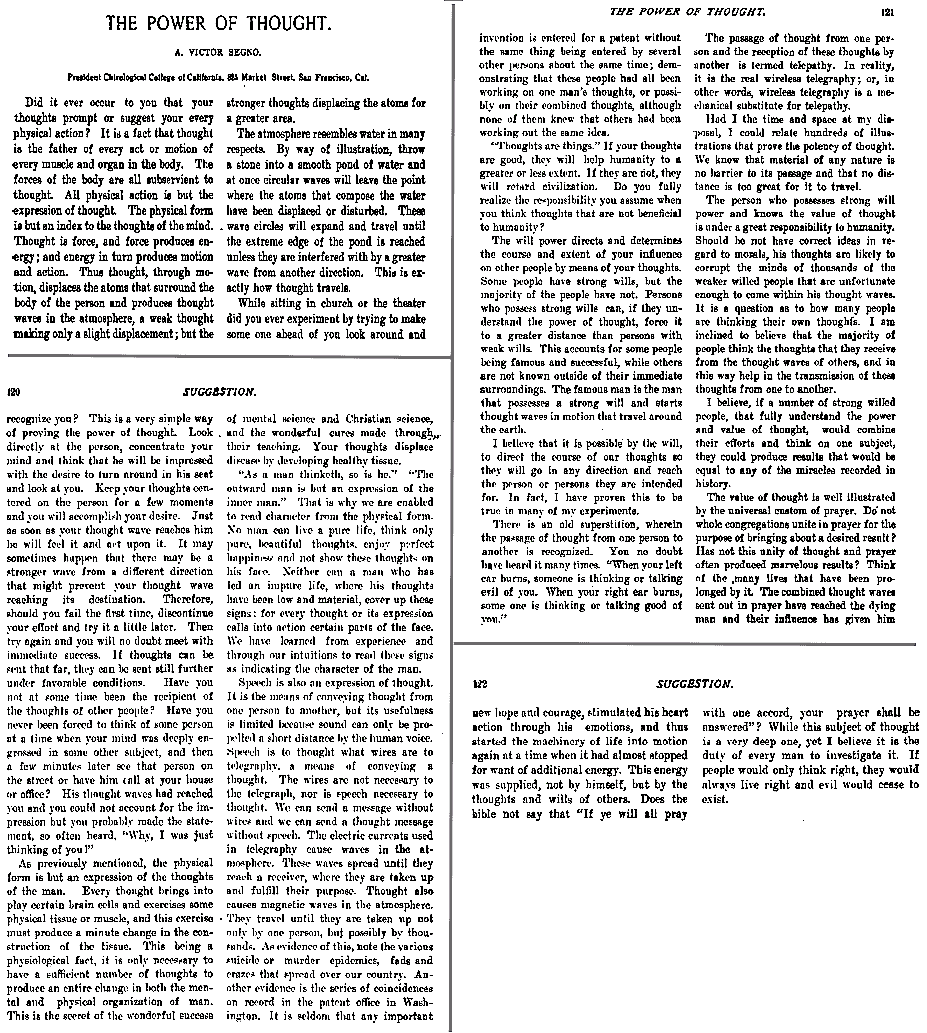
“The Power of Thought” 1902
When Segno returned to Suggestion in 1902, his subject had changed completely. His article, titled “The Power of Thought,” presented the ideas of a system he was calling Mentalism and was at the center of his first book, The Law of Mentalism, released that same year. The article began with the proposition that every voluntary action originates in thought. The body follows the mind, repeated thoughts produce repeated actions, and established patterns of thinking can eventually affect habits, behavior, and physical condition. From this, he arrived at one of the main declarations of his system: “Thought is force.”
Segno wrote that this force could operate both within the individual and between different minds. Thought created vibrations or “thought waves” that traveled outward and could be received by another person. He compared the process to waves spreading across water and drew heavily upon the new technology of Marconi’s wireless communication to demonstrate that the human mind operates according to a similar natural law, with one brain acting as a transmitter and another as a receiver. He described telepathy as a form of “real wireless telegraphy” with concentration, and Will determining the strength and direction of the thought being transmitted.
The same principle could operate collectively, with group thought waves explaining fads, crazes, simultaneous ideas, and cases in which similar inventions appeared independently in different places. Prayer could also be understood as the combined concentration of many minds upon the same purpose. Repeated thought or auto-suggestion directed inward could influence health, character, confidence, habits, and conduct. Segno repeatedly summarized this view with the phrases “Thoughts are things” and “As a man thinketh so is he.”
Prof. A Victor Segno’s article “The Power of Thought” in Parkyn’s Suggestion, Oct 1902.
Segno’s “The Law of Mentalism“
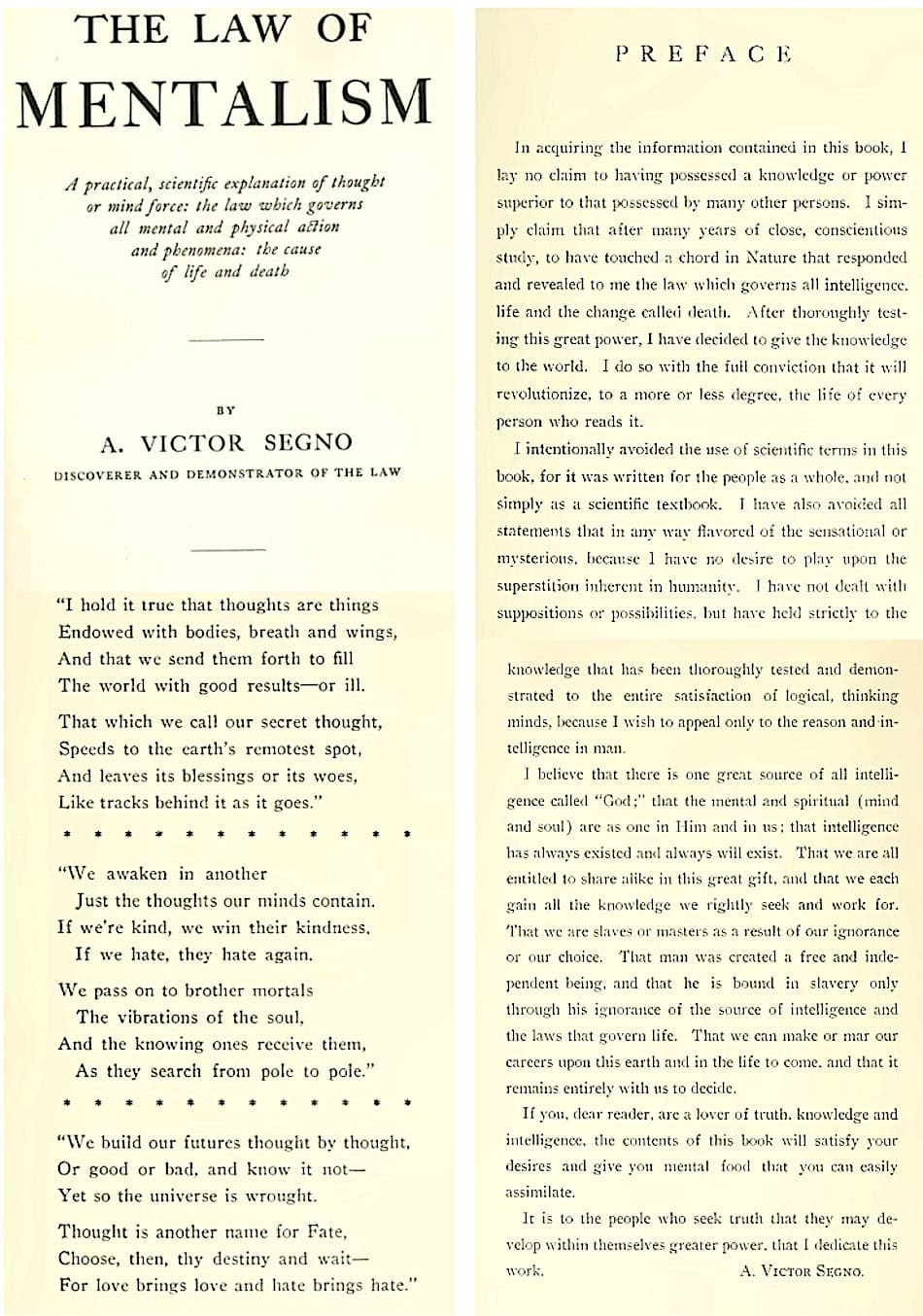
Published in 1902, The Law of Mentalism was Segno’s first full presentation of the system that would dominate the next stage of his career. Its subtitle described it as “A practical, scientific explanation of thought or mind force,” and Segno described himself on the title page as the “Discoverer and Demonstrator of the Law.” The book intended to explain how the mind affected the body, how thoughts could influence other people, and how mental forces could be deliberately directed toward health, happiness, and success.
A Victor Segno’s “The Law of Mentalism,” 1902.
Thought was treated as an actual “thing” with an actual force. Thoughts produced vibrations that could extend beyond the individual mind, much as other invisible forces traveled through space. Concentrated thought increased the strength of these vibrations, while Will supplied their direction. Telepathy, hypnosis, suggestion, personal magnetism, and magnetic healing were different manifestations of the same underlying mental force, governed by natural law.
This principle was carried into the physical body through the idea expressed in the phrase “As is the mind, so is the form.” Mental states were capable of molding physical conditions, habits, personality, and behavior. Repeated thoughts established patterns that could become increasingly fixed, while changing the dominant pattern of thought could redirect the individual.
Harmony was another important part of the system. A person seeking a particular result had to bring thought, emotion, desire, and Will into harmony with that objective. Conflicting or destructive thoughts weakened the process, while sustained concentration upon a definite purpose increased its power.
Mentalism was presented as a natural and demonstrable law, not as a mysterious occult doctrine. In the preface Segno claimed no extraordinary personal powers and said that years of close study had led him to a law governing “all intelligence, life and the change called death.” He deliberately avoided technical scientific terminology because the book was intended for ordinary readers, while also declaring that he had avoided sensational or mysterious explanations and confined himself to what he believed had been tested and demonstrated.
There was a distinctly spiritual dimension beneath this scientific language. Segno described God as the single great source of intelligence, with mental and spiritual intelligence existing within humanity as part of that source. Human beings, in his view, possessed the ability to become masters of their lives through knowledge of the laws governing mind. A person’s career and future were shaped through choices and through the intelligent direction of thought. The verses printed at the beginning of the book captured the idea succinctly: “We build our futures thought by thought.”
The Law of Mentalism = The Law of Suggestion
The psychological system Segno presented as the “Law of Mentalism” followed the same exact principles Dr. Parkyn had been teaching for years. Parkyn’s principle that “thought takes form in action” runs directly through Segno’s system, along with repetition, concentration, habit, Suggestion, and the replacement of undesirable thoughts with constructive ones. The system also drew together the same ideas of thought-force, personal magnetism, psychic influence, etheric energy, and mental transmission that were already being developed and published within Parkyn’s network. William Walker Atkinson was engaged in the same process, taking these principles and recasting them into books and systems under new terminology.
Segno’s “Law of Mentalism” was just another way of recasting Parkyn’s “Law of Suggestion.”
Yes — I misunderstood you. You wanted me to fix the opening and then give you the entire Success Club section, not stop after the opening. Here it is as one complete section, without getting into the earlier Psychic Research Company experiment until the end.
The Segno Success Club
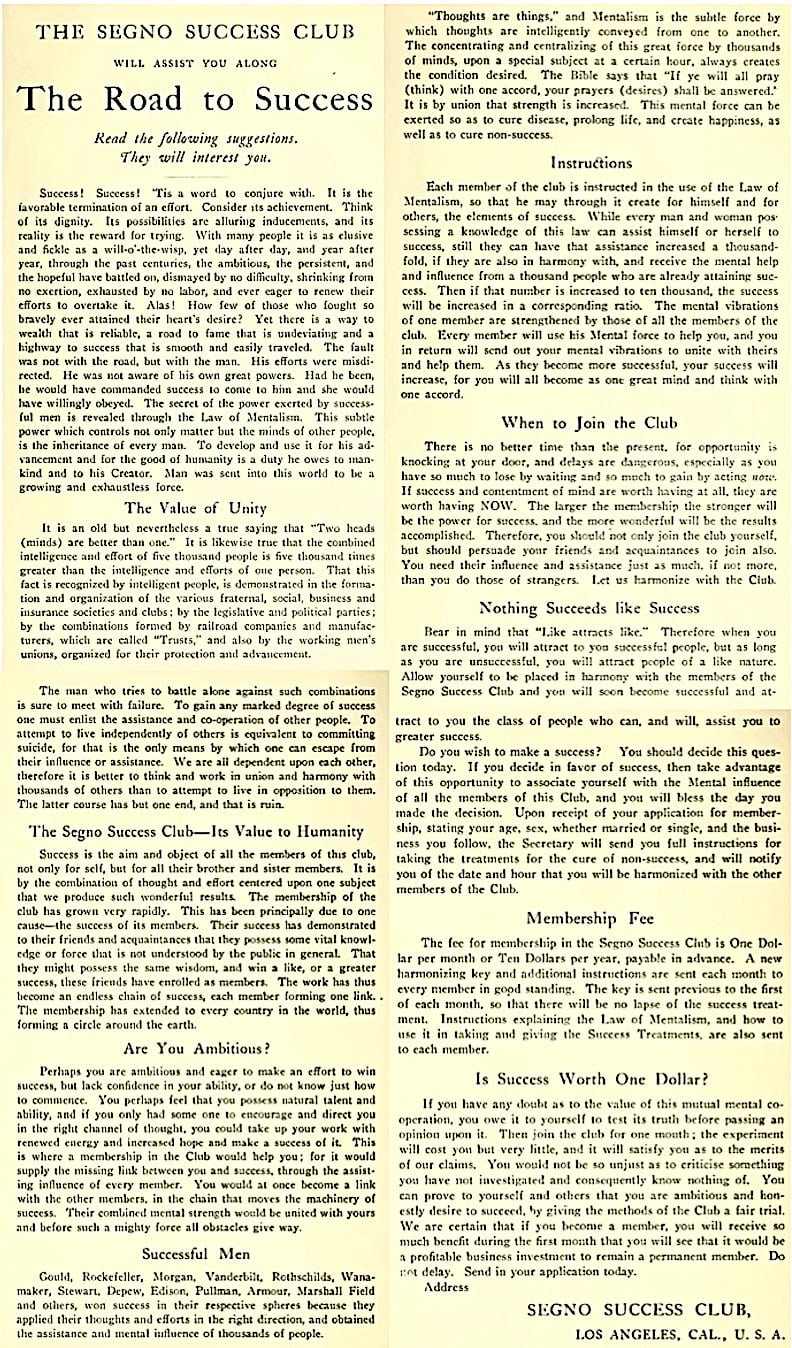
The Law of Mentalism marked the beginning of The Segno Success Club. The club was created to put the principles described in the book into actual use, with members joining together to apply Mentalism toward success, health, and happiness. At the center of the system was the idea that the mental influence of many people working together would be far more powerful than that of a single individual.
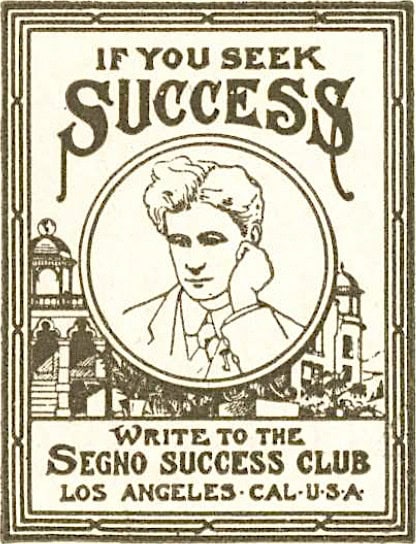
The Segno Success Club
The club called this principle “The Value of Unity.” Its literature stated that just as people increased their strength by combining their efforts in business, labor, politics, and other organizations, they could do the same with mental force. “Two heads (minds) are better than one,” it explained, and the combined influence of thousands of minds could be directed toward helping every individual within the group. Each member would contribute mental influence to the others while receiving the combined influence of the membership in return.
This was the basic idea upon which the Segno Success Club was built. As more people joined, the collective mental force would become stronger, giving every member access to an increasingly powerful body of concentrated thought. The goal was to expand the membership throughout the world until the individual participants formed what the club itself described as an “endless chain of success,” extending “to every country in the world, thus forming a circle around the earth.”
How the Segno Success Club Worked
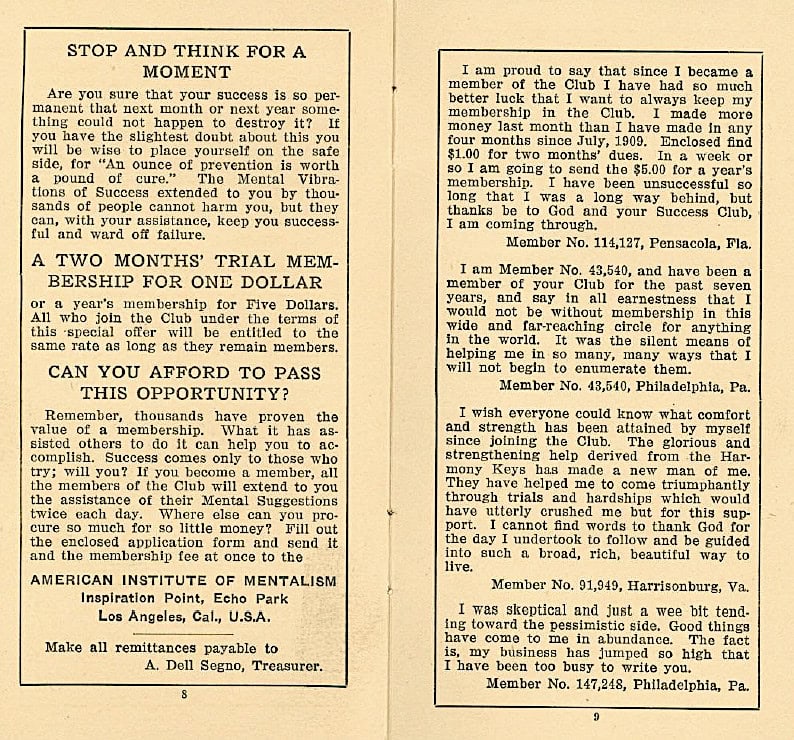
Membership cost one dollar per month, paid in advance. Once enrolled, each member received instructions explaining how to participate in the system, along with a specific date and hour when the member would be brought into harmony with the rest of the club. Members were promised regular mental treatments intended to help overcome “non-success,” while strengthening confidence, ambition, determination, health, happiness, and the ability to achieve their goals.
The club’s literature declared that “Thoughts are things” and described Mentalism as the force through which thoughts could be “intelligently conveyed from one to another.” Members were not simply passive recipients of these treatments. The system depended upon everyone participating. Each person was expected to send mental influence into the group while also placing himself or herself in a receptive state to receive the influence being generated by the others. The club explained that the mental vibrations of one member were strengthened by the other members and that every participant, in turn, contributed to strengthening everyone else. The objective was to bring thousands of individual minds into “harmony.”
Members were assigned treatment times and given information that let them adjust for their distance and time difference from Los Angeles. Each month they also received a new “Harmony Key,” which was to be used during the mental exercise. At the designated time, members cleared their minds, concentrated upon the key, and joined mentally with the rest of the organization. Members were also instructed to direct their mental force toward the president of the organization with the statement, “I send to our President, A. Victor Segno, the full strength of my mental influence for his continued success.”
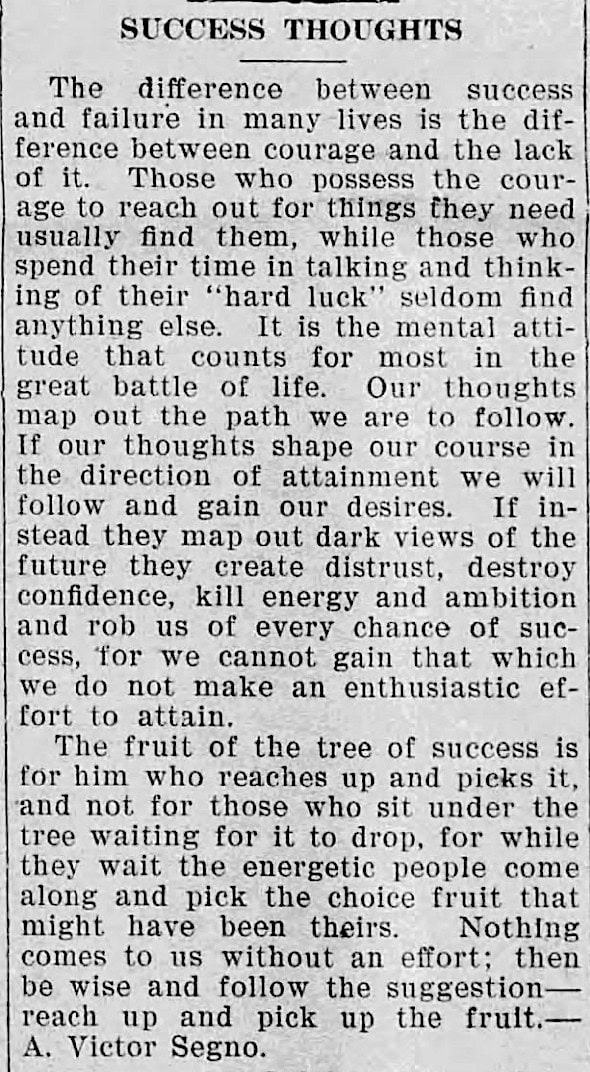
The club promised that these combined mental treatments could help members escape poverty and failure and draw them toward personal achievement. It used the terms “success waves,” “prosperity waves,” and “Like attracts like,” to describe the mental influence being directed toward members. The club maintained that concentrated mental force could be used “to cure disease, prolong life, and create happiness, as well as to cure non-success.” Mental influence could strengthen Will, confidence, health, courage, memory, and other qualities thought necessary for personal development. The club was thus applying the system presented in The Law of Mentalism to nearly every area in which an individual might seek improvement.
The Segno Success Club instructions that were sent to each member, 1902
The response was enormous. By 1903, the Segno Success Club had around 12,000 subscribers. The Los Angeles operation was handling as many as 6,000 to 7,000 letters a day, an extraordinary volume of correspondence for a private organization at the beginning of the twentieth century. The operation required a substantial clerical staff to process memberships, payments, instructions, correspondence, and the continuing flow of material between Los Angeles and members scattered around the world.
The Club kept expanding over the years, and at its peak, the Success Club claimed around 70,000 members. Whatever judgment might be made about the claims of Mentalism itself, the ability to assemble and maintain an international correspondence organization on that scale was remarkable. The system had succeeded in connecting tens of thousands of people to a central operation in Los Angeles.
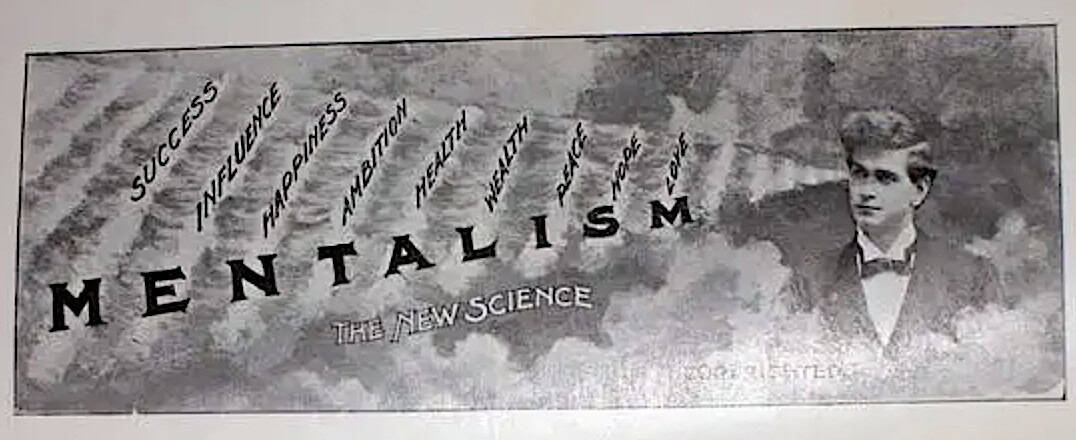
Segno ad for Mentalism
Its international subscribers were one of its greatest successes. The club followed the path that had already been developed by the Psychic Research Company and its president, Jay V. Daniels, who had worked to establish an international audience through London and the English-speaking world. The Success Club proved exceptionally effective at reaching the same worldwide audience. Thousands of its members lived throughout the British Empire and its colonies, with a substantial following across Africa.
This international distribution was central to the design of the system. The club itself described its expanding membership as an “endless chain,” with each member forming another link until the organization reached around the earth. By the time membership reached into the tens of thousands, this was no longer simply promotional imagery.
Was The Segno Success Club a Fraud?
Segno Success Waves
Prof. A. Victor Segno and his Success Club have been portrayed as an extraordinarily successful mail-order fraud and that he was nothing more than a scam operator who persuaded thousands of people to send him a dollar each month in exchange for invisible “success waves.” The enormous membership, the international correspondence operation, and the money flowing into Los Angeles are nothing more than evidence of the scale of the fraud. There was, however, another story behind what the Success Club was doing. The idea of assembling a worldwide network of mental students and coordinating their thoughts across the globe had existed before the Segno Success Club and it had already been pursued through the interconnected organizations and people surrounding Dr. Parkyn.
This changes the historical significance of the Segno Success Club. What has commonly been remembered as a fantastic scheme was also the vehicle through which an earlier worldwide experiment in collective thought was finally carried out on an extraordinary scale. Tens of thousands of people had been connected across continents, their participation synchronized through time differences, and their thoughts deliberately concentrated and directed as part of a common system.
To understand why that experiment appeared under Segno’s name in Los Angeles requires going back to the organizations that had originally been created to carry it out.
The 1903 Postal Investigation
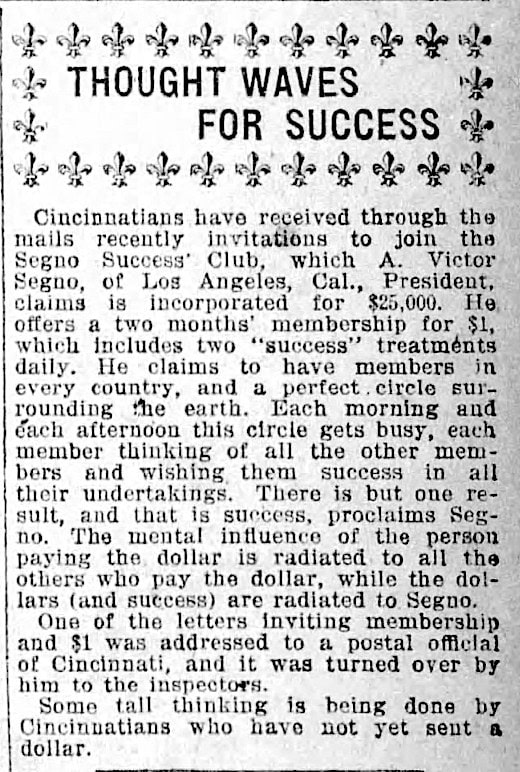
The rapid growth of the Segno Success Club soon attracted the attention of the United States Post Office. In 1903, postal authorities investigated the organization to determine whether its use of the mails warranted a fraud order. The investigation focused on the claims made for the Success Club and the mental influence members were promised through their participation.
The investigation did not result in a fraud order. The case was closed with the finding that the evidence was insufficient to justify such action. This is an important distinction in the later history of Segno, where the Success Club has frequently been described simply as a postal fraud. Federal postal authorities did investigate the organization during its early growth, but they did not establish sufficient grounds to prohibit Segno from using the mails.
The Earlier Organizational Foundations for a Worldwide Thought Experiment
The idea behind the Segno Success Club had already been put into practice through the Psychic Club, associated with the Psychic Research Company and New Thought magazine. The Psychic Club was organized as an international body of mental students whose combined thought could be consciously directed toward common purposes. Herbert A. Parkyn, along with his proteges William Walker Atkinson and Sydney B. Flower, as well as the closely connected group of writers and mental-science investigators surrounding his organizations, were already conducting the experiment.
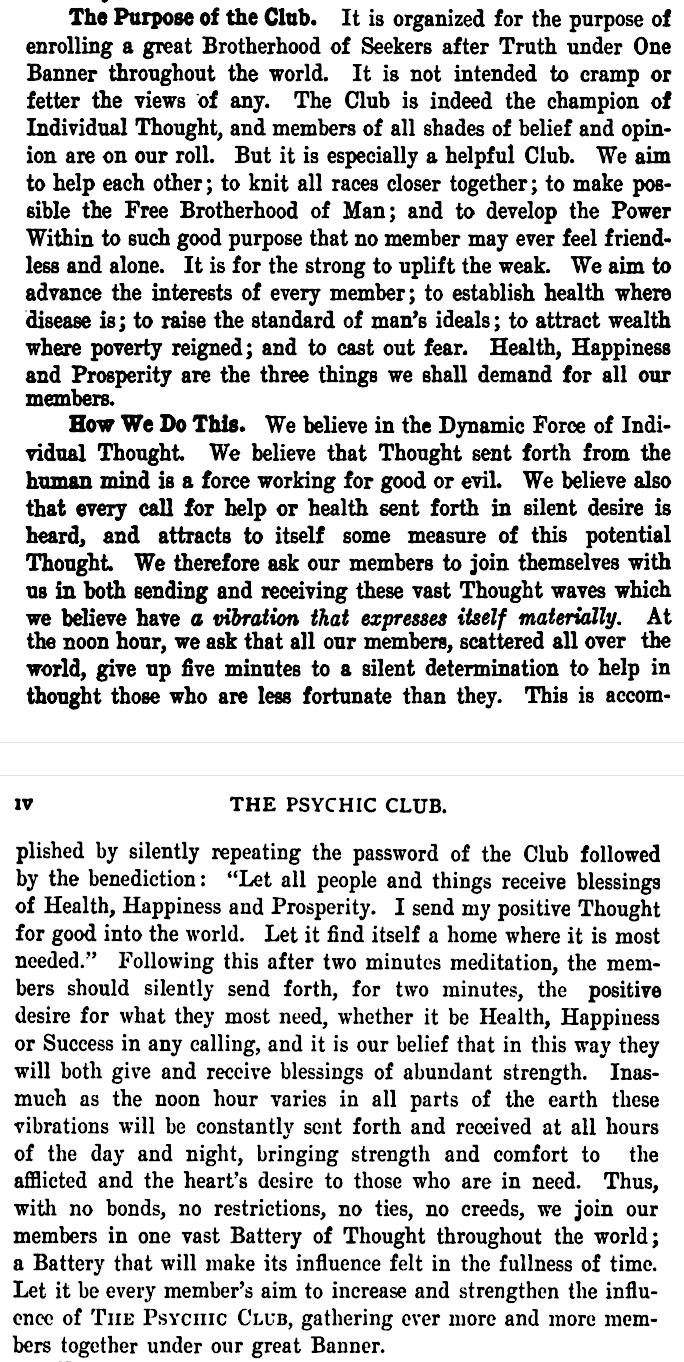
The Psychic Club information brochure, 1900
The resemblance between the Psychic Club and the Segno Success Club that followed is remarkable. The Psychic Club sought to enroll what it called a “great Brotherhood of Seekers after Truth” throughout the world. Its members were instructed to help one another, with the strong uplifting the weak, while directing their combined mental power toward health, happiness, and prosperity. The Club declared its belief that thought sent from the human mind was an actual force and that a desire for help or health would attract this combined mental power.
Every day at noon, members scattered throughout the world were asked to stop for five minutes and participate in the same exercise. After two minutes of meditation, they silently repeated the Club password and the benediction, “Let all people and things receive blessings of Health, Happiness and Prosperity.” They then spent another two minutes sending positive thoughts toward whatever was most needed. Members were both transmitters and receivers, contributing their own thoughts while drawing upon the combined thoughts of the Club.
The different time zones were actually part of the design. Because noon occurred at different hours around the earth, the Psychic Club believed that its mental vibrations would be sent and received continuously “at all hours of the day and night.” It described its worldwide membership as “one vast Battery of Thought throughout the world.” As noon moved around the globe, another group of members would take up the exercise, creating a continuous chain of directed thought.
The Segno Success Club followed the same system. Its members were also spread around the world, united through common instructions and coordinated periods of concentration, and asked to both send and receive mental influence directed toward health, happiness, prosperity, and success. Segno’s monthly Harmony Key performed the same coordinating function as the Psychic Club’s password and common benediction. The central idea of thousands of people combining their thoughts for the benefit of every member had already started in 1900 with the Psychic Club before the Segno Success Club appeared in late 1902.
The Psychic Research Company, Psychic Club, and New Thought also supplied the membership, correspondence network, publishing apparatus, and international contacts through which an experiment of this size could be conducted. What later appeared on a much larger scale through Segno was not an entirely new concept. The earlier organization had already created the model, recruited participants around the world, and attempted to maintain a continuous chain of collective thought extending around the earth.
The Psychic Research Company is Accused of Being a Fraud in Britain
The Psychic Research Company, however, ran into serious trouble in Britain. One of its most damaging opponents was Truth magazine, the enormously influential London periodical founded by Henry Labouchère. Truth made a specialty of exposing organizations and individuals it considered fraudulent, and being singled out by the magazine was devastating to an enterprise dependent upon reputation and public confidence. The Psychic Research Company became one of its main targets and was attacked as a fraudulent operation.
Henry Labouchère and his Truth magazine targeted the Psychic Research Company in Britain.
Truth magazine, however, was far from a neutral observer of the developing worlds of occultism, esoteric healing, New Thought, and the new forms of psychological and mental self-improvement appearing at the time. These movements certainly attracted fraudsters eager to exploit the enormous public interest in such subjects, but Truth made little distinction between the opportunists and the movements themselves. It painted the entire field with the same brush, repeatedly attacking organizations and individuals associated with these subjects and approaching their claims from an openly hostile position. The prejudices surrounding Truth and Labouchère were themselves called out in later assessments, including the antisemitism that appeared in the magazine and in Labouchère’s public career. Its campaign against the Psychic Research Company should be read with that history in view. The magazine’s attacks were influential and destructive, but its hostility did not by itself establish that the ideas or experiments it attacked were fraudulent.
The Society for Psychical Research Also Attacks It
Pressure also came from the London-based Society for Psychical Research. The similarity between the names “Psychic Research Company” and “Society for Psychical Research” had created confusion, and the Society emphatically rejected any connection between the two. It publicly warned its membership about the American organization and sought to distinguish its own scientific investigations from the commercial enterprise operating under the similar name.
Without Britain and Its Colonies, There Could Be No Worldwide Experiment
The problem was much larger than the reputation of the Psychic Research Company in Britain itself. Britain stood at the center of an enormous English-speaking imperial network extending through Canada, Australia, New Zealand, India, South Africa, and colonies and territories around the world. For an experiment intended to create a continuous international chain of minds, that network was indispensable. English was still the principal language through which the organization could recruit, instruct, and coordinate participants on such a scale. The movement was already finding a substantial audience in the French-speaking world and would eventually extend into other countries and languages, but the existing English-language infrastructure offered the most immediate means of building a mental network that could genuinely encircle the globe.
The attacks by Truth and the public rejection of the Psychic Research Company by the Society for Psychical Research thus threatened something much larger than the company’s British business. Once the Psychic Research Company name became compromised in Britain, that damage would follow it throughout the English-speaking world and into the very colonial networks needed to carry the experiment across continents and time zones. An undertaking based upon trust, correspondence, recruitment, and coordinated participation could not easily proceed internationally under a name being publicly denounced at the center of that communications network. If the worldwide experiment was going to continue, it needed a new organizational structure operating free of the controversy that had become attached to the Psychic Research Company.
The American Institute of Mentalism
As Mentalism developed into a complete system, it was also given a formal educational organization through the American Institute of Mentalism. Incorporated in Los Angeles in July 1902, the Institute was established to teach Mentalism as a defined course of study and to train students in its methods.
Its original directors were A. Victor Segno, Helen M. Taylor, Annie Dell Dinsmore, B. J. Loomis, and Joseph W. Musselman. The Institute provided courses in Mentalism and issued diplomas to students who became proficient enough to be designated “expert mentalists.” The Institute also taught students how to treat disease using the mental methods described in The Law of Mentalism.
Annie Dell Dinsmore, would serve as secretary of the Segno Success Club and also became Segno’s wife in early 1903. She had a direct connection to David Patterson Hatch and his wife, Ida S. Hatch, who was one of the incorporators of the Chirological College of California with Segno in 1899. Dinsmore was from Maine, where her family had been important early settlers of Dresden. David and Ida Hatch were also from Dresden, and their families likewise were important early settlers and lived right next door to Annie’s relatives. Historic sites and road names associated with the families remain to this day, and they were strongly connected to the Congregational Church of Dresden together.
The Segnogram and the Segnogram Publishing Company
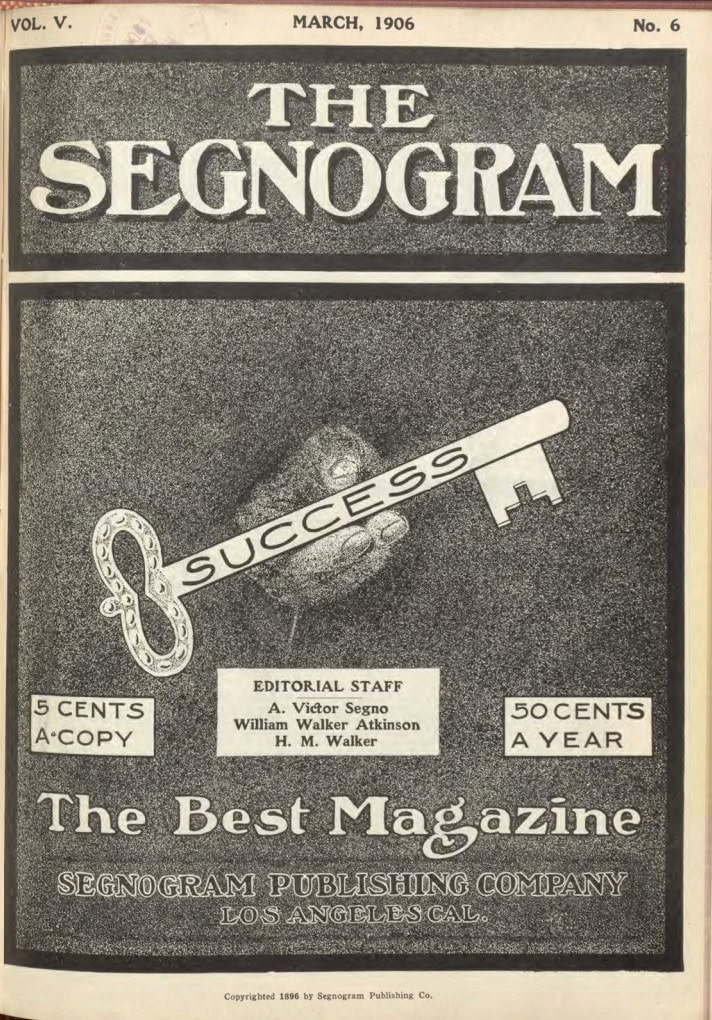
In October 1903, A. Victor Segno launched The Segnogram, a monthly magazine devoted to Mentalism, health, success, psychology, and the development of the mind. Segno served as its editor, and the magazine was published in Los Angeles by the Segnogram Publishing Company.
The Segnogram magazine logo
The Segnogram Publishing Company also published Segno’s books and instructional works, including The Law of Mentalism. It became the publishing arm for the books, periodicals, and other printed material associated with his work.
The American Institute of Mentalism Headquarters
“Inspiration Point,” The American Institute of Mentalism Headquarters.
In 1904, construction began on a permanent headquarters for the American Institute of Mentalism overlooking Echo Park in Los Angeles. The property occupied a commanding hillside site at Belmont Avenue and Kane Street, with views across Echo Park toward the mountains. The unusual concrete complex was designed by architect G. E. Voelkel and combined the Institute, Segno’s business operations, and his private residence on the same grounds.
The headquarters was built on a scale far beyond an ordinary correspondence school. One wing contained the American Institute of Mentalism, including its offices and lecture rooms, where classes and lectures could be held. Another portion contained Segno’s residence. At the center was an octagonal reception room beneath a large dome, while the rear opened onto a forty-foot-square patio surrounded by the principal rooms. The building also included a roof garden, and the hillside grounds were landscaped with terraces, walks, gardens, and retaining walls.
The Segnogram Publishing Company also operated from the property, where the books, magazines, lessons, advertisements, and other printed material connected with the organization were produced and distributed. The publishing operation became substantial enough to employ workers in the printing and bookbinding trades, while a large office staff handled the enormous correspondence generated by the Institute, Success Club, publishing company, and international membership.
The headquarters became known as “Inspiration Point,” an appropriate name for a complex devoted to Mentalism and positioned high above Echo Park. It was simultaneously a school, lecture center, publishing house, administrative headquarters, and residence, all concentrated within one remarkable complex overlooking Los Angeles.
Who Financed the Segno Organization?
The extraordinary speed with which the Segno organization appeared raises a question that has received surprisingly little attention. Segno has frequently been portrayed as a mail-order promoter who created the Success Club and built an enormous business around promises of mental influence and personal success. That description does not explain how the enterprise was started. Before thousands of members could provide membership fees, a considerable amount of money and an established organization were needed to reach them in the first place.
Segno Success Club marketing brochure
The Success Club was launched with professionally produced promotional literature and access to a large body of prospective customers who could be approached directly by mail. At the same time, advertisements appeared far beyond California inviting readers to request a free brochure, which then had to be printed and mailed to every respondent. The Law of Mentalism was published, the American Institute of Mentalism was organized, correspondence poured into Los Angeles, and within approximately a year the Success Club was reported to have around 12,000 members. None of this began with the money from those 12,000 members. The advertising, printing, postage, mailing lists, staff, and organizational machinery necessary to acquire them had to come first.
What Would It Cost to Find 12,000 Members?
The amount of money required can be measured against other large advertising campaigns conducted at exactly the same time. In 1903, the Greater Georgia Association prepared a $15,000 budget for a nationwide promotional campaign expected to generate approximately 35,000 inquiries. Of that amount, $7,000 was allocated to newspaper advertising, $3,000 to printing, $2,000 to postage, and another $2,000 to office staff and stationery, with $1,000 reserved for additional expenses.
The Success Club acquired approximately 12,000 paying members within about a year. Even if an exceptionally high ten percent of the people approached became members, approximately 120,000 prospective customers would have been required to produce 12,000 subscriptions. At a five percent conversion rate, that number rises to 240,000. The actual conversion rate is unknown, but either figure illustrates the enormous number of people who had to be reached.
The campaign was also international. A substantial portion of the Success Club’s membership came from outside the United States, with members scattered across Britain and the British Empire, Canada, Europe, Africa, Australia, New Zealand, Asia, the Caribbean, and other parts of the world. Advertisements had to reach those markets, inquiries had to be answered, free literature had to be mailed overseas, and new members had to continue receiving correspondence and Club material from Los Angeles.
A contemporary $15,000 American campaign was expected to generate only about 35,000 inquiries. Segno’s organization was acquiring thousands of paying members through a campaign extending around the world. This would easily push a first-year expenditure well into the tens of thousands of dollars to start an operation like this. To appreciate the size of that investment, $20,000 in 1902 represents roughly $780,000 in 2026 purchasing power. Whatever the precise amount, this was not an inexpensive operation that could simply be started with the first few dollars arriving in the mail.
The economics of the Success Club complicate its later portrayal as a simple confidence scheme. As we see, launching an international organization of this size required a substantial investment before anyone knew whether it would succeed. Tens of thousands of dollars could have been lost if the advertising failed to produce members, making the undertaking an unusually expensive and risky way to conduct a simple mail-order fraud.
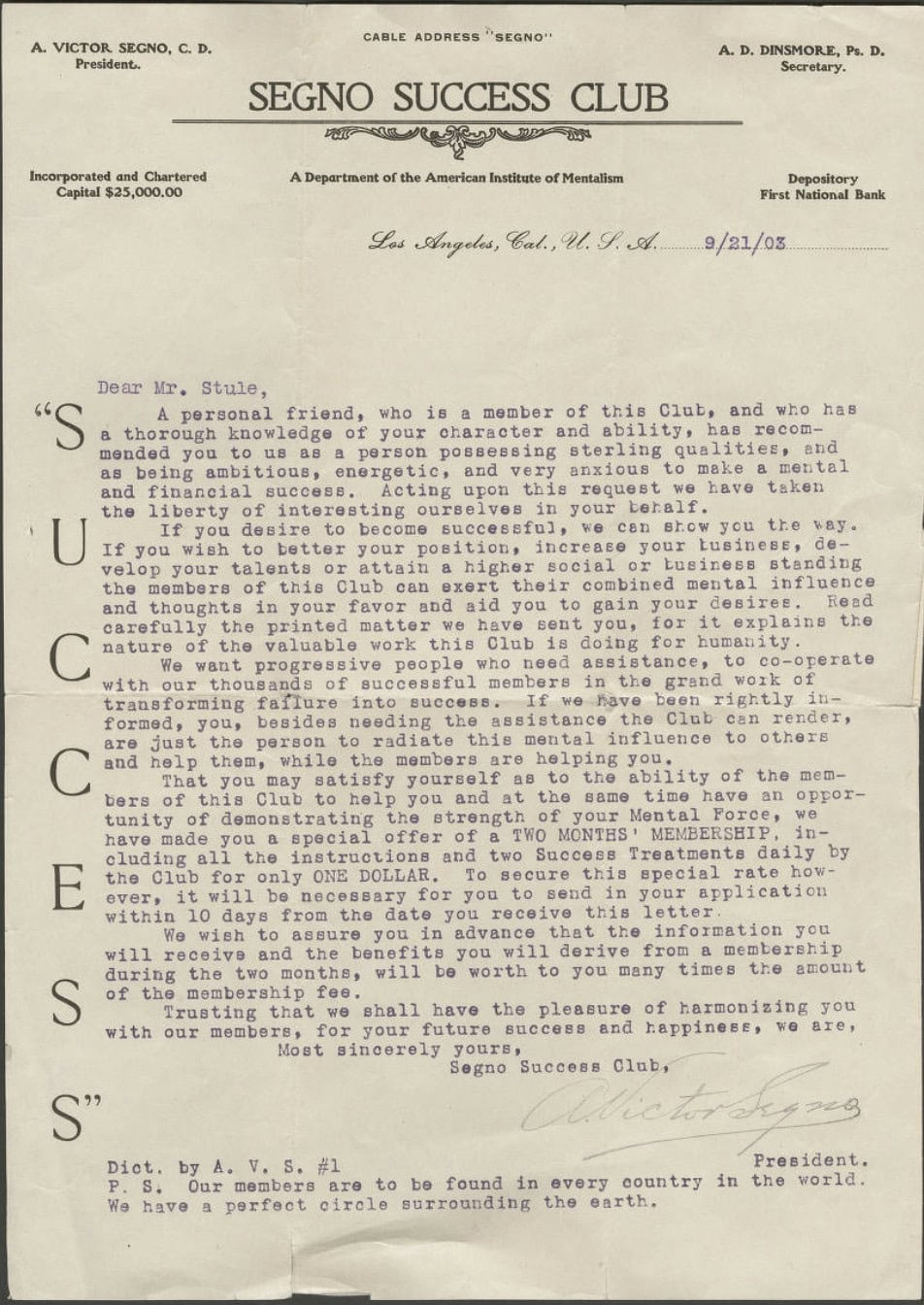
An early Segno Success Club marketing letter to a prospect, 1903. It states that they have a “perfect circle surrounding the earth.”
The Success Club Was More Than a Simple Mail-Order Scheme
The Segno Success Club appeared at a time when there was a large public audience for success organizations and the idea that the mind could exert measurable effects upon the individual and others. Many of the people joining organizations of this kind genuinely believed these forces existed. Nor were such ideas confined to mail-order promoters. Physicians and psychological teachers such as Herbert A. Parkyn had spent years demonstrating the effects of Suggestion in actual cases and developing methods based upon the ability of thought to produce physical and behavioral changes.
The proposition offered by the Success Club also had an appeal that can easily be lost when viewed only through later accusations of fraud. For one dollar a month or five dollars for a year, a member became part of an international organization in which thousands of other members were instructed to devote time each day to thoughts of health, happiness, and success for one another. Members were not simply waiting for Segno to send them a mysterious force from Los Angeles. They were instructed to participate themselves, concentrating at designated times, using the monthly Harmony Key, sending their own mental influence to their fellow members, and receiving the combined influence of the group.
Whether thought could literally be transmitted across thousands of miles is a separate question from whether people found value in participating in such an organization. Even someone uncertain about the physical transmission of thought could find something attractive in knowing that thousands of people around the world were performing the same exercise at the same time and directing constructive thoughts toward one another. For people who already accepted the reality of Suggestion and thought-force, the proposition would have been still more compelling.
Segno Success Club brochure
Where Did the Infrastructure Come From?
Segno’s career before this point makes the sudden transformation even more striking. He had built his reputation as a palmist and teacher of scientific palmistry. Then in 1902 he appeared with The Law of Mentalism, an elaborate psychological system centered upon thought, Will, concentration, habit, mental influence, healing, and the power of repeated thought to produce action. Much of its underlying psychology closely followed the teachings Dr. Parkyn had been teaching for years through the Chicago School of Psychology. Segno had already publicly entered Parkyn’s circle through Suggestion, where his first known article appeared in 1900, followed in 1902 by “The Power of Thought,” which provided substantial exposure for Segno and his developing system of Mentalism.
Behind Parkyn was an extensive publishing and correspondence network capable of supplying exactly the kind of infrastructure the new Segno organization required. The Psychic Research Company and the organizations and publications surrounding it had accumulated readers, students, book buyers, correspondence contacts, advertising experience, and connections extending outside the United States. Its activities had already demonstrated how books, periodicals, mail courses, advertisements, and direct correspondence could be used together to reach a large international audience.
Money alone does not explain Segno’s rapid rise. A large investment could purchase advertising and printing, but it could not instantly create mailing lists, experienced correspondence operations, publishing connections, overseas contacts, or a ready-made audience interested in mental science. Those resources had already been developed within the network in which Segno was operating.
E. Virgil Neal and his “Hypnotic Bank”
E. Virgil Neal
E. Virgil Neal and his organizations were themselves part of this network. Neal was a graduate of Parkyn’s school, and the New York Institute of Science was built around the same system of psychological instruction. Segno was connected with Neal’s organization well before the Success Club appeared. Geneva Baldwin, who conducted the instruction for the Chirological College in San Francisco, also promoted the New York Institute of Science, while Segno himself was associated with Neal’s Columbia Scientific Academy in New York. Segno’s ex-wife, Evelyn, also traveled as a hypnotist representing the New York Institute of Science.
Neal also had set up a bank under his E. Virgil Neal & Co. as a financial organization through which money could be assembled and invested in enterprises associated with this circle. Its presence could have supplied part of the financial structure missing from the familiar story of Segno simply creating a hugely successful mail-order business on his own. Neal’s Rochester operations, including the New York Institute of Sciences, already possessed customers, correspondence machinery, advertising channels, capital, and connections that also would have been needed to carry out an undertaking of this size.
*Truth magazine also went after Neal and his organizations, which resulted in the Sun newspaper in N.Y. running a story on him and dubbing his bank the “Hypnotic Bank.”* LINK
The Same Advertising Across the Network
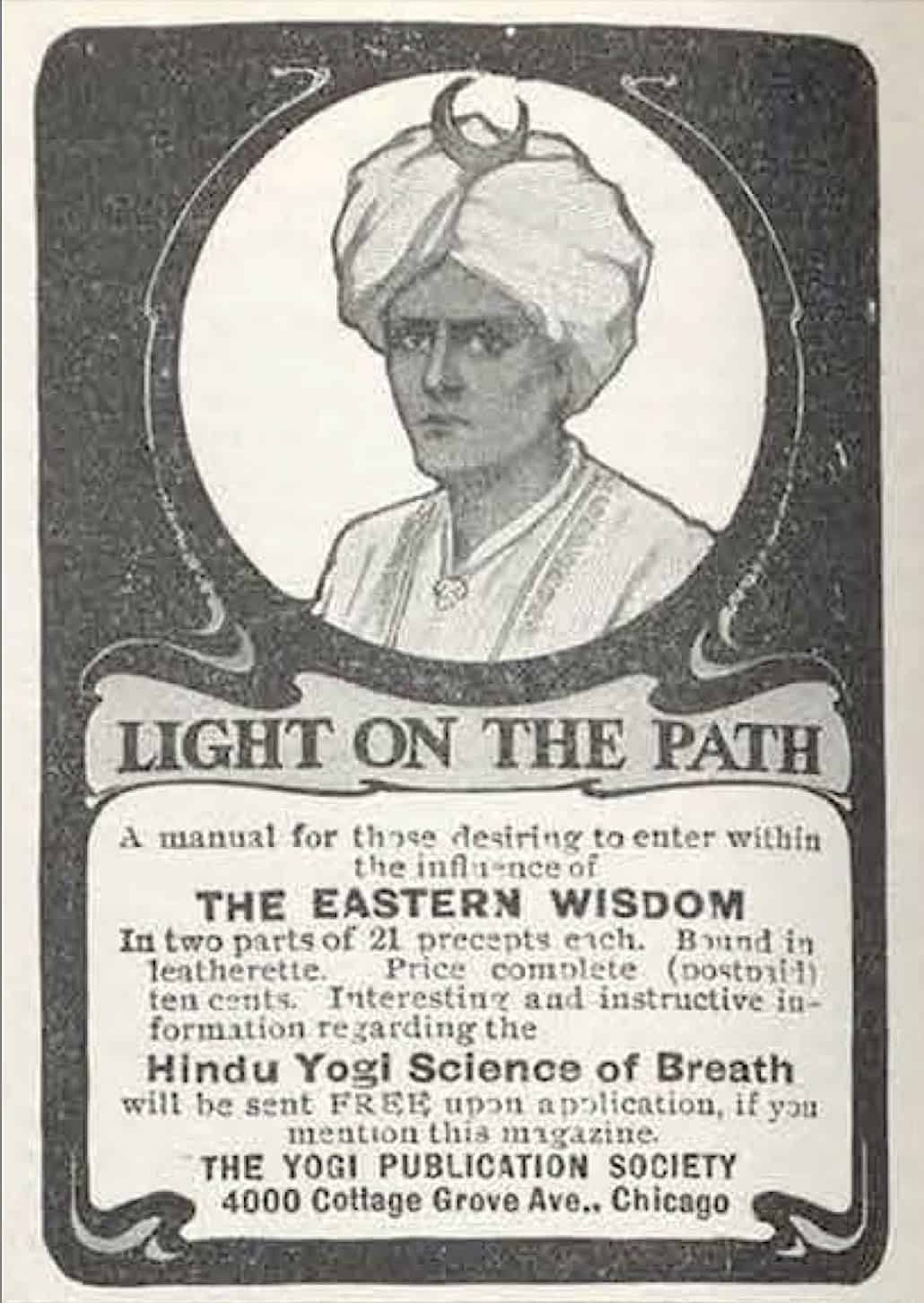
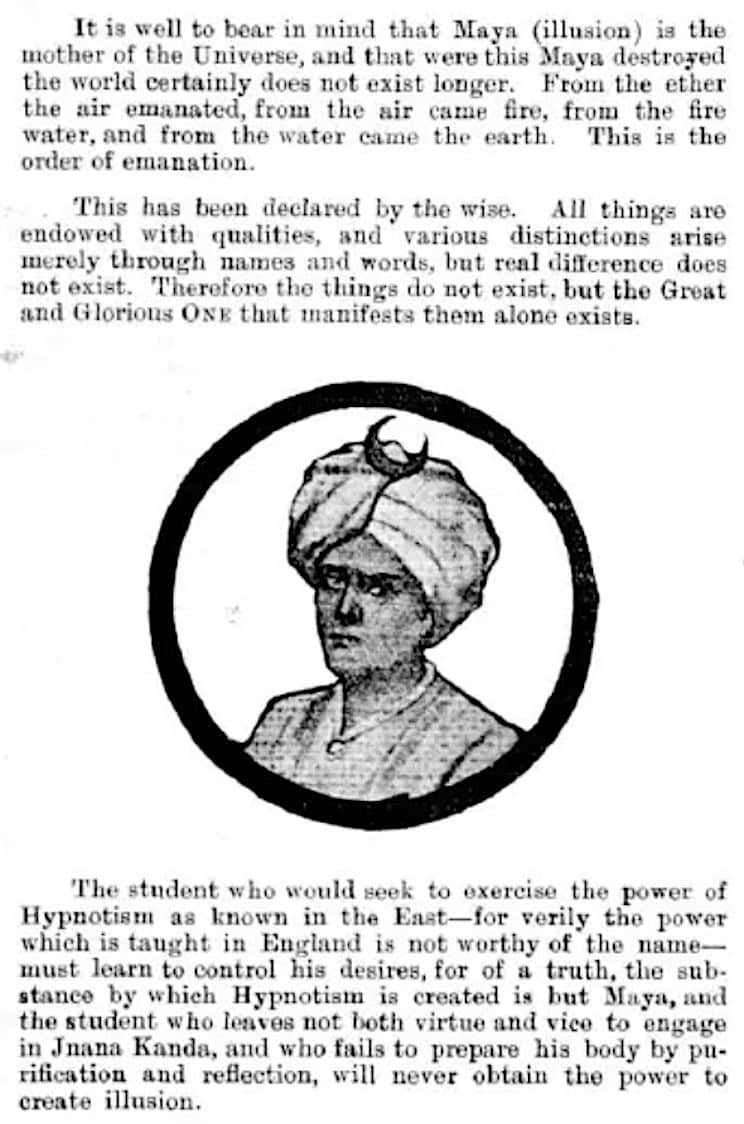
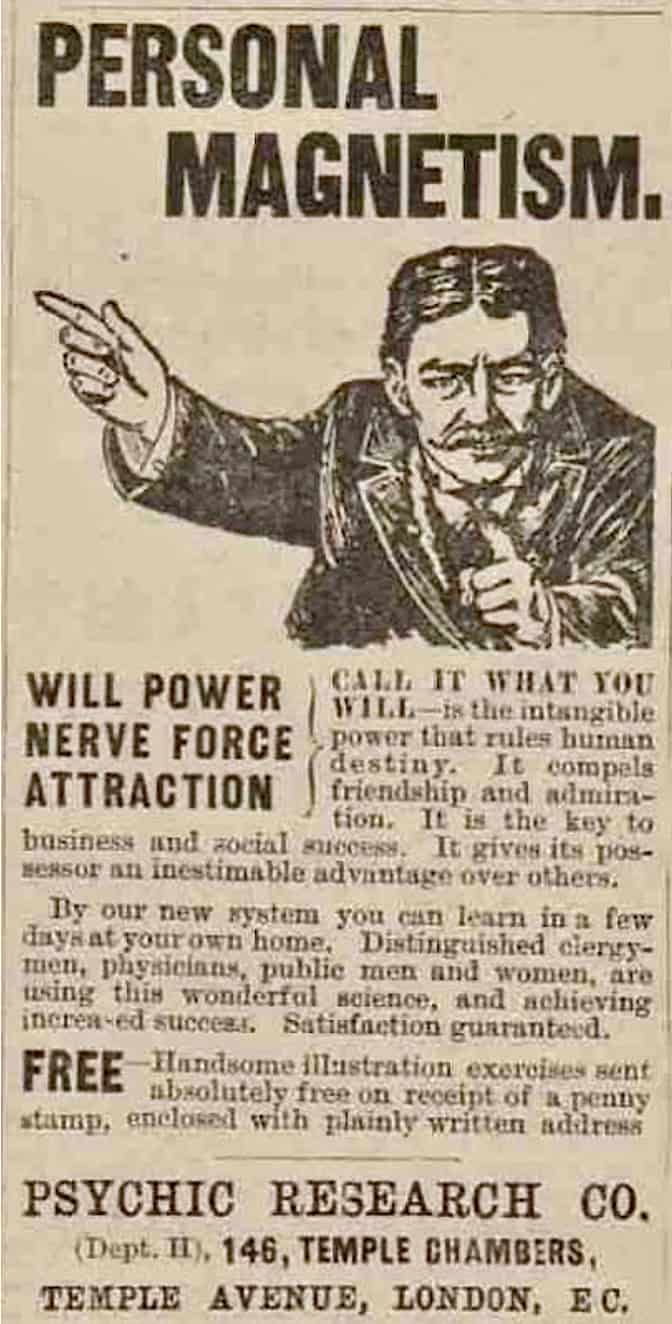
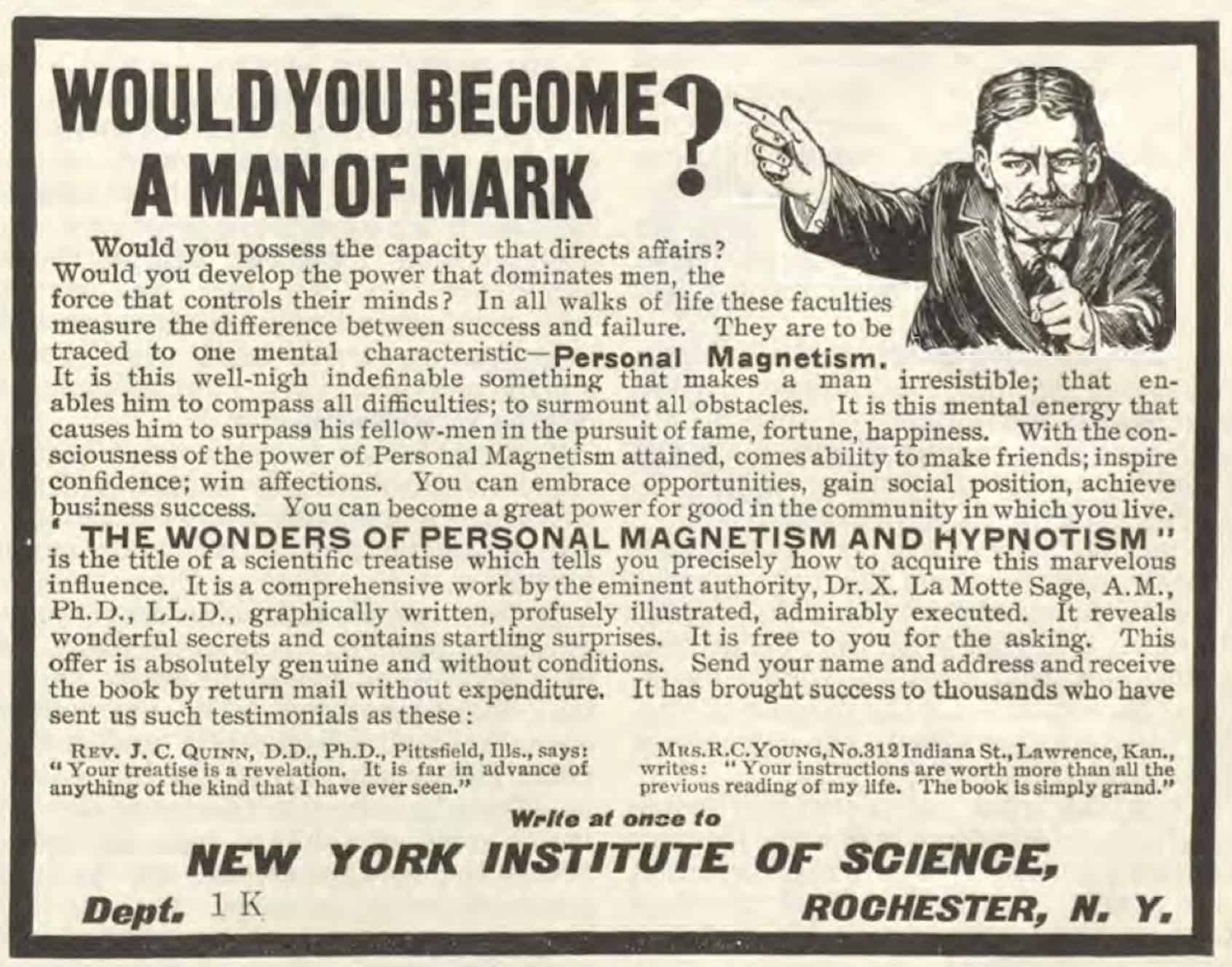
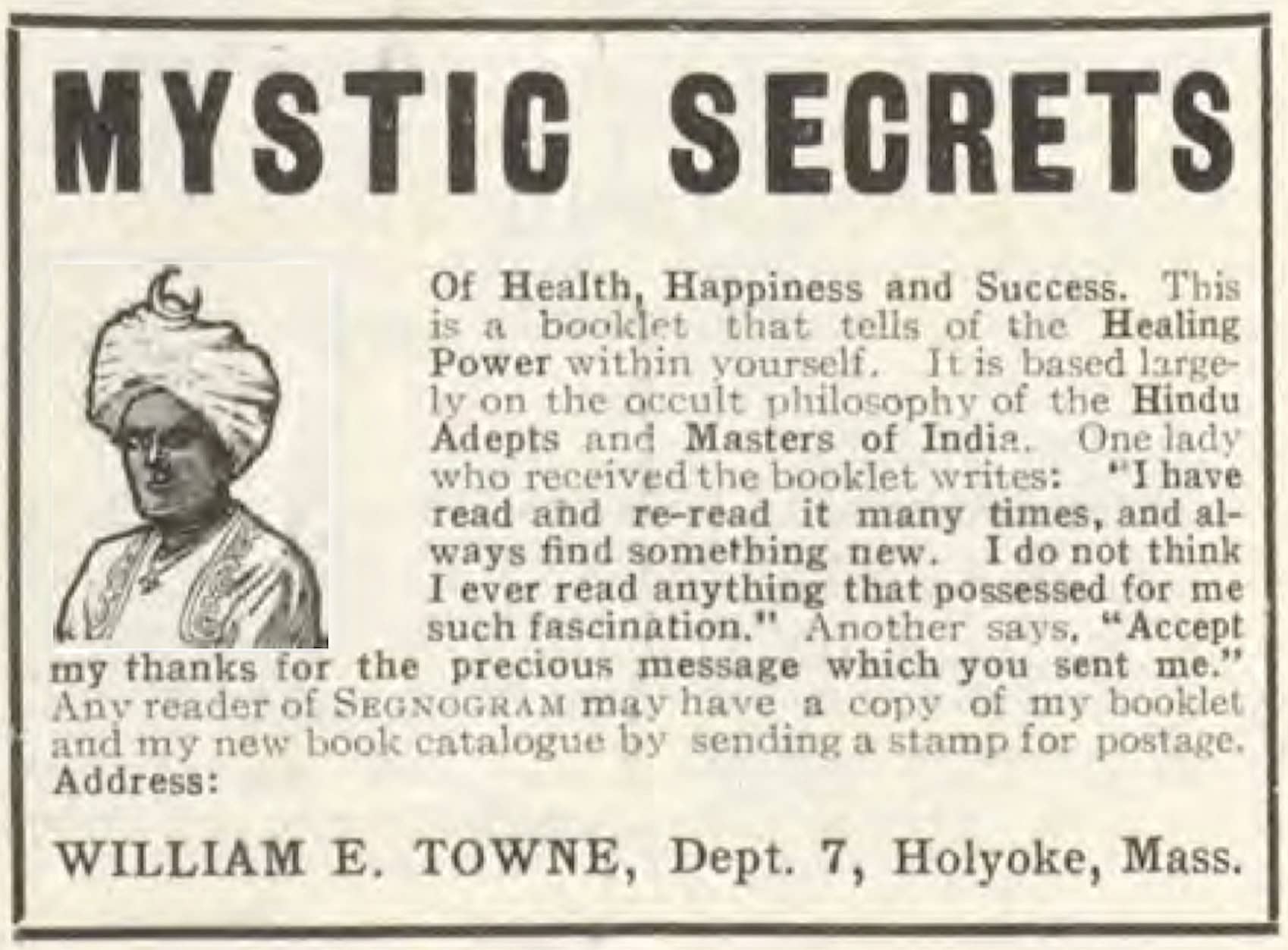
E. Virgil Neal was already directly connected to Parkyn as a graduate of the Chicago School of Psychology, but their relationship also extended into their later organizations. This can be clearly seen in the advertising material used by Neal’s organizations, the Psychic Research Company, and later the Yogi Publication Society. The same distinctive illustrations appear in advertisements issued by these different enterprises, including the identical pointing figure used by the Psychic Research Company and Neal’s New York Institute of Science, and the same image of a yogi later used by the Yogi Publication Society. These were not simply organizations operating in the same field and using similar imagery. The same advertising artwork was being passed between the Parkyn and Neal networks and reused for their different enterprises.
Both the YPS and Neil’s organization using the same Yogi illustrationThe Psychic Research Company and E. Virgil Neal’s New York Institute of Science using the same advertising illustration.
This history makes the familiar portrayal of Segno as a lone promoter who somehow built an enormous mail-order enterprise from scratch in Los Angeles increasingly difficult to sustain. The real mystery is not how the Success Club supported itself once thousands of members were sending money to Los Angeles. It is where the initial capital, mailing lists, prospective customers, international contacts, advertising channels, and correspondence infrastructure came from that allowed Segno to build a worldwide organization of approximately 12,000 paying members in barely a year.
The Networks Come Together in The Segnogram
William Walker Atkinson Joins The Segnogram
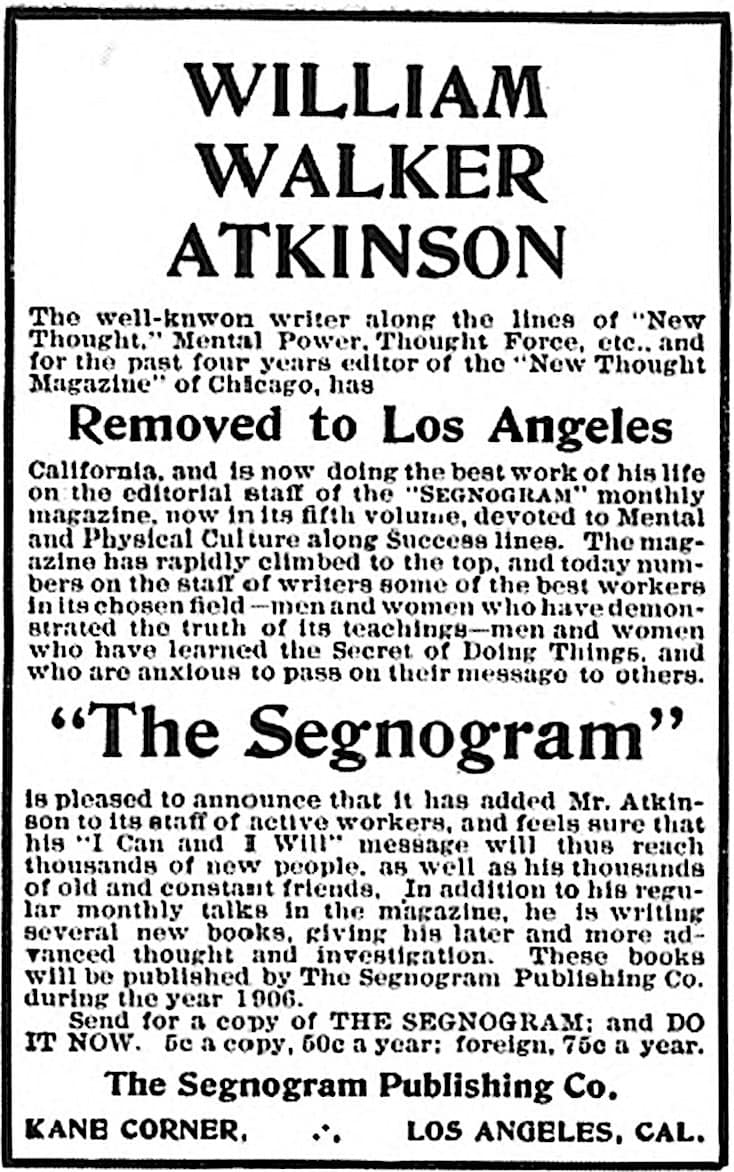
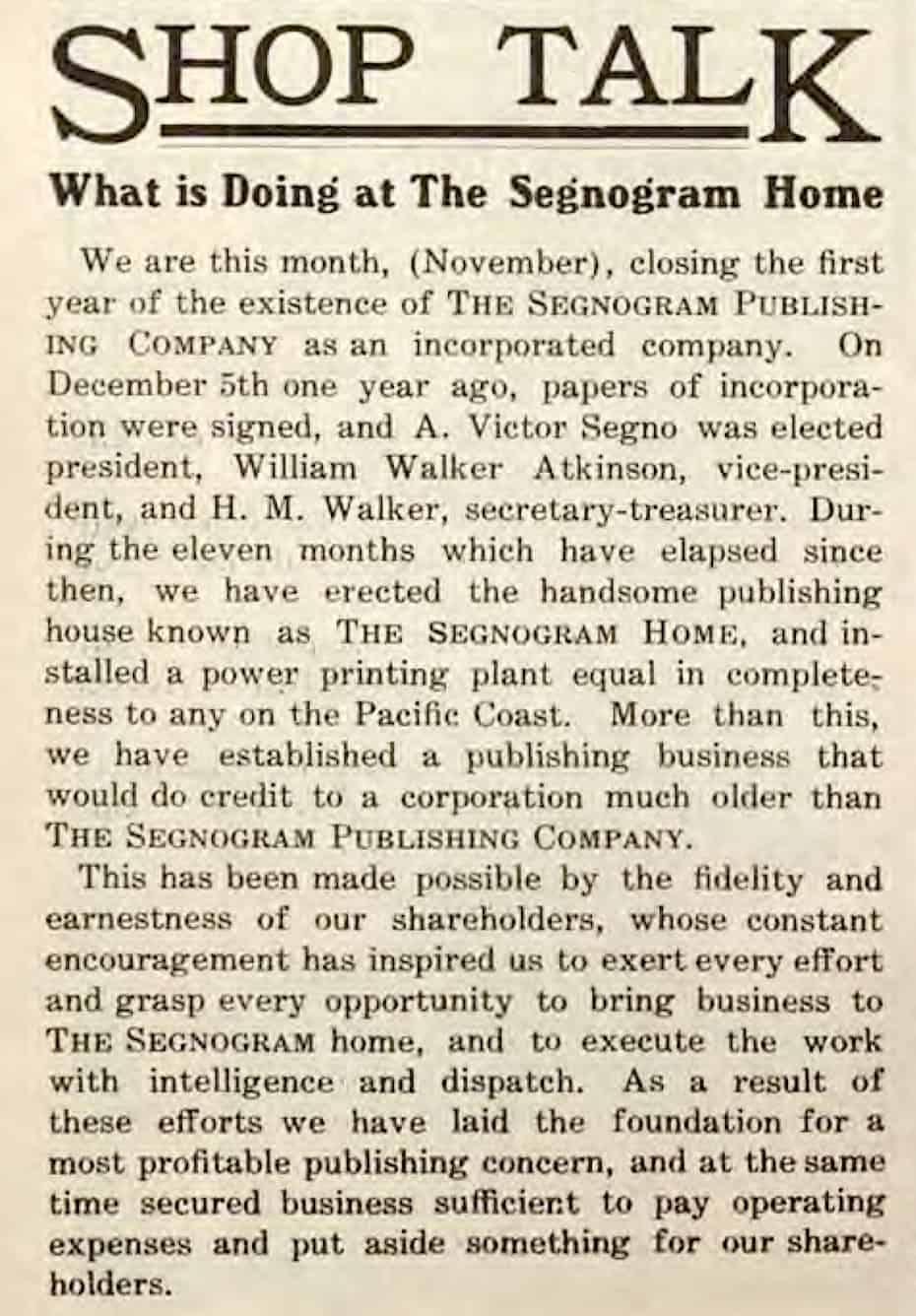
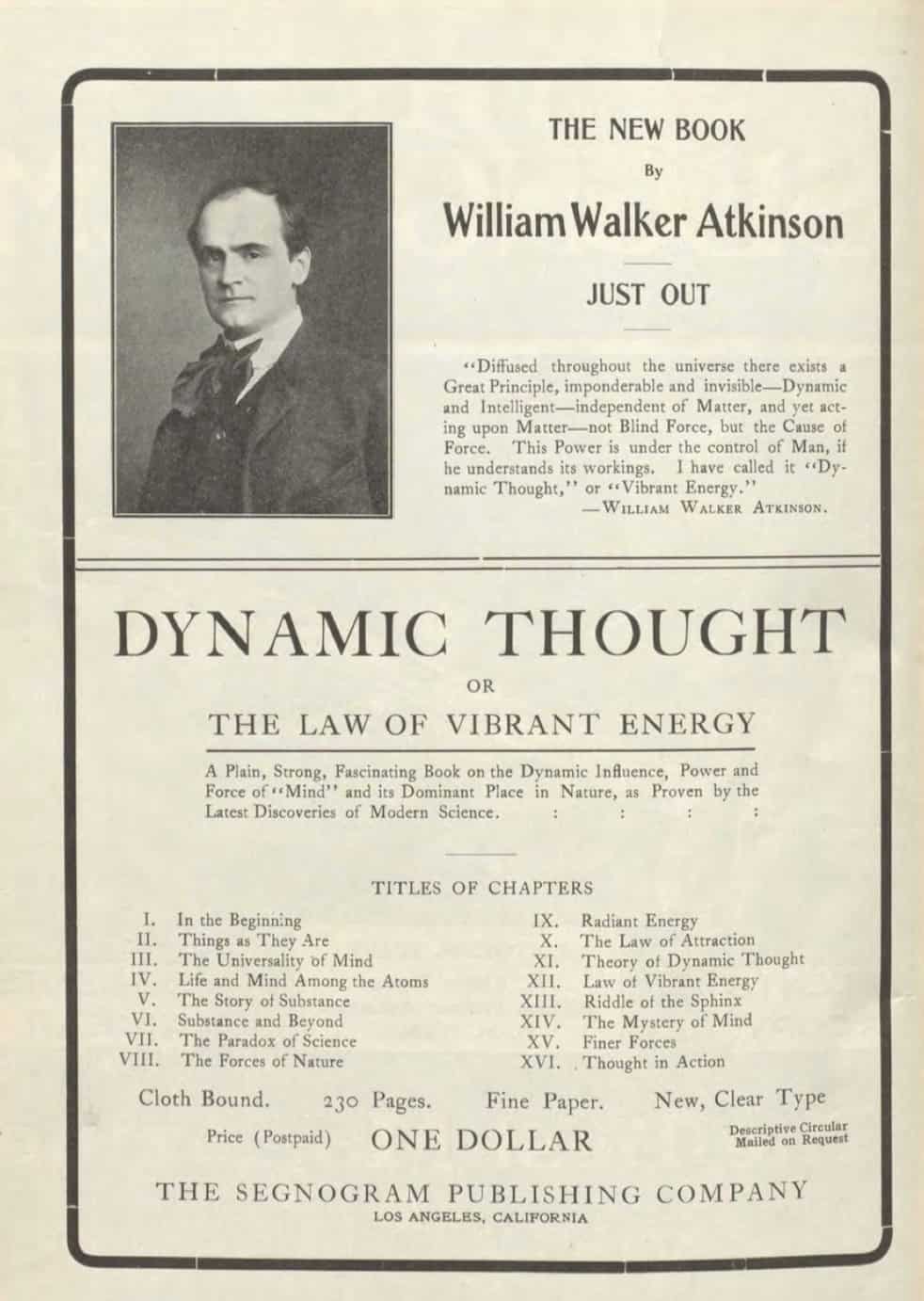
By the end of 1905, The Segnogram began to change and grow significantly. In December, William Walker Atkinson was sent to Los Angeles to serve as Vice President of the Segnogram Publishing Company. Then in January 1906 he became co-editor of The Segnogram and one of its principal contributors. His arrival placed the central writer from Parkyn’s Chicago network directly inside Segno’s publishing company.
William Walker Atkinson joins The Segnogram and becomes VP of the publishing comapany.
Atkinson’s contribution was substantial. While Segno continued to write extensively about Mentalism, the Success Club, and the activities surrounding his organization, Atkinson supplied much of the magazine’s psychological and mental-science material. The Segnogram Publishing Company also began publishing his books, including Dynamic Thought, and Atkinson started another periodical through the company called The Mystic.
William Walker Atkinson was an editor for The Segnogram, and his book Dynamic Thought was published by The Segnogram Publishing Company in 1906.
Neil’s Rochester Ventures Fill the Advertising Pages
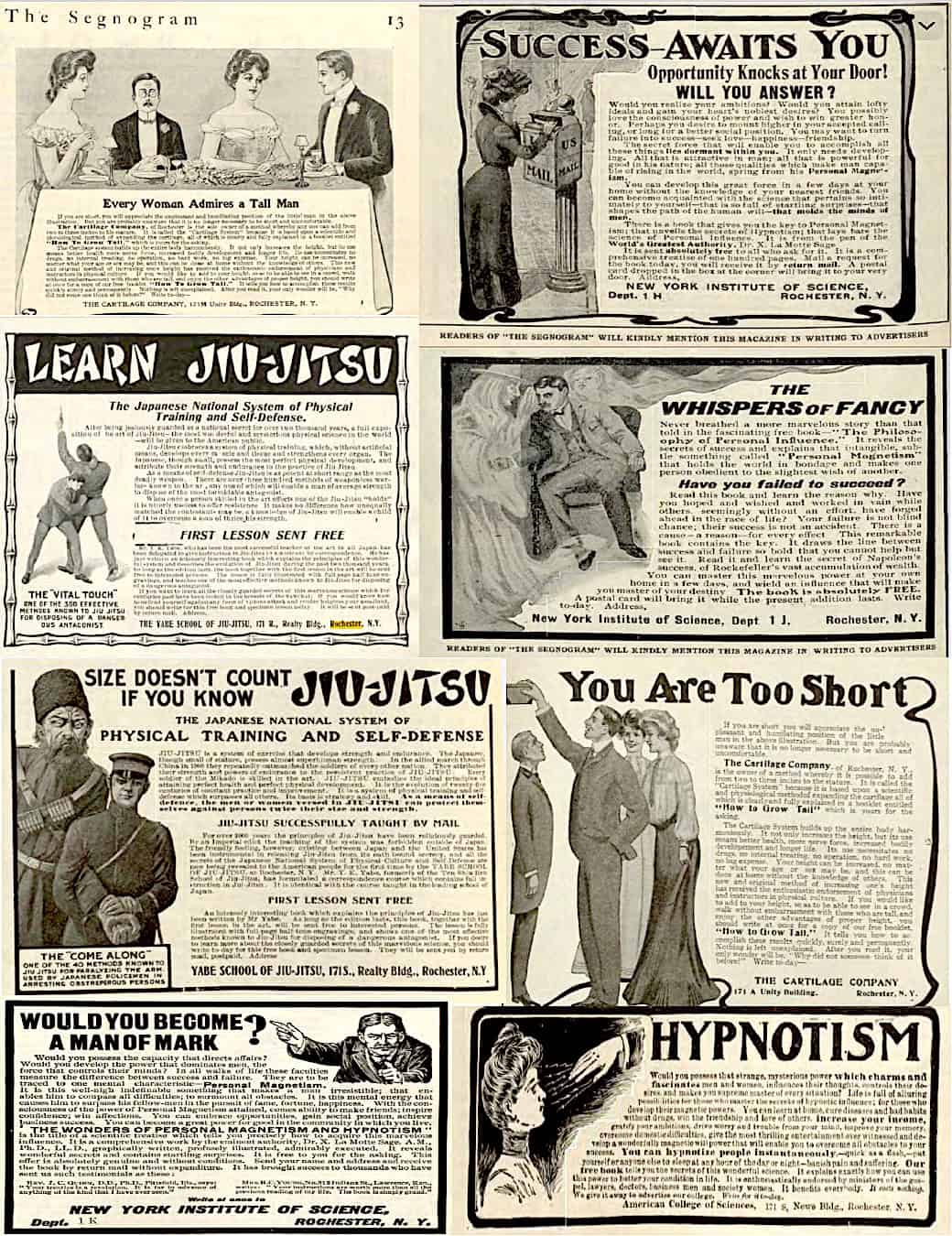
The other side of the network becomes visible in the advertising pages of The Segnogram. Organizations and business ventures connected with E. Virgil Neal and his associates in Rochester appeared throughout the magazine. This fits the financing system Neal used with publications and other enterprises. His financial involvement could be repaid in part through extensive advertising space, giving the businesses connected with him repeated access to the publication’s readership.
In The Segnogram, the Rochester presence was extensive. Advertisements included the New York Institute of Science, the American College of Sciences, the Yabe School of Jiu Jitsu, and the Cartilage Company, along with other enterprises connected with Neal and his collaborators. Charles S. Clark was one of those collaborators. He became involved with Segno in a pure-food company and the Lyvola olive-oil company. Frederick T. McIntyre was another important figure in the Rochester group and was associated with Neal through the American College of Sciences. Their appearance around The Segnogram adds another layer to the relationship already visible through Neal’s New York Institute of Science.
Some of the many Rochester ads that filled The Segnogram
The Wider Parkyn Network Also Appears in The Segnogram
The connections visible in The Segnogram also extended to Parkyn’s wider network. Elizabeth Towne and her husband William, whose Nautilus magazine had long been connected with the same New Thought circle surrounding Parkyn, also became closely involved in the exchange of advertising. The Nautilus and the Townes publishing ventures were advertised repeatedly in The Segnogram, while The Law of Mentalism and the Success Club appeared in The Nautilus with large advertisements extending across multiple pages.
An ad for Mystic Secrets, placed by William Towne of The Nautilus, using the same Yogi illustration as YPS and E. Virgil Neil’s organizations.
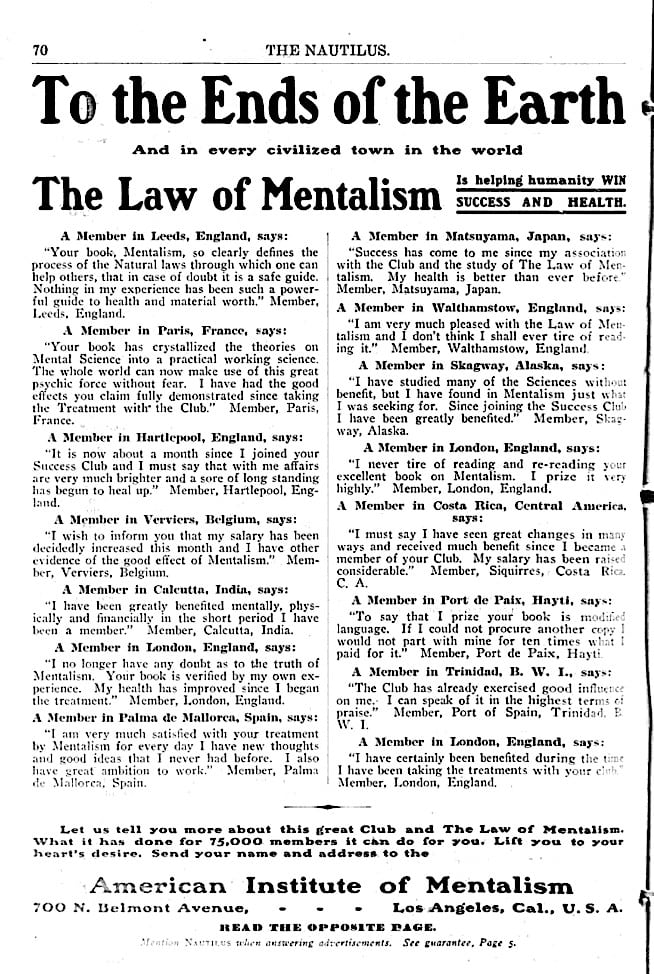
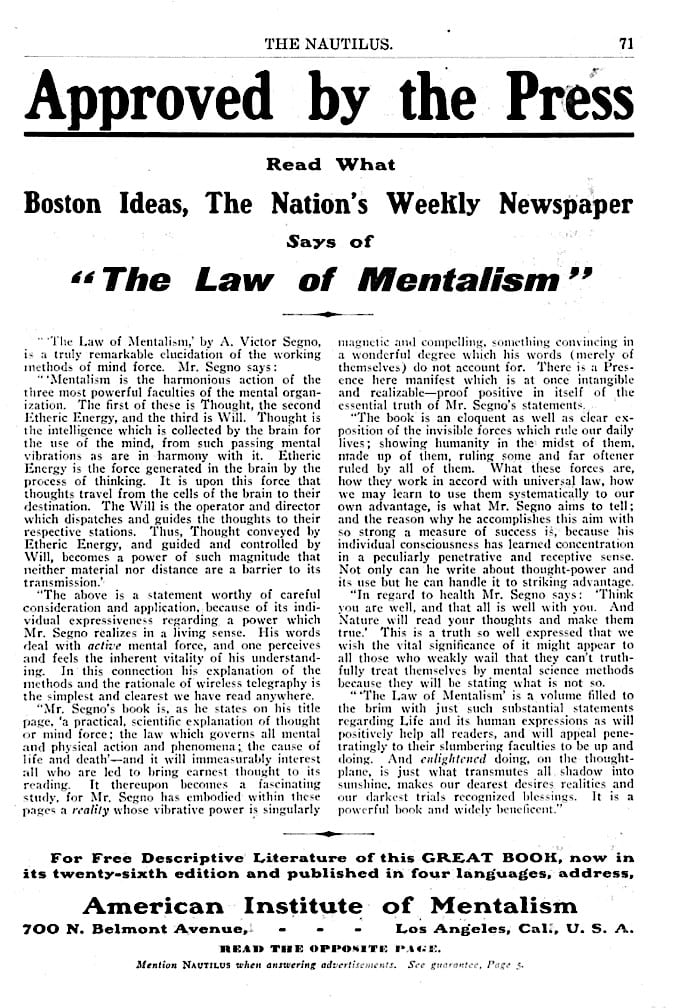
Multi-page ad for Segno’s The Law of Mentalism and the Success Club in The Nautilus magazine. The ad shows members from all over the world and claims to have over 75 thousand members.
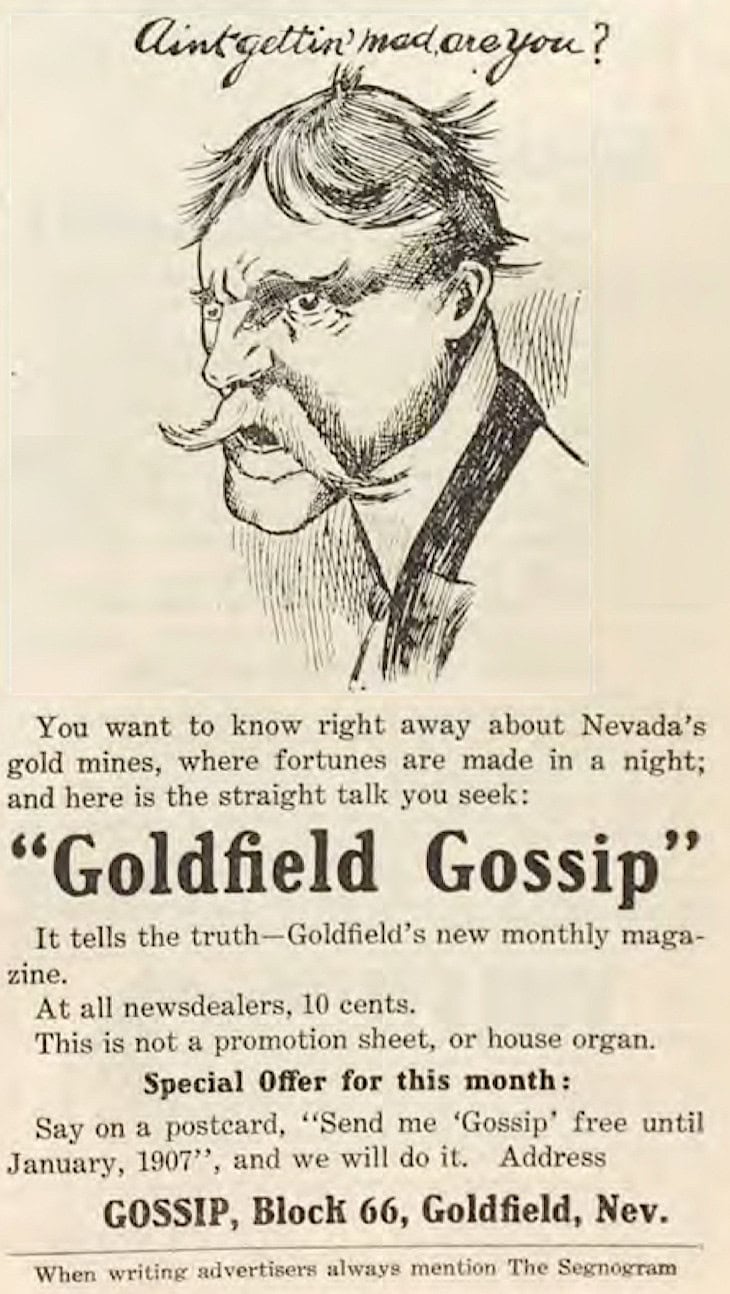
Other familiar connections from Parkyn’s network appeared there as well. Edward E. Beals and the Science Press advertised through the magazine, as did The Sheldon School, run by Parkyn’s close associate Arthur Frederick Sheldon, while Sydney B. Flower‘s Goldfield Gossip even appeared in its advertising pages. These were people, publications, schools, and businesses already connected through the Chicago world in which Parkyn, Atkinson, Flower, Beals, and their associates had worked.
Goldfield Gossip magazine by Sydney B. Flower being advertised in The Segnogram
The pattern becomes still clearer when the remaining advertisements are examined. The pages of The Segnogram contain what amounts to a who’s who of the same Chicago mental-science, correspondence-school, publishing, and self-development ventures that had advertised through Parkyn’s Suggestion and the publications surrounding it.
Segno as an Author
Alongside the Success Club, Segno developed a substantial career as an author. His books ranged from Mentalism and psychology to memory, health, longevity, marriage, beauty, death, and the nature of human existence. Most were issued through his own publishing organization in Los Angeles and were advertised extensively through The Segnogram.
His first major book, The Law of Mentalism, was soon followed by How to Live 100 Years and Retain Youth, Health and Beauty in 1903. In it, Segno argued that the accepted limits of human life were not fixed and that the body could continually renew itself if its cells and tissues were properly maintained. The work combined his ideas about the influence of the mind upon the body with instruction concerning health, longevity, physical renewal, and the preservation of youth and beauty. Segno continued promoting the system for years, claiming that the secret of prolonging life had been rediscovered and that a person could remain healthy, vigorous, and mentally active for at least a century.
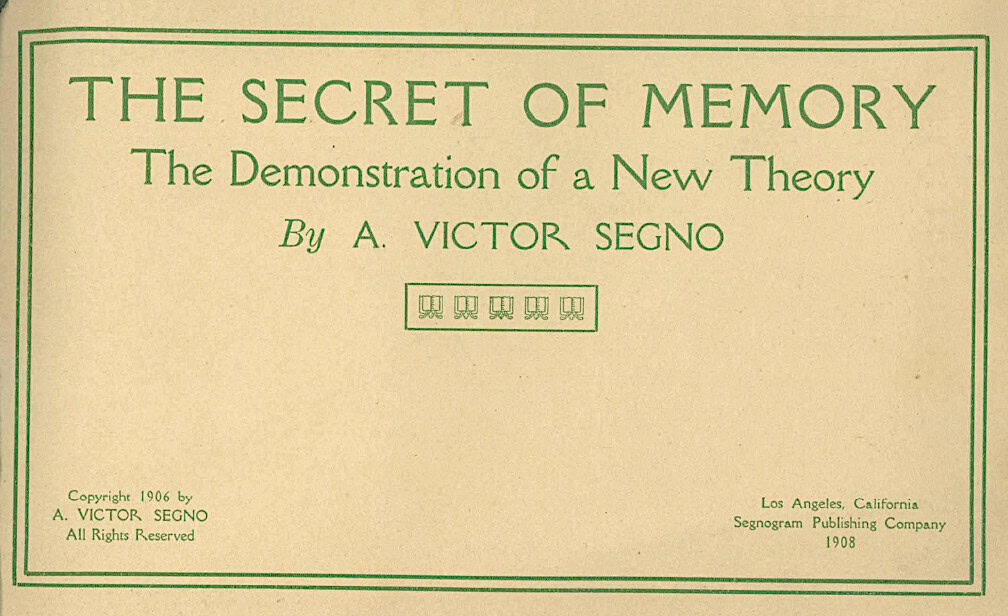
The Secret of Memory by A. Victor Segno
In 1906 he published The Secret of Memory: The Demonstration of a New Theory, a shorter work devoted specifically to the operation and development of memory. Segno approached memory as something that could be deliberately strengthened through mental training, with visualization and imagination playing important roles in forming and retaining impressions. The book included exercises intended to improve the reader’s ability to remember and recall information.
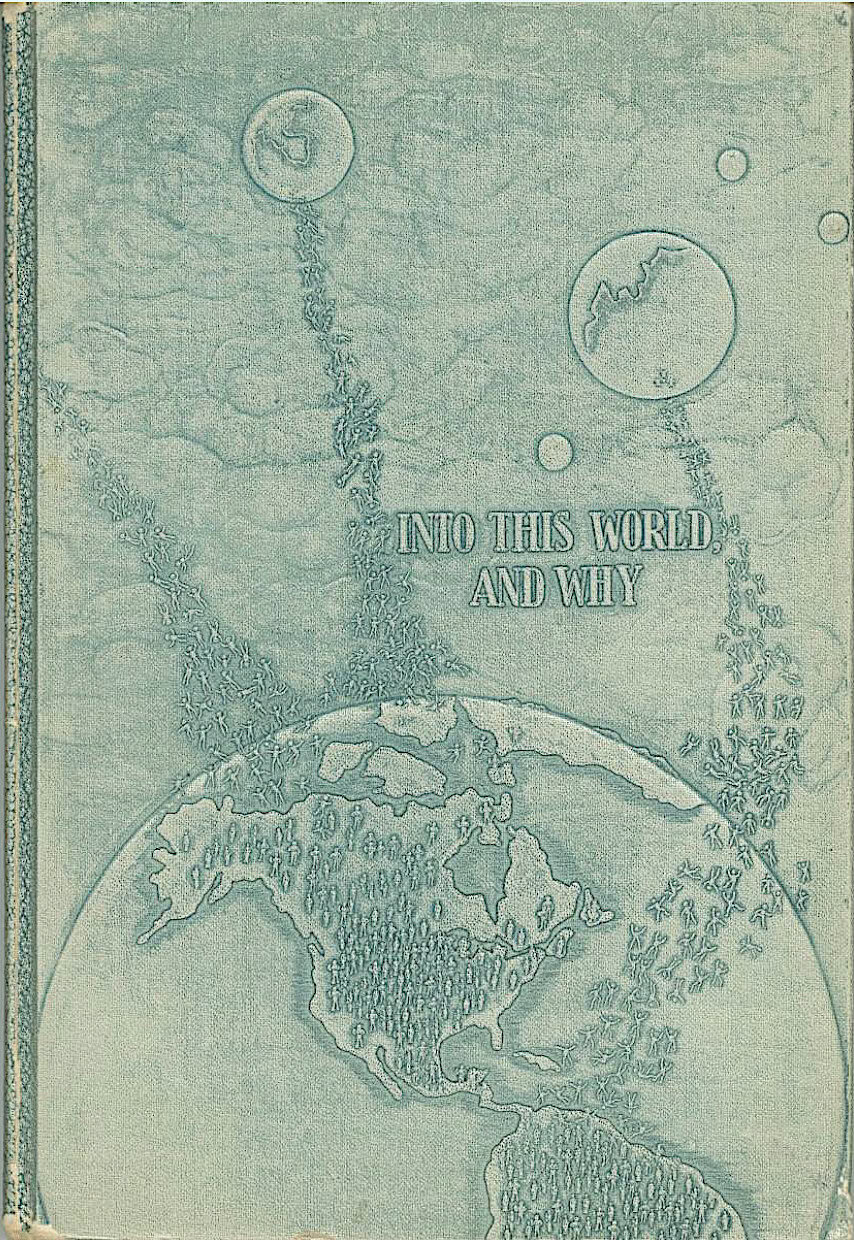
His later writing moved increasingly into questions of life, death, and human existence. Life in the Great Beyond; Or, The Law of Life and Death, published in 1911, was a compact work of about sixty-four pages dealing with survival after death and Segno’s understanding of the laws governing life and death. This side of his writing also appeared in Into This World and Why, which addressed the purpose of human existence and the reasons for entering physical life.
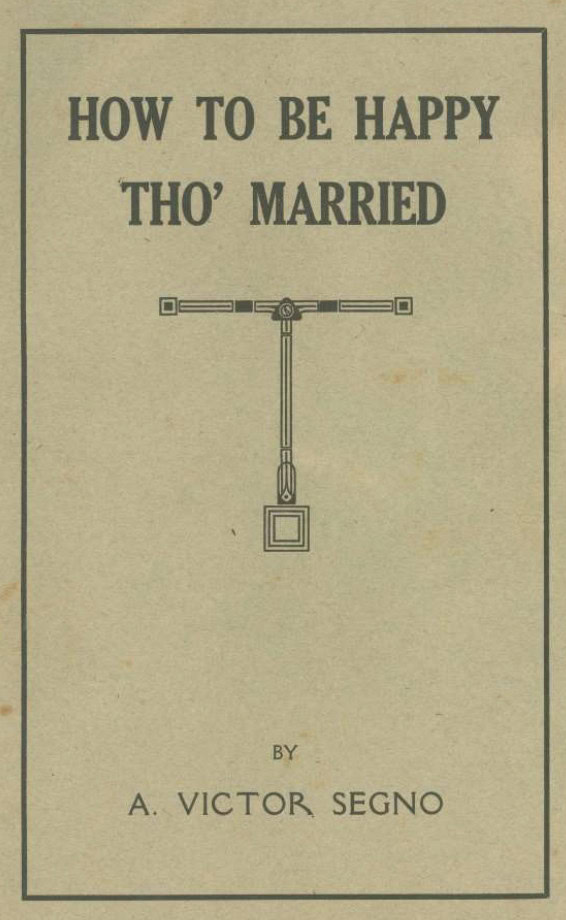
Segno also wrote on subjects much closer to everyday life. How to Be Happy Tho’ Married dealt with marriage and domestic relationships, while A Perfect Head of Hair and his writings on health and beauty carried his interest in physical well-being into subjects that could be applied directly by his readers.
How to be Happy Tho’ Married by SegnoInto This World and Why by Segno
Segno Leaves for Europe
Trouble in Guatemala
In February 1911, Segno became involved in a dispute surrounding a branch of his Chirological College operating in Guatemala. Students accused the school of fraud, bringing the matter to the attention of the American consul in Guatemala and educational authorities in California. Much of the dispute centered upon what the school had promised to teach and the meaning of “chirology.” The complaining students understood the term to mean palmistry, while Segno maintained that chirology meant the study of the hands and that this was how he had used the term throughout his career.
Segno traveled to Guatemala to deal with the accusations personally. He denied that the students had been deceived and argued that differences in language had contributed to the misunderstanding. His Spanish-language students were receiving instruction through the Los Angeles organization, and Segno maintained that the school’s literature explained the nature of the instruction being offered.
Segno and His Personal Secretary Disappear
Just a few months later, Segno abruptly left Los Angeles under circumstances that became a public scandal. On May 6, 1911, he departed after telling his wife, Annie Dell Segno, that he was traveling to establish additional schools connected with his work. His plans included a Canadian branch in Toronto followed by work in Europe, with Russia, London, and Paris among the destinations associated with the trip.
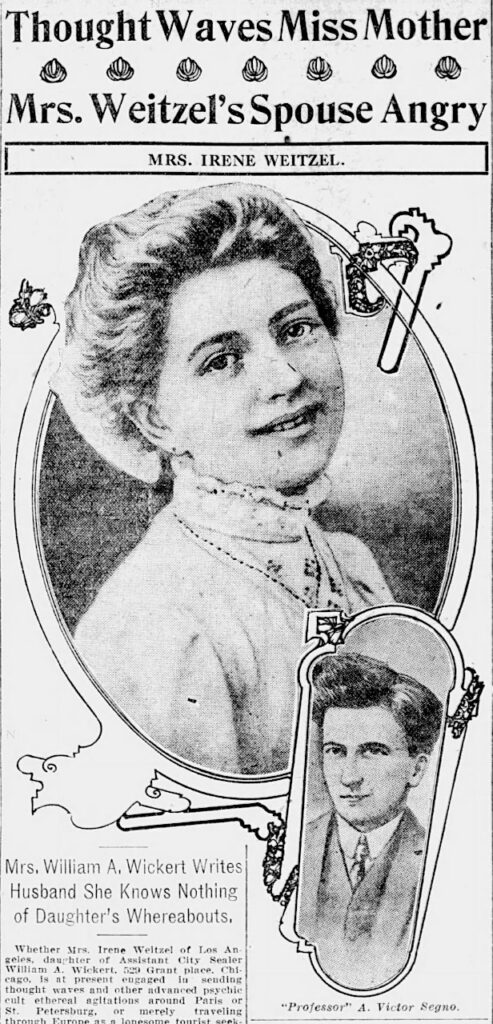
A. Victor Segno and his secretary, Mrs. Weitzel.
At almost exactly the same time, Segno’s private secretary, Irene Weltzel, disappeared from Los Angeles. Irene told her husband, Fred W. Weltzel, that she was going to Chicago to visit family and friends. She had worked for Segno for approximately four years and held an important position within his organization. She served as his private secretary, was treasurer of the Segno Publishing Company, and handled much of its German and Italian correspondence. She had continued working for Segno after marrying Weltzel less than a year earlier.
When Irene failed to arrive where her husband expected her to be, he began trying to locate her. Her mother eventually informed him that Irene was safe and had gone to Europe, but provided little additional information. By then Segno was also gone. The two departures had initially appeared to be separate. Segno did travel to Toronto, where he was supposed to establish a Canadian branch of his organization, while Irene was believed to be visiting Chicago. Their movements were soon traced farther. Irene had joined Segno in Toronto, and the two remained there only briefly before continuing to Montreal. From Montreal they sailed together for Europe.
Annie Dell Segno Files for Divorce
Annie initially refused to believe that her husband had eloped with his secretary. She defended Segno and maintained that she trusted him even as rumors concerning the two spread through Los Angeles. The confirmation that Segno and Irene had traveled together changed the situation. On June 8, Annie filed for divorce, alleging that her husband was having an affair with his former secretary. Segno later communicated from Europe that his marriage to Annie was over. Annie and Segno had been married for eight years.
The affair received widespread attention in both the United States and Canada. Segno was by then a well-known public figure, while Irene had occupied a trusted position inside his organization for years. Both had left spouses behind, departed Los Angeles at almost the same time under different explanations, met in Canada, and then crossed the Atlantic together.
A Mysterious Cablegram from Paris
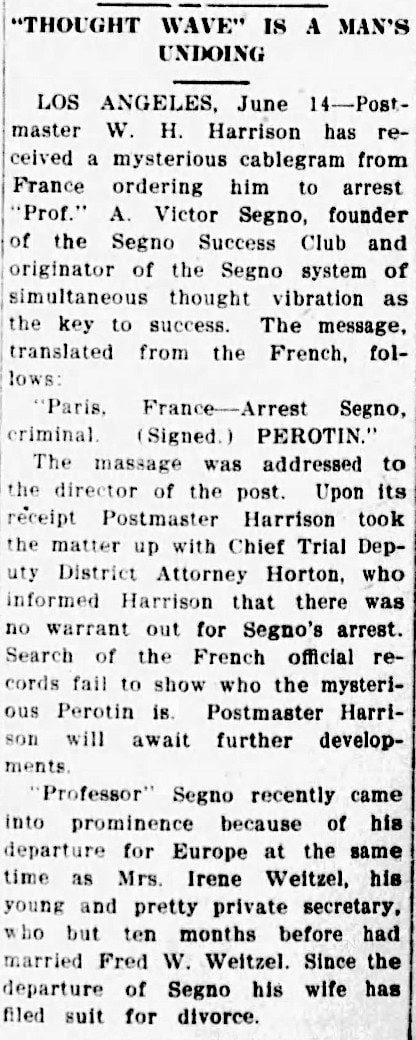
The story became stranger in June 1911, when the Los Angeles postmaster received a cablegram from Paris containing the message, “Arrest Segno, criminal,” signed by someone named Perotin. There was no warrant for Segno’s arrest, and authorities could find no information explaining who Perotin was or what crime the message referred to. No arrest followed.
Segno Resurfaces in Berlin
A. Victor Segno in Berlin
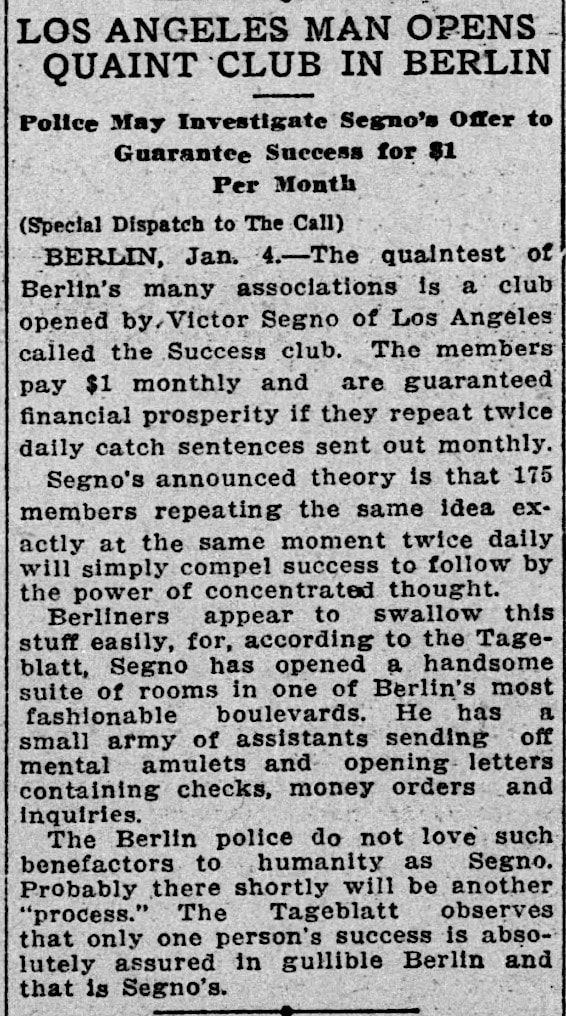
By late 1912, Segno had resurfaced in Berlin and was again operating the Success Club. He opened a large suite of rooms on one of the city’s fashionable boulevards and employed a staff to handle correspondence, inquiries, checks, and money orders. After leaving Los Angeles amid the scandal involving Irene Weltzel, Segno had succeeded in establishing a substantial new operation in Germany.
The Berlin organization followed the same system of coordinated mental influence that Segno had used in Los Angeles. Members concentrated upon the same thought at designated times, with Segno maintaining that the combined concentration of a sufficiently large number of minds could produce material results. By this time, Segno claimed that approximately 175 people were concentrating upon the same idea at the same moment.
Segno’s activities soon attracted the attention of German authorities. Berlin police were reported to be examining the Success Club and the claims being made for it, while the German press treated Segno and his methods with considerable skepticism. Despite this scrutiny, his Berlin headquarters was operating with a staff handling correspondence and payments arriving from participants.
The European Network
Segno’s move to Europe coincided with E. Virgil Neal and his close collaborators, Charles C. Clark and Frederick T. McIntyre, also moving to Europe. They were not the first members of the network to establish operations there. J. V. Daniels was already in Berlin, where he published Neue Gedanken, the German-language version of New Thought, through his Berlin-based Psychologischer Verlag company. Daniels was also active in England, Russia, France, and elsewhere in Europe. The European activities of Segno, Neal, Clark, McIntyre, and Daniels will be examined in a future article.
Annie Dell Segno Takes Over the Los Angeles Organization
Segno’s departure for Europe did not bring the Los Angeles organization to an end. Annie Dell Segno remained at Inspiration Point and took over the American Institute of Mentalism and the Success Club. She was already well prepared for the role, having served for years as secretary of the Success Club, contributed to The Segnogram, and worked alongside Segno in the business. Her earlier connection to David and Ida Hatch also tied her to the circle surrounding Segno’s organization before their marriage.
Annie had a financial stake in the enterprise as well. She later testified that she invested $750 in the startup of the business, compared with just $100 contributed by Segno. Whatever the exact division of responsibilities had been before 1911, she knew the organization well enough to continue running it after his departure.
The Segnos Divide Their Property
The collapse of their marriage was followed by a substantial division of their financial interests. Annie had filed for divorce in June 1911 after Segno’s departure with Irene Weltzel, but that first action, which alleged misconduct between Segno and Irene, did not proceed to a decree because the necessary proof could not be obtained. In August 1911, Segno and Annie instead reached a property settlement.
The size of the settlement shows how much wealth had accumulated around the Segno enterprises. Later accounts placed the property involved at very large values, with one describing $500,000 being divided between them and another valuing what Annie received from Segno at approximately $150,000. Their financial affairs did not immediately separate completely. On June 13, 1912, Segno and Annie jointly executed promissory notes totaling $80,000, secured by property they owned. This occurred while Segno was operating in Berlin and Annie remained in Los Angeles, showing that significant property and financial obligations continued to connect them after their personal separation.
Segno Returns to Los Angeles
Segno eventually returned to Los Angeles while continuing to maintain his European interests. By early 1914 he had been back in the city for several months and appeared personally in court during litigation involving promissory notes connected with the Institute. Annie had transferred certain notes associated with Segno’s interest in the business to Segno’s brother, Arthur S. Hall, making Segno’s testimony necessary when some of the obligations were disputed.
The 1911 scandal resurfaced during the proceedings. Annie’s attorney attempted to question Segno about his relationship with Irene Weltzel, but the judge ruled the questioning out. Segno maintained that Irene had been his employee and that he had taken her to Berlin to assist him in establishing the European branch of the Institute. By this time Irene was living in Chicago, while Segno intended to return to Berlin.
Annie Finally Divorces Segno
Annie brought a second divorce action in 1914, this time on the ground of desertion. The earlier allegations concerning Irene were no longer necessary to obtain the decree. On May 21, 1914, Annie Dell Segno was granted a divorce from A. Victor Segno. The divorce formally ended a marriage that had effectively broken apart three years earlier. It did not end Annie’s involvement with the Institute, which she continued to operate in Los Angeles. Nor did it immediately settle all of the financial consequences of the marriage and the businesses the two had built together. Litigation over property, notes, and legal expenses continued afterward.
World War I Ends Segno’s Berlin Operation
Segno returned to Berlin, where his European business continued until the outbreak of World War I severely disrupted it. By late 1914 he had been abroad for more than three years and was preparing to return to Los Angeles. The war had changed the economic conditions under which the Berlin Success Club operated, and Segno acknowledged that business had fallen sharply. The disruption ended what had been a substantial European undertaking. Segno had maintained offices in Berlin, employed a staff, and continued his correspondence operation there after leaving California.
The Los Angeles Institute Comes to an End
The financial obligations remaining from the earlier Segno organization eventually caught up with the Los Angeles operation. The $80,000 in promissory notes that Segno and Annie had jointly executed in June 1912 had been secured by property they owned. In 1916, a foreclosure action was brought against the mortgaged property. Neither Segno nor Annie appeared when the case was called, and judgment was entered by default. The foreclosure brought the remaining activities of the Institute of Mentalism in Los Angeles to an end. Nearly fifteen years had passed since Segno had organized the American Institute of Mentalism and launched the system that developed into the Success Club.
The Segno Success Club
Later Life
From A. Victor Segno to Albert James Hall
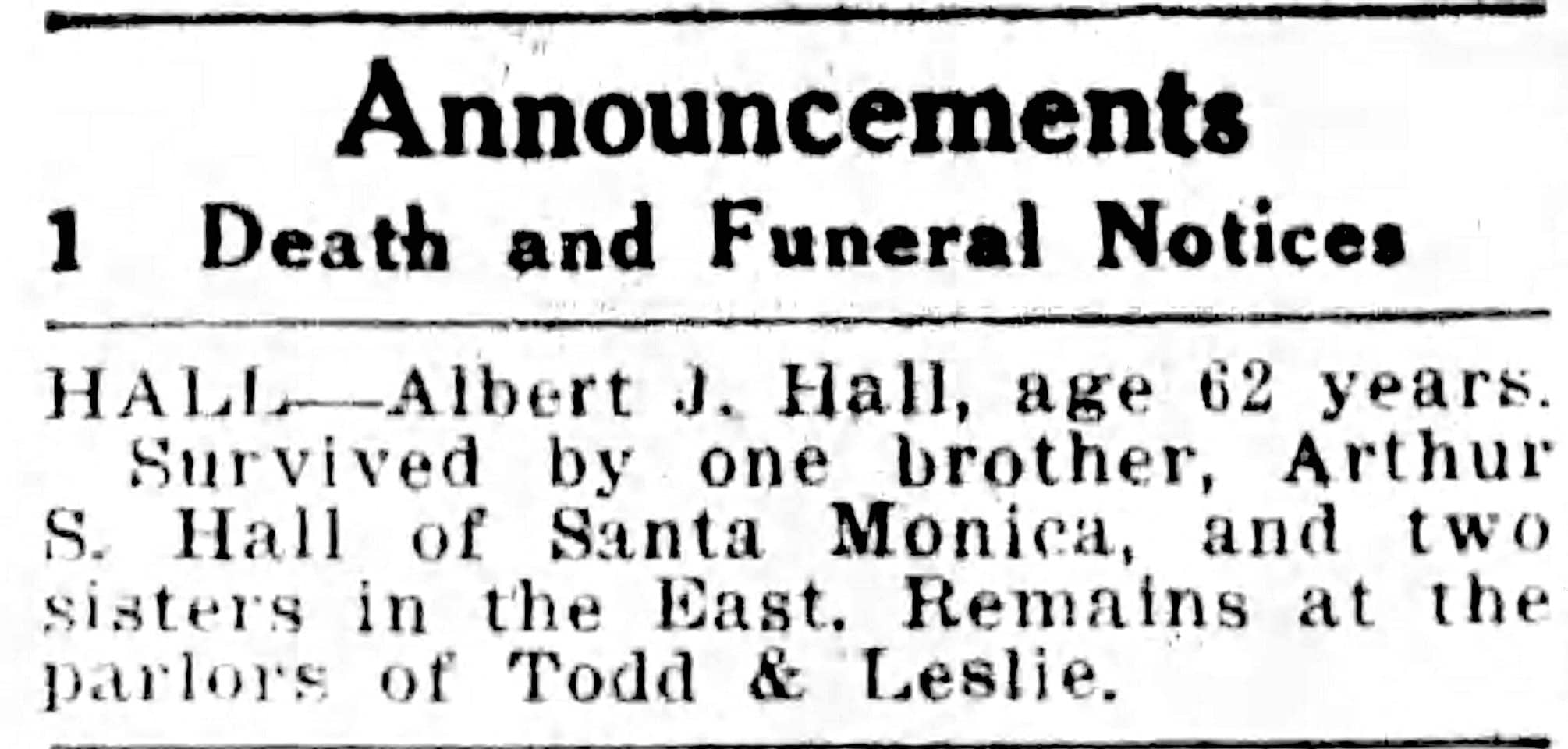
A. Victor Segno, now Albert J. Hall, 1920
After returning to California, Segno abandoned the name A. Victor Segno and began living and working as Albert James Hall. He did not return completely to his birth name of William James Hall, instead retaining Albert from the professional identity he had used for nearly two decades.
He continued writing under his new name, and in 1916 published Why Men Fail, subtitled Illuminates the Danger Spots and Erects Guide Posts Along the Road to Success. Although the Segno name was gone, the subject remained closely connected with the success teachings that had occupied much of his earlier career. In 1918 he published Into This World, and Why under Albert J. Hall.
He also became involved in real-estate development and was associated with Edward D. Silent and F. B. Howard in the firm Silent, Howard & Hall. When the company acquired approximately 450 acres in the San Jacinto Mountains for development into lodge sites, Hall was placed in charge of advertising and organization. It was work well suited to someone who had spent years building organizations through publishing, advertising, promotion, and direct correspondence. He also became involved in the motion-picture business through the Universal Scenario Corporation in Los Angeles. The company developed and marketed story ideas for motion pictures, accepting plots from writers and offering to revise, criticize, copyright, and market them. It also published the Scenario Bulletin-Digest. Hall had moved away from Mentalism, but writing, publishing, advertising, and the commercial development of ideas continued to occupy much of his later career.
Death of A. Victor Segno (Albert J. Hall)
A. Victor Segno ‘s obituary
Albert James Hall (A. Victor Segno) died in 1933 at the age of sixty-two. His death received little of the attention that had followed A. Victor Segno during the height of his career. A brief notice recorded that he was survived by his brother Arthur S. Hall of Santa Monica and two sisters in the East. By the time of his death, the name A. Victor Segno, once attached to an international Success Club, publishing company, magazine, correspondence school, and network extending across several continents, had largely disappeared from his public life.
Legacy
Prof. A. Victor Segno’s legacy can be summed up by this article published in the The San Benito Advance on Nov 19, 1913.
Publication note: This article contains original research by the Yogi Publication Society History Project. It was first published on this website in Oct. 2026 and archived by the Internet Archive’s Wayback Machine.
Newspaper."A. Victor Segno and Atkinson. " thought takes form in action" motto of Segnogram". Weekly Examiner. 1906-04-21. p. 12. Retrieved 2026-10-02.