

Person Research Collection
Jay Van Tuyl Daniels
1872–1934
Jay Van Tuyl Daniels (April 8, 1872 – February 7, 1934) was an American journalist, publisher, businessman, manufacturer, and international promoter whose career was closely connected with Herbert A. Parkyn from the 1890s through the early twentieth century.

Born into a prominent Minnesota business and political family, Daniels began his career in Minneapolis journalism before becoming president of the Psychic Research Company in Chicago in 1899. He later carried its publishing business into England, France, and Germany, where he edited the German New Thought magazine Neue Gedanken.
After returning to the United States, Daniels remained involved with Parkyn in business ventures, including with the American Placer Corporation and investments in Mexican agricultural projects. Daniels later built the Dearborn Supply Company into a highly successful international cosmetics business.
His career connects Parkyn’s early Minneapolis work, the Chicago mental-science publishing network, European New Thought publishing, and the group of publishers and businessmen from which the Yogi Publication Society developed.
Early Life and the Daniels Family in Minnesota
Jay Van Tuyl Daniels was born on April 8, 1872, in Rochester, Minnesota, to Donald A. Daniels and Mary L. Daniels. He came from a family that had been active in Minnesota business, banking, real estate, and politics since the state’s early development. His grandfathers, John Van Ness Daniels and Asahel Smith, co-founded the Smith and Daniels Company in the 1850s, which became one of the largest real estate firms in the region, specializing in farmland investment and sales. Together, they also established the First Union National Bank of Rochester, Minnesota, a major mortgage lender in the area. His grandfather, John Van Ness Daniels, also served multiple terms as a Minnesota state senator, a position later held by his son as well.

His father, Donald A. Smith, was a prominent Minneapolis businessman and a key figure in the Minnesota Linseed Oil Company, which grew into one of the largest paint supply firms in the United States. His cousin, Van Ness Daniels Smith, would later become his business partner in the Psychic Research Company. Smith trained as an attorney and handled the legal side of several of the family’s business interests.
Dr. Parkyn had known the Daniels family from Minneapolis, where in 1894 Jay’s father had become seriously ill with a progressive paralytic condition. In an effort to find relief, the family turned to Parkyn and Dr. Sudduth, hoping Suggestion might offer help. Although the treatment was ultimately unsuccessful in halting the disease, both Jay and his mother developed a lasting interest in hypnotism, with Mary L. Daniels in particular becoming deeply committed in the research of mental science. They would both become graduates of Parkyn’s Chicago School of Psychology.
Jay V. Daniels had first become aware of Dr. Parkyn and his hypnotism research while working for The Minneapolis Journal which had closely followed Parkyn’s career as a football star and hockey pioneer at the University of Minnesota and had reported extensively on the hypnotism experiments conducted by him and Dr. Sudduth at the University’s Dental School and free clinic.
Daniels Becomes a Minneapolis Journalist and Publisher
Daniels entered newspaper work while still a young man and became well known in Minneapolis as a journalist and editor for The Minneapolis Journal, and for serving on the house committee of the Minneapolis Press Club. Daniels was active in business, working as an advertising agent for the Great Northern Railroad and founding the journal, The Northwestern Immigrant Agent, which focused on steamship and land settlement opportunities for emigrants to the Northwest.
With his experience in newspaper management, editing, publishing, advertising, and business, he was later considered an ideal candidate to run the operations of the Psychic Research Company. Daniels would also be the means of expanding the company internationally by first establishing a London office at 146 Temple Chambers and subsequently moving into France and then into Germany, where the company operated under the name Psychologischer Verlag (Psychological Publishing) and published the German-language magazine Neue Gedanken (New Thought).
The Psychic Research Company
On September 20, 1899, Jay V. Daniels, with his cousin Van Ness Daniels Smith, and Sydney B. Flower incorporated the Psychic Research Company in Chicago with the minimum allowable capital stock of $2,500. In 1899, incorporating a company and getting its charter required at least three names on the incorporation papers. This was called the “rule of three.” It was quite common for the names to be three lawyers who worked for the firm that was hired to draft and file the paperwork, since it was only after the state approved the charter that the bylaws and Board of Directors would be created. As soon as the directors and shareholders took over, the incorporators’ job was complete. Using attorneys or dummy names for incorporating a company was also a common practice to keep the real people behind an enterprise secret. Parkyn would use this practice for many of his enterprises, including the University of Psychic Science.

Because Van Ness Daniels Smith was an attorney, he drafted the paperwork, and Daniels and Flower served as the other two incorporators. After the meeting of the directors and shareholders, Daniels was appointed president of the new company to handle daily execution, contracts, and operations, and Van Ness Smith was appointed corporate secretary to officially sign off on all contracts, meetings, etc… Flower would serve as the face and principal editor for the new company.

The company was organized to publish books and literature dealing with psychology and psychic research. Its formation came while Parkyn was expanding the work that had begun with the Chicago School of Psychology and his Special Mail Course in Hypnotism and Suggestive Therapeutics into a much larger educational and publishing system. Courses could be distributed through the mail, advertised through magazines, and sold to students who never attended Parkyn’s Chicago classes. The range of subjects was also expanding from hypnotism and suggestive therapeutics into concentration, mental influence, psychic research, mind reading, telepathy, clairvoyance, psychometry, and other branches of mental and psychic study.
Plans connected with the Psychic Research Company included a University of Psychic Science, regional Schools of Psychic Science, and a Psychic Club. Parkyn had already worked with J. C. F. Grumbine, whose own organizations combined instruction, publishing, psychic study, and organized groups of students. Parkyn’s version placed psychology and his system of suggestion at the center of a similar educational structure. Within a few months of creating the Psychic Research Company, Parkyn opened the University of Psychic Science.
Daniels would also serve as president of the Columbia College of Osteopathy, an affiliated correspondence venture within the Psychic Research Company and headquartered at the same address. Much like the National School of Osteopathy, which was headquartered at the same address as the University of Psychic Science.
Daniels Establishes the European Branch of the Publishing Network After the Postal Investigation Into the Psychic Research Company.
In 1900, a postal investigation into Suggestive Therapeutics magazine and the Psychic Research Company led to the magazine’s shutdown and caused a scandal in Chicago. To avoid the fallout, Daniels left the country to establish a European base for the publishing network.
Read the article: Suggestive Therapeutics and the Psychic Research Company are Investigated by Postal Authorities
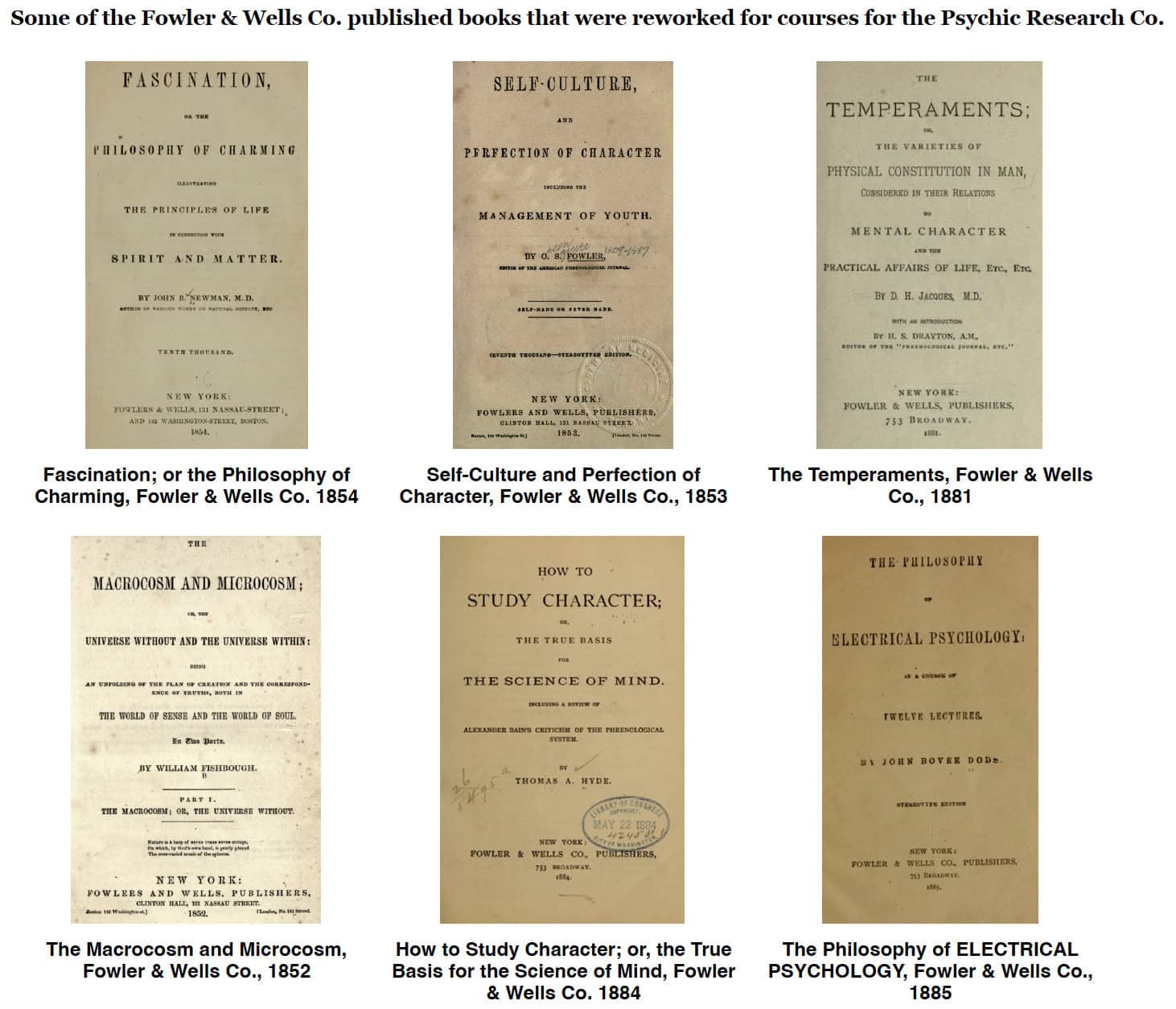
Daniels established offices in Temple Chambers, just a few blocks from L. N. Fowler & Company, which was the British branch of the American publishing business founded in 1835 as Fowler & Wells Company. They became the international distributors for the Psychic Research Company and later did the same for the Yogi Publication Society and Parkyn’s books. The Fowler back catalog included works on phrenology, physiology, fascination, memory, concentration, self-culture, and related subjects. The firm already had an established British publishing and distribution system, giving the network a way to reach readers throughout Britain and access to an enormous body of older mental-science literature.
The Psychic Research Company began issuing inexpensive books and instructional material across a wide range of subjects. Much of the older literature Fowler had published was adapted to the new language of psychology, suggestion, mental science, and New Thought. Methods previously described as fascination, mind reading, concentration, self-culture, and mental influence could now be presented alongside the newer teachings coming from Parkyn’s Chicago circle.
The Knights Templar Connection
The offices that Daniels set up in London for the Psychic Research Company were located at 146 Temple Chambers. This placed the company in one of the most historically distinctive locations in London. Temple Chambers stood within the Temple precinct, whose name and history came directly from the Knights Templar. The Templars established their English headquarters on this site in the twelfth century and built Temple Church as the religious center of their London complex. Long after the medieval order disappeared, the Temple name, buildings, and physical layout preserved the association.

The location forms an interesting parallel with the later history of the Yogi Publication Society, which used the Masonic Temple Building in Chicago for its offices after 1905. The Chicago Masonic Temple was itself a Knights Templar Mason building, erected by the Masonic Fraternity Temple Association under the leadership of Chicago Knights Templar and built as their Midwest headquarters.
This repeated Templar association also appears elsewhere around Dr. Parkyn and the publishing network connected with YPS. Parkyn’s own family included the Commander of the Knights Templar Masons for the State of Vermont, and several other members, making the order part of his family’s direct Masonic background. Another connection was through the Macoy Publishing and Masonic Supply Company, which, in 1900, bought the Theosophical publishing properties that included the Advanced Thought Publishing Company and Occult Publishing Company, bringing important parts of the same Chicago New Thought and occult publishing world into a major American Masonic publishing house. Robert Macoy was himself a famous nineteenth-century Freemason and Knights Templar figure whose books and organizational work helped shape American Masonic and Templar literature.
They were also directly connected through E. I. Rosenfeld, the general manager of the Knights Templar and Masons Life Indemnity Company, whose offices were also in Chicago’s Masonic Temple Building. Rosenfeld worked directly with the company’s president, George M. Moulton, who was then Grand Master of the Knights Templar for the United States. Rosenfeld would join with Edward E. Beals, a graduate and close collaborator of Parkyn, in establishing the Fiduciary Press, which acquired William Walker Atkinson’s publishing interests. The Fiduciary Press then issued several Atkinson books between 1907 and 1909, as well as Beals’s The Law of Financial Success, a book Atkinson later claimed that he had written.
The Daniels and “Fowler & Wells Company” Family Connection
Daniels’s London relationship with L. N. Fowler & Co. did not begin as a chance publishing arrangement. The Fowler brothers who founded the company, and the Daniels, and Smith families had long been connected through marriage, business, land, and political circles for decades. Orsena Susan Fowler, daughter of the older brother, Orson Squire Fowler, married Melville Clayton Smith, bringing the Fowler family directly into the family of Daniels and his cousin Smith.

Melville Clayton Smith and his brothers Delano Thomas Smith and Irving Daniel Smith had moved from New York to Minnesota at the same time their cousin Asahel Smith and the Daniels were building large interests in Minnesota farmland, banking, and development. Irving Daniel Smith became one of the largest landowners in the region, while Jay’s grandfather John Van Ness Daniels and Asahel Smith, the grandfather of Jay’s cousin Van Ness Daniels Smith, operated the firm of Smith and Daniels, which became one of the most important farmland investment businesses in Minnesota. They were also connected through the Union National Bank in Rochester and politically. John Van Ness Daniels served in the Minnesota Senate, while Delano and Melville Smith also held seats in the state legislature.
That family background helps explain why L. N. Fowler & Co. was such a natural partner when Daniels established the Psychic Research Company’s London operation. The Fowler publishing house had been built by Orson Squire Fowler and Lorenzo Niles Fowler and had spent decades issuing books and periodicals on phrenology, physiology, fascination, concentration, memory, mind reading, self-culture, and other subjects that later overlapped with psychology, hypnotism, suggestion, and New Thought. Lorenzo Fowler had established the London branch in the 1860s and also created the Fowler Institute at Ludgate Circus, making the firm one of the best-established English-language publishers in this field.
Daniels therefore arrived in London with both a business reason and an old family connection to the Fowler organization. L. N. Fowler & Co. already possessed the printing, bookselling, and distribution machinery Daniels needed, while Daniels brought the Psychic Research Company’s newer work in mental science, suggestion, psychology, and psychic development. The relationship gave the European branch a ready-made foundation for the next stage of the network’s publishing goals.
The Psychic Research Company reprinted James Esdaile’s Mesmerism in India, originally published by Fowler & Wells in 1851.

Neue Gedanken and the German New Thought Movement
Eventually, the operation was expanded beyond Britain into France and then Germany, where it was very well received. In Germany, the business operated as Psychologischer Verlag, or Psychological Publishing. It was in Germany that Daniels published the German-language version of New Thought magazine, called Neue Gedanken (New Thought). Daniels edited the magazine, which mostly consisted of articles from the American New Thought and from Parkyn’s Suggestion magazine, including many articles by Parkyn himself.
Its contributors included Herbert A. Parkyn, Sydney B. Flower, William Walker Atkinson, Helen Van Anderson, A. Victor Segno, Elizabeth Towne, Kate Atkinson Boehme, Fanny M. Harley, Eleanor Kirk, Paul Tyner, Ella Wheeler Wilcox, Nancy McKay Gordon, Harry Gaze, Henry Harrison Brown, Hugh O. Pentecost, Helen Wilmans, C. W. Leadbeater, and other writers circulating through the affiliated New Thought network. Parkyn’s appearance in Neue Gedanken is an important continuation of his relationship with Flowers and Daniels.
Psychologischer Verlag also issued collections of books, articles, and instructional lessons, including works associated with Flower and Atkinson. Its catalog reached beyond printed literature and included crystal balls, Ouija boards, and a device called the Somnoskop, a revolving mirror promoted as a mechanical aid to hypnotism. The magazine remained active for years after Daniels established it and helped introduce American New Thought literature to German readers.
Daniels returned to Chicago in 1910 and entered manufacturing, where his relationship with Parkyn continued in business investments.
Mexican Land Investment
The Daniels and Smith families had built much of their earlier wealth through real estate and farmland, and Jay Daniels and Van Ness Daniels Smith continued that tradition through investments in Mexico. By 1909 Smith owned property near Altamira in the Tampico region and was hosting visiting Minnesota businessmen interested in land and development opportunities there. Daniels was also involved in Mexican land investment during this period.
Parkyn was simultaneously involved in a much larger Mexican enterprise through his Motzorongo plantation interests in Veracruz. The Motzorongo organization controlled an enormous agricultural property with its own industrial and transportation infrastructure, and it also had a presence in Rochester, Minnesota, the hometown of Daniels and Smith. The properties were separate ventures, but Daniels and Parkyn were both investing heavily in Mexican land and development during the same period.
The American Placer Corporation and the Lees Ferry Expedition

In 1910 Daniels became involved with Parkyn’s American Placer Corporation and its mining operation at Lees Ferry, Arizona. Parkyn organized a major trip to the property that September with Daniels, T. J. Lovett, H. W. Huttig, William Hoskins, and Parkyn’s cousin Horatio Nelson Jackson.
Parkyn’s cousin, Horatio N. Jackson, was already one of America’s most famous motorists. In 1903, he became world famous as the first person to drive an automobile across the United States. His presence gave Parkyn’s Arizona expedition an added attraction, since the party intended to demonstrate that an automobile could penetrate the remote country leading toward Lees Ferry.
Parkyn arranged for a Thomas automobile and driver to meet the party at Flagstaff. From there, the men attempted a motor journey through country where automobiles were still almost unknown. Settlers and Navajos along the route came out to see the machine. Deep sand repeatedly slowed the car, and at the Little Colorado River the passengers had to get out and help push it across. The party continued over primitive wagon tracks until it reached a point only a few miles from the mining camp. The remaining dugway was too narrow and dangerous for the driver to attempt, so a wagon was sent from the camp to carry the men and their supplies the rest of the distance. The trip still created the record for the first crossing of that remote region by automobile.
The Dearborn Supply Company
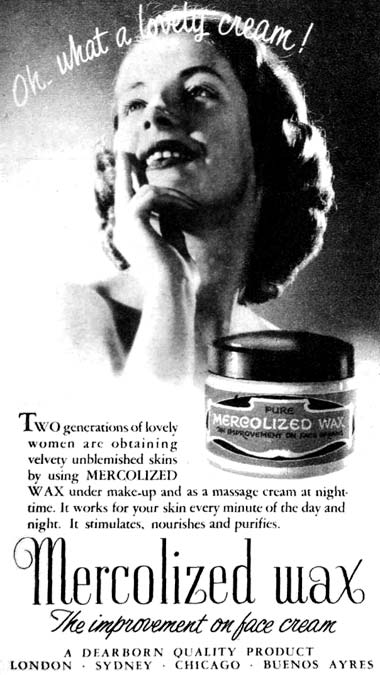
After returning to Chicago, Daniels established the Dearborn Supply Company and built a successful manufacturing and international sales business. Its best-known product was Pure Mercolized Wax, a cosmetic skin cream that became widely popular in the United States, Australia, Europe, and South America.
Daniels had spent much of his adult life learning how to sell ideas and products across great distances. His early railroad advertising promoted transportation and settlement. The Northwestern Immigrant Agent promoted land and commercial opportunities. The Psychic Research Company sold courses and books by mail. The European companies moved American mental-science literature across national and linguistic boundaries. Dearborn applied the same command of advertising and distribution to a mass-market consumer product.
His career in cosmetics also placed him alongside another commercially successful figure who had graduated from Parkyn’s Chicago School, E. Virgil Neal. Neal likewise moved from mental-science promotion into an international business aimed heavily at women and became wealthy through cosmetics and related products.
Mercolized Wax remained commercially successful for decades, although its use of ammoniated mercury later brought the product under increasing medical and government scrutiny. Mercury compounds were widely used in skin-lightening preparations during this period, but their dangers became harder to ignore as medical research and regulation advanced. Dearborn was eventually challenged over both the mercury content of Mercolized Wax and advertising claims made for the product.
Wealth and Life in Miami Beach
By the 1920s Daniels had accumulated substantial wealth from his business career. He and his wife Nora became regular winter residents of Miami Beach and spent about six seasons there before planning a large permanent winter residence at Indian Creek.
In 1928 architect A. Fraser Rose prepared plans for a sixteen-room Spanish-style estate for the couple. The house included a large living room, four master bedrooms, a loggia, terrace, patio, servants’ quarters, and yacht docks. A garage provided space for three automobiles and included separate quarters for a chauffeur. The grounds were designed with rock gardens, fountains, a roofed pergola, extensive plantings, and a surrounding garden wall. The property extended 232 feet from Indian Creek to Pine Tree Drive.
Daniels retired from active manufacturing and divided his later years between Chicago and Florida. In Miami Beach he became involved in philanthropic and civic activities and served as a member of the Committee of One Hundred.
Death of Jay Van Tuyl Daniels
By the early 1930s Daniels had been in poor health for several years. On February 7, 1934, he walked into the backyard of his Miami Beach home at 500 West Fifty-first Terrace. He removed his coat, placed it on the ground with notes folded inside, and shot himself in the head. He was taken to St. Francis Hospital and died within an hour. He was sixty-one years old.
One of the notes was addressed “To my darling wife.” Daniels wrote that his persistent illness had convinced him he would never recover sufficiently to work again and that he feared becoming an increasing burden upon both of them. “I am all in. At last, I know I can never regain my health sufficiently to be of any use and I am very tired.” He asked Nora to arrange a simple and private funeral, requested that she neither wear mourning nor observe a mourning period, and told her that he loved her deeply. “Do not grieve too deeply. Just remember that I love you better than anything in life and that I feel sure I am choosing the wisest.”
A second note was addressed to whoever found him and gave instructions to contact the police, along with his name, address, and telephone number. One Miami newspaper mistakenly called him “Jay Victor Daniels.”
Daniels left an estate valued at approximately $150,000, composed chiefly of securities. His wife, Nora Bell Daniels, was the sole beneficiary. Alternate provisions in his will named his daughter Evelyn Daniels and the Principia School in St. Louis if Nora had died before him. His body was returned to Minnesota, and he was buried at Lakewood Cemetery in Minneapolis.
Jay V. Daniels and the Parkyn Publishing Network
Daniels’s place in the history of Parkyn and the Yogi Publication Society begins well before YPS was founded. His family knew Parkyn during the Minneapolis period of the 1890s. Daniels wrote for Parkyn’s mental-science publications, joined Sydney B. Flower and his cousin, Van Ness Daniels Smith, in incorporating the Psychic Research Company in 1899, became its president, and managed its development. Within a year, he was establishing its European business in London. From there he moved into France and Germany and created a publishing operation that carried Parkyn and other members of the Chicago New Thought circle to a new international audience.
The relationship continued after Daniels left the mental-science publishing business. He and Parkyn entered the same world of large land and investment ventures, and Daniels later became directly involved in Parkyn’s American Placer Corporation. His participation in the 1910 Lees Ferry expedition places the two men together eleven years after they had formed the Psychic Research Company.
References
“Jay V. Daniels moves to London to set up a base of operations for the Psychic Research Company”. The Minneapolis Journal. 1900-09-04. p. 9. Retrieved 2025-06-01.
Tours, Historic London. “Temple of Templars: Temple Church”. Historic London Tours. Archived from the original on 2023-05-29. Retrieved 2025-06-02.
“American Phrenological Journal (IAPSOP)”. iapsop.com. Retrieved 2025-06-02.
“History of Phrenology on the Web”. www.historyofphrenology.org.uk. Retrieved 2025-06-02.
“The Fowler Brothers · Talking Heads · OnView”. collections.countway.harvard.edu. Retrieved 2025-06-02.
Self-culture, and Perfection of Character: including the management of youth, By O. S. Fowler, 1853, Fowler and Wells publishing.
A complete “Series B” Course in Personal Magnetism. Psychic Research Co. 1900
“Obituary for Delano T Smith”. Evening Times-Republican. 1905-05-10. p. 7. Retrieved 2025-06-02.
“Minnesota land and collection agency”. Saint Paul Weekly Minnesotian. 1856-09-27. p. 4. Retrieved 2025-06-02.
“Obituary for Melville C. Smith”. The Superior Times. 1898-01-15. p. 3. Retrieved 2025-06-02.
“Melville Smith was a state senator for Minnesota”. New-York Tribune. 1898-01-13. p. 7. Retrieved 2025-06-02.
“Obituary for Melville C. Smith”. The Sun. 1898-01-13. p. 3. Retrieved 2025-06-02.
“Asahel Smith started the First Union Bank with Daniels”. Post-Bulletin. 1948-07-09. p. 7. Retrieved 2025-06-02.
“Asahel Smith was a long time partner with his brother in law John Van Ness Daniels”. Post-Bulletin. 1904-03-14. p. 6.
Lee’s Ferry: From Mormon Crossing to National Park 9780874219104, 9780874212600″. dokumen.pub. Retrieved 2025-08-18
“Psychic Research Company is incorporated”. The Inter Ocean. 1899-09-20. p. 10. Retrieved 2025-05-24.
“Psychic Research Company is incorporated for the minimum legal amount of $2,500”. Chicago Tribune. 1899-09-20. p. 14. Retrieved 2025-05-31.
“Van Ness Daniels Smith’s grandmother was the sister of John Van Ness Daniels, the grandfather of Jay”. The Post and Record. 1870-01-15. p. 3. Retrieved 2025-05-31.
“Jay V Daniels father passes away”. Minneapolis Daily Times. 1898-01-26. p. 5. Retrieved 2025-05-26.
“Jay V. Daniels mother was a student of mental sciences and philosophy”. Post-Bulletin. 1916-08-08. p. 5. Retrieved 2025-05-24.
“Herbert A Parkyn and the victorious Minnesota Golden Gophers”. The Minneapolis Journal. 1895-11-16. p. 1. Retrieved 2025-03-26.
“U.S. National Bank Lookup (1863-1935)”. banklookup.spmc.org. Retrieved 2025-05-26.
“U.S. National Bank Lookup (1863-1935)”. banklookup.spmc.org. Retrieved 2025-05-26.
“Asahel Smith started the First Union Bank with Daniels”. Post-Bulletin. 1948-07-09. p. 7. Retrieved 2025-06-02.
“Asahel Smith was a long time partner with his brother in law John Van Ness Daniels”. Post-Bulletin. 1904-03-14. p. 6. Retrieved 2025-06-02.
“Jay V. Daniels becomes advertising agent for the Great Northern railroad”. The Post-Intelligencer. 1895-05-30. p. 5. Retrieved 2025-05-24.
“Jay V. Daniels editor and publisher of journal “Northwest Emigrant Agent””. The Minneapolis Journal. 1897-03-05. p. 6. Retrieved 2025-05-24.
“Jay V. Daniels member of the house committee for the press club”. The Minneapolis Journal. 1897-03-08. p. 6. Retrieved 2025-05-24.
“Jay V. Daniels a former Minneapolis newspaper man”. The Minneapolis Journal. 1901-06-20. p. 7. Retrieved 2025-05-24.
“Neue Gedanken (IAPSOP)”. iapsop.com
Jay V. Daniels writes for the Evening Journal and member of the Press Club”. Minneapolis Daily Times. 1893-06-05. p. 4. Retrieved 2026-09-10.
“His sister dies, was a famous singer”. Star Tribune. 1894-09-11. p. 5. Retrieved 2026-09-10.
“Jay Van Tuyl Daniels dies Feb 7th 1934. His estate valued at $150K”. The Miami News. 1934-02-15. p. 2. Retrieved 2026-09-10.
“Builds mansion”. The Miami Herald. 1928-07-20. p. 13. Retrieved 2026-09-10.
“Van Ness D Smith in Mexico”. Olmsted County Democrat. 1909-01-29. p. 1.