The Three Principles of the Divine Essence, originally published in 1619 by the German Christian mystic Jacob Boehme, presents one of the foundational works of Western esoteric philosophy that attempts to explain the origin and structure of existence. The 1909 Yogi Publication Society edition tries to summarizes the enormous scope of the work on its title page by saying; it concerns the “Eternal Dark, Light, and Temporary World,” while explaining the soul, the image and spirit of the soul, angels, Heaven, Paradise, Adam before and after the Fall, the wrath of God, sin, death, devils, Hell, and the ultimate destiny of creation. Rather than treating these subjects as disconnected theological doctrines, the book attempts to derive all of them from one underlying cosmological system. Behmen argues that the visible universe, human consciousness, spiritual good and evil, Heaven and Hell, and the drama of salvation can all be understood through three fundamental principles or modes of divine manifestation.
Jakob Böhme
The first principle is the eternal dark and fiery ground of nature, associated with contraction, severity, anguish, wrath, and the potentiality of fire. The second principle is the eternal world of divine Light, where the severity of the first principle is transformed into love, joy, harmony, wisdom, and heavenly life. The third principle is the temporary or created world of nature—the universe of stars, elements, bodies, birth, growth, corruption, and death in which the powers originating in the eternal principles become externally manifested. These are not simply three separate worlds existing beside one another. They penetrate one another, and their interaction explains both the universe and the human condition. The human being therefore becomes a miniature representation of the entire cosmic order: the dark ground, divine Light, and temporal nature are all reflected within human existence. Behmen repeatedly insists that the mysteries he describes are therefore not remote abstractions. When he speaks about Heaven and the generation of the elements, he says he is simultaneously speaking about processes occurring within the human body and soul, because humanity contains the same spiritual ground from which the larger creation proceeds.
This idea is essential for understanding the book. The Three Principles of the Divine Essence is not merely a speculative account of how the universe began. It is a spiritual map explaining what human beings are, why they experience conflicting desires, how evil becomes possible, what occurred in the Fall, why Christ is necessary, and how the soul can be regenerated. The creation of the world and the regeneration of an individual soul are ultimately expressions of the same underlying spiritual process. The book therefore moves continually between cosmology and inner experience, using the structure of the universe to explain humanity and the structure of humanity to explain the universe.
What Are the Three Principles of the Divine Essence?
The three principles form the organizing framework of the entire work. Behmen’s argument begins from the conviction that the visible world cannot explain itself. Beneath material existence lies an eternal spiritual ground, and within that ground are different modes or qualities through which divine life becomes manifest. The first principle is the dark or fiery ground; the second is the divine Light; and the third is the temporal created world. Understanding their relationship is the key to Behmen’s explanations of God, nature, angels, devils, humanity, salvation, Heaven, and Hell.
In simplified terms, the three principles may be summarized as:
The first principle: the eternal dark, fiery, severe, contracting ground of nature, associated with wrath, anguish, and the possibility of Hell when separated from divine Light.
The second principle: the eternal Light of God, associated with love, wisdom, mercy, joy, Paradise, and the heavenly divine life.
The third principle: the temporary created world of stars, elements, material bodies, generation, corruption, and physical nature.
Behmen does not mean that darkness is an independent evil power opposing God. The first principle belongs to the eternal ground from which manifestation becomes possible. Its harshness, attraction, resistance, movement, and fire provide the dynamic conditions through which life can become perceptible. The problem arises when a created will turns toward this fiery selfhood while separating itself from the divine Light. The book explicitly identifies the first principle as the ground through which the anger of God, darkness, eternal death, Hell-fire, and the condition of the Devil can be understood, while immediately proceeding from this discussion into the second principle, which it describes as the clear and pure Deity and the Heart of God.
.
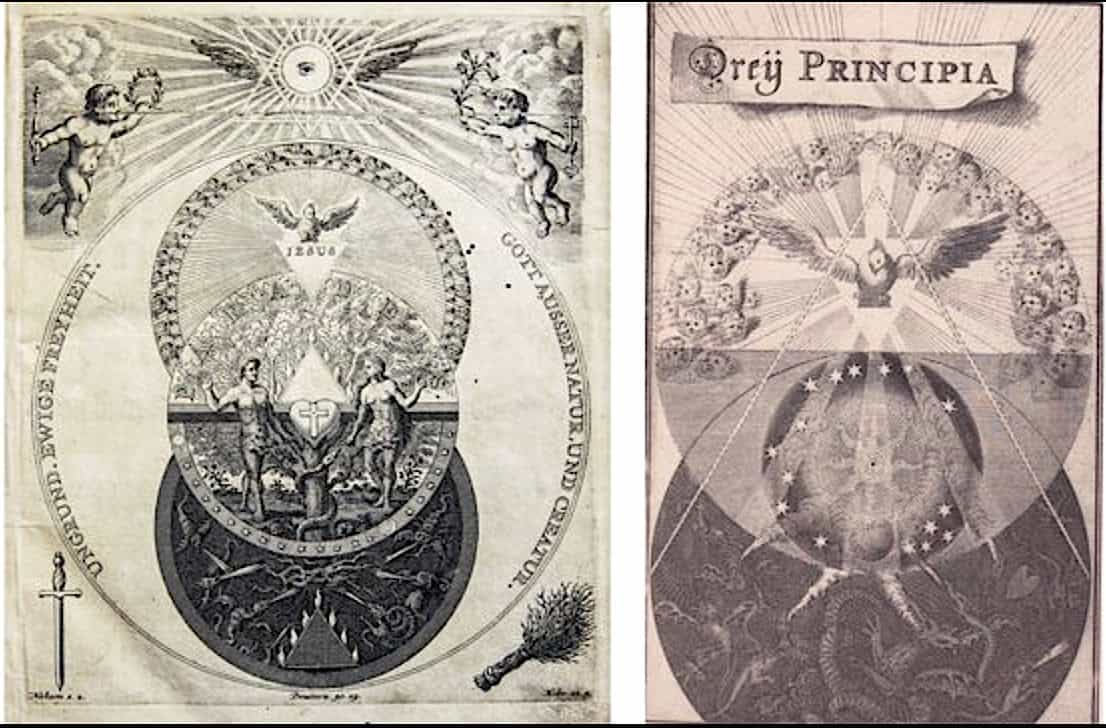
Diagrams of the principles, by Boehme
The First Principle: The Eternal Dark and Fiery Ground
Why Does Behmen Begin With Darkness?
Behmen begins with darkness because manifestation requires distinction, desire, movement, and resistance. Pure undifferentiated unity would contain everything potentially but would reveal nothing distinctly. The first principle describes the eternal ground in which qualities become distinguishable. Behmen repeatedly uses terms such as harshness, bitterness, attraction, anguish, fierceness, fire, and wrath to describe this process. These words can sound as though he is describing moral evil, but at this stage he is describing something more fundamental: the severe ground of nature from which active manifestation becomes possible.
The first principle contains an attracting or contracting tendency. This contraction produces resistance, and resistance generates movement, tension, anguish, and eventually fiery manifestation. Behmen describes these qualities as mutually generating rather than as isolated substances. Harshness produces bitterness or movement; the struggle among the qualities intensifies; and the resulting fiery breakthrough becomes the critical boundary at which darkness can either remain in torment or become illuminated. Fire therefore occupies an extraordinary place in the system. It belongs to the severe ground, yet it also creates the possibility for the revelation of Light.
This distinction explains why Behmen can speak about divine wrath without imagining God as an arbitrary ruler who simply becomes angry. Wrath is a condition or property of the first principle when experienced apart from the Light. The same eternal ground that becomes joy when harmonized with divine love becomes anguish when turned inward upon itself. Hell consequently develops from the same fundamental spiritual structure that makes heavenly manifestation possible. The difference lies in what governs the will.
What Is the Wrath of God?
The “wrath of God” in The Three Principles of the Divine Essence is closely connected with the severe qualities of eternal nature. It is not merely an emotional reaction comparable to human anger. Behmen treats wrath as the dark, fiery potential of the divine ground—the condition in which severity, contraction, bitterness, and fire operate without the transforming illumination of divine love. The first principle is therefore terrifying when isolated from the second, but it is also necessary within the complete divine order.
This allows Behmen to explain how apparently opposite realities can arise without positing two independent gods. Light and darkness, love and wrath, Heaven and Hell do not originate from rival eternal creators. They represent radically different manifestations and experiences of the same underlying eternal ground. Where the divine Light rules, fierceness is transformed into power, harmony, and joy. Where self-will separates itself from that Light, the fiery ground becomes torment.
The Second Principle: Divine Light, Love, and Paradise
How Does Light Emerge From the Dark Ground?
The second principle is the world of divine Light, and Behmen treats its manifestation as the decisive transformation of the first principle. The struggle and fire of eternal nature do not constitute the highest divine reality. Through the fiery breakthrough appears Light, and in the Light the severe qualities acquire an entirely different character. What was anguish becomes joy; what was fierceness becomes strength; what was opposition becomes harmonious distinction. The second principle is consequently the revelation of the divine Heart, the realm of love, wisdom, mercy, and heavenly life.
Behmen explicitly distinguishes the first principle from what he calls the “clear pure Deity” and “Heart of God” of the second principle. This distinction is central to his theology. The second principle reveals what the divine nature becomes when its eternal powers exist in harmonious illumination. Darkness has not defeated Light, nor has Light simply annihilated darkness. Instead, the underlying severity has been transformed within a higher harmony.
The second principle is therefore the true heavenly world. Paradise belongs to it. Divine Wisdom manifests through it. The Holy Spirit operates within it, and the enlightened human soul can perceive into it. Behmen states that the soul illuminated by the Holy Spirit sees into the Light of God and the heavenly essence of the second principle, whereas the astral and elementary aspects of human existence perceive only the realms from which they originate. Spiritual perception thus depends upon what has become active within the perceiver.
Divine Wisdom and the Eternal Image
An especially important concept in the book is eternal Wisdom, frequently represented as a Virgin or heavenly feminine principle. Wisdom is the eternal mirror or manifestation in which the divine wonders become perceptible. Through Wisdom the possibilities contained within the divine ground appear as images, distinctions, forms, and wonders. This does not mean that Wisdom is a separate deity. It functions as the eternal manifestation or reflection through which what lies within the divine ground becomes revealed.
This idea becomes particularly important when Behmen explains angels and humanity. The divine will longs to manifest its image and wonders, and creation becomes the means through which that hidden wisdom appears in differentiated form. The purpose of creation is therefore fundamentally revelatory: divine possibilities become visible through creatures without exhausting the infinite source from which they arise.
The Third Principle: The Temporary Created World
What Is the Temporary World?
The third principle is the visible universe in which human beings presently live. It includes the stars, planets, four elements, plants, animals, physical bodies, generation, time, decay, and death. Behmen calls it temporary because unlike the eternal principles, its present material form has a beginning and an end. Yet the temporal world is not meaningless or completely separated from God. It is an outward manifestation in which eternal spiritual powers have become material and visible.
The Oroboros, by Jakob Böhme
Nature therefore functions as a kind of book through which divine Wisdom may be studied. Behmen gives the striking example of a flowering meadow: many different herbs and plants grow beside one another, each possessing its own form and virtue, yet their differences contribute to the beauty of the whole. He says that someone seeking divine Wisdom can learn from such a meadow because visible nature presents a material similitude of the inexhaustible variety contained within divine Wisdom. The created world is therefore both fallen and revelatory. Its present condition is mixed and corruptible, yet traces of the eternal order remain visible throughout it.
The sun and stars also occupy an important position in this third principle. Behmen regards them as instruments through which powers operate within temporal nature, but he does not identify the visible celestial bodies with God. They are manifestations within the created order, reflections through which divine Wisdom can be perceived rather than the divine essence itself.
The Three Principles Exist Within the Human Being
One of the most important ideas in the book is that the three principles are not merely cosmic regions. Human beings participate in them. The soul has its root in the eternal spiritual ground, while the body belongs to the created elemental world. Humanity therefore stands at an intersection between eternity and time.
Behmen says that the soul originates from God’s first principle and is breathed into humanity within the third, or sidereal and elementary, principle. Because of its origin, the soul is capable of perceiving into the eternal ground from which it came. When illuminated by the Holy Spirit, it can also perceive the second principle, the divine Light. The human being thus contains the possibility of darkness, temporal nature, and divine illumination.
This provides Behmen with an explanation for the extraordinary range of human experience. A person can become animal-like through domination by bodily appetite, devilish through pride and self-will, or heavenly through regeneration in divine Light. Human freedom matters precisely because the human will stands among these possibilities.
What Are the Soul, Spirit, and Image of God?
The distinction between soul, spirit, body, and divine image is essential to Behmen’s anthropology. The soul is not simply another name for personality or intellect. Its deepest root belongs to the eternal spiritual ground. For this reason the soul possesses an enduring significance that the temporary physical body does not. Behmen explicitly groups the souls of human beings with angels and devils as beings arising from the eternal spiritual ground and says that the soul continues eternally because the eternal source from which it originates does not end.
The human being nevertheless also possesses a sidereal and elemental nature belonging to the third principle. The physical organism, passions, sensory consciousness, and influences of temporal nature operate through this lower constitution. The tragedy of the Fall is therefore not that humanity suddenly acquires a completely new evil substance. Rather, the proper relationship among the principles is overturned. Temporal and animal nature gains dominion over a being intended to live from the divine image.
The divine image represents humanity as originally intended: a creature in whom God could manifest divine Wisdom and wonders. Behmen describes the original human body or image as standing before the clear Deity within the holy pure element, with Paradise as its habitation. Humanity was created as an image and similitude in which God could dwell and reveal divine wonders.
Angels, Divine Wisdom, and the Origin of Spiritual Creatures
Where Do Angels Come From?
Behmen explains the angels through the same metaphysical system. Eternal Wisdom contains the divine images or possibilities, and the divine will brings these images into creaturely manifestation. The “Fiat,” Behmen’s term for the creative divine command or formative will, creates angelic beings according to these eternal images. The multiplicity of angelic beings therefore reflects the inexhaustible multiplicity contained within divine Wisdom.
The book describes innumerable distinctions, thrones, principalities, and spiritual powers proceeding according to the different essences manifested within divine Wisdom. Yet all arise from one divine ground. Multiplicity does not contradict divine unity; it reveals the richness contained within it.
Angels become true heavenly beings by directing their imagination and will toward the Heart of God. Their existence illustrates a recurring principle of the book: a creature becomes spiritually characterized by what its will embraces. Creation gives the creature capacities, but the orientation of the creature’s will determines how those capacities become manifested.
Why Did Lucifer Fall?
Lucifer provides the great example of what happens when a powerful created will turns toward the first principle rather than remaining in the humility and harmony of divine Light. According to Behmen, Lucifer was originally created in Light. His fall was not predetermined by God. He possessed the ability to orient his will toward Light or darkness.
Lucifer desired the fiery might and power of the divine ground for himself. Instead of allowing power to exist within divine harmony, he sought elevation, selfhood, domination, and independence. The book describes him as attempting to rise above divine meekness through the might of fire. Those spirits who followed his orientation likewise became devils. Behmen therefore places responsibility directly upon Lucifer: the Devil is “the Fault, and guilty of his own Fall” because he allowed his will to be moved by the sternness or fierceness when he could have chosen Light.
This is Behmen’s fundamental explanation of evil. Evil is not a substance created by God. It is the disorder produced when a creature takes a genuine divine power and turns it toward isolated selfhood. Fire, strength, desire, and individuality are not evil in themselves. They become hellish when separated from love and divine harmony.
What Is Hell?
Hell follows directly from this understanding of Lucifer. It is the first principle experienced without the second. The dark, contracting, fiery qualities continue to operate, but without the Light that would transform their conflict into joy and harmony. The result is perpetual anguish.
Behmen therefore treats Heaven and Hell less as distant geographical locations than as spiritual states grounded in the eternal principles. The first principle becomes the “Gate of Hell” for the soul whose Light is extinguished and which remains separated from the second principle. The damned soul experiences its own fiery ground without the reconciling Light of divine love.
This makes self-will central to damnation. Lucifer’s torment grows from the very principle he chose to magnify. Hell is selfhood trapped within itself.
The Creation of the Visible Universe
Jakob Böhme illustration
The creation of the temporal world represents the manifestation of eternal powers within a finite and material order. Behmen interprets the biblical creation narrative through his three-principle cosmology rather than reading Genesis only as a straightforward sequence of physical events. Earth, water, air, fire, celestial bodies, vegetation, animals, and humanity express different combinations and manifestations of deeper spiritual qualities.
The four elements themselves emerge from a more fundamental spiritual ground. Visible fire is not identical with eternal spiritual fire, nor is physical light identical with the second principle. Material realities are outward expressions of deeper powers. The third principle therefore acts as a visible theater in which invisible spiritual principles acquire temporary form.
The created world also occupies an intermediate condition between Paradise and the dark kingdom. Behmen describes the created heaven as moving between Paradise and Hell and says that the same birth exists within human body and soul. Once again, cosmology becomes anthropology: what happens in the universe is reflected within humanity.
Adam Before the Fall
What Was Humanity Originally Intended to Be?
Adam originally occupies a radically different condition from ordinary fallen humanity. Behmen portrays the first human as a true image of God, created to stand within the divine order while also possessing a relationship with the temporal world. Humanity was intended to become a living manifestation of divine Wisdom, capable of revealing God’s wonders within creation without becoming enslaved to material nature.
Adam’s original body should therefore not be imagined as identical to the gross physical body of fallen humanity. Behmen distinguishes the original heavenly corporeity from the corruptible elemental body. Before the Fall, humanity stood within what he calls the pure element, a heavenly corporeity associated with Paradise. The body was real, but it was not yet dominated by the four gross elements, the stars, hunger, decay, sexuality, and mortality in their present forms. This explains the enormous importance Behmen gives to the divine image. Humanity’s original destiny was mediatory. Adam united dimensions of existence that had become divided through Lucifer’s rebellion and was intended to manifest divine harmony within creation.
The Division of Adam and the Creation of Eve
Behmen’s interpretation of Adam and Eve forms part of his larger explanation of the Fall. Adam’s increasing inclination toward the temporal world reveals a weakening of the original paradisiacal condition. The emergence of the divided male and female condition is connected with humanity’s movement toward the animal and temporal mode of generation.
This does not mean that Behmen regards ordinary human love simply as evil. His concern is cosmological: the present biological system of sexual generation belongs to the third principle and to humanity’s earthly condition. The original divine image represented a more unified form of human existence. The separation into the present sexual mode reflects humanity’s increasing orientation toward external nature.
The story of Eve and the serpent therefore occurs after a deeper internal movement has already begun. The Fall is not reducible to eating a piece of fruit. The eating outwardly completes a spiritual orientation that has been developing inwardly.
What Really Happens in the Fall of Adam and Eve?
The Tree of Knowledge represents the mixed condition of the temporal world. By desiring and consuming its fruit, humanity turns its imagination toward the external kingdom and allows that kingdom to enter into and dominate human nature. Adam and Eve become aware of their nakedness because their mode of embodiment has changed. The body that had existed under the paradisiacal principle becomes subject to the elemental and animal conditions of temporal existence.
Behmen describes Adam and Eve after eating the fruit as becoming conscious of their altered bodily condition, including the stomach, intestines, sexual shame, and the fierceness of the stars and elements. They attempt to look toward Paradise but can no longer perceive it. This is an exceptionally important part of his interpretation: expulsion from Paradise is simultaneously a change of consciousness, embodiment, and spiritual orientation.
The serpent tempts Eve by mixing truth with falsehood. The promise that humanity will become “as God” contains a distorted truth, but it redirects divine aspiration toward worldly power and the first principle rather than toward the divine Light. Behmen identifies the Devil as the highest external cause of the Fall while still holding humanity responsible for consenting to the temptation.
The Fall therefore repeats Lucifer’s error on the human level. Both involve imagination turning away from divine harmony toward selfhood, power, and a lower principle of existence.
Why Does Humanity Lose Paradise?
Paradise does not simply disappear geographically. Humanity loses the capacity to live consciously within it. The human spirit moves from the heavenly condition into the spirit of the temporal world, and the body becomes earthly. Behmen says that after the Fall humanity no longer possesses the pure element as its ordinary bodily condition but instead lives through the four elements under the dominion of the stars.
This is why fallen humanity cannot simply walk back into Eden. The barrier is ontological rather than merely geographical. Human nature itself has changed.
The cherubim and flaming sword guarding Paradise symbolize this boundary. Behmen interprets the sword as the fierce gate through which fallen nature must pass before the soul can return to the second principle. Death cuts the earthly elemental body away from the spiritual image. Christ, however, has transformed this passage, so that the soul oriented toward divine life can pass through the gate with his assistance.
Sin as the Wrong Direction of the Will
Sin in The Three Principles of the Divine Essence is fundamentally a disorder of desire and imagination. Behmen repeatedly emphasizes what the will chooses to enter, love, imagine, and identify with. The creature becomes spiritually shaped by the object of its deepest desire.
This is why pride occupies such a central place in both Lucifer’s fall and humanity’s corruption. Pride concentrates the will upon itself. Instead of participating in divine life, the self seeks to become its own center. Greed, domination, envy, hatred, sensual excess, and spiritual arrogance develop from the same fundamental movement.
Salvation must consequently involve more than intellectual belief. If the Fall occurred through a change in the orientation of the will, restoration requires another transformation of that will.
Why Is Christ Necessary?
Jakob Böhme heart
After the Fall, humanity cannot restore the original divine image by its own earthly powers. The soul retains its eternal root, but it has become turned away from the Heart of God and captivated by darkness and temporal nature. Behmen therefore argues that humanity requires a new birth through the divine Light.
The book states the problem directly: once humanity had fallen from the holy into the unholy and from the image of God into earthly corruptibility, the soul could not restore the lost condition through its own power. Divine mercy had to accomplish what humanity could no longer accomplish for itself.
Christ represents the entrance of divine life into fallen human nature. Through Christ, the second principle penetrates the condition humanity inherited from Adam and opens a path through the fiery center back into divine life. Salvation is therefore not merely a legal declaration that human guilt has been canceled. It is regeneration—the actual formation of a new spiritual humanity.
What Does It Mean to Be Born Again?
Regeneration is one of the culminating subjects of the book. The fallen earthly person remains in the third principle, but another life can begin within the soul. Behmen describes this as the birth of the new man in Christ.
The divine virtue plants itself within the soul like a seed. As the individual sincerely desires God, repents, turns away from self-will, and directs the imagination toward divine life, that seed grows. The old Adam remains associated with temporal existence, while the new person increasingly lives within the divine life of Christ. Behmen describes this process as the soul entering into the life of Christ and the holy pure element.
Regeneration therefore begins during earthly life. Heaven is not merely something awarded after death. The heavenly principle must begin awakening within the person now.
Why Are Repentance and Desire So Important?
Behmen gives extraordinary importance to sincere desire because the will is the spiritual center of human transformation. He says that one of the most profitable beginnings of regeneration is earnest repentance accompanied by genuine purpose and resolution. The person must press toward the Kingdom of Heaven, where the regenerating divine life is already available within the depth of the mind. He compares its beginning to a mustard seed planted within the soul.
This cannot be reduced to outward religious conformity. Behmen is sharply critical of religion that remains historical, intellectual, institutional, or argumentative without producing inner transformation. No external authority can substitute for regeneration. He insists that the individual must enter inwardly and become new-born.
The true evidence of spiritual knowledge is consequently experiential transformation. Behmen even says that the new birth cannot be completely described because the person who enters it discovers within himself another mode of knowledge and another spiritual life.
Heaven and Paradise
Heaven in Behmen’s system is the manifestation of the second principle. It is the world in which divine Light transforms the powers of eternal nature into joy, harmony, beauty, and love. Paradise is closely connected with this heavenly condition and with the pure element in which the divine image properly lives.
Heaven is therefore both cosmic and inward. The enlightened soul can begin to perceive it because the same eternal principles underlying Heaven are present within human spiritual nature. This is why Behmen can say that when he speaks of Heaven he is speaking of humanity’s “native Country,” even though its reality remains hidden from ordinary bodily perception. Heaven and Hell consequently represent opposite realizations of the same fundamental spiritual capacity. One opens into divine Light; the other contracts into fiery selfhood.
Death and the Separation of the Principles
Physical death belongs to the temporary world. The earthly body is composed through the third principle and therefore cannot remain forever in its present form. At death, the relationship among the principles changes. The temporary body falls away, while the eternal root of the soul remains.
Death does not automatically regenerate the soul. Behmen’s emphasis on transformation during earthly life follows from this conviction. While living in time, the person is still in a condition of spiritual growth. The direction of the will is being formed. He compares earthly life to a growing plant and death to the moment when the plant is cut and becomes fruit: the process of growth has reached a decisive boundary.
The question therefore becomes what has grown within the soul. If the divine image has been regenerated, death releases the soul from the corruptible elemental body and opens its fuller participation in the heavenly principle. If the soul has hardened itself into self-will and darkness, removing the body does not magically create divine Light within it.
Why Heaven and Hell Begin Before Death
One of the most powerful implications of Behmen’s system is that Heaven and Hell begin within the orientation of consciousness before physical death. A soul living from pride, hatred, envy, domination, and self-centered desire is already awakening the qualities that constitute the dark principle. A soul turning toward humility, love, mercy, and divine Wisdom is awakening the second principle.
The afterlife therefore reveals rather than arbitrarily creates the spiritual condition cultivated during life. The temporary world partially conceals these realities because body, sensory experience, and external nature continually occupy human consciousness. Death removes that covering.
This also explains Behmen’s urgency. Spiritual regeneration cannot safely be postponed as though salvation were merely a future transaction. The human being is already participating in eternity while living within time.
The Spiritual Meaning of the Natural World
Despite its repeated descriptions of corruption, wrath, and temporal existence, The Three Principles of the Divine Essence is not fundamentally hostile toward nature. Nature is filled with symbols of the divine process. Fire, light, water, vegetation, stars, birth, growth, death, and regeneration all become visible analogies of invisible spiritual realities.
The flowering meadow provides one of the clearest examples. Its innumerable forms reveal diversity without destroying unity. Different plants possess different appearances and virtues, yet together they manifest the abundance of one living nature. Behmen sees this as a material reflection of Paradise and divine Wisdom. The person seeking spiritual understanding can therefore read nature symbolically. The visible world is not God, but it bears signatures of the spiritual powers from which it emerged.
The Microcosm and the Macrocosm
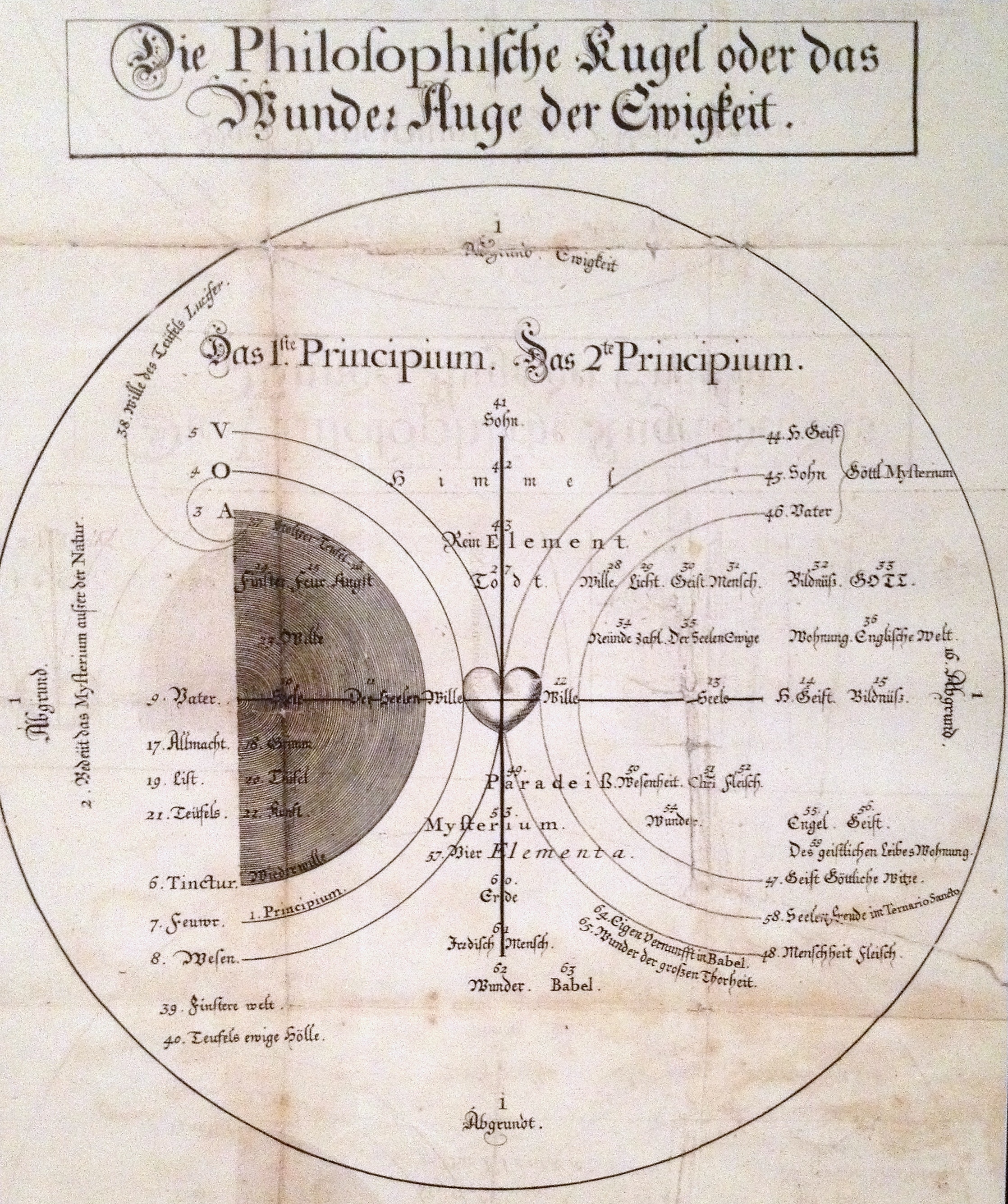
The Philosophical Sphere or the Wonder Eye of Eternity (1620). The cosmogony of Böhme’s.
Behmen’s statement that the creation of Heaven and the elements is also occurring within human body and soul provides perhaps the best single key to the entire book. Humanity is a microcosm—a small world containing correspondences with the greater world.
The fiery struggle of the first principle appears psychologically as desire, conflict, anger, anxiety, selfhood, and will. The second principle appears as illumination, love, harmony, wisdom, mercy, and spiritual joy. The third appears as bodily existence, sensory consciousness, biological life, and participation in material nature. Human spiritual development therefore reenacts the structure of the cosmos.
This is why Behmen can move so quickly from discussions of stars and elements to discussions of sin and salvation. To a modern reader these can appear to be unrelated subjects, but within his system they are different scales of the same process.
How Should The Three Principles of the Divine Essence Be Understood?
The book becomes considerably easier to understand once its many symbols are reduced to their underlying pattern. Behmen continually describes a movement from hidden potential into desire, from desire into opposition and anguish, from anguish into fire, and from fire either into illumination or deeper darkness. The same structure appears in cosmology, angelology, the fall of Lucifer, the creation of nature, Adam’s Fall, individual temptation, and spiritual regeneration.
The essential relationships can be summarized as follows:
God is the ultimate ground from which all existence proceeds.
Eternal nature provides the dynamic ground through which manifestation becomes possible.
The first principle is the dark and fiery ground of severity, desire, resistance, and power.
The second principle is divine Light, in which those powers become love, harmony, joy, Wisdom, and Paradise.
The third principle is the temporary created world in which spiritual powers become externally manifested.
Angels remain in divine harmony by directing their will toward the Light.
Lucifer falls by turning toward fiery selfhood, pride, and domination.
Humanity is created as the divine image and as a microcosm capable of participating in multiple principles.
Adam’s Fall occurs when human desire turns toward temporal and animal nature rather than remaining governed by Paradise.
Christ reopens the divine life within fallen humanity.
Regeneration is the birth of a new spiritual humanity within the soul.
Heaven and Hell correspond to the soul’s participation in divine Light or isolated fiery selfhood.
Physical death removes the temporary elemental condition but does not erase the spiritual orientation formed within the soul.
The Central Message of the Book
At its deepest level, The Three Principles of the Divine Essence is a book about the direction of the will. Its vast cosmology ultimately leads back to a practical spiritual question: toward what principle does the human being direct desire, imagination, and consciousness?
Lucifer possesses extraordinary power but turns it toward himself, transforming glory into Hell. Adam possesses the divine image but directs his imagination toward temporal nature and becomes subject to corruption. Fallen humanity continues the same struggle whenever self-will, pride, domination, sensuality, and worldly desire become the ruling center of consciousness. Christ reverses this movement by bringing divine Light into fallen human nature and making regeneration possible.
The three principles therefore describe more than the architecture of Behmen’s universe. They describe three dimensions of human existence. The dark fiery ground represents the tremendous power of desire and selfhood; the divine Light represents the transformation of that power through love; and the temporal world provides the field in which human beings encounter, experience, and choose among these possibilities.
The purpose of spiritual life is not to destroy the will but to transform its orientation. Fire becomes heavenly when illuminated. Strength becomes divine when joined with love. Individuality ceases to be imprisonment when it becomes a vessel of divine Wisdom. Regeneration restores the relationship that the Fall disrupted, allowing the divine image to arise again within humanity.
Why The Three Principles of the Divine Essence Matters
The Three Principles of the Divine Essence offers a remarkably unified explanation of subjects that conventional theology often treats separately. Creation, nature, angels, Lucifer, Adam, sin, the human soul, Christ, regeneration, Heaven, Hell, and death all arise from one metaphysical framework. The same principles explain the birth of worlds and the transformation of individual consciousness. That unity is one reason the book can initially seem so difficult: Behmen is not moving randomly among theology, psychology, cosmology, biblical interpretation, and mystical experience. He believes all of them describe different manifestations of the same underlying reality.
The work’s most distinctive claim is therefore that the great spiritual drama described in scripture is simultaneously taking place within the human being. Heaven is not merely above us, Hell is not merely beneath us, Paradise is not merely behind us, and regeneration is not merely promised for the future. The roots of all three principles are encountered within human existence itself. Behmen explicitly says that the eternal birth lies hidden in the center of humanity and that what he describes concerning Heaven and creation is nearer to us than we ordinarily realize.
The enormous cosmology of The Three Principles of the Divine Essence resolves into a comparatively simple spiritual teaching. Existence contains a dark fiery ground of tremendous creative power; divine Light can transform that power into love and harmony; and human beings presently live within a temporal world where both possibilities become manifest. Lucifer represents power turned toward itself. Adam represents the divine image becoming captivated by external nature. Christ represents the return of divine Light into fallen humanity. Regeneration represents that Light becoming active within the individual soul.
The ultimate question of the book is therefore not simply how the universe was created, but what is being created within the human being. The first, second, and third principles are cosmic realities, but they are also the framework through which Behmen explains every human choice between selfhood and love, darkness and illumination, corruption and regeneration. The restoration of humanity begins when the soul ceases to seek Paradise merely as a lost place or future reward and allows the divine life to be born again within itself.
Jacob Böhme, The Teutonic Theosopher. Biography
Jakob Böhme (Jacob Behmen) (1575–1624) was a German self-educated shoemaker by trade, who claimed that a series of profound mystical visions revealed to him the hidden spiritual structure of the universe and inspired the writings for which he later became famous. While his first major work, Aurora, generated considerable controversy within the Lutheran Church, his later writings established him as one of the founders of Christian theosophy and profoundly influenced generations of philosophers, mystics, and occultists.
Jakob Böhme
Although writing from within a Christian framework, Böhme combined biblical theology with Neoplatonic, alchemical, and mystical concepts to develop an original cosmology centered on the relationship between God, humanity, and creation. His works, including The Three Principles of the Divine Essence, The Signature of All Things, and Mysterium Magnum, explored themes of divine emanation, spiritual regeneration, free will, and the struggle between light and darkness. His teachings became foundational to later Rosicrucian, Christian Theosophical, and mystical traditions.
Böhme’s influence extended far beyond his own lifetime. His writings helped shape German Romanticism and Idealism, inspiring philosophers such as Hegel and Schelling as well as writers including William Blake, Novalis, and W. B. Yeats. His ideas also found a receptive audience within the Theosophical movement, where Helena Blavatsky regarded his works as important expressions of Western esoteric thought.
In Richard Bucke‘s influential 1901 work Cosmic Consciousness, Böhme was presented as one of history’s great examples of mystical illumination. Bucke argued that Böhme’s spiritual experiences revealed a state of consciousness in which the apparent separation between humanity and God disappeared, describing his visions as evidence of an ultimate nonduality between the human soul and the Divine.
During the twentieth century, Böhme’s cosmology attracted renewed attention through the teachings of both Boris Mouravieff and George Gurdjieff. Several scholars have noted striking similarities between Böhme’s doctrine of the Three Principles and Seven Qualities and the Law of Three and Law of Seven later presented by Gurdjieff. Böhme’s writings continue to be regarded as one of the foundational sources for the study of Christian mysticism, alchemy, Hermetic philosophy, and Western esotericism.