
The Philosophy of Alchemy
About This Publication
Albert Sidney Raleigh’s Philosophy of Alchemy was published in Chicago in 1924 by the Hermetic Publishing Company and was distributed by the Yogi Publication Society. Raleigh was the former “Official Scribe” of the Hermetic Brotherhood and “Hierophant of the Mysteries of Isis.” The book was a sequel to Raleigh’s earlier Philosophia Hermetica, a work published in 1916. Raleigh’s introductory note is signed August 1, 1916, as the book was published after his death by George W. Wiggs of Chicago.

Raleigh constructs the book around a Hermetic sermon attributed to Hermes Trismegistus, which he calls The Key of Thrice-Greatest Hermes. The first section reproduces the Hermetic text and identifies sources including Parthey’s Hermetis Trismegisti Poemander, Patrizzi’s Nova de Universis Philosophia, and G. R. S. Mead’s Thrice Greatest Hermes. Raleigh then takes the statements of Hermes sentence by sentence and supplies an extended esoteric interpretation. In his introductory note he calls this sermon the key to the entire teaching of Hermes and particularly an abridgment of the lost or otherwise unavailable “General Sermons to Tat.” The whole book therefore operates on two levels. There is the ancient or late-antique Hermetic discourse between Hermes and Tat, dealing with God, the Good, Mind, Cosmos, soul, body, Gnosis, death, and the ascent of man; and there is Raleigh’s own twentieth-century occult interpretation, in which those teachings become the philosophical foundation for alchemy. For Raleigh, understanding Hermes Trismegistus is not merely historical preparation for alchemy. The Hermetic cosmology itself is alchemy, because it explains how the One becomes the many, how energy descends into manifestation, how matter and life are generated, and how that process can eventually be reversed through transmutation and reunion with the Source.
The Key of Thrice-Greatest Hermes
Raleigh begins from the claim that the Hermetic sermon addressed to Tat contains, in condensed form, the essential doctrine of the teachings associated with Hermes Trismegistus. He interprets Hermes’s three principal auditors, Tat, Asclepius, and Ammon, not merely as historical disciples but as symbolic expressions of cosmic principles. Tat, as the son of Hermes or Taht, is connected with Kosmic Thought and the generation of life from thought or noumenal germs; Asclepius represents healing and Universal Harmony; and Ammon represents the sexual and generative principle in nature. Since The Key is addressed to Tat, Raleigh concludes that its deepest subject is the generation of manifested life from the monadic or noumenal principles issuing from Kosmic Thought. This is already Raleigh’s first major transformation of the Hermetic text into an alchemical system. Alchemy is not principally about metals. It is about generation itself: how invisible causes become visible forms, how thought becomes life, how energy assumes matter, and how differentiated existence arises from an ultimate divine unity.

This interpretation also explains why Raleigh regards The Key as the philosophical foundation of the Great Work. If an alchemist wishes to alter an existing form, he must first understand the process by which that form came into being. Transmutation cannot be understood solely by studying the visible object after it has already been produced. The alchemist has to work backward toward the causal forces responsible for manifestation. Throughout the book Raleigh repeatedly insists that visible transmutation is only an effect. The real alchemical operation occurs in what he calls the unseen region, where causal transformations take place before their consequences appear in the visible world. He consequently defines the Art of Alchemy as the art of reuniting things with their Source. This makes cosmology indispensable to alchemy: one cannot reunite something with its source without knowing what that source is or how manifestation proceeded from it in the first place.
.
God as Energy and Will
The first major principle developed from the Hermetic sermon is the identity of God with Energy. Hermes states that “God, Father and the Good” have the same nature, or more precisely the same Energy, and Raleigh interprets the three terms as three functions of a single Divine Energy rather than three separate beings or forces. As “Father,” or as Raleigh frequently insists would be more accurately expressed in both paternal and maternal terms, this Energy generates or gives form to things. As “God,” it energizes what has been brought into manifestation. As “the Good,” it continually bestows qualities and benefits without receiving anything from outside itself. Raleigh therefore interprets God, Father, and Good as a threefold functional description of one underlying power: the same Energy creates, animates, and endows. He specifically rejects the idea that God possesses a “nature” in the same sense that created things possess a nature, because nature belongs to change, growth, sequence, and transformation. Divine Energy itself is the changeless force passing through and producing those changes.
The next step is one of the most important propositions in Raleigh’s entire system: God’s Energy is God’s Will. Raleigh emphatically distinguishes this Divine Will from human-style personal intention, decision, or desire. The Will of God is not a supernatural person deciding that one event should happen rather than another. It is the universal dynamic force through which things are continually brought into existence. Divine Will is thus the creative activity inherent in reality itself. Everything that exists depends upon this Energy, and everything that comes into existence does so through its action. Raleigh calls it a centrifugal force, an outgoing creative power that brings the potential into manifestation. In this sense, creation is not something that happened once at the beginning of the universe. It is a continuous process in which Divine Energy is perpetually willing things into being. The distinction between “making” and “willing into being” becomes crucial. A maker works intermittently, constructs separate things, uses materials, and alternates between activity and inactivity. Divine Will, by contrast, is continuous, spontaneous, and universal. It does not manufacture existence from something outside itself; manifestation is born from the activity of the Will itself.
Raleigh then turns this theology directly into an alchemical lesson for the individual. The first lesson of alchemy, he says, is that genuine power does not come from dependence upon something outside oneself. To depend upon an external thing is to be enslaved by it. Creative power begins when the individual becomes capable of producing rather than merely seeking, acquiring, or consuming. Raleigh distinguishes the “will to get” from the “will to do.” The alchemist must attempt, in a limited human sphere, to imitate the creative character of Divine Will by converting thought, purpose, and surplus inner energy into creative action. He develops the unusual concept of the “surplus value of the Ego,” arguing that when an individual possesses more soul-force than is required merely for personal maintenance, the excess can become creative will-force. Man can never possess the absolute creative independence of the Good, because all human power ultimately derives from the divine source, but he can reproduce its creative mode within his own sphere. Thus the alchemist is not simply someone who knows secret chemistry; he is a person who has developed an inner excess of organized power capable of producing transformation.
The Sun, the Earth, and the Alchemical Process of Nature
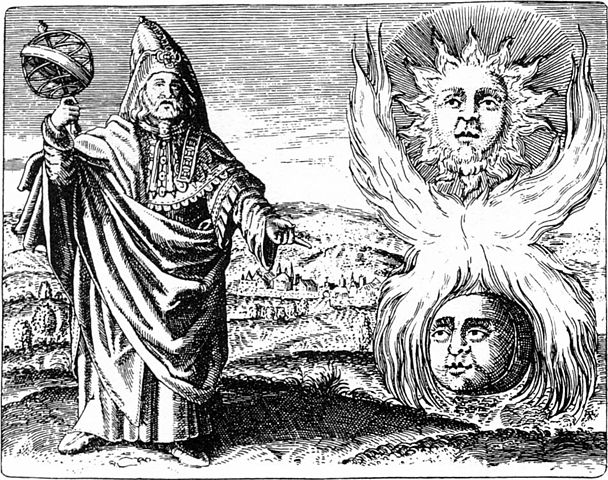
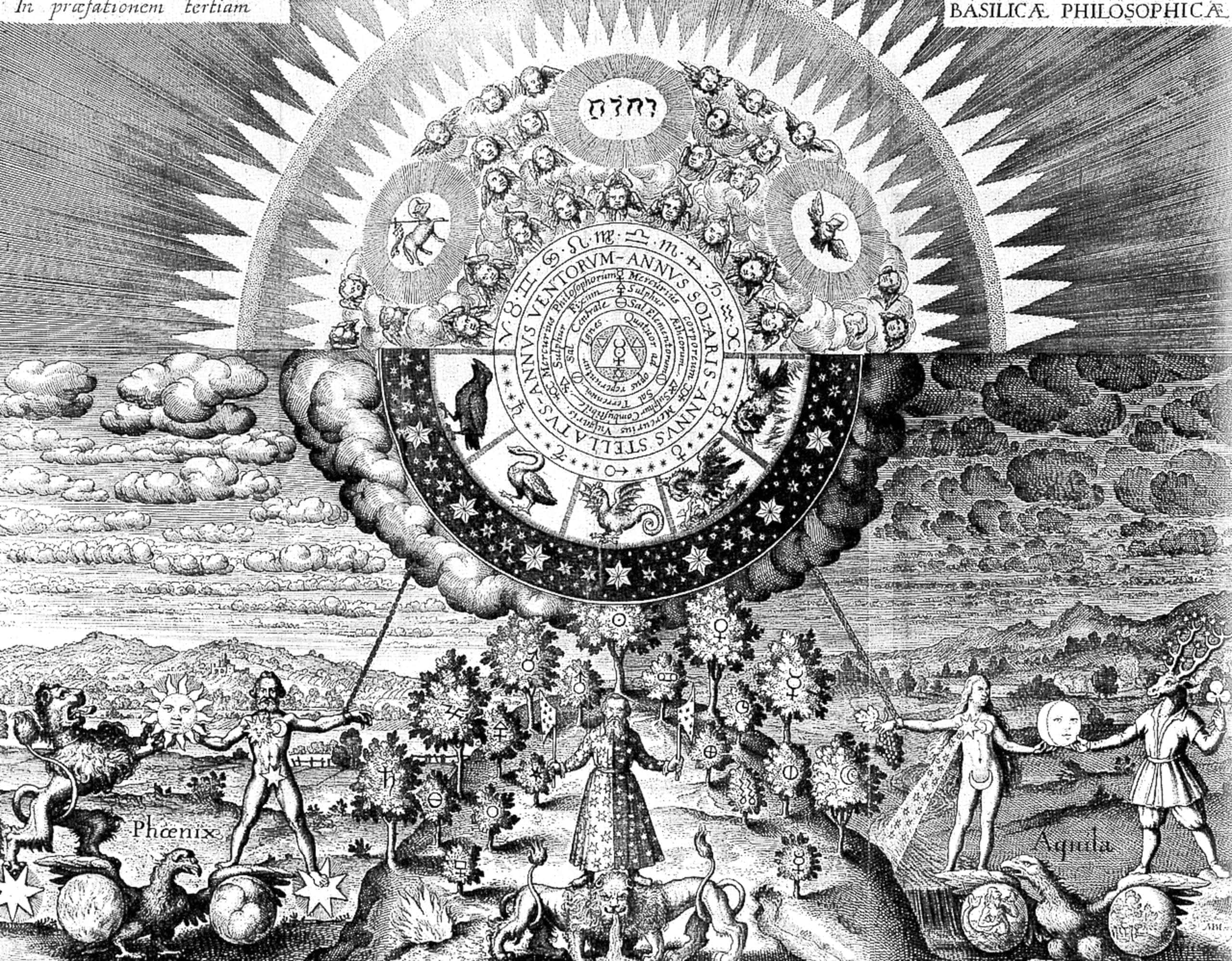
Raleigh next applies the Hermetic cosmology to the physical universe, particularly to the relationship between the Sun and the Earth. The Hermetic text describes the Cosmos or Sun as a generative father, but Raleigh interprets this symbolically rather than simply identifying the physical Sun with the entirety of the universe. The Sun represents the sensible or material Kosmos, a universe structured around radiating centers of energy. Solar rays act upon the Earth, and from their interaction arise the conditions responsible for mineral, vegetable, animal, and human life. Raleigh adopts the ancient sexual symbolism of Sun and Earth: the Sun is the active fecundating force and the Earth is the receptive maternal body in which generation occurs. The Earth becomes the “Vase of Art,” the great natural alchemical vessel in which solar and terrestrial forces unite and produce manifested forms. In this sense, nature itself performs alchemy constantly. Every mineral, plant, animal, and living body is the result of an ongoing transmutation through which energy becomes differentiated material form.
This natural process becomes Raleigh’s model for the laboratory and spiritual alchemist. The alchemist does not invent transmutation; nature is already an immense transmutative process. What human alchemy attempts is to understand the causal law beneath natural transformation and reproduce it consciously on a smaller scale. The Sun is therefore described as the great natural Alchemist, while the Earth is the vessel in which the Work proceeds. Yet Raleigh insists that even the Sun does not possess genuinely independent creative power. It functions as an instrument through which the Good-Will of the divine source operates. The sensible universe is therefore more like an enormous mechanism or system of vehicles through which the primal Energy is differentiated into the particular forces needed for manifestation. The deeper alchemical task is consequently not simply to manipulate matter mechanically but to understand and direct the energies that manifest through matter.
The Divinity of Matter
One of the most important and distinctive arguments in the book is Raleigh’s rejection of the idea of dead matter. He states explicitly that the divinity of matter is fundamental to the Philosophy of Alchemy. If matter is regarded merely as inert mechanical substance, transmutation becomes difficult to understand. If matter is instead understood as living or divine substance filled with energy and responsiveness, transformation from one state into another becomes not miraculous but natural. Raleigh describes matter as “surcharged with life and sense” and makes this one of the keys to alchemical transformation. Material forms are therefore not fundamentally separated from spirit by an unbridgeable gulf. They exist within the same universal process and embody differentiated states of a common divine reality.
This position allows Raleigh to reinterpret the traditional alchemical problem of transmutation. A metal, body, or soul does not have to be changed into something utterly foreign to its nature. Rather, the form must be altered by changing the forces, conditions, and vibratory states through which the underlying substance is presently expressed. Alchemy becomes a science of transformation because reality itself is continuously transformable. Form changes, combinations change, vibrations change, bodies arise and disappear, but the deeper Energy remains. The alchemist works with this plasticity of manifestation by understanding the causal states underlying visible form. This is why Raleigh repeatedly warns against working exclusively with appearances. The physical result is the terminal expression of processes that have already taken place on subtler levels.
The Vision of the Good and Gnosis

The philosophical discussion of creation eventually turns inward. The Hermetic text teaches that the highest knowledge is Gnosis of the Good, and Raleigh treats this not as intellectual belief but as a direct internal perception. He distinguishes ordinary belief from what he calls the “Vision of the Good.” A philosophical idea may first be accepted intellectually, but through sufficient mental development it can eventually become so vivid that it is experienced as an objective inner sight. Raleigh calls the faculty responsible for this the “mind’s eye.” In his terminology, the mind can develop the ability to render abstract truth internally visible, so that the individual no longer merely believes the Good exists but experiences its reality directly. This Vision produces an illumination of the whole soul and progressively transforms the individual.
Raleigh connects this state with several other religious traditions, especially Buddhism and Indian Yoga, although these comparisons are his own esoteric synthesis rather than historical arguments demonstrated in the book. He equates the Hermetic Vision of the Good with what he calls the Buddhist “Pure and Spotless Eye of the Truth” and with Nirvana, and he interprets the Hermetic discipline of withdrawal from the senses as resembling Yoga. The important point within his own system is that Gnosis requires a radical reduction of ordinary sensory and bodily activity. Hermes says that the person contemplating the Good ceases to attend to ordinary sights and sounds and enters a condition of profound stillness. Raleigh interprets this quite literally as an ecstatic state in which sensory impressions and bodily movement are suspended, allowing consciousness to become detached from material distractions and concentrated upon the inner vision. The student must therefore move from belief to visualization, from visualization to direct Gnosis, and from Gnosis toward transformation of the soul.
The Good itself, however, can never be completely analyzed or expressed. Raleigh stresses the Hermetic teaching that genuine Gnosis culminates in “holy silence.” The Absolute cannot be divided into parts for examination because it is the ultimate Unity, nor can it be adequately compared with anything else. The highest knowledge is consequently paradoxical: one may come to see or experience the Good without becoming capable of fully describing or intellectually comprehending it. Raleigh treats this limitation not as failure but as evidence of the transcendence of the object being known. The progress of the student therefore leads beyond ordinary discursive reasoning toward a condition in which knowledge becomes direct experience.
The Hermetic Discipline and the Great Work
At this stage the book begins to reveal more clearly what Raleigh thinks the Great Work actually is. Alchemy is simultaneously cosmic, physical, psychological, and spiritual because the same fundamental law of transmutation operates on every level. The alchemist must reproduce consciously the creative processes performed by the divine powers. But technical knowledge alone is incapable of doing this. Raleigh repeatedly insists that piety, wisdom, and morality must precede practical alchemical work. The alchemist must first be religiously and psychologically transformed because the operator himself is part of the apparatus through which the Work is accomplished. The state of the alchemist’s own soul therefore directly affects his ability to perform alchemical operations.
This produces one of the book’s strongest definitions of alchemy: “The Art of Alchemy is the art of uniting all things with their Source.” Transmutation is merely the visible consequence of that deeper reunification. If a thing can be returned to the causal state from which its current form arose, the causal conditions can be altered and a different visible form can then be produced. The Great Work therefore proceeds from causes to effects, not from effects to causes. Raleigh makes this principle almost humorous by invoking what he calls the “eleventh commandment”: one must not put the cart before the horse. Trying to perform physical alchemy without understanding the philosophy of causation, source, energy, mind, and manifestation reverses the proper order. The alchemist must understand what generated the thing before attempting to regenerate it differently.
Soul, Spirit, Reason, Mind, and Body
A large portion of the later book is devoted to constructing a detailed Hermetic psychology of the human being. Raleigh follows the Hermetic arrangement in which mind is vehicled in reason, reason in soul, soul in spirit, and spirit in body. These are not treated as synonymous words but as a hierarchy of vehicles through which higher principles become capable of operating in the material world. The physical body is the outer vehicle. Spirit is the life principle operating through bodily organization. Soul is associated with impulse and sensory mentality. Reason possesses the discriminating function through which impulses can be judged and sorted. Mind, or nous, is the highest and purest mental principle. Raleigh compares this sequence with the Indian doctrine of the koshas, identifying physical body, life-force, impulsive mind, discriminative intelligence, and higher mind with corresponding sheaths. He then makes the historically unsupported but revealing claim that the Upanishadic psychology of India was derived from Hermes. What matters for understanding his system is the structural parallel he perceives: human consciousness consists of nested vehicles through which increasingly subtle levels of being are expressed.
The role of reason is especially important because Raleigh regards mind itself as essentially pure. Mind receives and conceives thought, but reason acts as a discriminating intermediary between the impulses of the lower soul and the higher mental principle. In an undeveloped person, bodily sensation and emotional impulse dominate. In a more advanced person, reason increasingly discriminates among the impulses presented to consciousness, allowing the higher mind to function more freely. Spiritual evolution therefore involves not simply acquiring information but reorganizing the hierarchy of the human constitution so that higher vehicles rule lower ones. This is itself an alchemical process. Human development is the progressive transmutation of the soul under the pressure and influence of the mind.
Gnosis as Salvation
Raleigh interprets Hermes’s declaration that knowledge of God is the sole salvation of man in a very literal and expansive sense. Gnosis does not merely mean believing correct religious doctrines, behaving morally, or being forgiven for wrongdoing. It means transformation into a higher order of human being. Raleigh describes this as the “Way Up to the Mount.” Salvation is evolutionary and alchemical: through knowledge of God, the individual brings his own mind into greater correspondence or at-onement with Divine Mind. God already “knows” man and pours divine energy toward him, but man becomes capable of receiving and utilizing that energy only by acquiring Gnosis. The aspiration toward spiritual knowledge is itself interpreted as the activity of Divine Will drawing human consciousness upward.
For Raleigh, this has an important practical consequence. The human being is not saved by remaining essentially what he already is while merely receiving a changed legal or moral status. Salvation requires genuine transmutation. The person becomes different in constitution, capacity, and degree of consciousness. The lower organism is transformed into a higher type. This is why Raleigh’s language of religion, evolution, and alchemy repeatedly converges. Gnosis changes the soul; the changed soul becomes capable of bearing greater power; greater power allows higher forms of activity; and the expansion of power eventually alters the entire relationship between the individual and the Cosmos.
Metempsychosis, Death, and Immortality
The Hermetic text discusses transformations of the soul, and Raleigh places these teachings within a broader doctrine of metempsychosis and spiritual evolution. He rejects a crude interpretation in which the human soul literally becomes the soul of an animal after death, emphasizing instead the processes by which souls rise or fall in condition according to their knowledge, development, and attachment to bodily passion. Ignorance is the great vice because the soul that does not know its own nature becomes dominated by the body and its impulses. Gnosis is the corresponding virtue because knowledge enables the higher principles of man to assume their proper relation to the lower. Thus punishment is not principally an externally imposed penalty; it is the consequence of remaining trapped within lower conditions of consciousness.
Raleigh gives particular importance to the Hermetic teaching that the soul can become “like to God” even while embodied. This is the real alchemical objective. Immortality is not merely indefinite survival after physical death, because in Raleigh’s occult cosmology some level of postmortem existence is already assumed. The higher task is consciously to transform the mortal constitution so that it can participate in increasingly immortal forms of life. The Vision of the Good, Gnosis, spiritual discipline, purification of the soul, and the proper organization of the human vehicles are therefore all preliminary aspects of the same Great Work. Raleigh goes so far as to say that correct philosophical application of these principles should ultimately enable the student to “overcome death,” although he postpones the specific method of this “self-alchemicalization” to later instruction.
Chastisement as Alchemical Transmutation
One of Raleigh’s more unusual interpretations concerns the Hermetic account of chastisement. He does not understand punishment principally in juridical or theological terms. Chastisement becomes an alchemical process in which a lower vibratory condition is forced into contact with a higher one, producing pain because the existing organization cannot immediately accommodate the new rate of activity. Raleigh interprets the symbolic whip as a representation of this process. Purification of body and soul occurs through the transmutation of vibratory states, and the pain associated with chastisement accompanies the disruption and reorganization of those established states.
Mind therefore “chastises” soul by bringing a higher vibratory condition into contact with it. Reason, acting as the vehicle of mind, transmits this higher influence into the impulsive soul, where it destabilizes lower patterns and eventually transforms them. From Raleigh’s perspective, the purpose of the suffering is not suffering itself. It is transformation. The contact between higher and lower disintegrates the old condition so that a new one can be formed. This is again alchemy: dissolution precedes reconstruction, and purification means changing the state of the substance rather than merely labeling it good or bad.
Piety, Morality, and the Religious Foundation of Alchemy
Although Raleigh discusses cosmic forces, vibratory states, psychic vehicles, and the possibility of physical transmutation, he repeatedly insists that alchemy is fundamentally religious. The prospective alchemist must first become pious, then wise, then moral, before technical knowledge can be safely or effectively applied. Practical alchemy separated from religion is, in his view, a contradiction. The alchemist attempts to reproduce in miniature the creative work of the Gods, and only a soul purified and disciplined sufficiently to enter into harmony with the divine process can perform that work correctly.
Raleigh’s definition of religion is nevertheless unconventional. By the closing lessons he argues that man serves God primarily through the arts and sciences. Since divine energies act through Cosmos and human beings individualize those energies through creative activity, the cultivation and application of knowledge become religious duties. Raleigh therefore identifies genuine “practical religion” with an active soul engaged in creative work. Among all arts and sciences, alchemy occupies the highest position because it consciously reproduces the universal process underlying them all. The human soul itself becomes a Vase in which transmutation occurs, and the greatest art is therefore the art that teaches the individual how to participate consciously in this process. Knowledge of God, harmlessness toward other people, and devotion to creative arts and sciences become, in Raleigh’s formulation, the principal duties of the religious life.
The Alchemist as a Creative Being
As the book progresses, the alchemist increasingly appears not as a laboratory technician but as a new type of human being. The successful alchemist develops what Raleigh calls an excess or “surplus value” of Ego, increases the efficiency of his vehicles, and transforms himself from a passive recipient of forces into an increasingly creative center through which those forces can be individualized. The lower person consumes what already exists; the higher person creates. The distinction corresponds to Raleigh’s earlier contrast between dependence and freedom. To the extent that an individual depends entirely upon externally produced conditions, he remains controlled by them. To the extent that he can generate new conditions through disciplined creative power, he becomes freer.
This idea ultimately leads Raleigh to an extraordinary cosmic claim. Human development does not concern the individual alone. Divine manifestation itself depends in part upon what human beings are capable of individualizing and expressing. The salvation of the individual therefore becomes bound to the regeneration of the Cosmos. When man extends his own capacity and brings previously unrealized divine possibilities into manifestation, Raleigh says that he effectively expands the field through which God can live and act in the universe. The Great Work is thus simultaneously personal and cosmic. The alchemist saves himself by increasing his degree of conscious participation in Divine Energy, but in doing so he also contributes to the evolution and extension of the manifested universe. Raleigh calls those who accomplish this work “Heroes,” people engaged in the “Conquest of Power” through the development of the Ego and its vehicles.
The Meaning of Alchemical Transmutation
The most important conclusion to draw from the complete book is that Raleigh uses the word “alchemy” in a much broader sense than the familiar attempt to turn base metals into gold. Metallic transmutation belongs within the system, but only as one application of a universal law. Cosmos is alchemical because Divine Energy becomes differentiated nature. The Earth is an alchemical vessel because solar and terrestrial forces generate material forms within it. Biological life is alchemical because matter is continually reorganized into living structures. Human development is alchemical because body, spirit, soul, reason, and mind undergo transformation. Religion is alchemical because Gnosis reunites the individual with the divine source. Death and immortality are alchemical because the constitution of man can pass from one state into another. Even punishment is interpreted alchemically as the painful transmutation of lower vibratory conditions through contact with higher forces. In Raleigh’s system, alchemy is therefore the universal science of causation, transformation, differentiation, and reunion.
This interpretation also explains his insistence that the Philosophy of Alchemy must be mastered before the Science or practical Art of Alchemy. To begin with physical operations would be to start with the final visible effect while remaining ignorant of the causal process. The true operator first learns the origin and hierarchy of forces, the relation of Divine Will to Nature, the relationship of spirit and matter, the structure of human consciousness, and the process through which lower states are transformed by higher ones. Only then can those principles be applied systematically. Raleigh therefore ends the book not by giving laboratory formulas but by saying that the reader who has mastered its philosophical principles is now prepared to enter upon the Science of Alchemy.
The Great Work
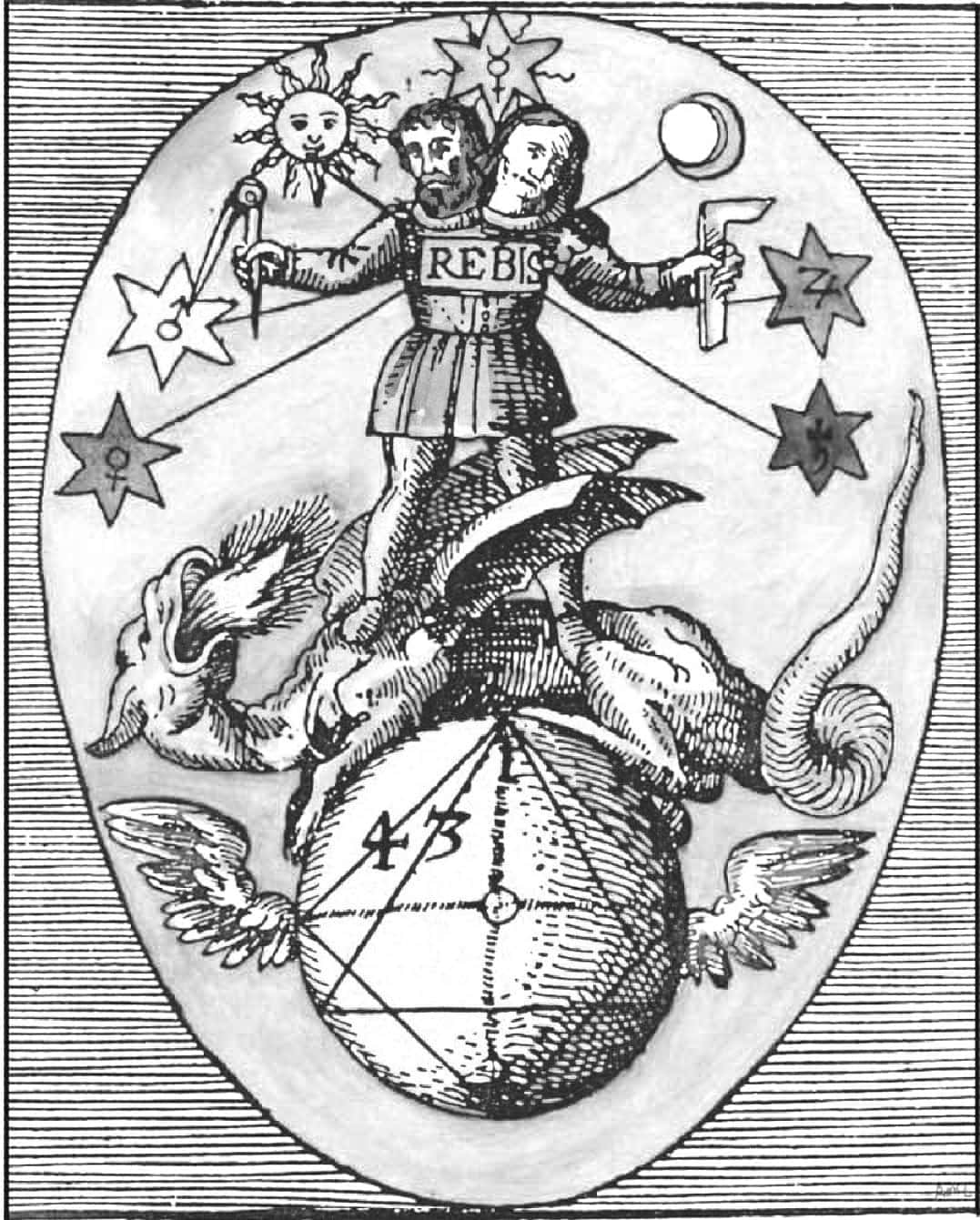
The Great Work in Philosophy of Alchemy is ultimately the conscious reproduction within man of the creative and transformative processes occurring throughout the universe. Its object is not simply to acquire hidden knowledge or obtain extraordinary powers. The alchemist must transform himself into a vehicle capable of participating increasingly in the Divine Energy from which all manifestation proceeds. He begins with piety and Gnosis, learns the nature of the Source, disciplines the body and senses, develops the higher mind and reason, purifies and transmutes the soul, increases the efficiency of his various vehicles, and converts the surplus energy of the Ego into creative Will. Through this process the individual gradually changes from something primarily acted upon by external forces into a conscious center capable of directing and individualizing those forces.
The Elixir and the conquest of death therefore belong to the culmination of a much larger transformation. Raleigh’s dedication says that the lessons are intended for students seeking to understand the Magnum Opus and expresses the hope that the work will show them the true method of “preparing the Elixir” and thereby assist them in accomplishing the Great Work. Yet the book never reduces that Elixir to a simple physical substance or recipe. Everything that follows points toward the preparation of the alchemist himself as the necessary condition of the operation. Before an Elixir capable of producing higher transformation can be understood, the operator must understand the forces of life, soul, mind, matter, and Divine Energy that make any genuine transformation possible. The preparation of the Elixir is therefore inseparable from the preparation of the person who would prepare it.
Overall Meaning of Philosophy of Alchemy
The Philosophy of Alchemy is Raleigh’s attempt to derive an entire philosophy of alchemical transformation from the teachings attributed to Hermes Trismegistus. Its central argument is that the universe is not composed of fundamentally dead and separate substances but is the differentiated manifestation of one underlying Divine Energy or Will. That Energy continually generates forms, acts through Cosmos, manifests through living beings, and becomes increasingly individualized through the development of mind. Because manifested things arise through transformations of a common underlying reality, further transmutation is possible. The alchemist’s task is to discover the causal processes behind those transformations and reproduce them consciously. Matter can be transmuted because matter is living and divine; the soul can be transmuted because consciousness exists in different states and degrees; man can become increasingly godlike because higher Mind is already present within the structure of his being; and the Great Work becomes possible because the same Divine Energy responsible for cosmic creation operates through the properly developed human individual.
The Yogi Publication Society was not merely distributing a conventional historical study of alchemy. It was distributing a complete modern Hermetic system in which Hermes Trismegistus, Gnosis, Divine Will, mental discipline, the evolution of the soul, the living nature of matter, creative power, immortality, and physical transmutation were all presented as different expressions of one universal process.