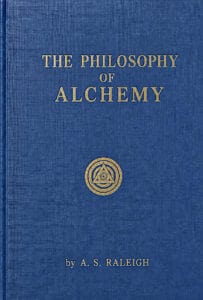
Dr. Albert Sidney Raleigh, (A. S. Raleigh) was an American occult teacher, metaphysical writer, and Hermetic author active during the early decades of the twentieth century. Although biographical information about Raleigh remains fragmentary and several details of his later life are still uncertain, surviving records make it possible to reconstruct a substantial outline of his career. Raleigh was born in Arkansas in 1881 and by 1910 he had moved to Chicago. Over the following decade he emerged as the author and instructor behind an extensive system of Hermetic philosophy, alchemy, occult psychology, metaphysical healing, sacred geometry, and mental development. He was a member of the Hermetic Brotherhood of Atlantis, in which he was the “Official Scribe,” and he also used the title “Hierophant of the Mysteries of Isis.”
The exact circumstances of Raleigh’s early education and his use of the title “Dr.” remain unclear, but by the early 1900s he was presenting himself professionally as a doctor and also as “Hach Mactzin El Dorado Can.” The Hermetic Brotherhood with which he was a memeber called itself a continuation of an ancient occult tradition reaching back through Egypt to Atlantis. Raleigh’s books were presented as official instructional texts of the Brotherhood and claimed to preserve and interpret its esoteric teachings.
By the middle of the 1910s Raleigh had moved to san Francisco where The Stanzas of Dzjn: Theogenesis was issued in 1915, while Philosophia Hermetica appeared from the Hermetic Publishing Company in 1916. He also wrote several other titles from the same period, including The Shepherd of Men and Woman and Super-Woman. Raleigh’s own writings indicate that he regarded these works as components of a larger curriculum rather than isolated books. Philosophia Hermetica was explicitly described as an introduction to The Philosophy of Alchemy, while other works developed what he called the Science and Art of Hermeticism.
Raleigh’s Hermeticism centered strongly on Hermes Trismegistus. Rather than simply reproducing the surviving Hermetic texts, he claimed to supply their hidden or esoteric interpretation according to the teachings of the Hermetic Brotherhood of Atlantis. The sermons attributed to Hermes were treated almost as encoded instructional documents whose deeper significance had been concealed from ordinary readers. Raleigh’s task, as he conceived it, was to reveal their underlying meaning and show how their cosmology could be applied to alchemy, mental development, spiritual transformation, and the evolution of the individual. His books consequently move back and forth between passages attributed to Hermes and lengthy commentaries explaining them according to his own metaphysical system. In Philosophy of Alchemy, for example, he interprets the Hermetic teaching concerning God, the Good, Mind, Cosmos, soul, and body as the philosophical basis of alchemical transformation. The visible world is presented as the product of deeper energetic and mental causes, and the work of the alchemist consists in understanding those causes sufficiently to redirect the processes of manifestation.
Alchemy occupied the center of Raleigh’s system, but his conception of it extended far beyond the conventional image of attempting to turn base metals into gold. Raleigh regarded physical transmutation as only one application of a much larger universal law. Nature itself was alchemical because forms were continually being generated, dissolved, reorganized, and transformed. The human being was likewise an alchemical organism whose body, mind, soul, and higher faculties could be consciously changed. The Great Work therefore became simultaneously physical, psychological, and spiritual. Raleigh repeatedly described the deeper purpose of alchemy as the transformation or regeneration of the individual, and some of his works were explicitly presented as training in the “Speculative Art of Alchemy” or the art of self-regeneration. A later description of *The Speculative Art of Alchemy* preserves Raleigh’s own insistence that Hermetic discipleship was a genuine course of training rather than merely a theory to be studied intellectually.
Raleigh developed a detailed theory of spiritual alchemy or “Soul Transmutation.” The soul, like matter, could exist at different conditions or levels and could be transformed through discipline, knowledge, and the action of higher mental forces. The ancient alchemical symbols of purification, dissolution, regeneration, and transmutation consequently acquired psychological and religious meanings. Ignorance represented a lower state; Gnosis, or direct knowledge of the divine, represented a higher one. The spiritual aspirant was expected to reorganize the relationship between body, emotion, reason, mind, and will so that higher faculties increasingly governed the lower. The philosopher’s stone, elixir, transmutation, and Great Work thus became simultaneously descriptions of external alchemy and symbols of the internal transformation required of the alchemist himself.
Raleigh attempted to give these ideas a scientific vocabulary appropriate to the early twentieth century. Energy, vibration, force, polarity, motion, geometry, and number occur repeatedly throughout his writings. In works such as *Hermetic Science of Motion and Number* and *Occult Geometry*, he sought to explain reality through patterns of movement and mathematical relation. Geometry was not merely abstract mathematics but a representation of the fundamental manner in which force organizes itself into manifestation. Motion generated form, number expressed order, and geometrical relationships revealed the structure through which cosmic energy became the visible universe. Raleigh therefore combined traditional Hermetic and occult symbolism with concepts borrowed from contemporary scientific language, presenting ancient esotericism as a hidden science whose principles could supposedly be restated in modern terms.
This concern with the laws of mind extended into what Raleigh called mentalism and into his unusual “Phrenogarten” system of education. His writings on mental development taught that the faculties of the mind could be intentionally exercised and strengthened rather than accepted as fixed limitations. The objective was to develop a more powerful and coordinated mental organism capable of directing thought, controlling habitual tendencies, and shaping conduct. In this respect Raleigh’s teaching overlapped substantially with the mental-culture, New Thought, suggestion, and applied-psychology literature circulating in the United States during the same period, although he placed these methods inside a much larger Hermetic cosmology. Mental development for Raleigh was not simply a means to worldly success. It formed part of the evolutionary transformation of the individual into a more capable vehicle for higher forms of consciousness.
Raleigh’s surviving bibliography includes works on Hermetic philosophy, occult geometry, motion and number, metaphysical healing, psychology, education, mystical interpretations of literature, and the development of human consciousness. His works included, The Stanzas of Dzjn: Theogenesis from 1915; Philosophia Hermetica, The Shepherd of Men, and Woman and Super-Woman from 1916; and The Hermetic Art from 1919. Later published works in 1932, included Phrenogarten System of Education, Metaphysical Healing, and esoteric interpretations of Rudyard Kipling’s “They” and “The Brushwood Boy.” The existence of these later publications is important because some modern biographical notices have claimed that Raleigh died in 1918. That date should not be treated as established. Some of the later books may have been issued from older manuscripts, but rother accounts suggest that he returned to Chicago around 1916 and remained connected with his publishing activity into the later period. Until a primary death record is identified, his date of death should be regarded as unresolved.
George W. Wiggs became an important figure in the later preservation and publication of Raleigh’s material. Research into Raleigh’s publishing history has linked Wiggs with the Hermetic Publishing Company and says the he was responsible for issuing and controlling much of Raleigh’s body of work. Claims about Wiggs’s other activities, including connections with gambling, financial schemes, or particular occult orders, need more investigation.
One of the defining characteristics of Raleigh’s writing is his attempt to synthesize traditions that he believed represented different survivals of a common primordial wisdom. Egyptian religion, Hermes Trismegistus, Greek philosophy, Buddhism, Hindu philosophy and Yoga, Qabalah, alchemy, Rosicrucianism, and modern metaphysics are repeatedly interpreted as expressions of related principles. Historically, many of the genealogies Raleigh claimed for these teachings cannot be accepted at face value. His assertions that particular doctrines originated in Atlantis or that later religious traditions directly inherited specific teachings from Hermes belong to his occult worldview rather than established historical scholarship. They are nevertheless crucial to understanding him. Raleigh did not regard himself as constructing a new system from unrelated sources. He believed he was restoring a primordial Hermetic science whose fragments had survived under different names and symbols throughout the world.
His concept of the Hermetic Brotherhood of Atlantis must be understood in the same way. Raleigh presented the Brotherhood as the custodian of an ancient initiatory tradition and his books as authorized interpretations of its teachings. The precise institutional history of the organization, however, is much harder to reconstruct than Raleigh’s own claims suggest. Earlier American occultists William P. Phelon and Nancy McKay Phelon were associated with organizations using Hermetic Brotherhood terminology, and later occult groups adopted related names, but a direct institutional succession from any ancient Atlantean order is obviously a religious or esoteric claim rather than a demonstrable historical fact. Raleigh nevertheless organized his public identity around this lineage and presented himself not merely as an independent occult author but as an officer and teacher transmitting the Brotherhood’s curriculum.
Raleigh created a remarkably comprehensive occult curriculum in which Hermetic philosophy supplied the metaphysical foundation, alchemy provided the universal model of transformation, psychology explained the development of the human organism, mentalism developed the power of thought and will, sacred geometry explained the organization of force into form, and spiritual discipline directed the entire system toward the transmutation of the soul. The same principles were intended to operate at every level. Cosmic creation was alchemical; natural growth was alchemical; human evolution was alchemical; mental development was alchemical; and spiritual illumination represented the highest form of transmutation.