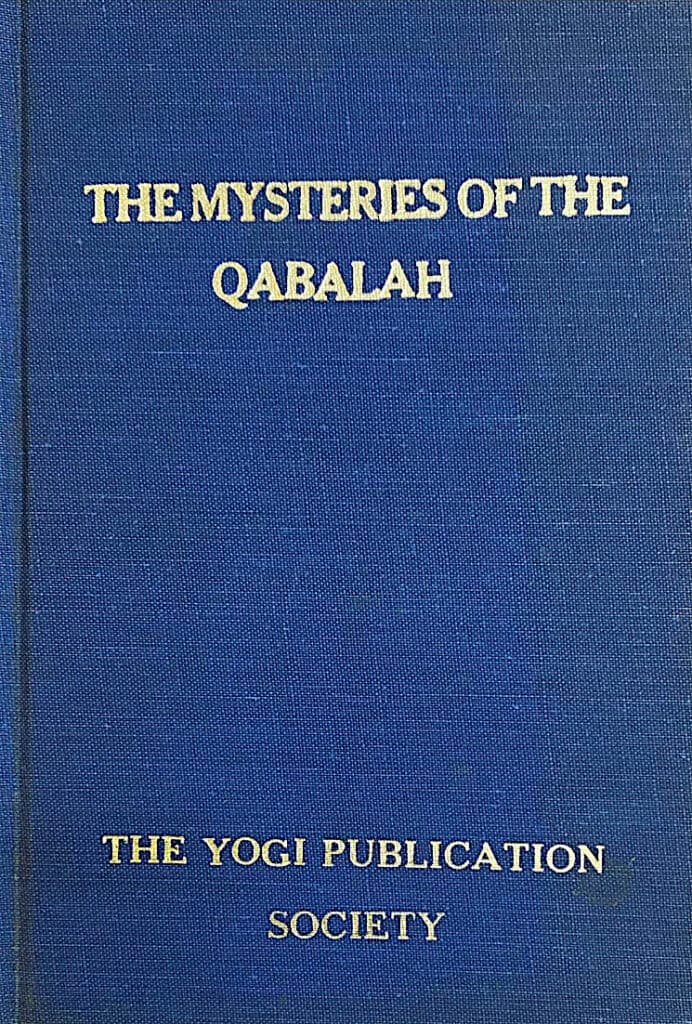
The Mysteries of the Qabalah was published in Chicago in 1922 by the Yogi Publication Society, and appeared as Volume II of a work having been “written down by seven pupils of E. G.” The dedication identifies E. G. as Elias Gewürz, whom the unnamed compiler calls “My Teacher,” crediting him with supplying the materials and pointing out the path upon which the work was based.
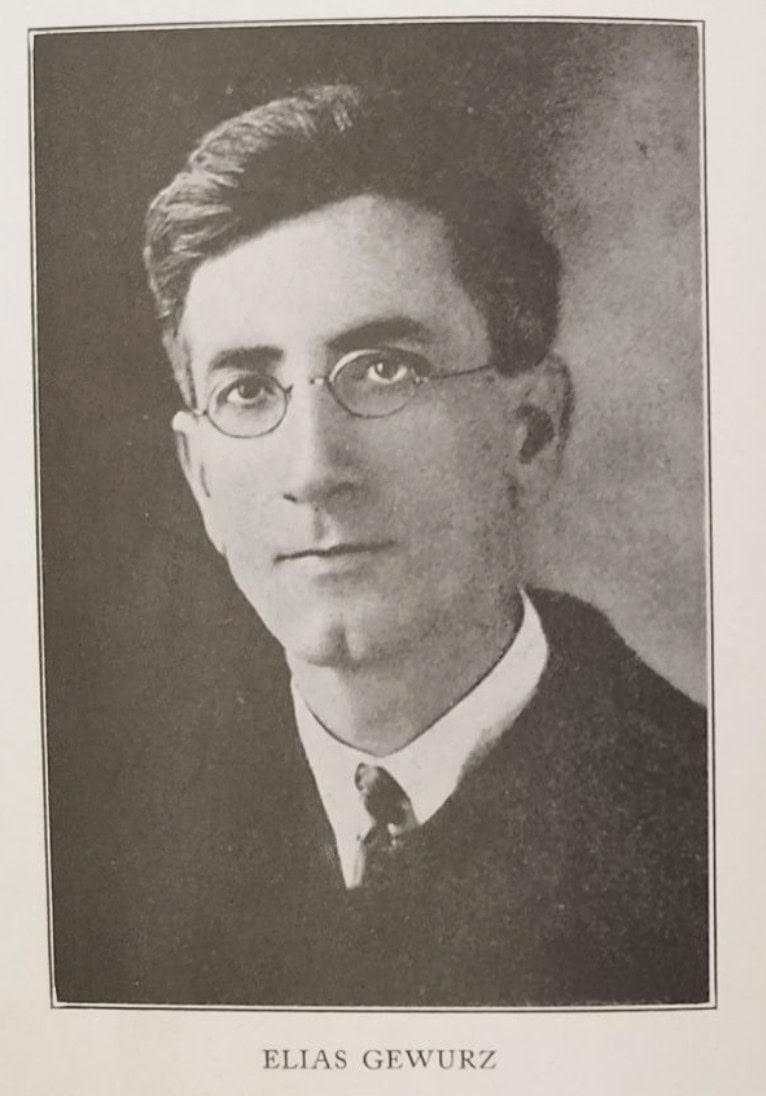
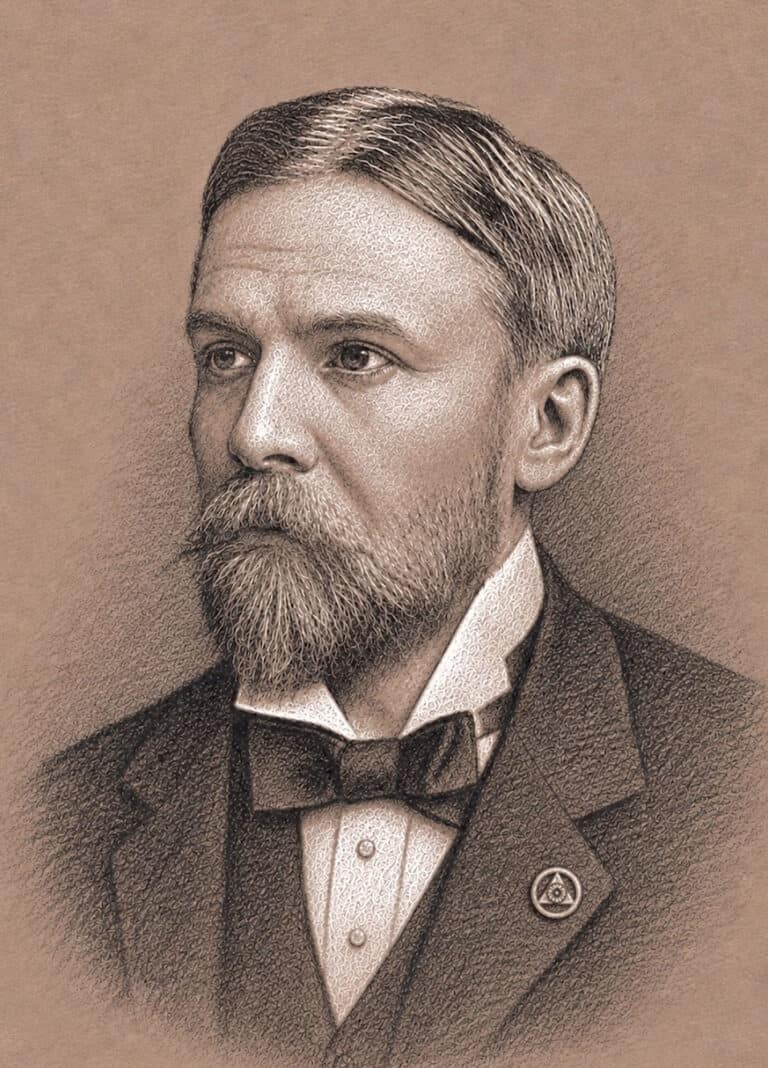
Elias Gewurz
The book fits naturally within the later Yogi Publication Society catalog because it presents the Qabalah alongside Sanskrit terminology and the Gnani and Bhakti yoga paths, ideas already familiar to readers of the Society’s works on Yogi philosophy. It also presents Hebrew mysticism, initiation, Hidden Masters, and spiritual development as related expressions of the same ancient spiritual knowledge.
The book begins with a symbolic interpretation of the Hebrew alphabet and then examines Nachash, the serpent of Genesis, the Brotherhood of the White Lodge, and initiation according to the Qabalah. From there, it turns to the origins and literature of the Qabalah, its methods of interpretation, the meaning of the Sephiroth, and the relationship between the individual and the universal. Its second half asks what the Qabalah actually is, considers competing accounts of its origin, explains several traditional methods of Qabalistic interpretation, and surveys its literature. The book is less a conventional history of Jewish mysticism than an occult instructional work. Its authors regard the Qabalah as a living system of initiation whose symbols conceal knowledge concerning human consciousness, spiritual evolution, the relation between the individual and the universal, and the path by which the student may progress toward direct knowledge.
What is The Mysteries of the Qabalah about?
At the center of The Mysteries of the Qabalah is the belief that sacred language contains several levels of meaning and that the student must learn how to move beyond the surface meaning of scripture. Hebrew letters are presented simultaneously as letters, numbers, symbols, and representations of cosmic or psychological principles. Biblical stories are approached in much the same fashion. The serpent of Genesis, for example, becomes a description of a force operating within human nature, while initiation becomes an evolutionary process through which the student gradually masters the physical, emotional, mental, and spiritual levels of experience.
This method gives the book two closely connected purposes. The first is to introduce the reader to Qabalistic symbolism: the Hebrew alphabet, numerical values, permutation of letters, hidden meanings of words, and different levels of scriptural interpretation. The second is to explain what those techniques are meant to accomplish. The authors repeatedly return to self-knowledge, intuition, initiation, the overcoming of lower desires, and the development of consciousness. Qabalah is presented as a path to knowledge that must eventually become an inner experience rather than remain an intellectual collection of doctrines.
Why does the book begin with the Hebrew alphabet?
The opening section, “The Hieroglyphical Interpretation of the Hebrew Alphabet,” establishes one of the book’s main ideas: a Hebrew letter possesses significance beyond its ordinary function in written language. A note states that this interpretation came from “a very rare and valuable manuscript” owned by Elias Gewürz and explains that Gewürz had spent more than ten years preparing a larger work titled The Restoration of the Hebrew Language.
Each Hebrew letter is then assigned an arithmetical value together with physical, psychological, philosophical, and esoteric meanings. Aleph, with the numerical value one, signifies man as a collective unity, the universal man, power, stability, continuity, and the central principle of a thing. Beth, valued at two, is associated with the mouth, speech, interior action, habitation, and movement; combined with Aleph it represents progress and passage from one state into another. Daleth, valued at four, represents the breast and is called an emblem of the universal quaternary and the origin of physical existence. Hai represents life, breath, spirit, and soul. Waw becomes a symbol of light, sound, water, and the mysterious point connecting and separating Being and Non-being.
The pattern continues through the alphabet. Mem is associated with woman, maternity, fruitfulness, formation, and passive action. Tzaddi is connected with accomplished ends, protection, guidance from above, and the disciple upon the Path. Qoph is linked with what the book calls the “Subliminal consciousness” and an earlier evolutionary condition. Reisch represents the head, determination, progress, independence, self-help, and self-initiated effort. Taw, the final letter, signifies reciprocity, sympathy, perfection, and what the book identifies as the universal soul.
The alphabet is therefore introduced as a symbolic vocabulary. Once letters possess both numerical and symbolic meanings, combinations of letters can be examined for relationships hidden from a purely literal reading. This becomes important later when the authors introduce Qabalistic methods of numerical valuation and permutation.
What does Nachash, the serpent, represent?
One of the clearest examples of the book’s symbolic method is its treatment of Nachash, the serpent of Genesis. Nachash is defined as the deep interior feeling that binds an entity to its individual existence and causes it to desire its own preservation and enlargement. The book identifies this force with “radical egotism,” the tendency of an individual to make itself the center around which everything else is interpreted. At the same time, Nachash is described as natural instinct, a force implanted deeply within living things for self-preservation.
This changes the serpent story into a psychological teaching. The serpent is a movement within human nature, and its offspring are the blind passions and self-seeking impulses belonging to humanity’s earlier stages of development. The following chapter, “The Lesson of Nachash,” develops the idea through a contrast between expansion and contraction. Love, hope, and faith are described as expansive forces, while hatred, fear, doubt, and despair contract the soul. The serpent represents this inward contraction—the tendency to draw everything toward oneself in the struggle for preservation.
Freedom from Nachash requires the development of a different relationship with other people and with life itself. Self-sacrifice and love loosen the grip of the self-centered instinct. The Genesis symbol thus becomes a lesson about the transformation of consciousness: the lower instinct is present within human beings, but spiritual development requires that its dominance be overcome.
What is the Brotherhood of the White Lodge?
The next major section introduces the “Brotherhood of the White Lodge,” and here the book begins to sound strikingly similar to the language of the Yogi and occult works already appearing through the Yogi Publication Society. The authors describe ancient seekers who withdrew from ordinary society to meditate, study, and pray, explicitly calling them the “Gnanis and Bhaktas of the past.”
The White Lodge is described as a continuing spiritual brotherhood whose representatives include Masters, teachers, messengers, and pupils working in the world. The book warns readers against assuming that spiritual teachers must appear in socially impressive circumstances. Great teachers may arise from poverty or obscurity, and the student may fail to recognize a representative of the Lodge because of outward appearances.
This section is important for understanding why The Mysteries of the Qabalah belongs comfortably within the Yogi Publication Society catalog. Its Qabalah is presented alongside the same language of Masters, disciples, Gnanis, Bhaktas, initiation, ancient wisdom, and spiritual evolution that YPS readers encountered in books published under names such as Yogi Ramacharaka and in the Society’s larger body of Yogi philosophy. The traditions are treated as different expressions of related spiritual truths.
How does The Mysteries of the Qabalah explain initiation?
“Initiation According to the Qabalah, From a Scientific and Philosophical Point of View” is one of the longest and most important sections of the book. Initiation is presented as a process of development occurring through successive levels of human experience. It involves far more than admission into a secret society or participation in a ceremony. The true initiation occurs within the individual.
The authors describe physical, emotional, mental, and higher stages of development. Experiences, ordeals, desires, suffering, knowledge, and self-mastery become parts of the initiatory process. The human being is gradually freed from domination by lower forces and becomes capable of functioning from progressively higher levels of consciousness. At the mental stage, the book describes the aspirant’s inner development as preparation of a temple for the indwelling of the “Most Holy One.” The benediction of the Master marks entry into an interior sanctuary.
The language then becomes explicitly Indian. At the center of the initiatory synthesis is the Jiva-atma, whose highest aspect is described through the three qualities of knowledge, being, and bliss. The soul advances toward freedom from Maya, while even thought must eventually be recognized as another form of bondage. The Qabalistic path has now been explained using Sanskrit concepts, making the book’s intended synthesis unmistakable.
Why does the book connect the Qabalah with Yogi philosophy?
The connections become even more explicit when the authors discuss the four levels of scriptural interpretation and the four initiations. A person who has mastered the four initiations of Earth, Water, Air, and Fire becomes what the book calls a “Pure One,” or Tahar. The authors then compare this directly with Sanskrit terminology, stating that Tahar or Arhat means a perfected one or Mahatma, which they describe as equivalent to a “Master in Israel.”
Whatever one may make of the historical or linguistic accuracy of these comparisons, they tell us exactly how the book itself wants the Qabalah to be understood. The authors believe that different initiatory traditions preserve versions of the same wisdom. Qabalistic Masters and Eastern Mahatmas belong to a shared spiritual framework; Gnani and Bhakti are used naturally in a discussion of the White Lodge; Jiva-atma and Maya are introduced into a chapter devoted to Qabalistic initiation.
For the history of the Yogi Publication Society, this makes the book a revealing example of how far the publishing program had expanded by 1922. YPS had spent years publishing works on Yoga, Vedanta, occultism, psychic development, mental science, Hermeticism, mysticism, and related traditions. The Mysteries of the Qabalah extends that presentation into Jewish esotericism while continuing to use the comparative vocabulary familiar to readers of the Society’s earlier books.
What does the book say about the origin of the Qabalah?
Part II begins by confronting the problem of origins. The authors acknowledge that there is no settled documentary answer for where the Qabalah began. They mention several competing traditions: that the wisdom was given by God to angels; that the Zohar was associated with Simeon ben Yochai around the period of the destruction of the Second Temple; and that other scholars attributed the Zohar to Moses de León.
The book does not attempt to settle the historical problem through modern textual scholarship. Its authors believe that excessive concentration on documentary history can obscure the spiritual knowledge itself. They acknowledge the usefulness of previous scholarship and include a bibliography, but state that the real object of study is the Qabalah itself and that intuition must eventually supplement documentary investigation.
The authors also reinterpret the traditional claim that Qabalistic wisdom came from God and angels. Esoterically, they suggest, “God” in such an account can be understood as an Avatar and the angels as Masters. Again the book translates Qabalistic tradition into the comparative occult vocabulary used throughout the work.
What is the “Soul of the Qabalah”?
“The Soul of the Qabalah” turns from history toward the actual methods by which hidden meanings are sought within sacred texts. The authors explain that scripture can be read on several levels and that Qabalistic interpretation provides techniques for penetrating beneath literal language.
Four ways of reading scripture are described. Pshat is the plain or literal meaning. Ramaz is the “hint,” a level intended for the developing intellect. Darash is an inferential or intuitive reading in which the “eye of the Spirit” begins to operate beyond ordinary intellectual reasoning. Sod is the secret level, associated with the deepest mysteries and traditionally reserved for students prepared to receive them.
The book does not reject intellect in favor of intuition. It specifically warns that a true balance requires both. Intellectual analysis has its place, but it cannot by itself reach every level of meaning contained in sacred writing. The student progresses from the visible statement toward increasingly interior meanings.
This structure also becomes a model of initiation. Reading scripture and reading life are parallel activities. The physical world presents a surface appearance, while deeper meanings become visible as consciousness develops. The sacred book is therefore treated as a miniature representation of a larger book—the world and human experience themselves.
How are numbers and letters used to uncover hidden meanings?
The authors next introduce methods through which relationships between words may be discovered. Numerical valuation depends upon the fact that Hebrew letters also possess numerical values. Words having corresponding numerical totals can therefore be compared for hidden relationships.
Temura, translated as “change” and identified with permutation by Christian Qabalists, rearranges or reverses letters to create new words and meanings. Notariqon uses the initial letters of words to form other words or teachings. The authors provide examples designed to show how these procedures can expose relationships that remain invisible when the text is read only at its surface level.
These techniques explain why the opening survey of the Hebrew alphabet occupies so much of the book. The letters are the building blocks of the system. Once every letter can function simultaneously as sound, number, image, and esoteric symbol, words become combinations of several kinds of information. Qabalistic interpretation consists in learning how to read those combinations.
What are the four levels of Qabalistic understanding?
One of the strongest ideas running through the book is that knowledge exists in degrees. The literal level is available to nearly anyone, but deeper knowledge demands corresponding development in the person seeking it. The four modes of scriptural interpretation are related to four initiations and to experience on the physical, emotional, mental, and higher planes.
This means that initiation cannot be reduced to acquiring secret information. A person may possess books, symbols, alphabets, numerical tables, and teachings without possessing the consciousness necessary to understand what they signify. The deeper mysteries are “secret” because the student must develop the capacity to perceive them.
That idea explains the book’s repeated emphasis on the teacher-disciple relationship. Elias Gewürz is identified on the dedication page as the teacher who supplied the materials and showed the path. The book itself is said to have been written down by seven pupils. Its form therefore mirrors its teaching: knowledge is transmitted, studied, interpreted, and finally experienced by the pupil.
What role does intuition play in the Qabalah?
Intuition becomes increasingly important as the work progresses. Historical research, linguistic analysis, numerical methods, and intellectual reasoning can bring the student a considerable distance, but the authors repeatedly insist that there is a point beyond which intellectual methods cannot carry the seeker.
In the discussion of Darash, intuition is described as the “eye of the Spirit.” The authors distinguish it from ordinary brain consciousness while still insisting upon balance between intellectual reasoning and intuitive perception. The aim is not intellectual abandonment. It is the development of another faculty capable of perceiving meanings that discursive reasoning alone cannot reach.
This gives the technical Qabalistic material a purpose. Numerical valuation, symbolism, permutation, and layered interpretation are aids for training perception. The student learns to look at the same text from several levels at once, moving from the obvious meaning toward relationships hidden within its structure.
What does the book teach about the individual and spiritual evolution?
The book repeatedly describes spiritual development as movement away from confinement within the isolated personal self. Nachash represents the inward pull of self-preservation and egotism. Love expands where fear and hatred contract. Initiation subjects the aspirant to experiences through which attachment to lower states is weakened. The White Lodge represents those who have advanced farther along the same path and who assist others in their development.
This evolutionary language appears even in the interpretation of individual Hebrew letters. Qoph is associated with the submerged or subliminal level of consciousness and an evolutionary stage lying behind humanity, while Reisch signifies determination, progress, self-help, and self-initiated endeavor. Letters therefore participate in the same story told by the book’s discussions of Nachash and initiation: consciousness passes through stages, and the human task is to participate consciously in that ascent.
The path eventually extends beyond ordinary thought itself. During the higher stages of initiation, thought is described as a finer form of matter and therefore another possible bond upon consciousness. Knowledge at the highest level is not simply the accumulation of more thoughts. It is a transformation in the state of the knower.
How does The Mysteries of the Qabalah fit within the Yogi Publication Society?
The Mysteries of the Qabalah shows how naturally Qabalistic material could be incorporated into the Yogi Publication Society’s publishing program by 1922. The book does not present the Qabalah as an isolated historical tradition. Its authors repeatedly move between Hebrew mysticism and Indian philosophy, using terms such as Gnani, Bhakta, Mahatma, Master, Jiva-atma, Maya, and Avatar to explain Qabalistic ideas.
That approach would have been familiar to readers of YPS books on Yogi philosophy, Yogi Ramacharaka, Hermetic philosophy, psychic development, and other forms of occult and mystical teaching. The vocabulary changes from book to book, but the reader repeatedly encounters the idea that ancient traditions contain hidden laws concerning mind, consciousness, nature, and spiritual development.
There is another feature that makes the publication especially interesting. The title page does not present a conventional individual author. It says that the material was “written down by seven pupils of E. G.” and prepared for publication by one pupil represented by a symbol. Elias Gewürz is then named only through the dedication. That presentation fits comfortably beside the unusual authorial identities found throughout the Yogi Publication Society catalog, where books appeared under spiritual names, collective identities, initials, anonymous authorship, and figures such as The Three Initiates.
What is the main message of The Mysteries of the Qabalah?
The central message of The Mysteries of the Qabalah is that the Qabalah is a method of spiritual interpretation and initiation. Hebrew letters, numbers, biblical symbols, numerical correspondences, and secret methods of reading are tools through which the student learns to look beneath appearances. Yet knowledge of those tools is only the beginning. The real mystery concerns the development of the person using them.
Nachash illustrates the self-centered instinct that must be overcome. The White Lodge represents the chain of teachers and initiates assisting humanity. The stages of initiation describe the gradual liberation of consciousness from physical, emotional, and mental limitations. The four methods of reading scripture show the movement from literal knowledge toward secret understanding. Throughout these teachings, Qabalah is presented as one expression of an ancient wisdom that the authors also recognize in the traditions of the Gnanis, Bhaktas, Mahatmas, and other initiatory schools.
For the history of the Yogi Publication Society, the 1922 book provides an especially clear example of the Society’s continuing presentation of different esoteric traditions within a shared language of ancient wisdom. The Mysteries of the Qabalah takes a reader from the Hebrew alphabet and the serpent of Genesis through the White Lodge, initiation, Sanskrit concepts, hidden methods of scriptural interpretation, numerical symbolism, and the literature of the Qabalah. What begins as an explanation of Hebrew letters develops into a complete theory of spiritual education: symbols provide the language, initiation provides the process, and transformation of consciousness provides the goal.
Elias Gewurz Biography
Elias Gewurz (1875–1947) was a Polish-American author, lecturer, and active member of the Theosophical Society, whose writings helped introduce Qabalistic philosophy to a wider English-speaking audience. Born on September 11, 1875, in Kraków, Galicia, Poland, he was educated in Vienna, Austria.
By 1908, Gewurz had transferred from the Austrian Section to the American Theosophical Society. During the First World War, while Galicia became a battleground between advancing Russian and German forces, he spent time writing in Las Palmas on Grand Canary Island before emigrating to the United States. Upon his arrival, he settled at the Krotona Theosophical Colony in Hollywood, California, where he delivered several lectures in 1915. Over the following decades he lived in San Francisco, where he worked as Assistant Librarian at the Olympic Club, later returned to Hollywood as a language teacher, and eventually settled in Ventura, California, supporting himself as a writer after becoming a naturalized American citizen.
Gewurz is best known for his influential works on Qabalah, particularly The Hidden Treasures of the Ancient Qabalah and Mysteries of the Qabalah. The Hidden Treasures of the Ancient Qabalah was first published by the Theosophical Book Concern at Krotona in 1915 after originating as a series of lectures delivered before the Krotona Lodge. The book was warmly received within Theosophical circles, with Gewurz donating copies to newly chartered lodges and their libraries. It was highly praised as an accessible introduction to one of the world’s oldest esoteric traditions. In 1918, the Yogi Publication Society issued its own edition.
Gewurz never married and remained devoted to writing, lecturing, and the study of Western esotericism throughout his life. He died in Ventura, California, on November 23, 1947.