
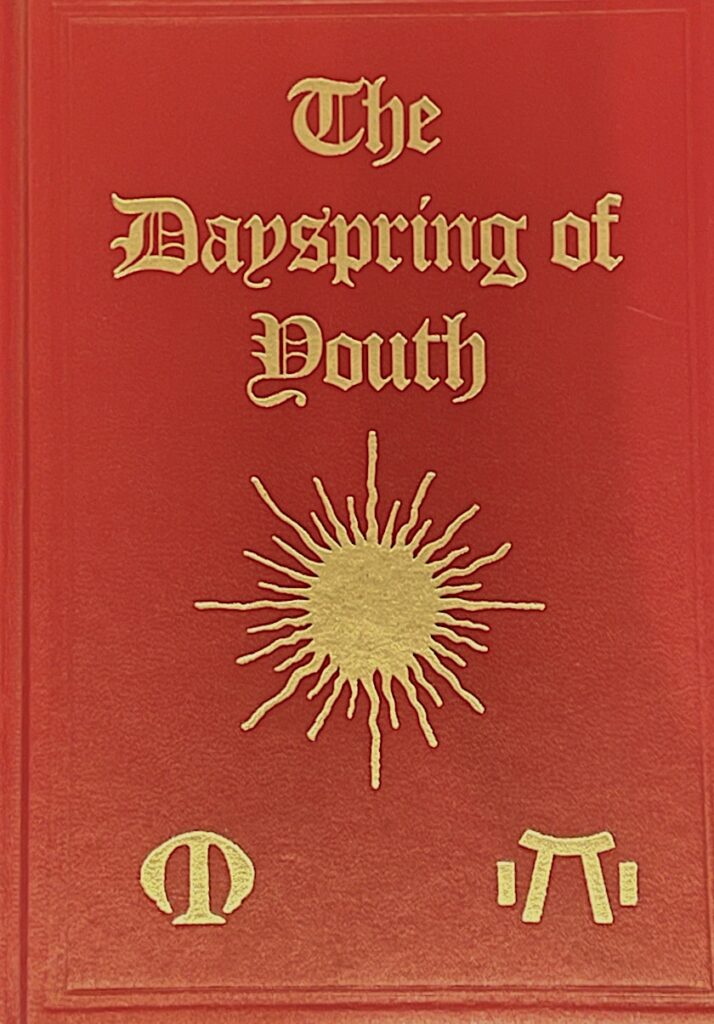
The Dayspring of Youth
About This Publication
The Dayspring of Youth, first published in 1931 as the prequel to The Lord God of Truth Within by Ernest Thurston under the pseudonym “M,” serves as his principal text for a spiritual system known as Western Yoga. While it incorporates universal mystical concepts, the book does not merely reiterate traditional Eastern methods. Rather, it adapts the fundamental aims of spiritual development to align with the lives, cultures, and psychological frameworks of Western individuals. The text synthesizes mysticism, esoteric philosophy, psychology, cosmology, and practical spiritual exercises to provide a comprehensive guide for personal transformation.
The central theme of the book is that humanity is experiencing a significant period of transformation. M asserts that the universe continually evolves through expansive cycles. At specific intervals, new spiritual energies emerge, offering opportunities for accelerated growth and transformation. The title, “Dayspring of Youth,” denotes one such occasion, signifying the introduction of a new spiritual force into human existence and the natural world. This force initiates a new cycle, enabling individuals to transcend outdated thought patterns and spiritual limitations. The author characterizes these influences as streams of cosmic energy entering Earth’s atmosphere during pivotal periods of change. Individuals do not generate these forces; rather, they receive them. The essential task is to develop the capacity to respond appropriately. Those who cling to established habits and beliefs frequently experience conflict and confusion, whereas those who adapt to the new energies participate in spiritual renewal. The text encourages readers to view personal growth as an integral component of a broader global transformation.
In contrast to many occult texts that emphasize esoteric knowledge, The Dayspring of Youth adopts a highly practical approach. M frequently emphasizes that genuine spiritual progress necessitates holistic transformation. Thoughts, emotions, habits, physical health, and behavior must all be harmonized with higher principles. Spirituality, according to the text, is not limited to beliefs or abstract ideas; it constitutes an active process that transforms every aspect of life. This emphasis on practicality underpins the central teaching of Western Yoga. M observes that many spiritual systems originated in cultures distinct from those of contemporary Europe and America. While expressing respect for Eastern traditions, he contends that Western practitioners require methods tailored to their specific contexts. Western Yoga prioritizes transformation within daily life rather than withdrawal from society. Practitioners are encouraged to remain engaged with familial, occupational, and social responsibilities while simultaneously pursuing inner development.
The objective of this system is not to evade the physical world but to enhance the body, emotions, and mind, which serve as instruments for spiritual awareness. The body is regarded as a tool that can be refined over time through healthy living, clear thinking, and the judicious use of subtle energies. The mind is conceptualized as a laboratory for cultivating higher faculties. Spiritual growth is depicted as an integrative process that unifies all aspects of life rather than renouncing them. A distinctive concept presented in the book is “The Churning of the Butter.” Derived from ancient esoteric symbolism, this metaphor represents the process of inner purification. Analogous to the production of butter from milk, the more refined spiritual elements within an individual must be separated from the denser, material habits that obscure them. This process is neither simple nor comfortable; it requires confronting ingrained habits, desires, fears, and limitations accumulated over a lifetime. Through sustained effort, higher qualities gradually emerge as lower tendencies diminish.
This process of purification constitutes a central theme in the text. Spiritual growth is depicted as a gradual transformation of awareness rather than an abrupt breakthrough. Practitioners frequently encounter resistance from entrenched patterns of thought and behavior. Progress requires patience, persistence, and the capacity to navigate uncertainty. The churning metaphor illustrates that substantive change results from continuous effort and adaptation, rather than passive contemplation. Energy management is intimately connected to this transformative process. M conceptualizes individuals as centers of energy operating within broader networks of natural and cosmic forces. Each thought, emotion, and action influences the movement of these energies. A significant portion of the text is devoted to explaining the creation, dissipation, conservation, and utilization of energy. Negative emotions are portrayed not merely as psychological phenomena but as disruptions to the natural flow of vital energy. Cultivating harmony, discipline, and self-control facilitates the entry and transformative effect of higher energies.
The author’s treatment of energy is notable for its integration of mystical and scientific terminology. Spiritual forces are articulated through concepts such as vibration, radiation, magnetism, and subtle atomic processes. M frequently endeavors to demonstrate that spiritual development adheres to discernible laws rather than arbitrary religious prescriptions. The universe is depicted as an orderly system governed by principles that can be understood and applied. In this respect, the book exemplifies early twentieth-century attempts to reconcile spiritual concepts with scientific understanding. Another central concept concerns the individual’s relationship to the broader universe. Individuals are portrayed as integral components of an expansive, living system that transcends perceptible reality. Every action, thought, and aspiration contributes to larger transformations within the world. Consequently, spiritual growth entails ethical responsibilities. Increased awareness necessitates learning to balance personal needs with the welfare of others and the broader world.
Throughout the text, M repeatedly emphasizes the importance of self-observation. Practitioners are encouraged to monitor their thoughts, emotions, motives, and reactions with diligence. Genuine self-knowledge is presented as the foundation for all progress. In its absence, spiritual practices risk devolving into empty routines or self-deception. The gradual cultivation of awareness reveals latent internal forces and equips individuals with the means for authentic transformation. Despite its emphasis on discipline, the book maintains an optimistic tone. The Dayspring force is depicted as benevolent and constructive. Humanity is portrayed as approaching a new phase of development. The challenges of contemporary life are interpreted not as indicators of decline, but as evidence of emerging opportunities. The fading of traditional patterns is attributed to the advent of new possibilities. Individuals who engage with this process are positioned to contribute to renewal both personally and collectively.
Although The Dayspring of Youth functions as a practical manual, it also presents a comprehensive cosmological perspective. M depicts the universe as characterized by intelligence, purpose, and continual growth. Life acquires significance through participation in this broader movement. Spiritual practice is framed not as an escape from reality, but as a means of deeper engagement with it. Practitioners are taught to recognize the subtle forces influencing their lives and the world, and to align themselves with those that foster growth and harmony. The significance of the book becomes more apparent when considered alongside its companion volume, The Lord God of Truth Within. The Dayspring of Youth establishes foundational concepts such as cosmic energies, Western Yoga, self-purification, and energy management. The subsequent text concentrates on the realization of God and the unification with the divine within. Collectively, these works constitute a comprehensive system: the first volume provides the groundwork for transformation, while the second addresses the advanced stages attainable once the foundation is established.
The London Interwar Occult Scene
The Lord God of Truth Within emerged from a small but unusually interconnected circle of occultists, publishers, writers, and spiritual seekers active in London between the First and Second World Wars. The book cannot be understood fully as the work of a single isolated author. It was the product of a living spiritual network centered upon Ernest Thurston, his students, and the occult publishing world that preserved his teachings after his death. Around this circle moved Michael Juste, Paul Brunton, Aleister Crowley, and figures linked with both Western ceremonial magic and the growing Western interest in Buddhism, Yoga, and Indian philosophy.
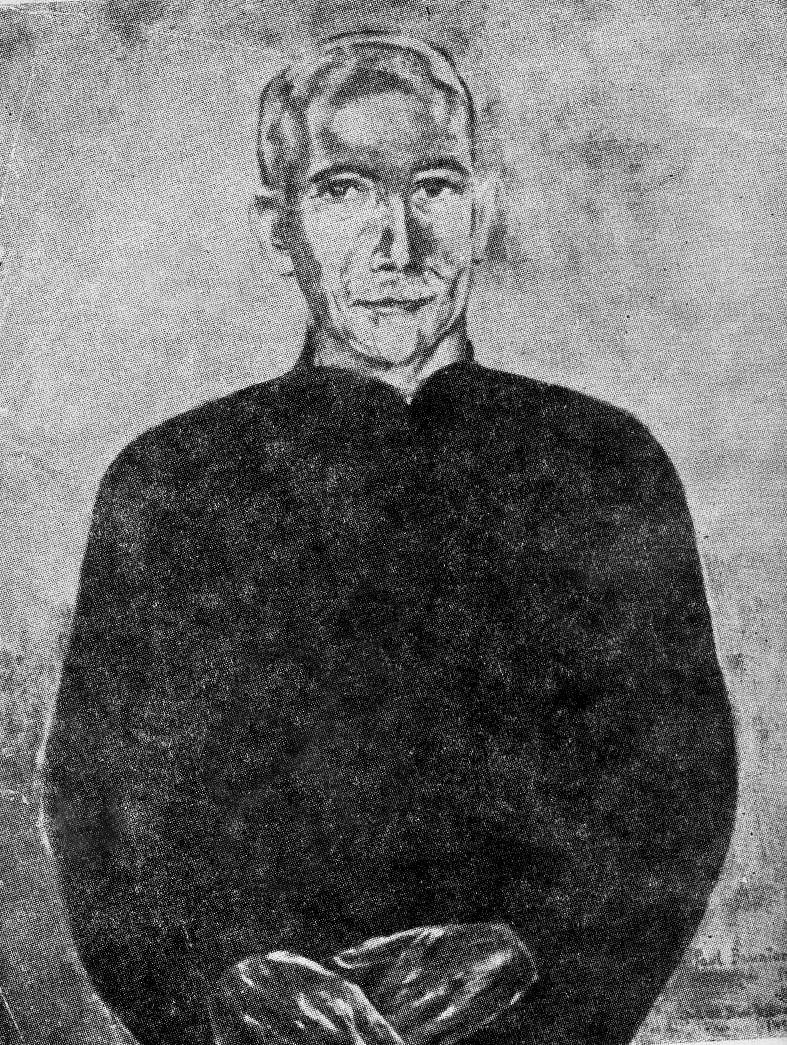
At the center of the story was Ernest Thurston, an American painter and intensely private spiritual teacher who lived in London and wrote under the single initial “M.” His students also knew him as “Brother M.” He deliberately concealed his identity because he did not want the teaching to become attached to his personality. His objective was not to establish himself as a public guru but to communicate a practical spiritual method through which Western students could discover the divine presence within themselves. Thurston taught what his followers described as Western Yoga. By this, he did not mean that Yoga had been invented in the West or separated from its Eastern foundations. He meant that the central work of spiritual realization had to be expressed in a form suitable for men and women living within Western civilization. His students were not expected to withdraw into monasteries, imitate Indian customs, or abandon their ordinary responsibilities. They were expected to use work, relationships, mental discipline, bodily energy, meditation, and service as instruments of inner development.
The foundation of Thurston’s system appeared in The Dayspring of Youth, originally published in 1931 and later in 1985 by the Yogi Publication Society. That book introduced the preliminary principles of his teaching, including the hidden forces operating within nature, the relationship between the physical body and subtler forms of energy, and the exercises required to awaken the dormant powers of consciousness. It functioned as an introductory manual for students beginning the work of self-transformation.
Thurston died in the mid-1920s while still working upon the manuscript. The survival of The Lord God of Truth Within therefore depended upon his immediate circle of students. They gathered his private journals, diaries, handwritten papers, and unfinished chapters, then attempted to arrange them without distorting the original teaching. The book was not written from beginning to end as a finished volume shortly before publication. It was reconstructed from materials left behind by a teacher whose students believed that his final and deepest work should not be lost.
Michael Juste
The most important figure in preserving those materials was Michael Houghton, better known by his literary name Michael Juste. Born in 1897, Juste was a poet, writer, printer, bookseller, and organizer who became one of the central connecting figures in London’s occult community. He was not simply a publisher of Thurston’s writings. He had studied directly under him and regarded Brother M as a genuine spiritual teacher. Juste helped gather and organize Thurston’s manuscripts after his death. His role placed him between the private instructional circle surrounding “Brother M” and the public world of occult publishing. Without that work, Thurston’s teaching might have survived only in scattered notebooks and private memories.
Juste later founded the Atlantis Bookshop in Bloomsbury. The shop became far more than a retail business. It served as a meeting place where ceremonial magicians, Theosophists, witches, mystics, writers, artists, Buddhists, and students of Yoga encountered one another. London’s occult world was not divided into clean, isolated movements. People moved between groups, shared books, attended lectures, argued over doctrine, and carried ideas from one circle into another. Atlantis became one of the physical locations where those exchanges occurred. Juste also attempted to bring these voices together through The Occult Observer, issued during 1949 and 1950. The journal reflected his belief that serious forms of mysticism, occultism, comparative religion, and spiritual philosophy should be placed into conversation rather than treated as unrelated movements.

Paul Brunton
Paul Brunton was another member of Thurston’s circle. Born Raphael Hurst in 1898, he later became one of the best-known interpreters of Indian spirituality for Western readers. Long before he traveled to India and met Ramana Maharshi, Brunton studied under “Brother M” in London. Thurston was not a minor preliminary influence that Brunton quickly discarded. He was one of the formative teachers of Brunton’s early spiritual life. The importance of that relationship is reflected in Brunton’s decision to name his son Kenneth Thurston Hurst in honor of his teacher. Throughout his later life, Brunton continued recommending The Dayspring of Youth to serious students. Although he became famous for describing his travels through India, his intellectual and spiritual formation had begun within London’s interwar occult world.
The Great White Brotherhood
Brunton and Michael Juste were close companions during their early years. They attempted to establish an esoteric bookshop together in the early 1920s, although the venture failed financially. Their relationship was later preserved in Juste’s 1927 autobiographical occult novel The White Brother, in which the character “David” was modeled upon Brunton. The title The White Brother placed their relationship within the language of the Great White Brotherhood. In Theosophy and related esoteric traditions, this Brotherhood was understood as a hidden hierarchy of spiritually advanced beings guiding human evolution. The word “white” referred to benevolent or constructive spiritual power rather than ethnicity.
Thurston’s students appear to have regarded him as either an earthly representative of such an inner order or as someone who had attained conscious relationship with it. The title “Brother M” therefore carried more than affectionate familiarity. It suggested initiation, service, and participation in an invisible spiritual fraternity. Brunton’s own understanding of this idea became more philosophical over time. He eventually rejected the literal Theosophical picture of physical Mahatmas living secretly in remote Tibetan residences, calling that interpretation romantic fiction. For him, the true Brotherhood was better understood as a condition of spiritual consciousness and inner realization. Spiritually advanced individuals might participate in the same universal wisdom without belonging to a visible organization or gathering physically in one location.
Aleister Crowley
Aleister Crowley occupied a very different position within this network. He was not a disciple of Thurston, and his methods and personality were often far removed from the disciplined inward spirituality associated with Brother M. Yet Crowley’s presence was impossible to avoid within the London occult world. He was the most controversial ceremonial magician of the period, the founder of Thelema, and a figure whose writings circulated through the same shops, journals, and private circles. Crowley was a regular presence at the Atlantis Bookshop. His relationship with Michael Juste was frequently hostile but enduring. They argued about royalties, book sales, personal behavior, and the purpose of magic. Crowley could be demanding, insulting, and disruptive, while Juste did not hesitate to confront him. Nevertheless, Juste recognized Crowley’s intellectual ability and continued to stock and circulate his works. At a time when many publishers and booksellers avoided Crowley, Atlantis provided him with one of his remaining points of contact with serious occult readers.
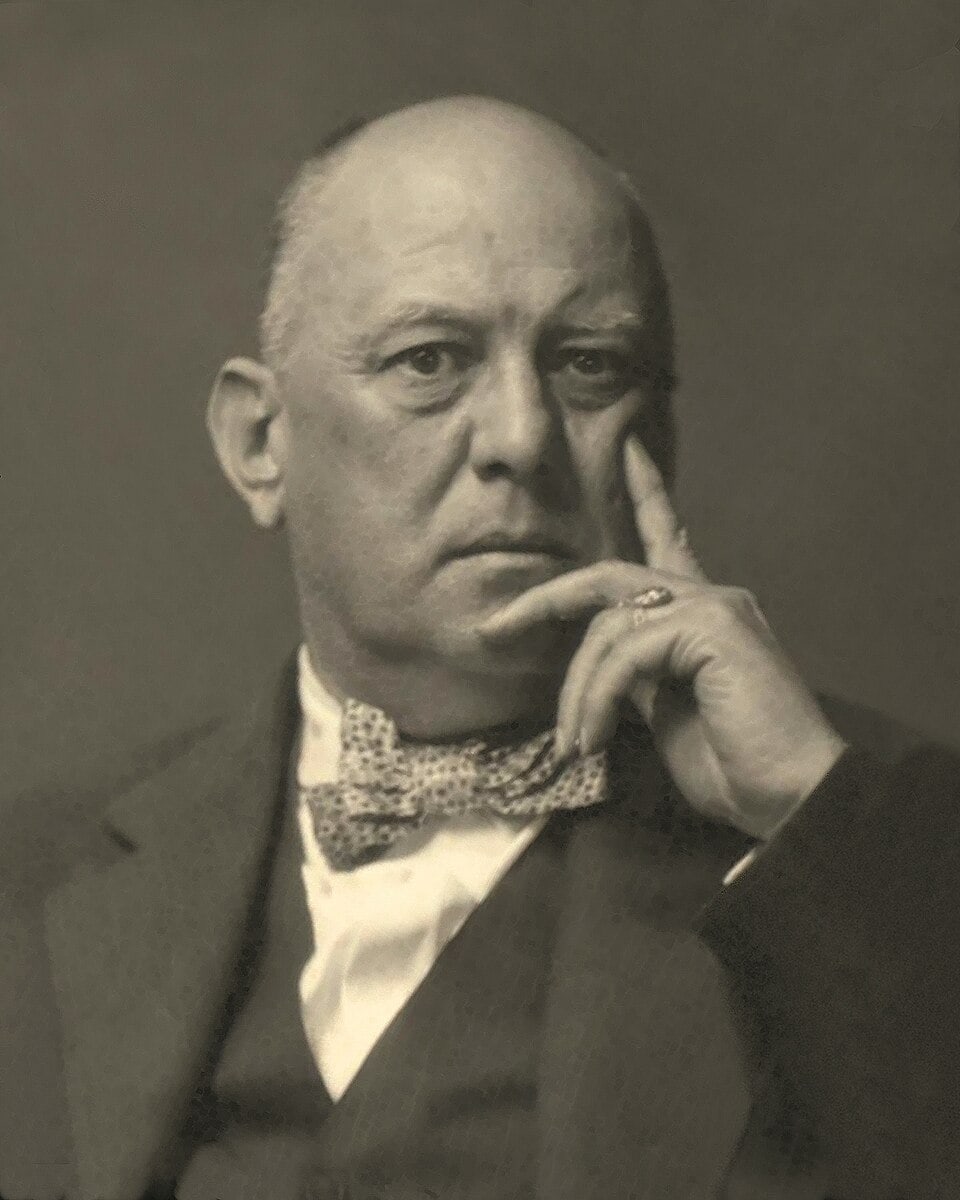
Crowley’s importance to this story is therefore not that he directed Thurston’s circle, but that the same publishing and social environment brought their worlds into proximity. The Atlantis Bookshop could contain works on Yoga, Hermeticism, Buddhism, Theosophy, ceremonial magic, alchemy, Christian mysticism, and Thelema on the same shelves. Students who entered through one tradition could easily encounter another.
Charles Henry Allan Bennett
Allan Bennett, later known as Bhikkhu Ananda Metteyya, created another bridge within this environment. Bennett had been Crowley’s most important early teacher in the Hermetic Order of the Golden Dawn. He instructed Crowley in ceremonial magic, the Qabalah, Yoga, meditation, and Eastern philosophy before abandoning magic and becoming a Theravāda Buddhist monk. Bennett later became connected with Brunton’s London education as a secondary mentor. This placed Brunton within a chain of teachings extending from the Golden Dawn into Buddhism and modern Western interpretations of Yoga. Through Thurston, Brunton received a system of inward realization adapted to Western life. Through Bennett, he encountered someone who had passed directly from Western ceremonial occultism into Asian monastic Buddhism.

Conclusion
These relationships demonstrate how misleading it would be to treat the London occult scene as a set of isolated schools. Thurston’s Western Yoga, Bennett’s Buddhism, Crowley’s Thelema, Brunton’s search for Indian wisdom, Juste’s publishing work, and the Theosophical idea of the Great White Brotherhood all overlapped through friendships, bookshops, lectures, manuscripts, and shared students. The publication history of The Lord God of Truth Within is a main part of this network. Thurston supplied the original teaching. His disciples preserved the unfinished materials. Michael Juste and the London circle organized the literary remains. Manly P. Hall, already internationally known through The Secret Teachings of All Ages, recognized the value of the work and helped bring it into print through Phoenix Press in Los Angeles.
The book finally appeared in 1941, nearly fifteen years after Thurston’s death, with the subtitle A Posthumous Sequel to The Dayspring of Youth. The decision to publish it under the name “M” preserved the anonymity Thurston had maintained during his lifetime. The students and publishers did not attempt to turn his private identity into a commercial attraction. They treated the teaching as more important than the teacher’s public reputation. This history also explains why the book sometimes feels like both a personal revelation and the statement of a school. Its voice belongs to Thurston, but its surviving form was shaped by a circle of disciples committed to preserving his thought. It emerged from private instruction, handwritten notes, spiritual relationships, and the cooperative work of students and publishers.
The Lord God of Truth Within is therefore more than an advanced manual of Western Yoga. It is a surviving document from the interwar London occult world, a setting in which Eastern and Western traditions were being actively compared, adapted, and recombined. Its teaching of the divine center within the individual belongs to the same general search that drew Brunton toward India, Bennett toward Buddhism, Juste toward occult publishing, and even Crowley toward his own doctrine of True Will. Yet Thurston’s path remained distinct. He did not seek notoriety, ceremonial rank, or public authority. His work emphasized inward realization, disciplined transformation, compassion, and responsibility toward nature. The true spiritual master, in this view, was not the loudest personality or the founder of the largest organization. It was the divine intelligence within each person, gradually awakened through practice until the lower personality became a conscious instrument of a greater life.