Ernest Lawton Thurston (1873–?) was an American educator, author, and mystic who spent the later part of his life in London. During his public career, Thurston achieved prominence as an educator, textbook author, school administrator, Superintendent of Public Schools for the District of Columbia, and trustee of George Washington University. Privately, however, he devoted himself to meditation, mysticism, and esoteric philosophy, carefully concealing this aspect of his life behind the anonymous initial “M.” Best known for developing a system of spiritual training that he called Western Yoga, his writings—particularly The Dayspring of Youth—later became influential within modern Western esoteric and yogic circles.
Educational Career
Thurston established a distinguished reputation in American education during the early twentieth century. He served as Superintendent of Public Schools for the District of Columbia throughout the 1910s and early 1920s, where he became known as an educational administrator and advocate for public instruction.
Alongside his administrative work, he authored several successful educational texts, including Business Arithmetic for Secondary Schools (1913), Our Surroundings: A Complete General Science, and the juvenile novel The Young Boss of Camp Eighteen. His standing within Washington’s academic community also led to his appointment as a trustee of George Washington University.
Throughout this period, nothing in his public career suggested his deep involvement in mysticism or esoteric philosophy.
London and the Hidden Mystic
Following his educational career, Thurston settled in London, where he devoted himself increasingly to spiritual study and teaching. There he gathered a small circle of students who knew him simply as “Brother M.” Believing that genuine spiritual teaching should stand on its own rather than depend upon the personality of its author, he deliberately concealed his identity and published his mystical writings anonymously under the single initial “M.”
Thurston sought neither publicity nor the role of a public guru. His objective was to communicate a practical method through which Western students could discover the divine presence within themselves while remaining fully engaged in ordinary life.
Western Yoga
The system Thurston called Western Yoga was not intended to replace or separate itself from the Eastern traditions from which it drew inspiration. Rather, he believed that the universal principles of yoga should be expressed in a form suited to the conditions of modern Western civilization.
Instead of encouraging students to withdraw into monasteries, imitate Indian customs, or abandon their ordinary responsibilities, Thurston taught that work, family life, mental discipline, physical vitality, meditation, and service to others could all become instruments of spiritual development. The goal was not escape from the world but the awakening of the divine presence within the individual while living an active and balanced life.
His teaching combined elements of Vedanta, Christian mysticism, Western esotericism, and yogic psychology into a unified system designed specifically for Western students.
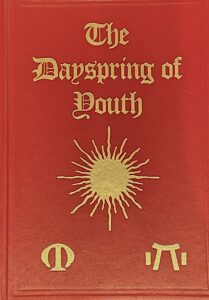
The Dayspring of Youth
Thurston’s principal work, The Dayspring of Youth, was first published anonymously in 1931 under the name “M.” The book introduced the foundational principles of Western Yoga, exploring the hidden forces operating throughout nature, the relationship between the physical body and subtler forms of energy, and the practical exercises required to awaken dormant powers of consciousness.
Rather than presenting abstract philosophy alone, the work served as an introductory manual for students beginning the process of self-transformation. It emphasized disciplined meditation, self-observation, ethical living, and the gradual refinement of both mind and body as essential stages in spiritual development.
The book was later republished by the Yogi Publication Society, introducing Thurston’s teachings to a new generation of readers interested in comparative mysticism, yoga, and Western spiritual traditions.
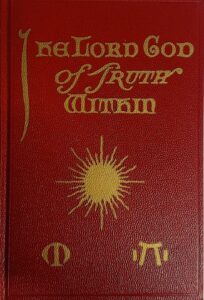
The Lord God of Truth Within
Thurston died before completing what his students regarded as his most important manuscript, The Lord God of Truth Within. Rather than allowing the work to disappear, his close circle of students gathered his private journals, diaries, handwritten manuscripts, and unfinished chapters, carefully arranging them into a coherent volume while striving to preserve his original teaching.
Consequently, the book was not written as a finished manuscript shortly before publication but reconstructed from the materials Thurston left behind during the final years of his life. His students regarded its publication not simply as an editorial undertaking but as the preservation of the mature expression of his lifelong spiritual work.
Legacy
For many years the identity of the mysterious author known only as “M.” remained unknown. Later historical research and copyright records identified him as Ernest Lawton Thurston, revealing that one of Washington, D.C.’s most respected educators had simultaneously devoted his private life to developing a sophisticated system of Western mysticism.
Today, Thurston is remembered both for his contributions to American education and for his philosophy of Western Yoga, which sought to harmonize Eastern spiritual disciplines with the realities of Western life. His writings continue to be valued by students of comparative religion, Christian mysticism, yoga, and Western esotericism for their practical approach to meditation, self-transformation, and the realization of the divine presence within the individual.