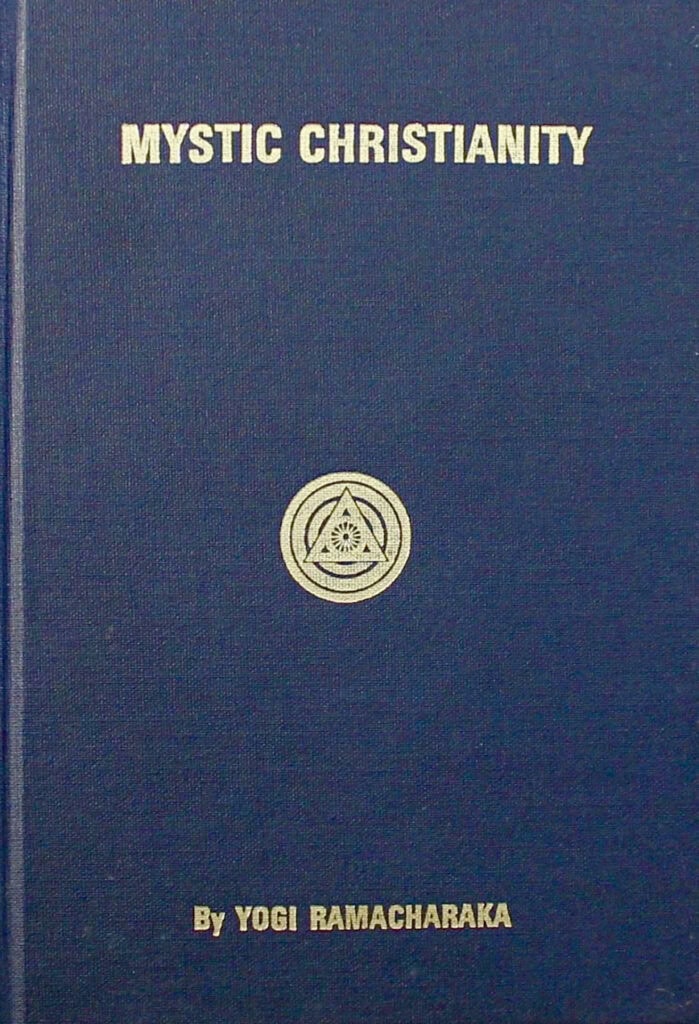
Mystic Christianity; or, The Inner Teachings of the Master is a twelve-lesson interpretation of the life and teachings of Jesus published by the Yogi Publication Society and attributed to Yogi Ramacharaka. Rather than presenting Christianity as a religious system fundamentally separate from the other traditions explored throughout the Ramacharaka books, Mystic Christianity argues that beneath the public doctrines, ceremonies, and theological disputes of Christianity lies an older esoteric teaching belonging to the same universal spiritual philosophy found beneath the world’s other religions.
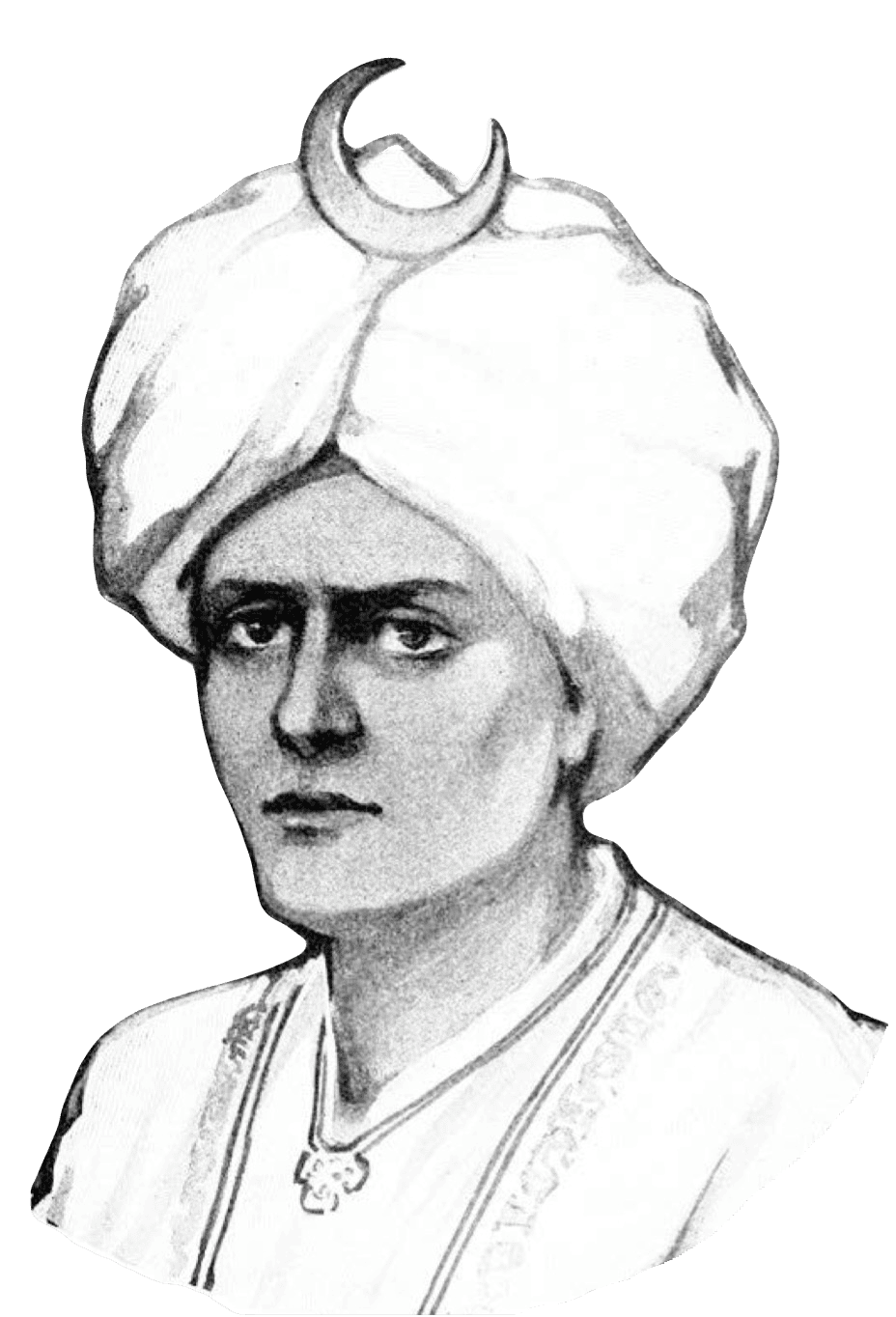
Yogi Ramacharaka
Jesus is presented not simply as the founder of a new religion, but as a supreme spiritual Master whose public teachings concealed deeper truths concerning God, the soul, reincarnation, Karma, spiritual evolution, the powers of mind, the divinity within humanity, and the attainment of higher consciousness. The book’s purpose is to recover what it calls the “Inner Teachings” of Christianity and to interpret the Gospel narratives through the occult philosophy already developed throughout the Yogi philosophy series. Near the end of the work it states this position explicitly: there is ultimately “but one real Occult Philosophy,” and the teachings presented in Fourteen Lessons in Yogi Philosophy, the Advanced Course, and Gnani Yoga provide the philosophical key through which the inner meaning of Christianity can be understood.
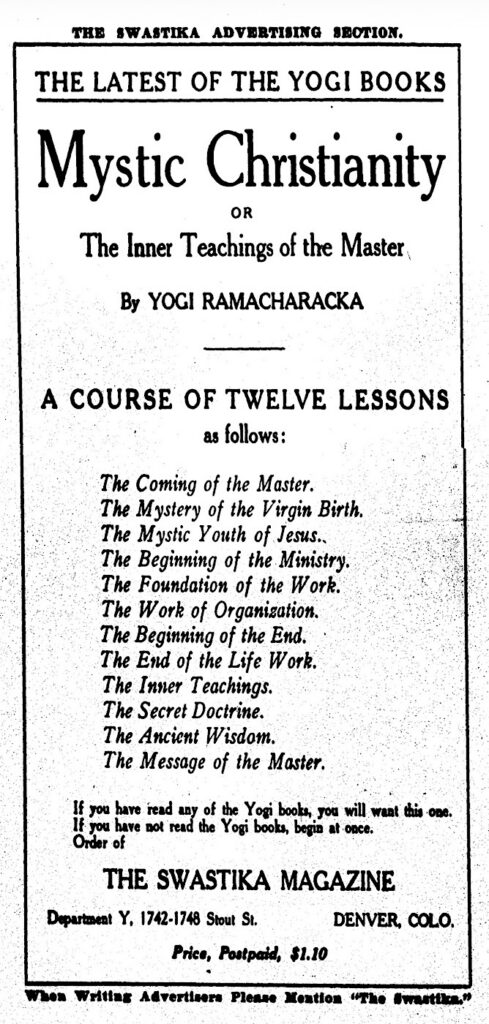
The book is both a retelling of the life of Jesus and an esoteric reinterpretation of Christianity. Its first eight lessons follow Jesus from the appearance of John the Baptist through his ministry, crucifixion, and continuing spiritual existence, while its final four lessons explain what the author believes those events actually mean. The twelve lessons are titled “The Coming of the Master,” “The Mystery of the Virgin Birth,” “The Mystic Youth of Jesus,” “The Beginning of the Ministry,” “The Foundation of the Work,” “The Work of Organization,” “The Beginning of the End,” “The End of the Life Work,” “The Inner Teachings,” “The Secret Doctrine,” “The Ancient Wisdom,” and “The Message of the Master.” This structure is important because the book gradually shifts the reader away from biography and toward doctrine. The story of Jesus becomes the vehicle through which Ramacharaka develops a much larger argument: Christianity originally possessed an esoteric dimension, Jesus transmitted different levels of instruction according to the preparedness of his hearers, and the deeper doctrines of the early movement were eventually obscured as Christianity became an institutional religion.
What Does Mystic Christianity Teach?
The central teaching of Mystic Christianity is that there are two levels at which Christianity may be understood. The first is the outer, or exoteric, religion available to the general population through scripture, preaching, moral instruction, ritual, and institutional Christianity. The second is the inner, or esoteric, teaching intended for those capable of understanding the spiritual principles beneath the outward forms. According to the book, Jesus deliberately taught at both levels. The multitudes received parables, ethical teachings, healings, and simplified statements of spiritual truth, while the disciples, and particularly the Twelve, received deeper explanations privately. Ramacharaka treats this distinction as essential to understanding passages in which Jesus explains that mysteries are given to certain disciples while the wider public receives teachings through parables. In the book’s reconstruction, Christianity began much like an occult school: there were degrees of understanding, an outer teaching for the many, and an inner teaching communicated to prepared students. The Twelve ultimately become more than followers. After receiving the deeper principles of the teaching, they become transmitters of the Master’s work themselves.
From this foundation, Mystic Christianity identifies several ideas as belonging to the inner Christian doctrine:
God is not merely a distant external ruler but an immanent spiritual Reality present throughout creation.
The Kingdom of Heaven is fundamentally an inner spiritual condition rather than simply a future geographical or supernatural realm.
Humanity contains an indwelling spiritual principle through which the individual may consciously approach the Divine.
The soul undergoes spiritual evolution, with reincarnation and karma forming part of the larger process.
Jesus represents an extraordinary manifestation of spiritual consciousness and a unique relationship between humanity and the Divine.
The miracles and healings of Jesus operate through spiritual and occult laws rather than violations of natural law.
Religious forms, institutions, and ceremonies are secondary to direct spiritual realization.
The same fundamental spiritual truth can be found beneath Christianity and the other great religious and philosophical traditions.
These principles provide the interpretive framework for virtually everything that follows. The Gospel narratives are repeatedly read not as isolated supernatural events but as outward manifestations of universal laws. What orthodox Christianity calls miracles, Ramacharaka frequently describes as advanced applications of forces inherent within nature. What theology describes as mysteries requiring unquestioning belief, the book attempts to reinterpret as occult truths capable of philosophical explanation. Christianity becomes another expression of what the Ramacharaka books call the Ancient Wisdom.
The Life of Jesus Through the Inner Teachings
John the Baptist and the Esoteric Origins of Christianity
The story begins not with the birth of Jesus but with John the Baptist, whom Mystic Christianity presents as far more than the wilderness preacher familiar from conventional Christian accounts. John is described as an initiate trained in the inner traditions of Hebrew mysticism and associated with the Essenes, whom the book portrays as an ancient Hebrew occult brotherhood. According to this reconstruction, John had access from youth to the “Inner Teachings” of the priesthood, including the Kabbalah, later withdrew into an ascetic life, and became connected with the Essene order. The Essenes are described as maintaining strict initiatory requirements, degrees of advancement, poverty, continence, discipline, mystical knowledge, and the ceremonial use of baptism. The book further attributes to them doctrines including reincarnation and the immanence of God and argues that John’s transmission of these ideas created an important bridge between older esoteric traditions and Christianity.
John’s baptism receives an occult interpretation. Water baptism is not merely a Christian ceremony but an initiatory rite with an older mystical history. When Jesus eventually appears before John, the encounter is presented as a meeting between initiates who recognize one another’s spiritual standing. John recognizes Jesus as belonging to a higher occult rank and initially hesitates to baptize him. Jesus nevertheless accepts the rite as an identification with the people and the beginning of his public mission. In this way, the opening of Mystic Christianity immediately establishes one of the book’s recurring arguments: the origins of Christianity cannot be understood in isolation. They belong to a much older stream of initiatory and mystical teaching.
The Magi and the Coming of Jesus
The familiar Wise Men of the Nativity story are likewise reinterpreted as the Magi, members of ancient Eastern priestly and occult traditions. Ramacharaka emphasizes that the Greek text of Matthew uses the term “Magi” and identifies these figures with the learned mystical orders of Persia, Media, and Chaldea. They are portrayed as custodians of ancient occult knowledge who preserved what the book calls the Flame of Mysticism through successive generations. Their appearance at the birth of Jesus is given a much larger significance than the conventional image of three foreign visitors bringing gifts. Within the narrative of Mystic Christianity, representatives of the Eastern wisdom tradition recognize that an extraordinary spiritual being has entered the world.
This theme connects directly with the book’s conception of Jesus. The Master does not emerge in spiritual isolation. His life is placed within a network of Hebrew mysticism, Essene initiation, Eastern wisdom, and ancient occult brotherhoods. The coming of Christ is portrayed as an event recognized by spiritually advanced individuals across traditions. Christianity, in this interpretation, grows from the same perennial spiritual source from which other great religions have emerged.
What Does Mystic Christianity Say About the Virgin Birth?
The second lesson directly confronts the doctrine of the Virgin Birth, contrasting orthodox Christian theology with rationalist, Higher Critical, and comparative-religion interpretations before presenting what the author calls the occult explanation. Ramacharaka does not simply repeat the conventional theological doctrine, but neither does he believe that rejecting the doctrine entirely solves the underlying mystery. Instead, he relocates the meaning of “virgin birth” from the physical circumstances of conception to the spiritual nature of Jesus himself.
The later explanation of the Inner Teachings makes the distinction explicit. Jesus possesses what the book calls a “virgin soul.” Unlike ordinary human souls, which it describes as progressing through repeated incarnations and accumulating karmic consequences, the soul of Jesus is presented as newly issuing from the Divine Source and not burdened by the karma of previous earthly lives. He is described as a “Free Spirit” and an “Unbound Soul.” The mystical significance of the Virgin Birth is primarily metaphysical. Jesus’ uniqueness rests not merely upon an extraordinary physical birth but upon the condition and origin of the consciousness incarnating through him.
This distinction becomes crucial to the theology of the entire book because Ramacharaka separates Jesus the human personality from the greater spiritual principle manifested through him. The life of Jesus becomes a process in which an exceptionally pure human vehicle increasingly realizes and expresses the Divine. The importance of Christ is preserved, but explained through the vocabulary of occult evolution, consciousness, and spiritual manifestation rather than through conventional dogmatic theology alone.
The Lost Years and the Mystic Youth of Jesus
The years between Jesus’ childhood and the beginning of his public ministry become especially important because Mystic Christianity attempts to fill the silence left by the canonical Gospels with traditions preserved, according to the author, among occult brotherhoods. Jesus is portrayed as intellectually and spiritually precocious from childhood, interested less in the literal forms of Hebrew scripture than in the spiritual principles underlying them. The book describes Nazareth as situated along caravan routes traveled by people from Samaria, Jerusalem, Damascus, Greece, Rome, Arabia, Syria, Persia, Phoenicia, and other regions, giving the young Jesus opportunities to encounter travelers carrying religious, philosophical, and mystical ideas from many lands.
From there, the narrative places Jesus within a much wider Eastern spiritual world. His development is understood as a period of study, initiation, and preparation through which the young mystic becomes acquainted with the deeper wisdom preserved in various traditions. Whether treated historically or as part of the occult tradition the book claims to transmit, these episodes serve a clear philosophical purpose: Jesus’ teachings are presented as participating in universal wisdom rather than appearing without intellectual or spiritual antecedents. The Christianity of Mystic Christianity is deliberately universalized. Jesus is Jewish, but the truths he embodies are not confined to Judaism; his message eventually transcends nationality, institution, and creed because the laws he teaches are understood as universal spiritual laws.
The Beginning of the Ministry
When Jesus returns to public life, John the Baptist is already preparing the population for the coming of a greater teacher. Following the baptism, Jesus enters the decisive phase of his mission. The traditional episodes surrounding the beginning of the ministry are interpreted psychologically and mystically. The “temptation” is not merely an encounter with an external devil but part of the Master’s confrontation with the possibilities and dangers accompanying extraordinary spiritual power. The question becomes whether power will be used for personal gratification, worldly authority, spectacle, or the service of the spiritual mission.
The ministry that follows combines preaching with extraordinary healing. Yet Mystic Christianity repeatedly resists describing these acts as supernatural violations of nature. The author instead argues that they are manifestations of laws that ordinary humanity does not yet understand. In discussing healing at a distance, for example, the book explicitly compares the process to what contemporary metaphysical movements called “absent treatment,” describing it as an application of subtle natural forces brought into operation through mental concentration rather than a suspension of natural law. This distinction is fundamental to the Ramacharaka interpretation of Jesus. The Master’s greatness is not diminished by placing his works under natural law. On the contrary, his mastery of those laws demonstrates the extraordinary degree of his spiritual development.
Healing, Mental Power, and Natural Law
Healing occupies an important but carefully limited position in the narrative. Jesus attracts enormous attention because of his ability to relieve suffering, but the book insists that healing was not the primary purpose of his mission. At one point he deliberately leaves Capernaum because the crowds of invalids seeking cures threaten to transform him into what the author calls a “professional healer” rather than a teacher of Truth. Even after leaving, however, he continues to heal as an incident of the larger ministry.
This distinction allows Mystic Christianity to connect the Gospel healings with the mental and psychic philosophy found throughout the Yogi Ramacharaka books. Faith, receptivity, mental influence, concentration, spiritual force, and the relationship between mind and body become mechanisms through which at least some of the healing accounts are interpreted. The miraculous is not discarded but reclassified. A phenomenon may appear miraculous because the observer does not understand its cause, while still operating according to law. Jesus represents mastery rather than exemption from law.
This is one of the most important recurring ideas in the book: spiritual truth and natural law cannot ultimately contradict one another. The more developed individual understands forces that remain invisible or mysterious to others. Jesus’ extraordinary works become evidence of higher knowledge and spiritual attainment rather than evidence that nature temporarily ceased to operate.
The Ministry and Organization of the Christian Movement
The Foundation of the Work
As the ministry develops, Jesus begins building an organization capable of preserving his teachings after his death. The disciples become increasingly important, and the selection of the Twelve represents a decisive transition. Mystic Christianity argues that Jesus knew the public phase of his work would be brief and concentrated upon preparing a small group capable of transmitting the deeper teaching. The Twelve receive instruction unavailable to the general population.
This distinction between the multitude and the initiated disciples becomes the book’s explanation for why many sayings of Jesus appear cryptic, paradoxical, or incomplete when read only at the literal level. The public teaching was adapted to ordinary consciousness; the inner interpretation was given to those prepared to receive it. Mystic Christianity maintains that Jesus’ ability to transmit this deeper understanding explains the survival and extraordinary expansion of the Christian movement after his death. Mere enthusiasm for a departed teacher, the author argues, would not have been sufficient. Jesus had effectively communicated his spiritual “spirit” and fundamental principles to prepared successors.
The Sermon on the Mount as an Esoteric Teaching
The Sermon on the Mount occupies a particularly important position. Rather than treating it merely as a collection of moral commandments, Ramacharaka regards it as one of the clearest public expressions of the Master’s Inner Teaching. Although spoken before a multitude, it is portrayed as being directed especially toward the disciples who possessed the interpretive key required to understand its deeper significance. The book explicitly states that the sermon can be properly understood only through the “Master Key of the Inner Teachings.”
This approach transforms sayings about the Kingdom of Heaven, purity of heart, nonresistance, prayer, judgment, worldly anxiety, spiritual treasure, and trust in God into instructions concerning states of consciousness. The Kingdom is inward. Purity involves consciousness rather than merely ceremonial observance. Prayer becomes communion with the Divine rather than an attempt to persuade a distant deity. Faith expresses an alignment of consciousness with spiritual reality. The command to seek the Kingdom first becomes an instruction to establish inner spiritual consciousness before pursuing external conditions.
The Work of Organization
Jesus’ movement continues to grow, but the expansion brings increasing conflict. Mystic Christianity depicts him as simultaneously organizing his followers, establishing centers of teaching, training disciples, healing the sick, and confronting the religious formalism of the period. His opposition to excessive ceremonialism becomes particularly important. Ramacharaka repeatedly portrays Jesus as attacking the substitution of external observance for inward spiritual transformation.
This conflict is interpreted as something larger than a disagreement over particular Jewish customs. It represents a universal tension between living spiritual experience and institutionalized religion. When religious authorities emphasize ceremonial purity while neglecting the condition of the inner person, Jesus denounces what he sees as hypocrisy. In the book’s telling, the opposition gradually succeeds in weakening his popular support. The same crowds that once protected him from direct action by religious and political authorities become less dependable, leaving him increasingly exposed.
The organization of the disciples becomes even more important. Jesus is not merely gathering admirers; he is creating carriers of a teaching that must survive him. The visible ministry may be temporary, but the transmission of the inner doctrine is intended to continue.
The Crucifixion, Resurrection, and Continuing Christ
The Beginning of the End
As opposition increases, Jesus becomes increasingly aware that his public work is approaching its conclusion. Mystic Christianity presents this not simply as a tragic political development but as something Jesus consciously understands and ultimately accepts as part of his mission. He reveals more of his nature and purpose to the apostles and prepares them for what is coming. According to the book, he explains that the immediate historical results of his work will not represent its true significance. He is planting seeds whose full development may require centuries.
This gives the journey toward Jerusalem a deliberate character. Jesus knows that entering the center of religious and political authority will expose him to his enemies, yet he proceeds. The drama of the final period is interpreted as the culmination of a consciously accepted mission rather than merely the accidental defeat of a religious reformer.
The Crucifixion and the End of the Life Work
The final events of Jesus’ earthly life are interpreted through the same occult framework applied throughout the book. The crucifixion remains a profound act of sacrifice, but the emphasis is shifted away from later theological formulas concerning divine punishment and substitutionary atonement. Jesus’ sacrifice is understood through his willingness to complete the work despite knowing the suffering that awaits him. His death becomes part of the spiritual mission rather than a transaction in which an angry God requires the death of an innocent victim.
The resurrection likewise receives a mystical interpretation. Mystic Christianity is concerned less with defending conventional theological formulations than with asserting the continuation of Jesus’ conscious spiritual existence. The Master survives physical death and continues his work. By the conclusion of the biographical portion, the author presents Christ as an active spiritual presence who remains in communion with humanity, guiding people toward recognition of the “Real Self,” or Spirit Within. Jesus becomes the “Abiding Spirit,” “Comforter,” “Helper,” and “Elder Brother.” His resurrection means, in the book’s language, his rising from mortal form into immortal spiritual existence.
Jesus and the Christ
One of the most important distinctions in the Inner Teachings is the relationship between Jesus and the Christ principle. The personality of Jesus and the Divine spiritual consciousness expressed through him must not simply be collapsed into the same concept. Jesus is the human Master whose extraordinarily pure soul makes possible a manifestation of the Divine at a level beyond ordinary humanity.
The importance of this teaching is practical as well as theological. If Christ is understood only as an external historical figure, the believer’s relationship to him remains primarily external. If the Christ principle represents the manifestation of Divine Spirit through human consciousness, then the life of Jesus reveals something about the spiritual destiny of humanity itself. Jesus remains exceptional within the book’s system, but his life demonstrates the possibility of increasingly conscious union between the human and Divine.
The Inner Doctrine of Mystic Christianity
What Are the Inner Teachings of Mystic Christianity?
The ninth lesson turns explicitly from narrative to doctrine and states that the mystery surrounding the true life and nature of Jesus forms the foundation of the Christian Inner Teachings. The outward biography is not rejected, but it is treated as incomplete without the metaphysical principles beneath it. The true subject of Christianity becomes the relationship between human consciousness and Divine Spirit.
The Inner Teaching places great emphasis upon the Spirit within. Human beings ordinarily identify themselves with the body, personality, social identity, desires, and surface mind. The mystical path reverses this identification. The deeper self is spiritual, and religious development consists increasingly in recognizing and living from that spiritual center. This is why Mystic Christianity repeatedly returns to Jesus’ teachings about the Kingdom being within. The statement is not treated as poetic metaphor. It becomes the key to the entire system.
What Is the Secret Doctrine of Christianity?
The tenth lesson develops the claim that early Christianity possessed mysteries comparable to those of other ancient spiritual traditions. Ramacharaka appeals to early Christian writers and the history of esoteric movements to argue that primitive Christianity contained teachings reserved for prepared students. The later disappearance of these mysteries is portrayed as a major loss that transformed Christianity from a system containing direct spiritual knowledge into one increasingly dominated by belief and theological authority.
The book ultimately answers its own question about the content of this Secret Doctrine with remarkable clarity. The Christian Mysteries, it says, contained the same occult philosophy and mystical teaching presented throughout the Yogi philosophy and Oriental Occultism lessons, together with special teachings concerning the nature, mission, and sacrifice of Jesus. The underlying Truth remains the same regardless of the name of the religion or teacher through which it is expressed. This is perhaps the single clearest statement of what Mystic Christianity is attempting to accomplish. The book is not merely adding Eastern ideas to Christianity. It claims that the esoteric core of Christianity and the esoteric core of the Eastern traditions are manifestations of the same primordial knowledge.
Reincarnation and Karma in Mystic Christianity
The eleventh lesson, “The Ancient Wisdom,” concentrates heavily upon reincarnation and karma. Ramacharaka argues that reincarnation is not a foreign doctrine being imported into Christianity from India but an ancient teaching once present within Christianity itself. The doctrine of metempsychosis or rebirth is presented as belonging to the esoteric level of religions generally and to the Christian Mysteries specifically.
The book attempts to support this argument through early Christian sources and interpretations of biblical passages, particularly those concerning John the Baptist, Elijah, preexistence, and the relationship between earthly circumstances and prior spiritual causes. It also cites Origen and other early Christian authorities as evidence that ideas of preexistence, rebirth, and karmic causation were compatible with strands of early Christian thought. The author argues that reincarnation and karma were eventually driven from orthodox Christianity and associates their official rejection with developments culminating in the sixth century and the Second Council of Constantinople in 553. He further presents later groups such as the Albigenses as preservers of remnants of the suppressed Inner Teaching.
Whether accepted historically or doctrinally, this argument is central to the book’s construction of Christianity. Reincarnation explains the progressive education of the soul; karma explains the continuity of cause and consequence across lives; spiritual evolution explains the direction of the process. Together they allow Christianity to be incorporated into the larger metaphysical system already developed throughout the Ramacharaka writings.
The Ancient Wisdom Behind All Religions
The phrase “Ancient Wisdom” summarizes the universalist philosophy underlying the entire book. Religions differ in scriptures, symbols, rituals, institutions, and theological language, but Ramacharaka argues that their deepest mystical teachings converge upon the same fundamental realities. The differences belong largely to outward expression; the inner Truth is one.
Christianity is neither rejected nor treated as uniquely exclusive. Instead, it is reclaimed as one expression of the universal wisdom. Jesus remains the central Master of the Christian manifestation of that wisdom, while the principles he teaches are understood as universal laws accessible through other traditions as well. This is why the book can move so easily among Christianity, Hebrew mysticism, the Kabbalah, Essene traditions, Eastern philosophy, reincarnation, karma, occult brotherhoods, and Yogi teachings without regarding them as contradictory systems. They are interpreted as different historical channels carrying portions of the same underlying knowledge.
The Message of the Master
The Kingdom of Heaven Is Within
The twelfth and final lesson, “The Message of the Master,” brings the argument back to Jesus’ own sayings. Ramacharaka identifies the recurring mystical message of Jesus as the existence of Spirit within the individual: an inner spiritual reality to which a person can turn for guidance, strength, wisdom, and direction. The teachings to seek the Kingdom first and to recognize the Kingdom within become the interpretive center of Christianity.
This inward Kingdom changes the meaning of religion. Spiritual authority cannot ultimately be confined to churches, priests, books, ceremonies, or creeds because the point of contact with the Divine exists within consciousness itself. External teachings can direct the seeker toward it, but they cannot substitute for realization. Jesus’ role as Master is to awaken people to something already latent within them.
The Sermon on the Mount is reread from this perspective. Its teachings become instructions for inner transformation: overcoming hatred rather than merely avoiding outward violence, mastering desire rather than merely conforming to external morality, refusing to become dominated by anxiety, relinquishing judgment, cultivating purity of consciousness, trusting the Divine order, and making spiritual realization the central aim of life. Christianity becomes a discipline of consciousness rather than primarily a system of doctrinal assent.
Faith, Thought, and Spiritual Power
Faith in Mystic Christianity is more than intellectual belief. It represents an inward condition in which consciousness becomes aligned with a spiritual reality strongly enough for that reality to express itself through life. This interpretation helps explain the repeated relationship between faith and healing in the Gospel narratives. The receptive person becomes capable of responding to the force exerted by the healer or teacher, while doubt, fear, and resistant mental conditions can obstruct that response.
The same principle applies beyond physical healing. Thoughts, beliefs, emotional states, expectations, and habitual mental attitudes help determine how individuals experience and respond to life. The Master’s repeated effort is to redirect attention from appearances toward the spiritual Reality underlying them. Fear gives way to trust, hatred to love, anxiety to spiritual confidence, external dependence to recognition of the inner Spirit. Mental transformation and spiritual transformation become inseparable.
Why Does Mystic Christianity Reject Religious Formalism?
One of the strongest themes running through the book is its opposition to religion becoming trapped in outward form. Ramacharaka’s Jesus repeatedly clashes with religious authorities because they have confused the vessel with its contents. Rules, ceremonies, scriptures, theological formulas, and institutions may have value, but they become spiritually destructive when obedience to them replaces direct realization of truth.
The distinction is not between religion and irreligion. It is between living religion and dead formalism. The mystic seeks the principle behind the symbol. The formalist protects the symbol even after losing sight of the principle. Jesus is presented as repeatedly forcing attention back toward the inner person: purity of heart over ceremonial cleanliness, compassion over rigid observance, direct relationship with God over institutional status, and spiritual understanding over mere textual literalism.
Jesus as Master, Teacher, and Elder Brother
The Jesus who emerges from Mystic Christianity differs substantially from the figure presented by conventional Christian theology. He is Divine, but the meaning of divinity is interpreted mystically. He is a Savior, but salvation involves awakening the spiritual nature rather than merely accepting a theological proposition. He performs miracles, but those miracles express higher natural laws. He rises from death, but resurrection reveals the immortality and continuing activity of Spirit. He teaches publicly, but beneath the public message lies an initiatory doctrine transmitted to prepared disciples.
Most importantly, Jesus is repeatedly called the Master. That title captures the book’s conception of him as one who has attained complete command of spiritual consciousness and teaches from realization rather than theory. At the conclusion of his earthly work, he does not disappear from the spiritual history of humanity. The book portrays him as continuing to work within the consciousness of humanity, guiding individuals toward recognition of the Spirit within.
Mystic Christianity Within the Yogi Ramacharaka Series
Mystic Christianity is especially important within the larger Yogi Ramacharaka series because it makes explicit something that earlier books frequently imply: the philosophy being presented is intended as a universal interpretive system rather than merely an introduction to Indian religion. The final lesson specifically directs readers back to Fourteen Lessons in Yogi Philosophy, the Advanced Course, and Gnani Yoga, explaining that those books contain the fundamental principles necessary for understanding the Inner Teachings of Christianity.
Mystic Christianity effectively applies the Ramacharaka system to the Christian tradition. Concepts developed elsewhere in the series, including the Divine Reality, the spiritual Self, reincarnation, karma, mental power, spiritual evolution, higher consciousness, psychic forces, natural law, and the essential unity of religious truth, are now used to reinterpret the life and teachings of Jesus. The result is not conventional Christian theology with a few Yogic concepts added to it. It is a systematic reconstruction of Christianity through the philosophical framework that the Yogi Publication Society had already been developing across the Ramacharaka books.
Within the history of the Society, this also places Mystic Christianity among the works associated with the larger body of writing connected with William Walker Atkinson and the Yogi Ramacharaka name. The book shows how far the Ramacharaka publishing program had moved beyond introducing readers to Yoga and Indian philosophy alone. The same interpretive framework was now being applied directly to Christianity, presenting Christian mysticism as another path into the universal spiritual philosophy developed across the series.
The Central Message of Mystic Christianity
Mystic Christianity teaches that the real message of Jesus concerns the discovery of Divine Spirit within human consciousness. The historical narratives, miracles, parables, doctrines, rituals, and institutions of Christianity are meaningful insofar as they lead toward that realization. The Kingdom is within. The individual contains a spiritual center deeper than personality and material existence. Spiritual development consists of awakening to that center and allowing it increasingly to govern thought, conduct, and consciousness.
For this reason, the book presents Jesus not as the founder of an exclusive religious institution but as one of history’s supreme revealers of universal spiritual Truth. His message belongs to Christianity, yet the Truth behind it belongs to no single religion. The same laws appear, according to Ramacharaka, beneath the mysteries of the ancient world, the teachings of the East, Hebrew mysticism, and the esoteric traditions of early Christianity. The outward languages differ because they arise in different peoples and periods; the inner Reality remains one.
This is the meaning of the book’s subtitle, The Inner Teachings of the Master. Mystic Christianity asks the reader to move beneath the historical and theological surface of Christianity and search for the spiritual principles that the author believes Jesus actually intended his prepared disciples to understand. Once those principles are recovered, the Gospel becomes not simply the record of extraordinary events that happened to one person two thousand years ago, but a map of spiritual consciousness. The life of Jesus demonstrates the supremacy of Spirit over the limitations of material personality, his teachings point toward the Kingdom within, his works demonstrate the operation of higher law, and his continuing spiritual presence represents the possibility of humanity’s gradual awakening to its own Divine source. In the interpretation offered by Mystic Christianity, that awakening, rather than theological conformity, is the ultimate message of the Master.
Mystic Christianity ad in The Swastika magazine. Dec. 1908.