A Visit to a Gñáni; or, Wise Man of the East by Edward Carpenter and published by the Yogi Publication Society, is a first-person account of Carpenter’s extended contact with a South Indian Gñáni, or spiritual teacher, during his travels in Ceylon in the late nineteenth century. The work first appeared as part of Carpenter’s larger travel book From Adam’s Peak to Elephanta and was later issued separately so that his record of the teacher and the Indian “Wisdom-religion” could circulate on its own. Carpenter states in the 1911 preface that he had visited the Gñáni almost every day for about six weeks some twenty years earlier and had attempted to record as plainly as possible what he heard and observed.
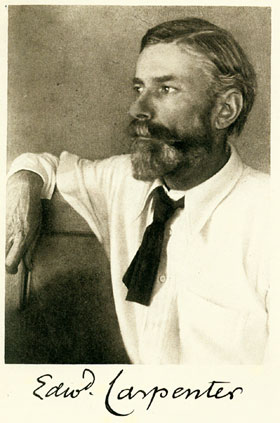
Edward Carpenter
A Visit to a Gñáni examines what Carpenter understood as a form of consciousness beyond ordinary thought. His Gñáni teaches that the continual activity of the personal mind prevents a person from directly experiencing a deeper and more universal consciousness, and Carpenter spends much of the book trying to understand what such a claim could mean to a Western reader.
The book moves from his personal encounters with the teacher into an extended inquiry into consciousness, then into the disciplines used by Indian students to attain higher states, and finally into the ancient traditions that the Gñáni had inherited. Carpenter remains sympathetic without accepting everything he hears. He is deeply impressed by the Gñáni’s character and apparent spiritual attainment while openly questioning his traditional astronomy, cosmology, physiology, and other inherited teachings. That combination gives the book much of its value: it records an encounter between a late Victorian Western intellectual and a representative of an Indian teaching tradition that Carpenter believed had been transmitted for thousands of years.
The book was highly influential among early twentieth-century intellectuals and spiritualists. Carpenter’s thoughtful approach to Vedanta helped spark greater Western interest in Eastern religions and influenced figures such as E. M. Forster, D. H. Lawrence, and Sri Aurobindo.
What Is A Visit to a Gñáni About?
Carpenter begins with the claim that during his stay in Ceylon he was fortunate enough to meet one of the esoteric teachers of what he calls the ancient religious mysteries. He describes such Gurus or Adepts as scattered throughout India, living secluded lives and generally avoiding the influence of Western civilization. In Carpenter’s account, these teachers belonged chiefly to two traditions, the Himalayan and the South Indian. He associates the Himalayan school with a more Buddhistic line and the South Indian school with Brahmanical and later Hindu traditions. Although philosophical differences existed between them, Carpenter believed that their fundamental spiritual work pointed toward the same end. His teacher belonged to the South Indian school and was staying temporarily in Ceylon when Carpenter met him.
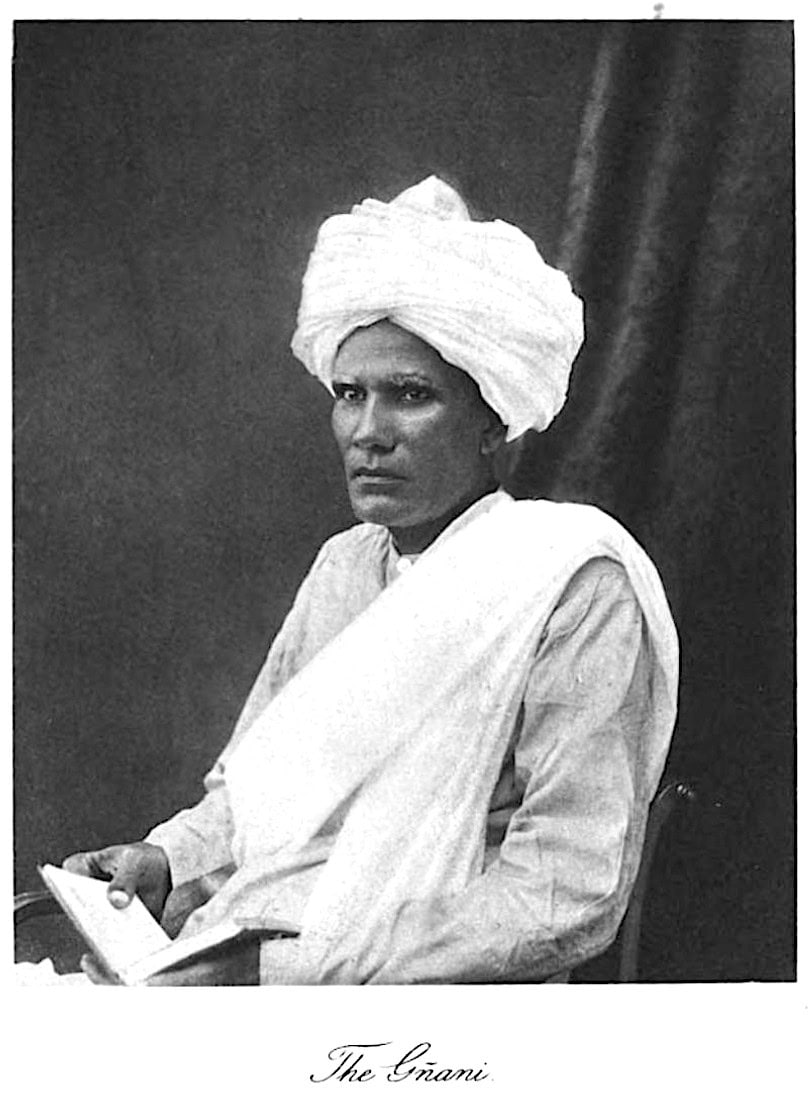
The frontispiece of the book gives the reader a portrait of the Gñáni himself, seated in a turban and simple clothing. Carpenter warns in the preface that the photograph fails to communicate what most impressed him in person: the intensity of the man’s eyes, the calmness of his expression, and a youthful appearance remarkable for someone about seventy years old. Carpenter’s descriptions throughout the book return to these qualities. The teacher was physically slight yet active, possessed a striking directness of manner, and seemed almost completely free of the ordinary self-consciousness that Carpenter associated with civilized social life. The impression mattered because Carpenter regarded the Gñáni’s personality as evidence that the disciplines being discussed had produced an observable transformation in the man who practiced them.
Carpenter’s Meeting With the Gñáni
The Gnani, Ramaswamy
Carpenter first finds the teacher staying in the precincts of a Hindu temple. He passes through a garden and a porch decorated with images of Hindu deities and enters a side chamber where the elderly teacher sits on a simple couch that serves both as bed and daytime seat. Carpenter describes a man wearing little more than a white muslin wrapper, with a shaven head and face, finely formed features, dark eyes, and an unusual combination of gentleness, authority, and childlike directness. This simplicity becomes one of the recurring features of Carpenter’s account. He does not present the Gñáni as a theatrical occultist surrounded by ceremonial mystery. His interest lies in the teacher’s consciousness, conduct, conversation, and apparent freedom from many of the psychological habits that Carpenter associated with ordinary personality.
Communication required assistance because the Gñáni did not speak English, and Carpenter was conscious that interpretation created difficulties. This limitation becomes important later when he tries to explain the teacher’s ideas. Carpenter repeatedly acknowledges that he cannot guarantee that every Western formulation he gives reproduces the Gñáni’s meaning with perfect accuracy. He is describing another person’s inner experience across languages and across very different philosophical traditions. That caution is one of the most important features of the book. Carpenter wants to understand the Indian teaching without pretending that a few translated conversations have given him mastery of it.
What impressed him most was the Gñáni’s manner of being. Carpenter describes an absence of embarrassment, affectation, and social self-consciousness. Whether sitting with his feet beneath him on his couch, speaking at a table, standing during an animated discussion, or allowing his garment to slip unnoticed from his shoulder, he retained the same composure. Carpenter believed that the ordinary barriers separating one personality from another seemed unusually weak in his presence. He uses the idea of “non-differentiation” to describe the spiritual condition that might lie behind this quality. The Gñáni’s freedom from self-consciousness appeared outwardly as simplicity, ease, dignity, and direct contact with other people.
What Does Carpenter Mean by “Consciousness Without Thought”?
The second chapter turns the personal encounter into the central philosophical question of the book: what kind of experience does the Gñáni claim to possess? Carpenter knows that the problem is difficult because an experience can only be directly known by the person having it. Language can describe its conditions and effects, yet the description remains separate from the experience itself. He also recognizes that the teacher’s ideas reached him through an interpreter and through a conceptual vocabulary very different from his own. For this reason Carpenter does not claim to provide a definitive exposition of Indian philosophy. He tries to construct an intelligible account of what the experience appears to involve.
The central idea is that thought and consciousness are not identical. Ordinary Western habits encourage people to associate consciousness so closely with thinking that a state without thought can sound like unconsciousness. Carpenter asks the reader to consider another possibility: thought may represent one activity occurring within consciousness, while consciousness itself may extend far beyond the stream of words, judgments, memories, comparisons, and distinctions ordinarily occupying the mind. The Gñáni’s discipline is directed toward quieting that mental activity sufficiently for another order of awareness to become accessible.
Carpenter compares the personal consciousness cultivated so intensely in Western life with the universal or cosmic consciousness sought in the East. He is careful to present this as a rough distinction, since India contained many philosophical schools with highly developed differences concerning reality, divinity, mind, and liberation. His generalization is still central to the argument: Western civilization had concentrated tremendous energy upon the formation and development of individual consciousness, while the Eastern spiritual quest had devoted comparable effort to discovering a consciousness extending beyond the boundaries of the individual personality.
What Happens to the Individual Self?
The problem of the self runs through Carpenter’s explanation. Ordinary consciousness divides experience continually: self and other, subject and object, desirable and undesirable, past and future. The mind labels, compares, remembers, anticipates, and judges. These operations have immense practical value, yet they also create the mental structure through which a person experiences himself as a separate individual standing apart from the rest of existence. The Gñáni’s path attempts to quiet this differentiating activity until consciousness is experienced without the usual stream of personal thought.
For Carpenter, this helps explain the Gñáni’s extraordinary lack of self-consciousness. The man before him appears to have weakened the constant psychological reference to “I” that accompanies ordinary action. His behavior is spontaneous because he does not seem perpetually occupied with an image of himself performing it. Carpenter sees this freedom expressed in small physical details, conversation, posture, emotional composure, and the ease with which the Gñáni relates to others. Spiritual realization is presented here as something that changes the organization of consciousness and, through it, the visible character of a human being.
How Is Higher Consciousness Attained?
The third chapter, “Methods of Attainment,” asks how an Indian student attempts to reach the state Carpenter has been describing. This is where the book comes closest to the instructional literature on Hindu philosophy that became familiar to Western readers during the same period through figures such as Swami Vivekananda and, within the Yogi Publication Society, Yogi Ramacharaka. Carpenter treats the practices as parts of a long system of mental and spiritual education. The purpose is to acquire command over the restless activity of the mind so that consciousness can cease being dominated by involuntary thought.
The methods differ according to school, teacher, and student, but Carpenter’s discussion centers on disciplined attention, concentration, control of the mental processes, regulation of bodily activity, and the long cultivation of inward stillness. The body and mind are treated as connected parts of the work. A person whose attention is continually carried away by sensations, impulses, fears, desires, memories, and passing ideas has little chance of discovering the state described by the Gñáni. Training begins by learning to steady these movements.
The essential progression can be summarized in a form useful for understanding Carpenter’s account:
attention is withdrawn from its habitual scattering among external objects and passing thoughts;
the student learns concentration and greater control over mental activity;
bodily and emotional disturbances are brought under increasing regulation;
the ordinary stream of thought becomes quieter;
the personal sense of separation begins to loosen;
consciousness may then be experienced in a less divided and more universal form.
Carpenter does not treat this as something achieved through intellectual agreement. Reading a doctrine about universal consciousness does not produce the experience. The distinction is important throughout the book because the Gñáni represents knowledge obtained through disciplined consciousness. The word Gñáni itself points toward knowledge or wisdom, yet the knowledge under discussion is experiential. A person may understand the proposition intellectually and still remain completely outside the state to which it refers.
Why Is the Teacher Important?
The Guru occupies an important place because the path concerns states that cannot be communicated fully through definitions. A teacher who has undergone the process can guide the pupil through difficulties that written doctrine alone cannot anticipate. Carpenter’s own encounter illustrates the point. He repeatedly struggles to translate the Gñáni’s statements into categories that make sense to him, while the Gñáni speaks from a traditional framework in which the experience itself carries greater authority than speculative argument.
The Difference Between Intellectual Knowledge and Gñána
One of the clearest lessons running through the work is the difference between accumulated information and transformed consciousness. The Gñáni may possess ideas that Carpenter considers scientifically indefensible, while still possessing an inner development that Carpenter finds profound. This creates a problem that he refuses to solve by simply declaring the teacher either enlightened or ignorant. A person can have exceptional insight into consciousness while accepting inherited descriptions of the physical universe that do not withstand critical examination.
Carpenter’s willingness to maintain this distinction gives the final chapter much of its interest. His admiration for the teacher survives serious disagreement. He finds the Gñáni’s character compelling while recognizing that the man’s astronomy, physiology, chemistry, and related ideas had passed through an ancient oral and textual tradition largely untouched by modern Western science. The encounter forces Carpenter to separate spiritual attainment from factual infallibility.
What Was the Ancient Wisdom-Religion?
The final chapter, “Traditions of the Ancient Wisdom-Religion,” examines the body of inherited cosmology and esoteric teaching preserved by the Gñáni. Carpenter felt at moments as though he had been transported several thousand years into the past. The teacher’s appearance, habits, assumptions, and intellectual world seemed to him strikingly close to what he imagined an ancient Vedic teacher might have been. India’s extraordinary continuity of custom led Carpenter to suggest that living teachers could sometimes preserve elements of the ancient world more vividly than texts alone.
The strength of that continuity also created problems. Carpenter discovers that the Gñáni accepts an ancient cosmology in which the earth occupies the center of the physical universe, the sun moves around it, Mount Meru stands in the north, and eclipses are associated with the dark planets Rahu and Ketu. The teacher also speaks of repeated destructions and recreations of the earth and of many other planetary or solar systems. Carpenter does not accept these statements as physical science. His interest shifts toward understanding why such ideas could coexist with the psychological insight he had witnessed.
When challenged, the Gñáni sometimes appeals to things having been perceived in “pure consciousness.” Carpenter remains unconvinced that the teacher himself had directly perceived everything he described. He suspects that inherited tradition and personal experience had become intertwined. The intimate teacher-pupil relationship could make it difficult to distinguish an individual vision from an account received from previous teachers. Carpenter also worries that a discipline designed to quiet ordinary thought may weaken the habits of criticism needed when evaluating claims about events and physical facts.
This is one of Carpenter’s strongest observations. He does not dismiss the spiritual discipline because its cosmology contains claims he rejects, and he does not accept the cosmology because he admires the teacher. He keeps the questions separate.
The Inner and Outer Universe
The ancient cosmology becomes more interesting to Carpenter when he realizes that some of its language may operate on more than one level. The external universe described in traditional terms can also serve as a map of internal experience. Sun, moon, Mount Meru, worlds, transformations, and cosmic processes may describe physical things in one setting and states or structures of consciousness in another. Carpenter records the principle that the universe within the soul and the universe outside it correspond to one another, allowing the same symbolic language to describe both.
This correspondence gives Carpenter a bridge into Western esotericism because he recognizes a similar method in European alchemy. Alchemical writings could describe metals, furnaces, mercury, gold, and physical transformations while simultaneously encoding an interior process of spiritual transformation. Carpenter is surprised when the Gñáni discusses the transmutation of copper into gold through solidified mercury, a teaching that reminds him of European alchemical traditions associated with writers such as Paracelsus. He recognizes that the story may carry an esoteric significance alongside its literal meaning.
Carpenter’s Criticism of Tradition
Carpenter’s sympathy never becomes unquestioning acceptance. He sees a danger in traditions whose authority has become so great that statements pass from teacher to pupil without sufficient examination. A doctrine may begin in a genuine spiritual experience and later acquire explanatory material that succeeding generations repeat because it belongs to the tradition. Once personal vision, symbolic language, inherited cosmology, and literal claims become mixed together, distinguishing among them can become extremely difficult.
Yet Carpenter believes that rejecting the entire tradition because of such problems would miss the most important evidence before him: the Gñáni himself. Whatever Carpenter thinks of ancient astronomy, he cannot easily dismiss the man’s composure, simplicity, concentration, insight, and apparent freedom from ordinary psychological agitation. His investigation keeps returning to this living result. The question is no longer whether every traditional statement is factually correct. It is whether the methods of consciousness preserved within the tradition disclose capacities of the human mind that Western psychology had barely begun to examine.
The Gñáni’s View of Western Civilization
The Gñáni is also an observer of British India. Carpenter records his criticism of British rule and his belief that government under the Crown had become excessively commercial. The teacher claimed that the earlier East India Company period had contained some conception of state policy and responsibility toward the population, while the later system had become dominated by money. Carpenter found the judgment striking because it came from a man who had remained largely outside Western intellectual influence yet had considerable experience of public affairs and administration.
These comments help prevent the Gñáni from appearing as a figure concerned only with private meditation. Carpenter presents him as someone who had lived in the world, observed government and society, and later embodied an ancient spiritual discipline. His withdrawal from ordinary mental preoccupations did not mean that he lacked opinions about social life. Carpenter’s portrait is compelling precisely because the teacher remains an individual human being rather than becoming a generic symbol of Eastern wisdom.
Why Did Carpenter Consider the Gñáni Important?
Carpenter believed he had encountered a living representative of a very old tradition of consciousness. In his 1911 preface he explains that Western discussion had already become filled with references to Mahatmas, Adepts, Gñánis, and hidden teachers, yet straightforward descriptions of actual encounters with such people were surprisingly scarce. His purpose in republishing the material separately was to provide a plain record of one person he had known over a sustained period. He had seen the Gñáni almost daily for roughly six weeks, observed his habits and personality, listened to his conversations, and formed his conclusions from repeated contact.
Carpenter also warns readers against imagining that every Gñáni must conform to one standard type. Spiritual teachers remain individuals. The man Carpenter calls “the Grammarian” was significant because of his strong adherence to the ancient tradition and because his personality seemed to Carpenter to preserve something of a much earlier Indian world. After the teacher’s death, Carpenter reports, a shrine was erected over his body and became a place of pilgrimage, indicating the high regard in which he was held by his own community.
The book includes a second portrait, of Paramaguru Swami, placed opposite the opening of “Methods of Attainment.” Carpenter says that he never personally met Paramaguru Swami, though friends knew him. He describes him as another teacher of transcendent matters who withdrew into the woods, lived close to animals and villagers, and attracted the unwelcome attention of British officials because of his lack of clothing. Carpenter contrasts his temperament with that of another teacher, Tilleináthan Swami, describing Paramaguru as approachable and especially gracious toward women and children.
What Is the Central Message of A Visit to a Gñáni?
The central idea of A Visit to a Gñáni is that ordinary thinking may represent only one form of human consciousness. Carpenter asks the Western reader to entertain the possibility that beneath the continual movement of thought lies another mode of awareness in which the rigid division between self and world becomes less dominant. The Gñáni represents a tradition devoted to reaching and stabilizing that condition through long mental and spiritual discipline.
Carpenter does not finish the book by asking readers to accept every doctrine of the ancient Wisdom-religion. His own disagreements make such a conclusion impossible. What survives his criticism is his conviction that the human being he met possessed an unusual degree of inward freedom and that the tradition behind him contained knowledge of consciousness worthy of serious investigation. The Gñáni’s calm, simplicity, absence of self-consciousness, disciplined attention, and sense of unity become more important to Carpenter than the cosmological framework through which some of those experiences were explained.
For modern readers, this is what gives A Visit to a Gñáni its lasting interest. It preserves an extended late nineteenth-century encounter between a Western writer and a traditional Indian spiritual teacher while documenting an important stage in the transmission of Indian ideas about consciousness to Western audiences. Carpenter approaches the subject with admiration, curiosity, skepticism, and a willingness to admit the limits of his own understanding. The result is both a record of a remarkable individual and an inquiry into one of the central questions of Hindu philosophy: whether the personal thinking mind represents the full extent of consciousness, or whether disciplined experience can disclose a deeper field of awareness in which the ordinary boundaries of the individual self begin to disappear.
Edward Carpenter Biography
Edward Carpenter, 1905
Edward Carpenter (1844–1929) was an English philosopher, poet, author, and social reformer. He grew up in Brighton, studied at Brighton College and Trinity Hall, Cambridge, and was first ordained as an Anglican clergyman. Later, he left the ministry to focus on social reform, writing, and spiritual ideas. Inspired by Christian Socialism and writers like John Ruskin, Ralph Waldo Emerson, and Henry David Thoreau, Carpenter became known for supporting socialism, vegetarianism, simple living, and humanitarian causes.
In the 1880s, Carpenter became a key figure in Britain’s socialist movement. He joined groups like the Social Democratic Federation, the Socialist League, and the Fabian Society, and later helped start the Independent Labour Party with Keir Hardie and Ramsay MacDonald. He spoke up for workers’ rights, opposed industrial capitalism, campaigned against vivisection and capital punishment, supported women’s right to vote, and stayed committed to pacifism during both the Boer War and World War I.
Carpenter was open about being gay and lived for many years with his partner George Merrill. He was one of the first English writers to say publicly that homosexuality is a natural part of human sexuality, not a moral problem. His ideas about sexual freedom influenced people like Havelock Ellis and later writers such as D. H. Lawrence, Siegfried Sassoon, and E. M. Forster.
Along with his social and political work, Carpenter became very interested in Eastern philosophy and Western mysticism. His travels in India and Ceylon led him to write several important books that introduced many Western readers to ideas like Vedanta, yoga, meditation, and universal consciousness. Carpenter kept writing until his death in 1929.