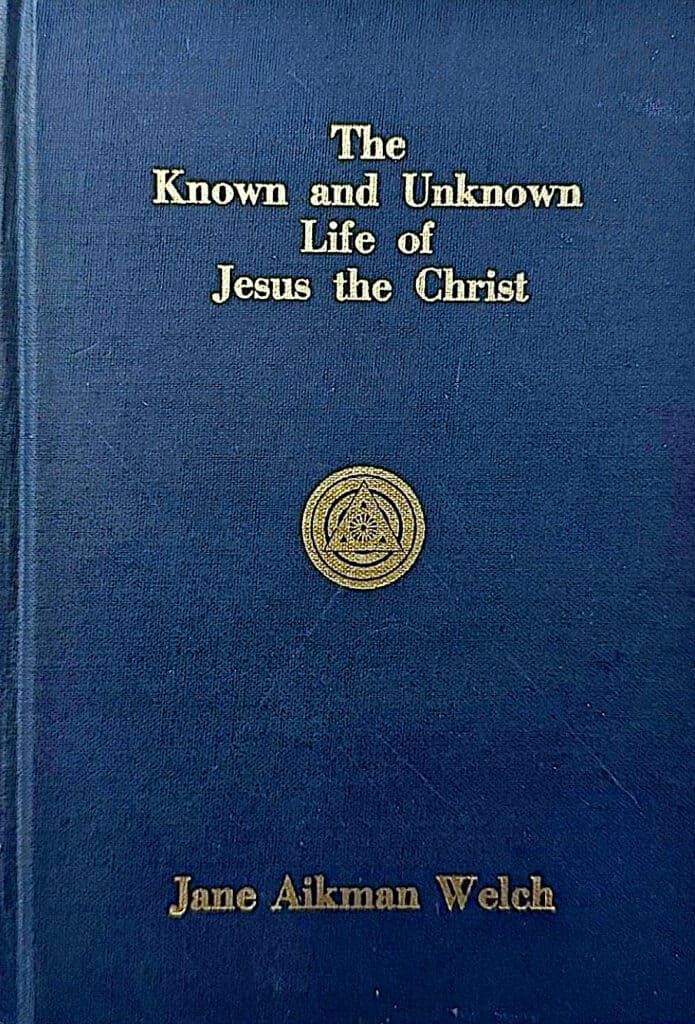
The Known and Unknown Life of Jesus the Christ, by Jane Aikman Welch and published by the Yogi Publication Society in 1924, presents a complete occult biography of Jesus covering what Welch describes as the full thirty-five years of his earthly manifestation. The book combines a reconstructed life of Jesus with astrology, numerology, hidden Biblical symbolism, ancient mystery teachings, Rosicrucianism, psychic powers, and the idea that Jesus demonstrated the spiritual attainment toward which humanity itself is progressing.
Welch does not confine her account to the events preserved in the New Testament. She supplies an extensive history of Jesus’ childhood, education, travels, teachers, initiatory training, healing work, and the years normally absent from the Gospel narratives. India, Egypt, secret brotherhoods, the Rosicrucian tradition, ancient schools of wisdom, and the hidden meanings of Biblical numbers and astronomical symbols all become parts of a single account. The result is a distinctly esoteric interpretation of Christianity in which the life of Jesus is both a historical narrative and a demonstration of laws governing human spiritual development.
What Is The Known and Unknown Life of Jesus the Christ About?
First cover
Welch states the scope of the book directly on its title page. It gives an account of Jesus’ travels and works during “the entire 35 years of his manifestation on earth,” together with the “two fundamental sciences, Astrology and Numerology.” These sciences, according to Welch, contain the key to the hidden knowledge of Scripture. Without them, she says, “the Bible is a closed book.”
This is the governing idea of the book. Welch believes that the familiar Gospel account preserves only part of the life of Jesus and that conventional Biblical interpretation has lost the ancient system required to understand what remains. Her purpose is to restore both. She reconstructs the missing biography while simultaneously interpreting the events of that biography through astrology, numbers, occult symbolism, and an ancient wisdom tradition that she believes existed long before Christianity.
The historical and symbolic portions are consequently intertwined. An event in Jesus’ life may be described as an actual occurrence, interpreted through its corresponding number, connected with a sign of the Zodiac, and then used to explain the spiritual development of every human being. Jesus’ life becomes a pattern through which Welch believes the laws behind human life can be read.
Why Are Astrology and Numerology Central to the Book?
Astrology and numerology are not secondary subjects added to Welch’s biography. She presents them as ancient sciences built into the structure of the Bible and the universe itself.
On page 12 she writes that “No true student of the Bible and the 2 sciences, astrology and numerology, can fail to find that the Bible is so full of references to the fundamental truths contained in these sciences” that its spiritual meaning cannot be properly understood without recognizing its references to numbers, stars, and constellations. She goes much further, claiming that Biblical symbols “from the garden and the serpent, to the cross and the crown” were represented in the heavens ages before they appeared in Scripture.
Welch then organizes much of Jesus’ life through numerical stages. Numbers correspond with periods of development, events in his life, spiritual lessons, and astrological relationships. The Zodiac supplies another symbolic structure. Aries, for example, represents the ram and the beginning of a new cycle. Welch connects Jesus with the end of the Arian age and explains the title “Lamb of God” through this astrological symbolism. “The Ram (Aries), leads the whole circle in its journey around the heavens,” she writes on page 31, “so is it the mission of Jesus to lead all who will follow the path.”
The movement between astrological ages is also used to reinterpret Biblical history. Welch associates the Exodus with the passage from Taurus into Aries. The bull belonged to the departing age, while the ram or lamb became the symbol of the new one. The Golden Calf is then given an astrological meaning because Israel had returned to the symbol of the previous age.
This method continues through the crucifixion and resurrection. Number nine becomes the number of crucifixion and sacrifice, while ten represents a new and higher manifestation. Welch connects the tenth stage with Capricorn, which she describes as the climbing sign. Jesus, whom she identifies as born under Capricorn, becomes the spiritual climber who has reached the highest attainment available to humanity in the present age.
What Does the Book Say About the Childhood of Jesus?
Welch greatly expands the childhood narratives found in the New Testament. Jesus is presented from birth as the object of a carefully organized plan involving wise men, hidden initiates, Hillel, and the angel Gabriel.
The flight and protection of the infant Jesus are described as an organized operation. Welch says that sages acting under Gabriel’s direction prepared caves with food, clothing, and attendants along the family’s route so Mary and the child could remain concealed during the day and travel safely at night. The route itself connected with caravan roads leading toward India and Egypt.
Hillel becomes one of the most important figures in this hidden history. Welch identifies him as president of the Jewish Sanhedrin and secretly a member of the same ancient order to which the wise men belonged. She claims that this order was the ancestor of later Masonic and Rosicrucian traditions. Because of Hillel’s membership, she says, much of the responsibility for Jesus’ education and protection was entrusted to him.
Jesus’ childhood education is equally unusual. Welch credits Hillel with teaching him knowledge far beyond ordinary religious instruction. On page 36 she states that Jesus learned “to create bread from the atmosphere by the power of His thought, to walk on water, to cast out demons, to bring water out of a rock in the desert,” and to become “complete master of all the forces of nature.” She again identifies the source of this knowledge with the ancient Brotherhood from which she says Masonic and Rosicrucian knowledge descended.
This changes the meaning of Jesus’ later wonders. They are not introduced as abilities that suddenly appeared during his public ministry. Welch describes them as the result of knowledge and mastery acquired through years of preparation.
What Happened During the Unknown Years of Jesus?
The missing years form one of the central attractions of Welch’s book. According to her account, Jesus did not remain in Nazareth working as a carpenter until the beginning of his ministry.
Welch says that after returning home Jesus attempted Joseph’s trade, but this lasted only six months. She describes him as uninterested in physical labor, preferring conversation with learned men and periods of meditation. At the end of his thirteenth year, Gabriel directs Mary and Joseph to send Jesus into the world so that he can encounter the experiences required for his development.
The ensuing travels supply Welch’s answer to the Biblical silence surrounding Jesus’ adolescence and early adulthood. Jesus moves through centers of ancient learning, encounters teachers and initiates, studies spiritual and occult subjects, and develops the abilities later displayed during his ministry.
Egypt is an important part of this education. Welch describes Jesus teaching among peoples whose records were subsequently lost and claims that additional records of his Egyptian life remained preserved in monasteries around Mount Sinai, Mount Horeb, and the Egyptian mountains. She predicts that these records would eventually become available when conditions permitted their release.
India and the East occupy the same intellectual geography. They are not presented simply as exotic destinations. They belong to Welch’s network of ancient centers through which sacred knowledge had been preserved and transmitted.
Jesus as a Student of the Ancient Wisdom
Welch repeatedly removes the division between Biblical religion and the ancient mystery traditions. Jesus is educated within an international wisdom tradition that predates Christianity.
One example appears in her account of the “School of the Prophets.” Jesus and his followers remain there for approximately two months. His disciples study, Jesus teaches, and Jesus himself continues learning. Welch says specifically that he learned more about “the laws appertaining to the stars, or what we term Astrology,” while ensuring that his followers also understood the stars and their relationship to humanity.
The school taught what Welch calls the wisdom of the Chaldeans, which she compares directly with Rosicrucian teachings. She describes these Schools of the Prophets as centers of higher learning containing master teachers from different lands, not as institutions belonging to a single religious sect.
Jesus is thus presented as both master and student. His authority does not depend upon ignorance of previous traditions. His greatness is expressed through his command of them.
This is one of the book’s most important departures from conventional Christian biography. Christianity becomes one expression of a much older body of wisdom, while Jesus becomes its greatest representative for his age.
What Does Welch Mean by the Christhood?
The central spiritual teaching of the book is contained in Welch’s use of the word “Christhood.” Jesus represents an attainment that humanity is intended to approach.
The purpose of human life is spiritual development. The individual encounters conditions, obstacles, experiences, and successive stages because these produce the development necessary for the soul. Welch even interprets difficult circumstances in this manner, arguing that people are born under the vibrations and into the environment needed for their progress.
Jesus stands at the highest point of that process. He has already reached the state toward which others are moving.
This explains Welch’s repeated use of Jesus’ command “Follow me.” She reads it as more than a call to religious allegiance. Jesus has demonstrated the path of development itself.
Her discussion of the crucifixion makes this explicit. On page 375 she writes that the lower senses or lower self must undergo crucifixion, with Jesus’ physical sacrifice serving as the great demonstration. “In this He has shown the way all men must travel to reach the goal,” she explains. The crucifixion becomes both an event in Jesus’ life and a symbol of the conquest of the lower nature required for higher spiritual attainment.
The resurrection then represents another stage. Welch compares the darkness of the tomb to the darkness preceding physical birth. Jesus emerges into “a higher expression,” no longer subject to the former limitations of physical existence. She immediately applies the same law to humanity, connecting it with the promise, “What I do ye shall do also.” Jesus is unique in degree of attainment, but the laws demonstrated through him are universal.
How Does the Book Explain the Miracles of Jesus?
Welch interprets the miraculous powers of Jesus through occult law and mastery over forces normally unknown to humanity.
This begins with his training. The extraordinary acts of the later ministry are abilities he has learned through instruction, experience, and spiritual mastery. Creating food, walking upon water, healing, materialization and dematerialization, and other Biblical wonders belong to a body of higher knowledge.
This places the miracles within the book’s larger teaching about human potential. The extraordinary is not lawless. It represents command of laws and forces that ordinary people do not yet understand.
Healing occupies an important place in the narrative. Jesus repeatedly encounters the sick, blind, crippled, and impoverished, heals them, and teaches them their relationship to the Father. Welch describes one such period around Cana where Jesus spends a month healing large numbers of people while teaching that they are children of a Father who loves them and desires their happiness.
The emphasis is not simply upon supernatural proof of Jesus’ identity. His powers accompany his spiritual development and service to others.
What Role Does the Hidden Brotherhood Play?
A hidden fraternity of sages runs through Welch’s reconstruction almost from the birth of Jesus onward.
The wise men belong to it. Hillel belongs to it secretly. Gabriel directs its activities. Its members protect Jesus, educate him, preserve sacred knowledge, and maintain connections between different centers of ancient wisdom.
Welch explicitly links this Brotherhood with later Rosicrucian and Masonic traditions. On page 24 she says the order of the wise men is the one “from which we have the Masonic and Rosicrucian orders today,” while on page 36 she again says that knowledge preserved by the Brotherhood passed into these later fraternities.
The significance of this claim extends beyond identifying Jesus with a secret society. Welch is constructing a continuous transmission of hidden wisdom. The wisdom behind the Biblical prophets, the sages who protected Jesus, the mystery schools in which he studied, the Chaldean teachings, and later Rosicrucian traditions are different historical manifestations of the same ancient knowledge.
The Bible is then one repository of that knowledge, but its hidden meaning requires the keys that the mystery traditions preserved.
Why Does Welch Believe the Bible Has Been Misunderstood?
Welch distinguishes between the surviving text of Scripture and the knowledge required to interpret it.
Astrology and numerology provide part of the lost key. Ancient mystery teachings provide another. She also argues that surviving Biblical texts do not preserve the complete historical record.
Late in the book she discusses tablets and manuscripts that she believes were assembled incorrectly or incompletely. She says that some tablets were placed in the wrong connections and that only a small portion of the available material was examined, while explanatory material was omitted. The resulting gaps and confusion, in her account, contributed to disagreements among Christians.
She makes an exception for Revelation, which she attributes to John the Harbinger and says survived intact because its mystical meaning was not understood. Earlier she describes Revelation as containing knowledge of the soul and “its journey of unfoldment,” with a double meaning that had escaped conventional interpretation.
Scripture for Welch is consequently an occult document. Its stories operate historically, astrologically, numerologically, and spiritually at the same time.
Jesus as the Pattern of Human Spiritual Development
This is the thread that holds the long historical narrative together.
The book is not merely attempting to answer the popular question of where Jesus went during his missing years. Welch uses those years to explain how the Jesus who appears in the Gospel ministry acquired and demonstrated extraordinary knowledge.
Childhood training leads into initiation. Travel leads into contact with different wisdom traditions. Study leads into mastery. Mastery leads into healing and teaching. Sacrifice leads into a still higher form of existence.
Even the structure of the numbered chapters reinforces this developmental reading. Each numerical stage carries qualities that are then illustrated through the corresponding period of Jesus’ life. By the ninth stage, crucifixion represents the sacrifice of the lower nature. The tenth stage becomes renewed manifestation and spiritual leadership. Capricorn, the climbing goat, supplies the astrological image of ascent. Welch describes Jesus as having climbed “to the highest point of spiritual attainment possible to man in this age of earth unfoldment.”
The biography is thus simultaneously Welch’s map of spiritual development.
How Does The Known and Unknown Life of Jesus the Christ Fit with the Yogi Publication Society?
The 1924 publication of Welch’s book by the Yogi Publication Society makes sense when placed beside the religious and occult works already associated with the publisher.
Long before Welch’s book appeared, YPS had published works that presented Christianity, Hindu philosophy, Western esotericism, psychic development, reincarnation, and ancient mystery teachings as parts of a connected field of study. An earlier YPS catalog places Mystic Christianity by Yogi Ramacharaka alongside The Bhagavad Gita, The Kybalion, Reincarnation and the Law of Karma, The Spirit of the Upanishads, Jacob Boehme, A. P. Sinnett’s Karma, and Édouard Schuré’s Jesus: The Last Great Initiate.
Welch’s book enters almost directly into that established program.
The connection with Mystic Christianity is easy to recognize. Both works move beyond conventional church doctrine in search of an esoteric Christianity. Jesus is approached through initiation, hidden teachings, ancient wisdom, and spiritual laws that connect Christianity with teachings outside the familiar Biblical tradition.
The relationship with Schuré’s Jesus: The Last Great Initiate is equally direct at the level of subject. YPS was already offering its readers a Jesus interpreted through the language of initiation and ancient mystery traditions. Welch greatly expands that kind of treatment by supplying a continuous thirty-five-year biography and making astrology and numerology the organizing sciences of the narrative. The fact that Jesus: The Last Great Initiate appears in an earlier YPS catalog beside Ramacharaka’s books shows that an occult life of Jesus was not a new direction for the publisher in 1924.
The Eastern travels also fit naturally with the YPS presentation of Yogi philosophy. From its earliest Ramacharaka books, the Society had introduced Western readers to Indian philosophy, Yoga, occult powers, psychic healing, reincarnation, and the proposition that ancient Eastern teachings preserved knowledge largely forgotten in the West. Welch places Jesus inside that same world of international sacred knowledge.
Her treatment of extraordinary powers also belongs comfortably beside the YPS books on clairvoyance, psychic healing, mental influence, psychometry, and other occult faculties. Welch’s Jesus masters forces of nature that appear miraculous only from the standpoint of ordinary human knowledge. YPS books had long presented unusual mental and psychic phenomena as faculties or forces governed by laws, capable of being studied and understood.
The Rosicrucian element adds another connection. Welch does not merely mention Rosicrucianism as a later movement. She places it in a claimed line of transmission extending backward through the Brotherhood that educated and protected Jesus. Her Schools of the Prophets preserve Chaldean wisdom similar to Rosicrucian teaching, while Hillel secretly belongs to the ancient Brotherhood from which she says later Rosicrucian and Masonic fraternities descended.
Most important is Welch’s conception of Jesus himself. He is not presented only as someone to worship from an unreachable distance. His life demonstrates what spiritual development can produce. His command to follow him becomes a command to undertake the same movement from lower consciousness toward higher attainment. His crucifixion symbolizes conquest of the lower self. His resurrection demonstrates entrance into a higher manifestation. His powers show what mastery of higher laws can accomplish. His Christhood stands as the goal toward which human spiritual development points.
That makes The Known and Unknown Life of Jesus the Christ a strong late example of the religious philosophy YPS had been publishing for more than twenty years. Christianity, Eastern philosophy, occult science, ancient mystery traditions, astrology, numerology, psychic powers, and the progressive development of human consciousness are brought together within the life of Jesus himself. Welch’s book does not sit outside the older YPS catalog as an unusual Christian title. It brings many of the catalog’s established subjects into a single occult biography of Christ.
Related Research Articles
The Sacred Geometry of the Yogi Publication Society Logo
This article examines the Yogi Publication Society logo and its sacred geometry meaning, comparing it with Hindu, Hermetic, Rosicrucian, Masonic, and Theosophical traditions to show the intention behind the publishing network.