The Hindu-Yogi Science of Breath was the first original book published by the Yogi Publication Society under the name Yogi Ramacharaka. It quickly became a popular introduction to yogic breathing (pranayama) for Western readers. Instead of seeing breathing as merely a biological need, the book says that controlling how we breathe is essential to physical health, mental focus, psychic growth, and spiritual progress. Aimed at readers new to Yoga, it aimed to connect modern science with ancient Indian ideas, showing that Western science explains only the physical aspects of breathing, while Eastern philosophy preserves its deeper mental and spiritual meaning.
The book starts by addressing common Western misunderstandings about Yoga. It explains that true Yogis differ from the wandering fakirs and ascetics often depicted in travel stories. Ramacharaka says Yoga is not about unusual physical tricks, but a well-developed science focused on a person’s full growth. The word “Yoga” means union, showing the balance of body, mind, and spirit through regular practice. The Science of Breath is just one part of this bigger system, but it is the base for everything else.
The book opens by stating that “Breath is Life,” and that all living things need to breathe, but modern life has led people to breathe poorly. Bad posture, tight clothing, sitting too much, and shallow breathing have made people less healthy and less energetic, and most long-term health problems start with poor breathing. The answer is not medicine, but to relearn the natural way of breathing people once had. Good breathing brings more oxygen to the blood, strengthens organs, aids digestion, boosts disease resistance, and restores energy. But deep breathing is just the first step in a much bigger science.
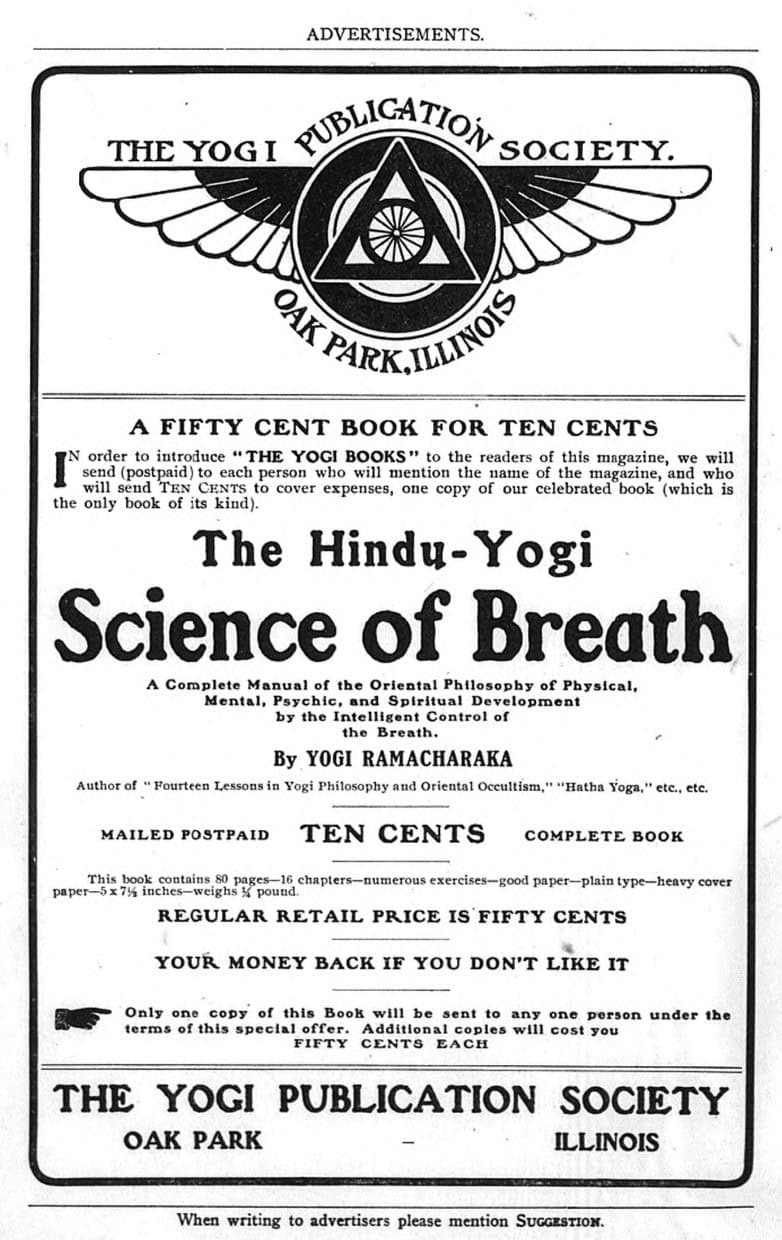
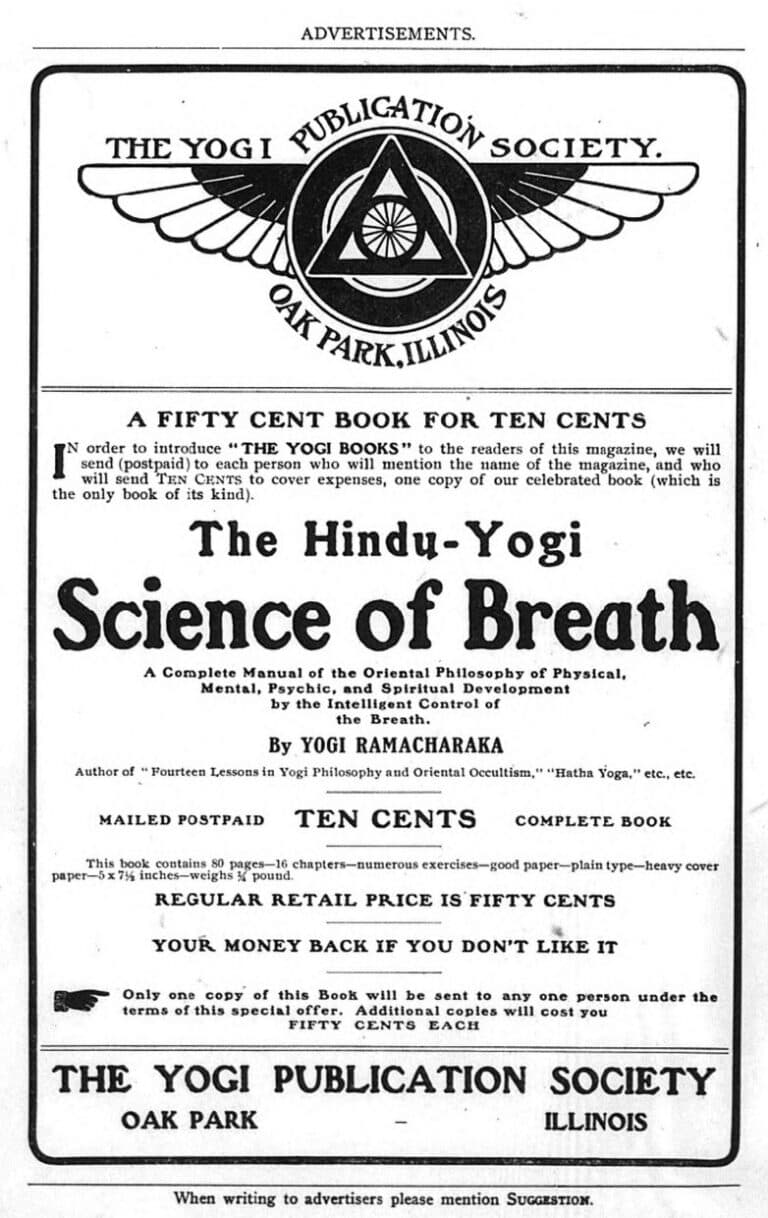
Full-page ad in Suggestion magazine for Science of Breath. Aug 1904. It was the first ad to include the wings on the YPS logo, which was designed by Parlow of Chicago, who had also designed Parkyn’s ads for his winged magnetic cup. (This ad has not been found in any other publications)
Ramacharaka goes on to explain how breathing works, using terms from Western medicine. It describes the lungs, diaphragm, blood flow, and nerves in detail. He agrees that these facts are right, but says they are not the whole story. Western science explains how oxygen cleanses the blood and nourishes the body, but overlooks an important part found in the air: Prana.
Prana is not the same as oxygen; it is described as a life force found everywhere in nature. All living things take in prana, but normal breathing only brings in a small amount. By practicing controlled breathing, a person can take in more of this energy and store it in the brain and nerves, like a battery stores electricity. Prana is behind every thought, action, feeling, and choice. So, good breathing restores not just physical energy, but all of a person’s vitality.
Ramacharaka pays special attention to the nervous system, calling it the primary means by which prana operates in the body. He explains the difference between the central nervous system, which controls the actions and thoughts we choose, and the sympathetic system, which regulates automatic bodily functions. Prana flows through both, energizing all organs and mental activities. Just as oxygen travels through the blood, prana moves through the nerves, providing “nerve=force.” Every thought, feeling, movement, or focus uses some of this energy, so it must be replaced often to stay healthy and effective.
A large part of the book focuses on fixing common breathing mistakes. It warns strongly against breathing through the mouth, since the nose cleans and warms the air before it reaches the lungs. Ramacharaka says that always breathing through the mouth can harm health, cause illness, and keep the body from getting the full benefits of good breathing. He also warns against shallow chest breathing, and instead recommends the complete Yogi breath. This method uses the belly, diaphragm, and upper chest together to fully fill the lungs. This full breath is the base for all the other exercises in the book.
After teaching complete breathing, the book introduces more advanced techniques. There are seven main exercises that mix careful breathing in, holding the breath, controlled breathing out, body movement, focus, and posture. Other smaller exercises are taught that help with certain health problems, strengthen organs, improve blood flow, and improve nerve control. These are not just simple exercises, but ways to guide prana to parts of the body that need more energy. Ramacharaka then introduces rhythmic breathing. This practice matches breathing with the heartbeat, pulse, muscle movement, and mental focus. He says rhythm is a basic law of nature. By syncing their breathing with these natural rhythms, a person can bring their own energy into alignment with the larger forces of the universe. Controlling rhythm turns breathing from a simple act into a means of cultivating calmness, emotional balance, and stronger willpower.
In the later chapters, Ramacharaka focuses more on psychic growth. Prana is now seen not just as a source of health, but as the force behind thought itself. Using prana on purpose can help with focus, healing, personal charm, and sharing energy with others. The book says one person can help another by sending out this vital force, and that magnetic healing is based on the natural laws of prana. Problems like fear, anxiety, weakness, and emotional ups and downs can be managed by mastering breathing and willpower. Breathing is shown as the link between body, mind, and spirit, and the main practice to connect to the universal life force
One of the most notable aspects of The Hindu-Yogi Science of Breath is its blend of scientific terms and spiritual ideas. Ramacharaka always starts with detailed medical facts about the body before talking about prana, psychic force, magnetic healing, and spiritual energy. His approach makes Eastern philosophy seem like a natural part of modern science rather than something separate, and his detailed knowledge of Western medicine and human physiology shows that the author had extensive medical training.
Dr. Parkyn’s teachings throughout the book
Looking at Herbert A. Parkyn’s teachings, many of the main ideas in the book were already around before the Yogi Publication Society was founded. Starting in 1896 at the Chicago School of Psychology, Dr. Parkyn taught methods that mixed controlled breathing, movement, vocal work, and mental focus as part of Suggestive Therapeutics. His classes stressed that health comes from training both mind and body simultaneously, using breathing to improve blood flow, strengthen nerves, boost energy, and support self-suggestion.
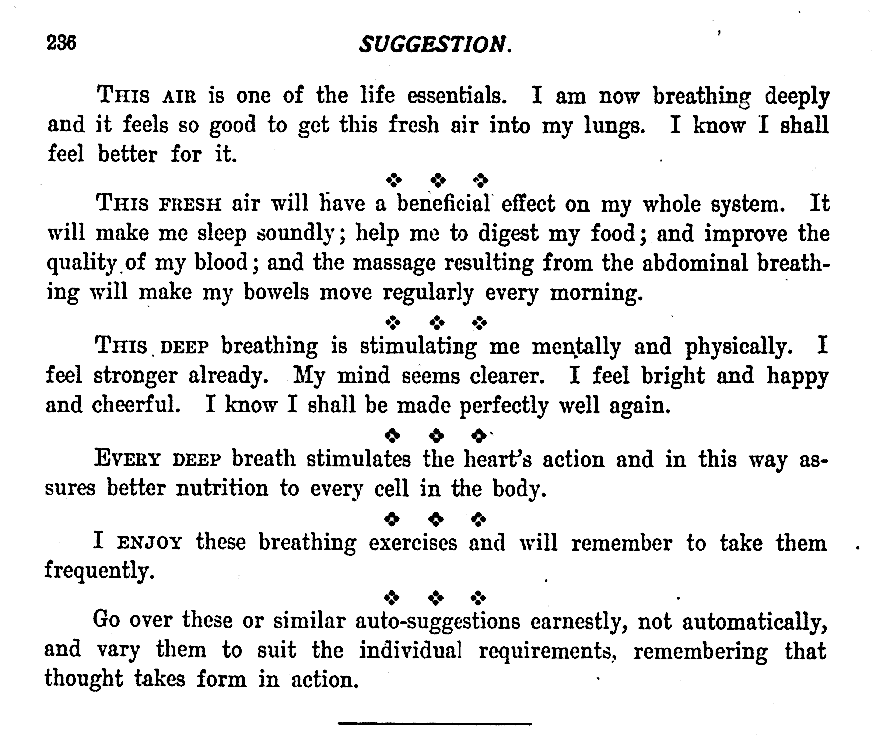
These ideas were also a key part of Parkyn’s “Life Essentials,” which he taught and wrote extensively about in Suggestion magazine. For Parkyn, Air meant more than just getting fresh air; it meant practicing deep, steady breathing every day for health. He said that good breathing brings more oxygen into the blood, strengthens organs, aids digestion, and fights disease—points that are mirrored in the opening of The Hindu-Yogi Science of Breath.
In spring 1904, Dr. Parkyn’s Suggestion magazine promoted The Hindu-Yogi Science of Breath with a full-page ad and two main articles about the benefits and science of breathing, plus another on the history of thought power in India. Parkyn wrote “Breathing Exercises and Auto-Suggestion,” while another article, “Rhythmical Breathing,” explored the scientific and spiritual roots of rhythmic breathing in Eastern traditions. These articles mentioned Vedanta Philosophy, stating:
“When mind changes into will the currents change into a motion similar to electricity. When all of the motions of the body become perfectly rhythmical, the body has, as it were, become a gigantic battery of will.”
They also explained that prana, described as “absolute energy, vital force, spirit of life,” is stored in the brain and nerve centers, especially the abdominal brain or solar plexus.
The same issue included another article about thought power in India. It claimed that the idea of “thought as matter” is “one of the oldest beliefs on earth.” The article called “Hindo Vedanta” “the most wonderful product of the human mind,” and said it teaches that “thought came into existence first, and then matter formed into shape around it.” It also stated that the power of thought to affect matter from a distance has been known for:
“many centuries in the remote east, to the wonderful psychics of ancient India, that fountain stream of all esoteric wisdom.”
Auto-Suggestion affirmations by Herbert A. Parkyn for healthy breathing, Suggestion May 1904.
Related Research Articles
The Science of Psychic Healing: A Bridge Between Yogi Philosophy and the Law of Suggestion
This article explores the book The Science of Psychic Healing and its close parallels with Herbert A. Parkyn's teachings and examines its role in connecting Eastern philosophy with the emerging science of mind.
The Sacred Geometry of the Yogi Publication Society Logo
This article examines the Yogi Publication Society logo and its sacred geometry meaning, comparing it with Hindu, Hermetic, Rosicrucian, Masonic, and Theosophical traditions to show the intention behind the publishing network.
The True Meaning of the Name and Back Story of Yogi Ramacharaka
This article breaks down the hidden symbolism and meaning behind "Yogi Ramacharaka", the pen name that was created by the Yogi Publication Society and shows the allegory that reflected the ideas the books were…