Jesus, the Last Great Initiate by Édouard Schuré is an influential work of Western esotericism that presents the life of Jesus Christ through the lens of mystical philosophy rather than traditional Christian theology. Originally published in 1889 as part of Schuré’s larger work, The Great Initiates, the book portrays Jesus as the culmination of an ancient lineage of enlightened teachers that includes Rama, Krishna, Hermes Trismegistus, Moses, Orpheus, Pythagoras, and Plato. Schuré argues that Christ’s mission was not the beginning of an entirely new religion, but the highest expression of a timeless spiritual wisdom preserved through the world’s mystery traditions.
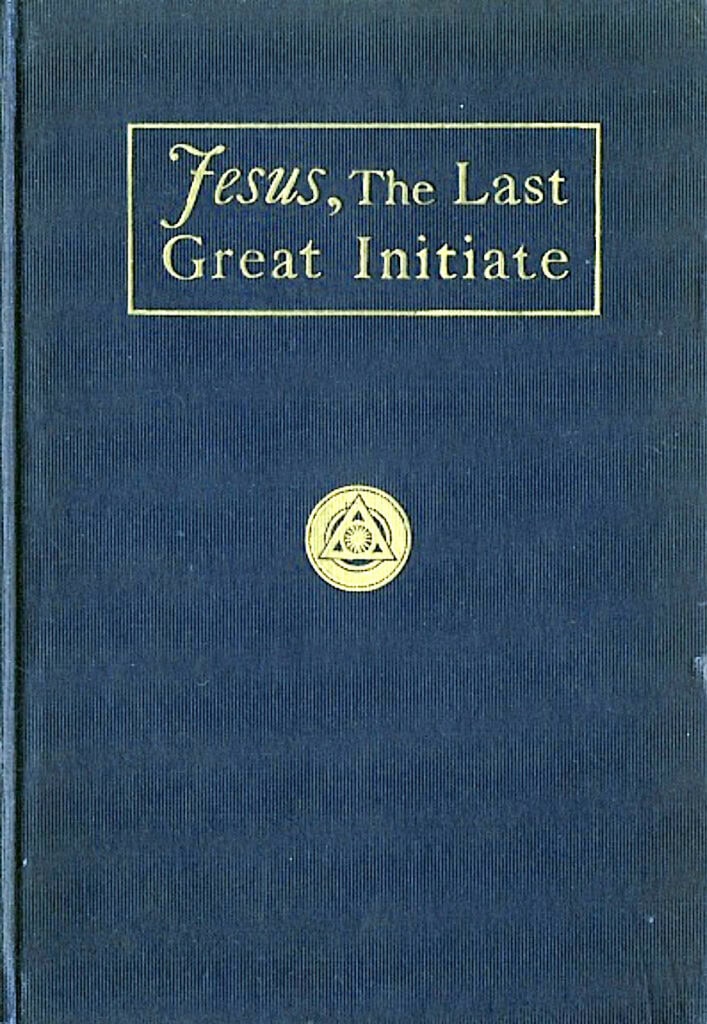
Jesus, the Last Great Initiate. Original cover.
Central to the book is the belief that Jesus underwent a process of spiritual initiation before beginning his public ministry. Schuré proposes that Christ received instruction among the Essenes and was influenced by the ancient mystery schools of Egypt, where he acquired the esoteric knowledge that later formed the basis of his teachings. Within this framework, the life of Jesus is interpreted as the journey of an initiate who had mastered the universal laws governing both the visible and invisible worlds. Rather than reading the Gospels as straightforward historical narratives, Schuré presents many of their major events as symbolic stages of spiritual development. The baptism, temptation in the wilderness, miracles, Transfiguration, crucifixion, resurrection, and ascension are interpreted as successive initiatory experiences illustrating the soul’s gradual awakening to divine consciousness. The life of Christ thus becomes a model for every individual seeking spiritual enlightenment and union with God.
Schuré argues that the true message of Christianity lies not in religious institutions or dogmatic belief but in inner transformation. The Kingdom of God is presented as an inward state of spiritual realization attained through self-purification, wisdom, love, and direct experience of the Divine. By emphasizing mystical experience over external authority, Schuré sought to reconcile Christianity with the traditions of Hermeticism, Theosophy, and ancient wisdom teachings.
The book attempts to unite historical scholarship with esoteric philosophy by presenting Jesus as both a historical individual and the earthly manifestation of a universal spiritual archetype. Through this synthesis, Schuré places Christianity within a continuous stream of sacred wisdom extending across civilizations and religious traditions.
Jesus, the Last Great Initiate became one of the most influential works of the late nineteenth-century occult revival. Its interpretation of Christ as an initiate profoundly influenced later esoteric movements, particularly Rudolf Steiner and the development of Anthroposophy.
Édouard Schuré (1841–1929) was a French philosopher, poet, playwright, music critic, and one of the leading figures in the nineteenth-century revival of Western esotericism. Best remembered for his influential work The Great Initiates (1889), Schuré sought to demonstrate that the world’s great religions and philosophical traditions originated from a common source of ancient spiritual wisdom. His writings became foundational to the study of comparative religion, Theosophy, Anthroposophy, and modern esoteric philosophy.
Born in Strasbourg, the son of a physician, Schuré was educated in both French and German culture and studied law at the University of Strasbourg before devoting himself entirely to literature and philosophy. Early in his career he gained recognition as a music critic and became one of France’s foremost champions of Richard Wagner, publishing several important studies of the composer and his music dramas. Through Wagner he also became acquainted with Friedrich Nietzsche, although his admiration for Wagner eventually gave way to a deeper interest in mysticism and occult philosophy.
During the 1880s Schuré increasingly immersed himself in esoteric studies under the influence of French occultist Fabre d’Olivet. His introduction to Helena Petrovna Blavatsky in 1884 further strengthened his interest in Theosophy and the ancient wisdom traditions. These influences culminated in the publication of The Great Initiates, in which he portrayed figures such as Rama, Krishna, Hermes Trismegistus, Moses, Orpheus, Pythagoras, Plato, and Jesus as members of a continuous lineage of enlightened teachers who transmitted universal spiritual truths across civilizations. Schuré believed that the world’s religions were outward expressions of a single perennial wisdom tradition and that true spiritual progress required recognizing the unity underlying all faiths.
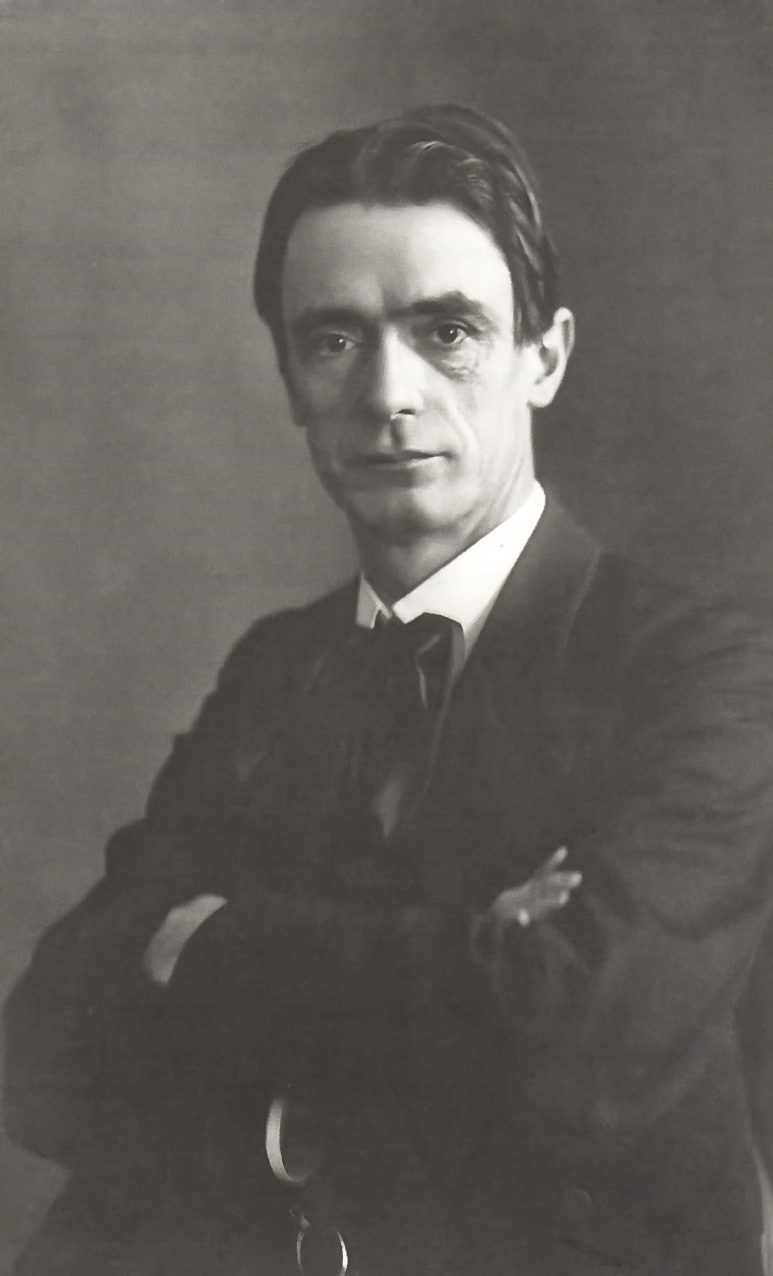
Schuré’s relationship with Rudolf Steiner became one of the most important collaborations of his later life. Introduced through Marie von Sivers in 1906, Schuré immediately regarded Steiner as an authentic initiate in the tradition described in The Great Initiates. After attending Steiner’s lectures in Paris, Schuré was so impressed that he reconstructed the lectures entirely from memory, later publishing them as Esoteric Cosmology. Steiner and von Sivers subsequently staged several of Schuré’s esoteric dramas at Theosophical congresses, while Schuré translated Steiner’s Christianity as Mystical Fact into French, helping introduce Anthroposophical ideas to a wider audience. Although the First World War temporarily strained their friendship, the two men later reconciled and remained important figures within the European esoteric movement.
In addition to The Great Initiates, Schuré authored Jesus, the Last Great Initiate, From Sphinx to Christ, numerous philosophical essays, historical studies, and dramatic works exploring the relationship between ancient mystery traditions and modern spirituality. His writings profoundly influenced Rudolf Steiner, the early Anthroposophical movement, and countless students of Western esotericism. By presenting history as the unfolding transmission of a universal spiritual wisdom, Schuré helped shape the modern understanding of Hermeticism, Theosophy, Rosicrucianism, and comparative religion throughout the twentieth century.
Related Research Articles
The Sacred Geometry of the Yogi Publication Society Logo
This article examines the Yogi Publication Society logo and its sacred geometry meaning, comparing it with Hindu, Hermetic, Rosicrucian, Masonic, and Theosophical traditions to show the intention behind the publishing network.