
Archive Document
Thought-Force in Business and Everyday Life: A Series of Lessons in Personal Magnetism, Psychic Influence, Thought-Force, Concentration, Will-Power, and Practical Mental Science
Document Description
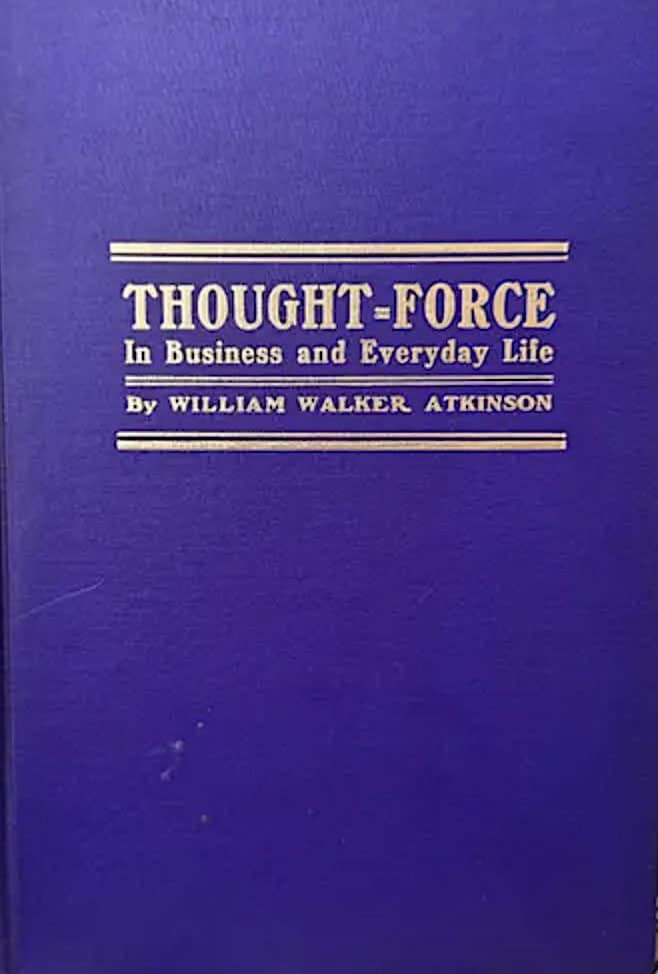
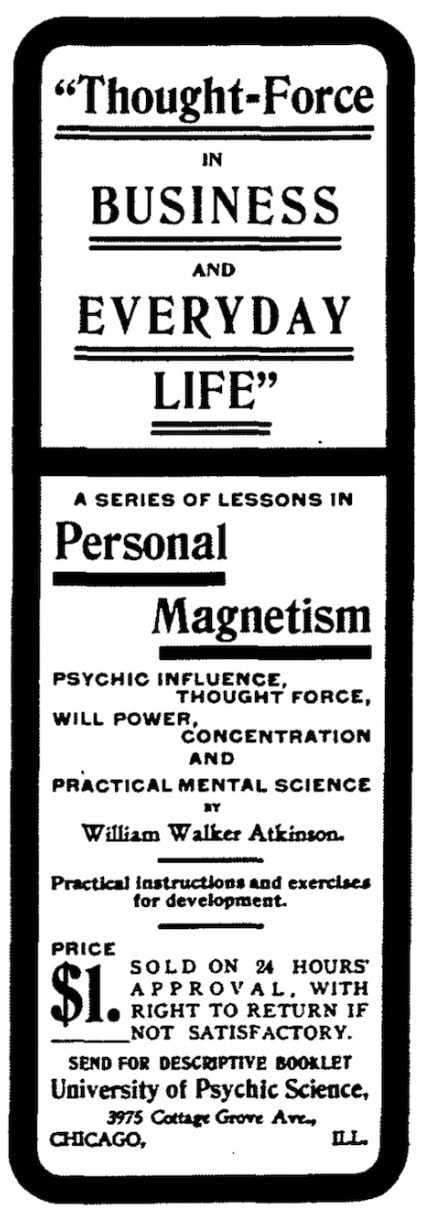
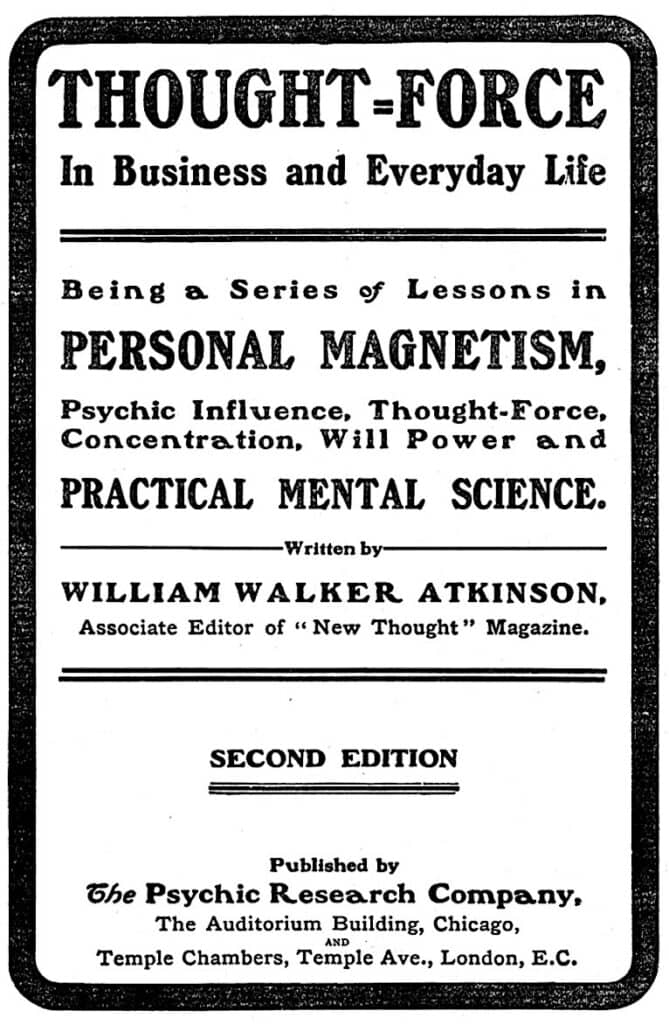
A Series of Lessons in Personal Magnetism was published in 1900 by the University of Psychic Science in Chicago under the name William Walker Atkinson. Its full title identifies its subjects as Personal Magnetism, Psychic Influence, Thought-Force, Concentration, Will-Power and Practical Mental Science. Parkyn would eventually change the title of the book to its better-known title, Thought=Force in Business and Everyday Life.
The work consists of fifteen lessons moving from the nature of personal magnetism into suggestion, thought influence, the magnetic gaze, will power, telepathy, mental attraction, character building, auto-suggestion, and concentration. The preface, dated December 4, 1900, describes the lessons as having been prepared from lecture notes and says they were “practically being the syllabi” of those lectures. Its stated purpose is to teach students to develop and use the forces said to exist within them, with the central transformation expressed as replacing “I CAN’T” with “I CAN and I WILL.”
The book is an early presentation of the mental system that would soon become closely associated with Atkinson’s New Thought writings and later appear in different forms throughout publications connected with the Yogi Publication Society. Yet the book itself places its psychological foundation inside the system of Herbert A. Parkyn. When it reaches suggestion and the two functions of mind in Lesson IV, it specifically directs students to Parkyn’s writings and to his University of Psychic Science. That acknowledgment becomes important because many of the teachings developed throughout the remaining lessons had already been taught in Parkyn’s Special Mail Course in Hypnotism and Suggestive Therapeutics.
What Does the Book Mean by Personal Magnetism?
The opening lesson rejects the idea that personal magnetism depends upon vegetarianism, celibacy, sexual abstinence, deep breathing, or the absorption of a mysterious magnetic fluid from the atmosphere. These practices may have value of their own, the book argues, but none explains the power by which one person influences another. It criticizes writers who supply theories without teaching readers how to obtain results and presents the lessons as the product of investigation and experiment. Students are repeatedly told not to accept claims merely because an authority makes them. They should acquire a working knowledge of the subject and test it themselves.
Lesson II then supplies the book’s definition. Personal magnetism is not physical magnetism or electricity. It is described as a “subtle current of thought-waves, or thought-vibrations, projected from the human mind” (p. 13). Every thought is treated as a force possessing an intensity corresponding to the strength with which it is produced. Strong thoughts can influence other minds, while repeated thoughts can succeed where a single stronger impression fails. The illustration used is steady dripping eventually wearing away stone.
Thought operates in two directions. It influences other people, but it also acts continuously upon the person producing it. Repeated thinking is said to alter character, behavior, and even outward appearance. Changes in occupation are used as an example because a new occupation creates new habits of thought that gradually express themselves in the individual.
This leads to one of the book’s most important statements. “Thoughts take form in Action” (p. 15). The book immediately explains what this means through courage, energy, confidence, and will. A person who continually thinks courage manifests courage. A person who thinks energy manifests energy. Most significantly, “The man who thinks ‘I can and I will,’ ‘gets there,’ while the ‘I can’t’ man ‘gets left’” (p. 15). Action is presented as the natural expression of sustained thought.
Personal magnetism is thus moved away from the image of an invisible magnetic substance and placed within a system of thought, will, suggestion, attention, habit, and action.
How Can Thought-Force Change a Person’s Life?
Lesson III applies this principle to everyday success. The student is told that thought does not merely influence isolated actions. Persistent thought creates mental characteristics, and those characteristics determine how the individual approaches other people and circumstances.
The lesson challenges the belief that temperament and character are fixed. A person may lack qualities needed for success, but those deficiencies can be corrected through what the book calls the “Law of Mental Control.” Existing qualities can be strengthened and new ones cultivated. The student is promised instruction in changing the habits of thought responsible for his present character.
The responsibility remains with the individual. The course can point out the method, but “Every man must work out his own salvation” (p. 21).
This idea becomes the foundation for Lesson XII, where the book returns to character building and explains the actual methods by which this mental reconstruction is supposed to occur.
How Does Suggestion Produce Personal Influence?
Lesson IV, “Direct Psychic Influence,” divides personal influence into three forms. The first is suggestion conveyed through voice, manner, appearance, and the eye. The second is the deliberate projection of thought toward another person. The third is the “adductive quality of thought,” in which habitual thinking creates an influence that operates without a deliberate attempt to affect someone at that moment.
The lesson begins with suggestion and defines it as “an impression, consciously or unconsciously received through any of our senses” (p. 23). People constantly receive such impressions and either accept or reject them according to their mental receptivity.
At precisely this point, the book introduces the dual nature of mind. Various writers have called the two sides Objective and Subjective, Voluntary and Involuntary, or Conscious and Subconscious. The book adopts the terms “Active Function” and “Passive Function.”
The Active Function performs voluntary and volitional thinking and manifests will power. The Passive Function performs automatic and involuntary mental work. It is described as the servant that handles much of the mind’s ordinary labor without conscious effort. The Active Function requires effort and consumes more “nervous force,” while the Passive Function operates easily and habitually.
The Passive Function is also more receptive to suggestion. People who habitually allow others to think for them are described as relying excessively upon this function. The person who develops the Active Function becomes harder to influence because an incoming suggestion encounters deliberate judgment and resistance.
This distinction supplies the psychological explanation for personal influence. The successful influencer attempts to reach the receptive function while avoiding unnecessary opposition from the active one.
Why Does the Book Direct Its Readers to Herbert A. Parkyn?

The most revealing passage in Lesson IV occurs immediately before the Active and Passive model is explained. Readers who want a fuller understanding of hypnotism and suggestion are told:
“There are several good books on this subject, but I would suggest the works of Dr. Herbert A. Parkyn as best fitted for his purpose” (p. 24).
A footnote adds, “These works may be obtained from the University of Psychic Science, Chicago.”
This is not a passing name in a bibliography. Parkyn is introduced at the exact point where the book needs to establish the psychological mechanism upon which its system of personal influence depends. The text then proceeds directly into a two-function conception of mind corresponding to the Voluntary and Involuntary functions taught in Parkyn’s earlier Mail Course.
Suggestion also becomes the bridge between ordinary psychology and what the book calls psychic influence. Voice, expression, posture, confidence, expectation, and the eye all become means of conveying impressions to another person’s receptive mind.
How Are Voice, Manner and the Eye Used to Influence Others?
The lessons next move from psychological explanation to interpersonal behavior. Personal influence is not represented as thought projection alone. The student’s appearance, confidence, speech, manner, self-command, and expectations continually communicate suggestions.
Lesson V applies these ideas to ordinary dealings with people. The student is instructed to avoid appearing anxious, dependent, timid, or desperate for approval. Confidence itself communicates an impression. Weakness can likewise be suggested through conduct before anything explicit has been said.
Lessons VI and VII concentrate on the eye. The book treats steady eye contact as one of the strongest means of conveying suggestion and directed will. The “Magnetic Gaze” is not simply staring. It is an intentionally cultivated gaze backed by concentration and a definite mental purpose.
Exercises are supplied to develop steadiness and control. The student learns to hold the gaze without wandering attention, then to combine it with directed thought. The physical eye is functioning as an instrument through which attention and will are expressed.
The underlying rule remains the same. The visible action gains its effectiveness from the mental condition behind it.
What Is the “Volic Force”?
Lesson VIII introduces what the book calls the “Volic Force,” deriving the term from volition or will. Will is treated as something capable of giving direction and intensity to thought. Thought already possesses influence, but concentrated thought charged with deliberate intention is said to acquire much greater power.
This introduces a distinction that becomes central to the next lessons. A person may radiate thoughts without consciously attempting to influence anyone. Volation occurs when thought is deliberately directed toward a chosen object or person.
The lessons thus develop a sequence from thought to controlled thought, from controlled thought to concentrated thought, and from concentrated thought to thought intentionally projected by will.
What Is Direct Volation?
Lesson IX applies Volic Force when the person to be influenced is physically present. The student concentrates upon a definite result, directs attention toward the other person, and mentally wills the desired action.
A series of exercises moves from simple experiments to more deliberate attempts at influence. One exercise asks the student to cause another person to look in his direction. Another involves mentally supplying a word when someone hesitates while speaking. The book claims that a sufficiently appropriate and forceful mental suggestion may cause the person to speak the suggested word.
The exercises are intended to train concentration as much as influence. Success requires a clearly formed intention and sustained attention. Doubt divides the mental effort, while expectation concentrates it.
The magnetic gaze, suggestion, thought projection, and will are now combined into a single method.
How Does Telepathic Volation Extend the Same Method Across Distance?
Lesson X removes physical presence. What had been direct volation becomes “Telepathic Volation,” with the thought directed toward someone who is elsewhere.
The basic mechanism does not change. The student forms a clear mental conception of the person and the desired result, concentrates upon it, and sends the thought with deliberate intention. The theory rests upon the earlier claim that thoughts travel outward as vibrations and can affect minds beyond immediate sensory contact.
This places telepathy inside the same system as personal magnetism. Direct suggestion, face-to-face thought influence, and distant mental influence are presented as different applications of mental force, not unrelated subjects.
The lesson also emphasizes repetition. A thought repeatedly directed along the same line is expected to produce a stronger effect than an occasional or uncertain effort.
What Is the “Adductive Quality of Thought”?
Lesson XI changes the emphasis again. Instead of deliberately sending a thought toward one person, the student is told that habitual thought creates an attracting influence of its own.
Thoughts are said to attract thoughts of corresponding quality. Fear, discouragement, jealousy, anger, confidence, courage, and success each create their own mental conditions and draw corresponding influences toward the thinker.
The book gives the negative example of someone continually thinking discouragement, lack of confidence, and “I can’t.” Such thinking is said to attract similar thoughts while also causing other people to respond to the individual as incapable. The opposite is produced by confident thought:
“But just brace up and send out earnest, confident, fearless, ‘I can and I will’ thought-waves” (p. 67).
The teaching is extended beyond internal confidence. On page 69 the book again states that “Thought takes form in Action,” and says that “I CAN and I WILL” thoughts influence how others respond, attract people capable of helping, and bring together individuals whose interests and mental states correspond.
The lesson explicitly calls this a “New Thought plan” and asks readers to test it through experience (p. 71). This places the book directly within the mental culture that would soon become a major part of Atkinson’s published New Thought work.
Can a Person Deliberately Rebuild His Character?
Lesson XII, “Character Building by Mental Control,” brings the earlier teachings inward. Personal magnetism is now a method for influencing oneself.
The lesson opens with an uncompromising claim that a person can make himself what he wills to be. Weak faculties can be strengthened, unwanted traits reduced, and desired characteristics cultivated. “Regeneration,” the book says, “is no idle dream. It is a living truth” (p. 72).
Character is explained largely through habit. People repeatedly travel familiar mental paths because those paths offer the least resistance. The book compares established habits of thought to well-worn paths through the woods. Even when another route would be better, people continue along the old path because creating a new one requires effort.
The solution is the Law of Mental Control.
Four methods are identified for changing character. They are Force of Will, Hypnotic Suggestion, Auto-Suggestion, and Thought Absorption.
Force of Will attacks the unwanted habit directly. Hypnotic suggestion introduces the desired idea through another person. Auto-suggestion allows the individual to give suggestions to himself. Thought Absorption fills the mind with the quality that the person wants to acquire.
The last method is given special importance. Instead of continually fighting an undesirable characteristic, the student concentrates upon its desirable opposite. The desired quality is repeatedly contemplated until it occupies more of the mental field and begins to express itself in behavior.
The earlier principle has now completed a circle. Thought takes form in action. Repeated action and thought establish habit. Habit forms character. By controlling thought, the student is expected to rebuild character.
The lesson closes with the declaration, “You are your own master. MAKE OF YOURSELF WHAT YOU WILL” (p. 82).
Why Is Concentration Necessary?
Lessons XIII and XIV deal with what the book calls “Concentering.” Concentration supplies the control required for every preceding method. A person who cannot hold attention cannot effectively direct thought, resist suggestion, perform auto-suggestion, build a new mental habit, or exercise Volic Force.
The training begins with control of the body. The student must learn to remain still and suppress unnecessary muscular movement. The exercises then proceed toward finer voluntary control, steadiness, attention, and the exclusion of irrelevant impressions.
The governing relationship is stated clearly in Lesson XIV. The body must be placed under the mind, and the mind under the will. A mind strengthened by will is said to become a stronger projector of thought vibrations.
The exercises include sitting perfectly still, controlling movements of individual muscles, cultivating physical ease, eliminating habitual movements, fixing attention upon objects, and repeatedly bringing wandering attention back to its chosen subject.
Concentration is thus not an isolated ability added at the end of the course. It is the discipline that makes the entire system possible.
What Is the Final Purpose of the Course?
The final lesson returns to self-command and the ethical use of mental influence. The student is warned not to misuse what has been learned for injury or exploitation. The book gives the rule, “WRONG NO MAN, AND RENDER UNTO EVERY MAN HIS DUE” (p. 98), followed by another warning not to use the newly acquired power to harm another person.
The closing pages also introduce “the Silence.” When a teaching remains unclear, the student is told to relax the body and mind, “ENTER THE SILENCE,” and allow understanding to develop. The course closes by returning to its original purpose. New thoughts are valuable only when they become actions and results.
Across its fifteen lessons, A Series of Lessons in Personal Magnetism develops one continuous mental system. Thought affects the thinker and other people. Repetition strengthens thought. Suggestion reaches the receptive mind. Will directs thought. Concentration intensifies it. Auto-suggestion turns the same process upon oneself. Repeated thought establishes habit, habit becomes character, and character expresses itself through action.
How Closely Does A Series of Lessons in Personal Magnetism Follow Herbert A. Parkyn’s Teaching?
The relationship with Herbert A. Parkyn is unusually direct because the book itself tells readers where to look for the psychological system behind its explanation of personal influence. In Lesson IV, immediately after defining suggestion and immediately before introducing its two functions of mind, it recommends Parkyn’s writings as the works “best fitted” for understanding the subject and directs readers to Parkyn’s University of Psychic Science (p. 24).
The comparison becomes much stronger when the teachings of the book are placed beside Parkyn’s earlier Special Mail Course in Hypnotism and Suggestive Therapeutics.
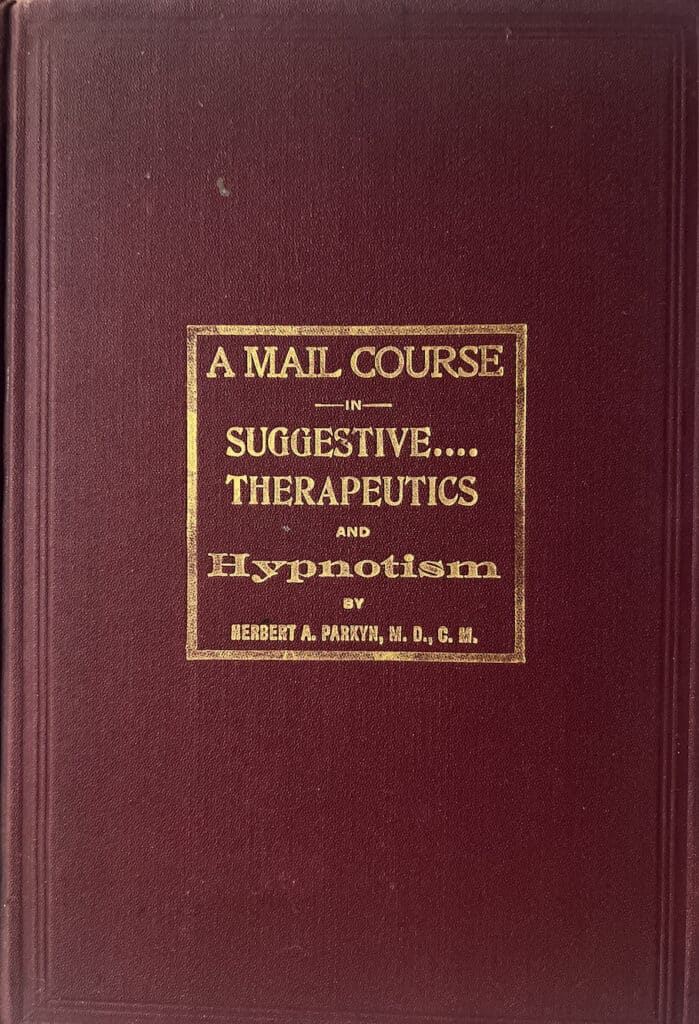
Suggestion as an Impression Received Through the Senses
Parkyn begins his Mail Course by defining suggestion as an impression reaching the mind through the senses. In Lesson I, page 1, he teaches suggestion as an impression consciously or unconsciously received through one of the senses.
A Series of Lessons in Personal Magnetism gives the same definition in Lesson IV:
“A suggestion is ‘an impression, consciously or unconsciously received through any of our senses’” (p. 23).
The book then immediately recommends Parkyn’s writings.
The Two Functions of Mind
Parkyn’s Mail Course divides mental activity into the Voluntary and Involuntary minds. The Voluntary mind reasons, chooses, directs attention, and exercises conscious will. The Involuntary mind carries out automatic functions and is receptive to suggestion. Parkyn develops this distinction in Lesson II, pp. 11–18.
A Series of Lessons in Personal Magnetism renames these the Active and Passive Functions. The Active Function performs “voluntary, volitional thinking” and manifests will power. The Passive Function performs “instinctive, automatic, involuntary” thinking and serves the Active Function (p. 24).
The terminology changes. The division and functions remain substantially the same.
Repetition Increases the Power of Suggestion
Parkyn repeatedly teaches that suggestion gains force through repetition, with this principle developed in Lesson V, pp. 29–36.
The Personal Magnetism book applies the same rule to thought influence. A single strong thought may encounter resistance, while repeated thoughts sent along the same line can eventually gain entrance. It illustrates this with steady dripping wearing away stone (p. 14).
The same mechanism then appears throughout the lessons on suggestion, telepathic influence, habit, and character building.
Thought Expresses Itself in Action
One of Parkyn’s recurring teachings is that thought becomes outward action. His Mail Course states, “Thoughts take form in action” in Lesson XXXIV, p. 273, while the relation between thought and action is developed much earlier in Lessons II and VI.
A Series of Lessons in Personal Magnetism states:
“Thoughts take form in Action” (p. 15).
It repeats the phrase again while explaining character and success:
“The above qualities of mind will invariably win out if persisted in. They will mould the character to suit the task, as ‘Thought takes form in Action’” (p. 69).
This is not merely the same general subject. The distinctive wording itself appears in both systems.
“I Can and I Will”
Parkyn used “I Can and I Will” as a formula for cultivating will, confidence, and action.
The phrase is placed at the center of Personal Magnetism from its preface onward. The stated mission of the book is to replace “I CAN’T” with “I CAN and I WILL.”
Lesson II then joins it directly to the teaching that thought takes form in action:
“The man who thinks ‘I can and I will,’ ‘gets there,’ while the ‘I can’t’ man ‘gets left’” (p. 15).
It appears again in the lesson on mental attraction, where “I CAN and I WILL” thoughts are said to create the mental condition that attracts people and opportunities (pp. 67–69).
Mental Paths and the Line of Least Resistance
Parkyn explains habit through established mental pathways in Lesson XXII, pp. 157–159. Repeated thought creates a path that becomes progressively easier to follow.
The Personal Magnetism book gives the same teaching in Lesson XII. Character consists largely of acquired habits. People follow “well worn mental paths” because these provide the line of least resistance, even when they know that a new path would eventually serve them better (p. 74).
Both systems then teach the deliberate construction of new mental pathways.
Auto-Suggestion as Self-Directed Mental Treatment
Parkyn defines and teaches auto-suggestion in Lesson VII, beginning on p. 44. The person deliberately supplies the Involuntary mind with suggestions until the desired mental condition becomes established.
Lesson XII of Personal Magnetism identifies Auto-Suggestion as one of its four principal methods of character reconstruction. The process is placed inside the Active and Passive model already introduced from the suggestion teaching. The conscious side supplies the desired thought and the receptive side gradually accepts it.
Again, the terminology has been modified, but the psychological mechanism remains recognizable.
Replacing an Undesirable Thought With Its Opposite
Parkyn’s Mail Course teaches that an established thought habit should be displaced by creating another pathway and repeatedly directing thought into it, developed in Lesson XXII, especially p. 159.
The Personal Magnetism book applies the same principle through what it calls Thought Absorption. Instead of keeping attention fixed upon the trait one wishes to destroy, the student fills the mind with the desired quality. Repetition strengthens the new thought until it becomes habitual and expresses itself through character.
The process joins the same sequence of thought, repetition, mental pathway, habit, and action.
Attention as an Exercise of Will
Parkyn’s lessons on attention explain voluntary attention as an exercise of conscious will and show that concentrated attention reduces the mind’s receptivity to competing impressions.
The closing lessons of Personal Magnetism turn this into a systematic concentration program. “The body must be brought under the direct control of the mind; the mind under the direct control of the will” (p. 89). The student practices excluding external impressions, holding attention upon a selected object, controlling involuntary movements, and repeatedly restoring wandering attention.
The concentration exercises supply the training needed to operate the same voluntary mental faculty described earlier in the Active Function.
Parkyn’s System Inside Personal Magnetism
The relationship between the two works is strongest where several of these teachings occur together. A Series of Lessons in Personal Magnetism does not merely share isolated subjects with Parkyn’s course. It defines suggestion in nearly the same language, recommends Parkyn immediately afterward, presents the same two-function mental structure under new names, teaches repetition as the means of strengthening an impression, treats habitual thought as the creation of mental pathways, uses auto-suggestion to alter those habits, develops voluntary attention through will, teaches that thought expresses itself in action, and repeatedly uses “I Can and I Will.”
The book itself provides the connection. When its explanation reaches the psychological mechanism needed to understand everything that follows, it sends the student directly to Dr. Herbert A. Parkyn and the University of Psychic Science. From that point forward, Parkyn’s earlier teachings supply much of the framework through which A Series of Lessons in Personal Magnetism develops suggestion into a wider system of personal influence, thought-force, character building, will power, and mental control.

Related Research Articles
From Mental Breakdown to Atkinsonia: How Herbert A. Parkyn Turned William Walker Atkinson into a New Thought Phenomenon
This article explores how Dr. Herbert A. Parkyn's treatment, mentorship, and network transformed William Walker Atkinson from mental breakdown into the most prolific and influential writer in the New Thought movement.
Read Article
The Science of Psychic Healing: A Bridge Between Yogi Philosophy and the Law of Suggestion
This article explores The Science of Psychic Healing, its close parallels with Herbert A. Parkyn’s teachings, and its role in connecting Eastern philosophy with the science of mind. The following information is based on…
Read Article
Thought-Force in Business and Everyday Life: Herbert A. Parkyn’s Intellectual Property Behind the First Book Under the Name William Walker Atkinson
This article reveals how Herbert A. Parkyn’s 1898 Mail Course provided the intellectual foundation for Thought-Force, the first book published under the name William Walker Atkinson.
Read Article