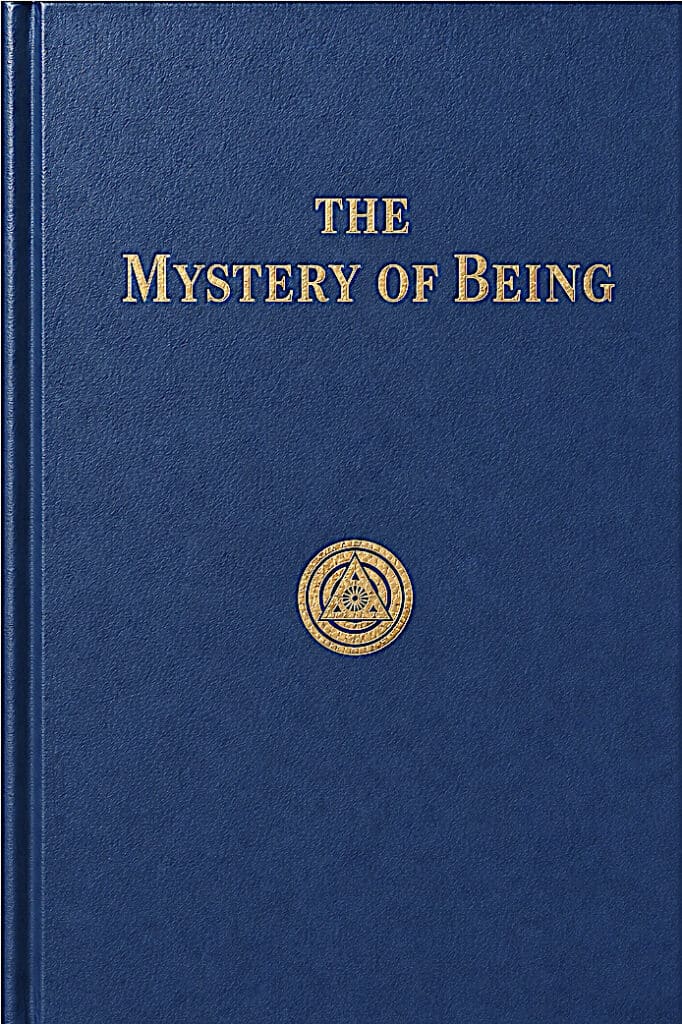
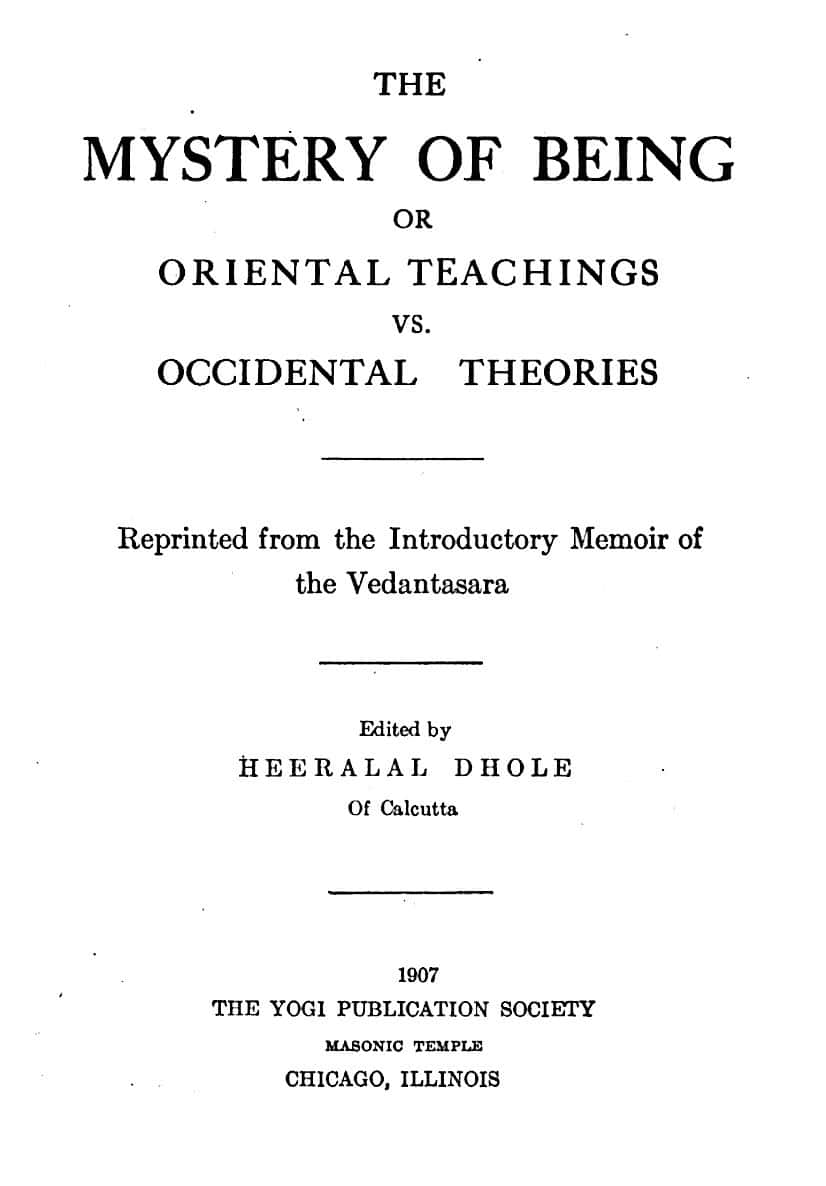
The Mystery of Being; or, Oriental Teachings vs. Occidental Theories, edited by Heeralal Dhole of Calcutta and published by the Yogi Publication Society in 1907, is a philosophical study of consciousness, matter, mind, life, causation, evolution, and the nature of God. The title page explains that the work was reprinted from Dhole’s introductory memoir to the Vedantasara, making one of the main books through which Indian philosophy was being interpreted for English-speaking readers.
Oriental teachings are placed beside the scientific, philosophical, and religious theories of the West to see what each can explain about existence. The book begins with the Sankhya conception of Prakriti and Spirit and then moves through the properties of matter, the three Gunas, the nature of mind, primordial substance, matter and force, the constitution of the human being, the origin and development of life, causality, and the competing ideas of pantheism and an anthropomorphic God. Dhole takes Western science seriously and repeatedly references its findings, yet he argues that physical investigation cannot settle the entire problem of being because consciousness is itself part of the evidence that any complete philosophy must explain.
The Mystery of Being examines whether matter and physical force are sufficient to explain mind, consciousness, will, life, and the universe. Beginning with Sankhya philosophy and moving through Indian theories of mind and matter, Dhole compares Oriental philosophy with Western materialism and scientific thought. He accepts many discoveries concerning the physical dependence of mental activity upon the brain and nervous system, while maintaining that direct consciousness, will, and subjective experience cannot simply be discarded. The later chapters extend the inquiry to life, evolution, causality, and Deity, leading to a philosophical defense of a universal conception of being closer to Indian metaphysics than to either strict materialism or a narrowly anthropomorphic theology.
What Is The Mystery of Being About?
At the center of The Mystery of Being is a problem that Dhole believes neither religious dogma nor scientific materialism can settle by itself: what is a human being, and what kind of reality must exist for matter, consciousness, thought, will, and life to appear together? He opens by describing an intellectual age in which inherited religious authority has been subjected to criticism and scientific inquiry. Biblical explanations of creation have lost their former unquestioned position, while evolutionary science and free inquiry have changed the terms of religious discussion. Dhole sees Indian philosophy entering this debate with an advantage. Its teachings have also been subjected to scrutiny, yet he believes that they remain capable of addressing questions that Western materialism has left unresolved. His first task is accordingly to establish the philosophical vocabulary through which the rest of the investigation will proceed.
This makes the book more than a simple introduction to Vedanta or Sankhya. Dhole continually moves between Indian and Western systems, asking what can be accepted from each and where their explanations become incomplete. Physical science has discovered genuine relations between brain, nerves, bodily condition, sensation, and mental activity. Dhole does not try to erase these findings. His objection arises when physical correlation is turned into the stronger assertion that consciousness has been fully explained by matter. The existence of thought, feeling, knowledge, attention, and will remains something directly known through experience, and a philosophy of being must account for that evidence as seriously as it accounts for objects perceived through the senses.
How Does Sankhya Explain Matter and Spirit?
Dhole begins with the Sankhya system associated with Kapila. Prakriti, or primordial Matter, is described as eternal and coexistent with Spirit. It does not arise from absolute non-being and is continually undergoing transformation. In its primordial condition Prakriti is subtle, undifferentiated, and insentient. The visible universe represents its development into increasingly differentiated forms possessing the qualities through which objects become perceptible to the senses. Sound, touch, taste, smell, and the other characteristics associated with material existence belong to this manifested condition, while primordial Prakriti lies behind these particular forms.
Spirit, or Atma, is presented in its free condition as pure intelligence or consciousness, without the attributes and attachments associated with embodied existence. The difficulty of ordinary human experience comes from the relationship between consciousness and manifested matter. The individual Spirit becomes entangled with the senses and identifies itself with conditions that belong to material existence. Dhole uses this relationship to establish one of the themes that runs through the book: ordinary consciousness does not automatically disclose the deepest nature of reality because human perception operates through a mind and sensory organization already conditioned by material existence.
Knowledge of the deeper condition of Prakriti requires a corresponding transformation of the individual. Dhole describes a disciplined life involving moderation in food, abstinence from intoxicants and animal food, bodily cleanliness, purity of mind, truthfulness, restraint of speech and passion, and the relinquishment of excessive worldly desire. Intellectual study alone is insufficient. The aspirant employs Sravana, hearing or receiving the teaching; Manana, consideration and analysis; and Nididhyasana, profound contemplation. Through continued practice the mind becomes more receptive and luminous, allowing primordial reality to be reflected in consciousness. This gives the early chapters a practical dimension even though the book is primarily philosophical. The problem of being is connected with the condition of the person attempting to perceive it.
What Are the Gunas?
A major part of Dhole’s explanation of matter depends upon the three Gunas, the fundamental qualities or tendencies inherent in Prakriti. Sattva is associated with light, clarity, intelligence, and equilibrium; Rajas with activity, motion, passion, and change; and Tamas with inertia, darkness, heaviness, and resistance. These should not be understood merely as moral labels attached to human behavior. Within Sankhya they are constituent tendencies of manifested nature itself, and their varying proportions help explain differences in physical and mental conditions.
The Gunas give Dhole a way of describing a universe that can remain rooted in a common primordial substance while displaying immense variety. The difference between one manifested condition and another does not require an entirely different underlying reality. Change in the proportion and interaction of the qualities produces different expressions. The same framework can then be applied to human mental life. A clear and perceptive mind displays the influence of Sattva; restless activity and desire express Rajas; dullness and inertia reveal Tamas. Mental development can be described as a change in the balance of these tendencies, linking cosmology, psychology, ethics, and spiritual discipline within one system.
What Is the Mind According to Dhole?
The chapter on mind becomes one of the most important parts of The Mystery of Being because Dhole examines several competing explanations instead of immediately assuming a single definition. Indian schools had disagreed about the relation of mind, consciousness, body, and Atma just as Western philosophers had disagreed about mind and matter. Dhole describes views in which mind is closely identified with the Self as well as opposing views in which mind is treated as an insentient instrument activated by consciousness.
This distinction becomes critical. Knowledge, will, attention, perception, and action appear through the mind, but their appearance through it does not necessarily prove that the mind is the ultimate conscious principle. The senses themselves require mental cooperation before their impressions become meaningful experience. Seeing an object involves more than the physical existence of an eye and an external object; sensory information must enter the organized field of awareness. Dhole uses such questions to separate the instrument through which experience is organized from the consciousness by which experience becomes known.
The argument also prepares the reader for Dhole’s criticism of a purely cerebral explanation of human existence. Brain conditions unquestionably affect thought. Disease, injury, intoxication, heredity, nutrition, and other bodily factors can alter mental activity. Such facts establish an intimate relationship between physical organization and mental expression, but for Dhole they do not prove that consciousness and brain matter are identical. Correlation is important evidence, yet the fact that mental states vary with bodily states does not by itself answer what consciousness is.
Can Matter and Force Explain Consciousness?
The middle of the book brings the Oriental and Occidental sides of Dhole’s inquiry into especially close contact. Western physical science had increasingly described nature in terms of matter, force, motion, energy, nervous action, and physical law. Dhole examines these ideas carefully, including attempts to treat vital or nervous force as a physical substance comparable to electricity. He notes experimental observations concerning the transmission of nervous impulses and uses them to show the problems involved in simply identifying nervous activity with electrical action.
His larger concern is the temptation to extend physical explanation beyond what the evidence establishes. A scientific account may describe the material conditions accompanying sensation, thought, or movement without explaining why there is subjective experience at all. The measurable movement of a nerve impulse and the experienced sensation associated with it belong to different kinds of evidence. One is observed externally; the other is directly known in consciousness.
Dhole gives considerable attention to the materialist position because he recognizes the evidence supporting it. Medical observation demonstrates correlations between bodily and mental conditions. Proper nourishment and oxygenation affect mental activity; cerebral disease can disturb intellectual functions; heredity can transmit pathological conditions; intoxicants can produce temporary mental derangement. These facts cannot be ignored by a serious philosophy of mind. Yet Dhole insists that the materialist must also confront another body of evidence: the immediate testimony of consciousness itself.
Why Is Will Important to the Argument?
Will becomes one of Dhole’s strongest examples because ordinary experience presents it as an active determining element of human consciousness. Materialism may attempt to reduce willing to physical processes, but the individual experiences deliberation, intention, choice, and direction as real features of mental life. Dhole points to conditions in which ordinary voluntary control is suspended, including forms of natural and artificial somnambulism, to emphasize what changes when the directing activity of will is absent or altered.
The importance of this argument is larger than the specific question of free will. Dhole is establishing that an adequate account of the human being must include first-person experience among its evidence. A theory cannot claim completeness by explaining the observable body while dismissing the consciousness through which the theory itself is conceived and evaluated. Thought, knowledge, intention, and awareness are facts requiring explanation.
This places The Mystery of Being close to several subjects that recur throughout the Yogi Publication Society catalog. Books issued under the Yogi Ramacharaka name repeatedly explore the relationship among mind, body, will, consciousness, and a deeper Self. Dhole approaches these questions through comparative philosophy and the terminology of Indian philosophical schools, giving the YPS catalog a work that could connect its presentations of Yogi philosophy with contemporary arguments over psychology, materialism, and science.
What Is the “Human Aggregate”?
Dhole’s discussion of the human aggregate asks what exactly is present when we refer to a human being. Body, nervous system, senses, mind, feelings, ideas, consciousness, and force participate in human existence, yet grouping them together does not establish that they are identical. This is where he finds difficulties in both extreme materialism and simple spiritualism. Each can select one class of facts and make it carry more explanatory weight than it can bear.
The distinction between mind and matter is especially important. Matter possesses extension and occupies space. Mind, as known through feelings and ideas, does not present itself to consciousness as a spatial object of the same kind. Matter becomes known through sensory perception; mind becomes known through direct consciousness. Dhole regards feelings and ideas as among the most certain realities available to us because their existence is immediately experienced. The challenge is to formulate a conception of the human being capable of respecting both kinds of evidence without forcing them into an artificial identity.
Dhole accordingly turns attention toward the relationship between mind and force. The point is not that physical existence is unreal. His argument depends upon the reality of both the physical and conscious sides of experience. The human aggregate is a meeting point at which bodily processes, forces, mental phenomena, and consciousness must somehow be related, and the inability of a theory to account for one side cannot be solved by declaring that side nonexistent.
How Does The Mystery of Being Explain the Origin of Life?
After establishing the philosophical problems of matter, mind, and consciousness, Dhole extends the discussion to life itself. The question becomes whether living organization can be explained entirely as a development of material processes or whether life reveals principles that cannot be exhausted by a mechanical account. Here the book engages directly with the nineteenth-century scientific discussion that had transformed Western ideas about nature.
Dhole does not need to reject scientific observation in order to challenge philosophical materialism. Throughout the book he distinguishes between discoveries about how physical processes operate and claims about what reality consists of in its entirety. The fact that increasingly complex living forms can be studied through physical structure, heredity, adaptation, and biological development does not automatically establish that consciousness is nothing more than an arrangement of matter. Life introduces organization, responsiveness, sensation, and eventually self-conscious intelligence into the inquiry, making the original problem more difficult as the discussion advances.
The “origin of life” is thus connected with the “mystery of being” announced in the title. Explaining the physical conditions under which an organism exists is valuable, but Dhole wants to know what kind of universe makes life and consciousness possible in the first place.
What Does Dhole Say About Evolution?
The chapter “The Ascent of Life” places evolutionary development within Dhole’s larger philosophical scheme. Evolution had transformed nineteenth-century Western thought by providing a natural explanation for the diversification and development of living forms. Dhole accepts evolution as an intellectual fact that Indian philosophy must address, and the opening chapter already acknowledges how thoroughly evolutionary ideas had displaced older literal accounts of creation.
Yet evolution also raises a philosophical question. If life advances from simpler toward more complex forms, and if conscious experience becomes increasingly elaborate as nervous organization develops, what exactly is developing? A materialist answer concentrates upon the organism. Indian metaphysics allows Dhole to consider development as manifestation: qualities that become visible under increasingly complex conditions need not have been created from absolute nothing at the moment they appeared.
This allows ancient cosmological concepts and modern evolutionary ideas to occupy the same discussion. Prakriti is already conceived as dynamic and capable of transformation. The Gunas provide a model of changing combinations and conditions. Manifested nature proceeds through variation and differentiation. Evolution can therefore describe an observable process without becoming a complete metaphysical explanation of existence.
What Is the Doctrine of Causality?
The doctrine of causality brings the earlier discussions together. Change does not occur without relation to antecedent conditions, and an effect cannot be treated as an inexplicable appearance from absolute non-being. Indian philosophy had developed sophisticated doctrines concerning whether an effect already exists potentially within its cause and how manifestation should be understood. Such ideas are important to Dhole because they offer another way of thinking about evolution and creation.
If the effect arises through transformation of what already exists in causal form, the universe does not need to be imagined as something suddenly produced out of nothing. Manifestation becomes a process through which latent or unmanifest conditions become perceptible forms. This is consistent with the Sankhya conception of Prakriti that begins the book: primordial matter persists through changing manifestations.
Causality also limits simplistic explanations. Naming the immediate physical cause of a phenomenon does not necessarily answer every question concerning its existence. A chain of physical causes can be extended backward while leaving unanswered the philosophical problem of the causal order itself. Dhole’s inquiry continually returns to this distinction between explaining a process within the universe and explaining the basis upon which such processes are possible.
Pantheism vs. Anthropomorphism: What Is God?
The final chapter brings the inquiry to its largest question: the nature of Deity. Dhole contrasts pantheistic ideas of divine reality with anthropomorphic conceptions that imagine God in personal and human-like terms. This is the natural destination of the book because every earlier question—matter, consciousness, force, life, evolution, and causality—eventually raises the question of whether existence rests upon a universal principle.
An anthropomorphic God provides an intuitive religious image, but Dhole’s philosophical method pushes toward a conception capable of encompassing the whole order of existence. Indian philosophy supplies models in which ultimate reality is not another individual being situated somewhere outside the universe. The relation of the individual to the universal, of Atma to the deepest reality, and of manifested nature to its source requires a conception of Deity that exceeds ordinary human personality.
Pantheism, however, carries its own philosophical difficulties if it is interpreted simply as saying that the collection of visible material objects is God. Dhole’s earlier distinctions remain important. The ultimate cannot be reduced to gross matter because matter as ordinarily perceived is itself a manifested condition. Nor can consciousness simply be removed from the account. His discussion points toward a universal ground within which matter, force, life, mind, and consciousness can be understood as aspects or expressions of a deeper order of being.
Why Does Dhole Compare Oriental Philosophy With Western Science?
The comparison announced in the subtitle is one of the most distinctive features of The Mystery of Being. Dhole does not present “Oriental Teachings” and “Occidental Theories” as two sealed systems having nothing to say to one another. Western science supplies evidence that Indian philosophy must confront, while Indian philosophy supplies conceptual tools for questions that physical science alone may not answer.
That approach explains why Dhole spends so much time on the brain, nervous system, heredity, physical force, physiology, evolution, and materialism. He is not writing an exclusively devotional treatment of Vedanta. He is attempting to show that ancient philosophical doctrines concerning Prakriti, Atma, mind, causation, and universal reality can participate in contemporary arguments about science and human existence.
The title’s word “versus” can therefore be misleading if taken to mean that every Western theory is rejected. Dhole frequently accepts the observations and experimental results of Western science while disputing the philosophical conclusions drawn from them. His disagreement is strongest when materialism turns a successful explanation of physical processes into a universal assertion that only physical processes exist.
What Is the Central Argument of The Mystery of Being?
The book’s argument can be reduced to several connected propositions:
Matter and physical force are real parts of human experience and must be studied through observation and science.
Mind and body are intimately correlated, and physical conditions can profoundly affect mental activity.
Consciousness is also a fact and is known directly through subjective experience.
The existence of a physical correlation does not by itself establish that consciousness and matter are identical.
Will, thought, feeling, attention, and knowledge must be included in any complete account of human existence.
Sankhya and related Indian systems provide a framework in which manifested matter can change while consciousness remains conceptually distinct from material extension.
Life and evolution describe processes of manifestation and development but do not automatically settle the metaphysical question of what existence is.
Causality points toward continuity between cause and effect and challenges the idea that reality can arise from absolute nothing.
The question of being eventually becomes a question about universal reality or Deity and the relationship of individual consciousness to it.
These propositions explain the book’s unusual movement from Indian cosmology into psychology, physiology, evolution, and theology. Dhole is pursuing one question through each field: what conception of reality can accommodate all the facts without discarding either the physical world or consciousness?
Why Is The Mystery of Being Important?
The Mystery of Being is valuable because it preserves an early encounter between Indian metaphysical philosophy and the scientific worldview of the late nineteenth and early twentieth centuries. Dhole does not treat modern science as an enemy to be dismissed, nor does he accept the claim that scientific success makes metaphysical inquiry unnecessary. He takes discoveries concerning the body, brain, nervous system, matter, force, heredity, and evolution seriously while asking whether they explain consciousness itself.
That question gives the book much of its continuing interest. Dhole distinguishes between finding the physical conditions associated with thought and explaining why conscious experience exists. He distinguishes the object known through the senses from the act of knowing it. He recognizes bodily influences upon the mind while refusing to treat those influences as proof that mind, consciousness, and matter are the same thing. These problems remained central to philosophy of mind long after the particular nineteenth-century scientific theories discussed in the book had changed.
Within the history of the Yogi Publication Society, the book also demonstrates the range of material the publisher was assembling for its readers. The YPS catalog was not confined to instructional Yoga books. It included translations, reprints, comparative religion, Indian philosophy, Western occultism, mysticism, and works attempting to bring ancient philosophical systems into conversation with contemporary intellectual life. The Mystery of Being is a particularly clear example because that conversation is the book’s declared purpose.
What Is the Main Message of The Mystery of Being?
The main message of The Mystery of Being is that no explanation of existence is complete if it accounts for matter while leaving consciousness unexplained. Physical science reveals genuine laws governing bodies, nerves, forces, and living organisms, but human beings also possess immediate knowledge of thought, feeling, attention, intention, and will. Those facts belong to reality just as surely as objects perceived through the senses.
Dhole turns to Sankhya, Vedantic thought, and other Indian philosophical traditions because they preserve distinctions among manifested matter, mind, consciousness, and the deeper Self that allow these different aspects of experience to be examined together. Prakriti supplies the changing field of manifestation; the Gunas explain qualities and transformations within it; mind mediates experience; consciousness supplies the fact of awareness; causality links manifestation to what precedes it; and the inquiry finally opens into the question of universal Being.
The “mystery” in the title is therefore the mystery behind every individual act of knowing. Human beings are part of the material world and are affected by its laws, yet they are also conscious of that world, conscious of themselves, and capable of asking what existence means. Dhole’s answer is that the problem cannot be solved by choosing one fragment of experience and treating it as the whole. Matter, force, life, mind, will, and consciousness must be brought into a single philosophical inquiry, and it is through that inquiry that the ancient teachings of India enter into conversation with the scientific and philosophical theories of the West.
Heeralal Dhole was an Indian philosopher, author, and publisher who became a leading advocate for the preservation and dissemination of India’s classical philosophical literature in the late nineteenth and early twentieth centuries. Operating from Calcutta (now Kolkata), he devoted his career to making foundational Hindu philosophical texts accessible to both Indian and Western audiences through affordable translations, commentaries, and original works. His measures contributed significantly to the preservation of Sanskrit traditions during an era marked by increasing international engagement with Eastern philosophy, which was transforming global religious and philosophical discourse.
Dhole was closely associated with the Society for the Resuscitation of Indian Literature, an organization established to revive and promote India’s ancient intellectual heritage through scholarly publishing. Working alongside his relative, Dr. Nundalal Dhole, he helped produce the respected Dhole Vedanta Series, which included translations and studies of important works on Vedanta, Sāṃkhya, and other schools of Indian philosophy. The series became an important resource for students pursuing reliable introductions to classical Hindu thought.
Among his best-known works is The Mystery of Being; Or, Oriental Teachings vs. Occidental Theories (1907), in which Dhole contrasts the philosophical systems of East and West while introducing Western readers to the central principles of Advaita Vedanta. Throughout the work, he argues that Eastern philosophy gives a more complete understanding of consciousness, reality, and human existence than the increasingly materialistic and reductionist philosophies then dominant in Europe and America.
Dhole’s writings frequently explored the fundamental doctrines of Indian metaphysics, including the nature of Brahman, the individual Self, the three Gunas, the evolution of the universe through the principles of Sāṃkhya philosophy, and the relationship between the material and spiritual worlds. Rather than treating these ideas as abstract speculation, he presented them as practical systems for understanding consciousness and attaining self-realization.
Related Research Articles
Herbert A. Parkyn’s Foundation in Eastern Philosophy
This article examines Dr. Herbert A. Parkyn's early study of Eastern philosophy and the network of individuals and ideas that helped lay the foundation for the Yogi Publication Society and its publishing program.
Who Was the Author Behind the Name “Bhikshu”? The Case of Swami Pareswara Bikshu vs. Charles Henry Allan Bennett
The identity of the author who wrote under the name Bhikshu remains an iunresolved question in the history of the Yogi Publication Society. The case of Swami Pareswara Bikshu vs. Charles Henry Allan Bennett.
Yogi Ramacharaka: The True Meaning and Origin of the Name
This article breaks down the hidden symbolism and meaning behind "Yogi Ramacharaka", the pen name that was created by the Yogi Publication Society and shows the allegory that reflected the ideas the books were…