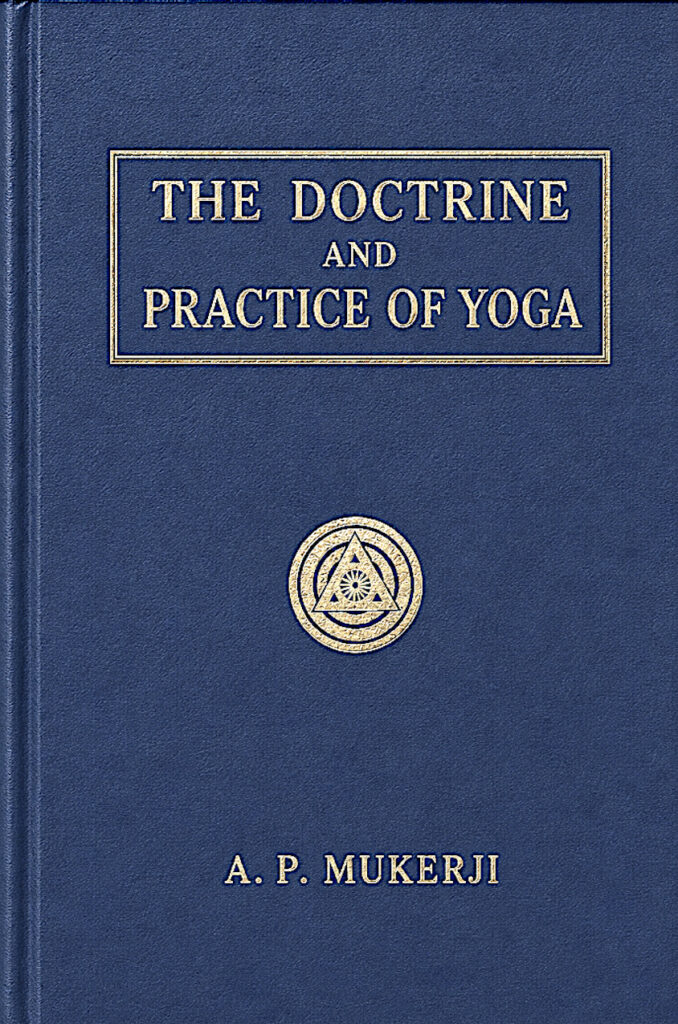
About This Publication
The Doctrine and Practice of Yoga by Swami A. P. Mukerji, first published in 1922, describes yoga as a full system for developing the mind, morals, and spirit, not just a set of physical exercises. Drawing from Vedanta and Raja Yoga, the book explains that yoga’s real goal is to master the mind, build a strong will, and gradually realize one’s divine nature. Mukerji guides readers with both philosophy and practical exercises, offering a clear path to self-mastery and higher awareness.
A key idea in the book is what Mukerji calls Will-Force. He says that the strength of your will shapes your life, and real spiritual growth starts with mastering your lower nature. By training the mind, facing fears and desires, and building a steady sense of purpose, a person can gain control over their inner urges and the world around them.
The book highlights concentration as the main way to develop higher awareness. Mukerji gives practical exercises for both objective concentration, which means focusing on things outside yourself, and subjective concentration, which means turning your attention inward to ideas and deeper parts of the soul. He also explains the difference between active thinking, where you guide your thoughts, and passive thinking, where you quiet the mind to receive insight and spiritual understanding.
Along with practical advice, The Doctrine and Practice of Yoga looks at key ideas from Hindu philosophy. Mukerji talks about Maya, which is the illusion of the material world that hides the true reality, the role of the Guru as a spiritual guide, and the need to face both good and hard times as chances to grow inside. He presents these teachings as useful principles for daily life and spiritual progress, not just as abstract ideas.
One theme that comes up often is the creative power of thought. Mukerji explains that strong ideas, sincere desires, and steady attitudes bring matching people, situations, and chances into your life through a universal law. By choosing to focus on positive ideals and aligning your will with higher spiritual values, you can slowly shape your character and future.
The Doctrine and Practice of Yoga is more than just a yoga manual. It offers a complete philosophy of conscious growth. By blending mental training with classic Vedantic wisdom, Mukerji shows yoga as a way to master the mind, discover the higher Self, and realize our natural spiritual potential.
Swami A. P. Mukerji
Swami A. P. Mukerji was an Indian spiritual teacher, author, associate editor of The Kalpaka, and member of the South India Order. His writings played a key role in introducing traditional yogic philosophy to Western readers when yoga was still unfamiliar outside India. Instead of focusing on physical exercise, Mukerji described yoga as a complete philosophy centered on mental discipline, moral growth, and spiritual awakening. He highlighted willpower, concentration, character, and higher consciousness as the main goals of yogic practice.
Some of his most well-known books include The Doctrine and Practice of Yoga, Yoga Lessons for Developing Spiritual Consciousness, The Yogi Conception of Character Building, and The Yogi Role of Prayer. These early twentieth-century works gave readers practical guidance on meditation, concentration, visualization, breath control, prayer, and training the mind. Mukerji aimed to make classical yoga principles easy to understand for Western readers and show how they could be used in daily life.
A key idea in Mukerji’s philosophy was what he called Will-Force. He believed that a person’s willpower shapes their life, and that mental training helps people control both their inner urges and the world around them. Instead of seeing fate as unchangeable, Mukerji taught that people can shape their own character and future by working hard, thinking positively, and practicing self-control.
Mukerji also stressed that people need to rise above their material desires to reach higher spiritual awareness. He saw life as a journey where every experience helps the soul grow. By practicing meditation, living ethically, and learning to control their thoughts, people can move beyond fear, selfishness, and illusion, and become more aware of the deeper spiritual reality behind daily life.
Mukerji combined traditional Vedantic philosophy with practical ways to develop the mind. His ideas were similar to those of the New Thought movement, but he stayed true to classical yoga teachings. His books were some of the first to introduce Indian spiritual philosophy to Western readers and are still valued today for their focus on self-mastery, building character, and developing spiritual awareness.