
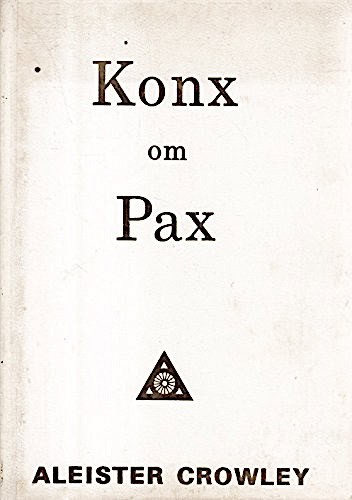
Konx Om Pax
About This Publication
Konx Om Pax: Essays in Light, originally published in 1907, is regarded as one of Aleister Crowley’s most ambitious and complex books. He wrote it as he moved beyond his Golden Dawn training and began forming ideas that would later become Thelema. In this work, Crowley seeks to bring together mysticism, Kabbalah, alchemy, ceremonial magic, Eastern philosophy, and spiritual psychology into a single literary and symbolic whole. He saw it as one of his greatest achievements and later called it “the most remarkable book on the Mystic Path ever written.” Instead of laying out a clear doctrine, the book explores spiritual growth through allegory, drama, satire, poetry, and philosophy, asking readers to consider its ideas from multiple angles.
The title comes from the ritual traditions of the Hermetic Order of the Golden Dawn. Crowley took the phrase from the Neophyte initiation ceremony, where it stood for spiritual light emerging from darkness. He linked it to the idea of “Light in Extension,” seeing consciousness as a ray of divine light reaching out into the world. In the book, light is both a deep principle and a symbol of awakening. The story shows the human journey as a gradual move from confusion and limits to greater awareness and connection with higher realities.

The first main section, The Wake World, is likely the easiest part of the book to read. It is written as a mystical fairy tale and follows a young soul’s spiritual growth through a symbolic world based on the Kabbalistic Tree of Life. The story turns the ten sephiroth and twenty-two paths into real experiences, bringing complex occult ideas to life. Instead of applying technical diagrams or definitions, Crowley shows Kabbalah as a passage of the mind. Each meeting represents a step in inner growth, and each place reveals a different aspect of spiritual understanding. This section works as both a mystical story and a practical guide to the path of initiation in Western esoteric traditions.
The second section, Ali Sloper; or, The Forty Liars, has a very different tone. It is a satirical play that uses humor, incredible situations, and exaggeration to point out the flaws and pride often found in occult circles. Crowley criticizes spiritual pretension, strict institutions, and the way seekers can confuse symbols and titles with real progress. Under the comedy, there is a serious warning about ego and self-deception. The play suggests that real spiritual growth needs both the search for wisdom and the ability to see through the many illusions the mind creates.
The third essay, Thien Tao; or, The Synagogue of Satan, shows Crowley’s growing interest in Eastern ideas. Written like a classic Taoist text, it looks at balance, leadership, action, and spiritual detachment. In this essay, Crowley tries to bring together Western occult ideas with Eastern ways of reaching enlightenment. Instead of supporting strict moral codes or fixed rules, he focuses on harmony with universal principles and finding inner balance. The essay shows Crowley’s belief that the deepest truths of both East and West lead to the same spiritual realities, even if they use different symbols and languages.
The last and most famous section, The Stone of the Philosophers, looks at what Crowley saw as the highest goal of alchemy and mysticism. Using Hermetic symbols, alchemical images, and mystical ideas, the essay explores how a divided human personality can become a unified spiritual self. The Philosopher’s Stone is shown not as a real object but as a symbol of perfect awareness. The essay discusses the link between matter and spirit, and between the individual and the universal, attempting to describe the final realization that all true spiritual paths seek. Crowley thought this essay was one of his best works and one of the deepest statements of his mystical beliefs.
Several themes recur throughout the book. One is that truth cannot be fully shared through normal language. Crowley uses symbols, myths, stories, rituals, and poetry because spiritual realities go beyond simple words. Another theme is that all real traditions have something in common. Kabbalah, alchemy, Taoism, mysticism, and ceremonial magic are shown as different ways of expressing the same basic truths. Crowley often looks for connections, saying that the world’s traditions can work together rather than conflict.
Another main theme is the change in consciousness. Each part of the book looks at how a person can go beyond normal limits. This might be through climbing the Tree of Life, breaking illusions with satire, finding Taoist balance, or searching for the Philosopher’s Stone. The main goal is always the same: reaching a higher state of being. Spiritual growth is shown not just as gaining secret knowledge, but as a deep change in the person.
The first 1907 edition became almost as well known for its cover as for what was inside. Crowley designed the detailed geometric cover himself, filling it with a maze of lines and letters. Later stories say he came up with parts of the design while using hashish and wanted the geometry to be more than just decoration. The cover was meant to show the book’s main ideas, acting as a visual symbol or charm that showed the hidden links between light, consciousness, and sacred geometry. This mix of art and occult symbols matched the book, where every style was used to teach spiritual lessons.

Konx Om Pax shows Crowley at a key point in his intellectual and spiritual life. The book stands between his time with the Golden Dawn and his later creation of Thelema, bringing together many ideas that shaped his worldview, including Kabbalah, Hermeticism, alchemy, Eastern philosophy, and mystical psychology. Instead of being a simple guide to occult practice, it urges readers to explore the mystical path through symbols and imagination. Using allegory, satire, philosophy, and poetry, Crowley sought to shed light on the journey from ignorance to enlightenment, presenting spiritual awakening as the discovery of the light that has always been within.
Aleister Crowley
Aleister Crowley (1875–1947) was an English occultist, ceremonial magician, poet, novelist, mountaineer, and the founder of the religious philosophy called Thelema. He became one of the most influential and controversial figures in modern Western esotericism. Crowley turned away from the strict evangelical Christianity of his Plymouth Brethren upbringing and spent his life exploring mysticism, ceremonial magic, comparative religion, Eastern philosophy, and ancient traditions. The press often called him “the wickedest man in the world,” but his writings had a major impact on twentieth-century occultism and still influence modern magical, esoteric, and alternative spiritual movements.
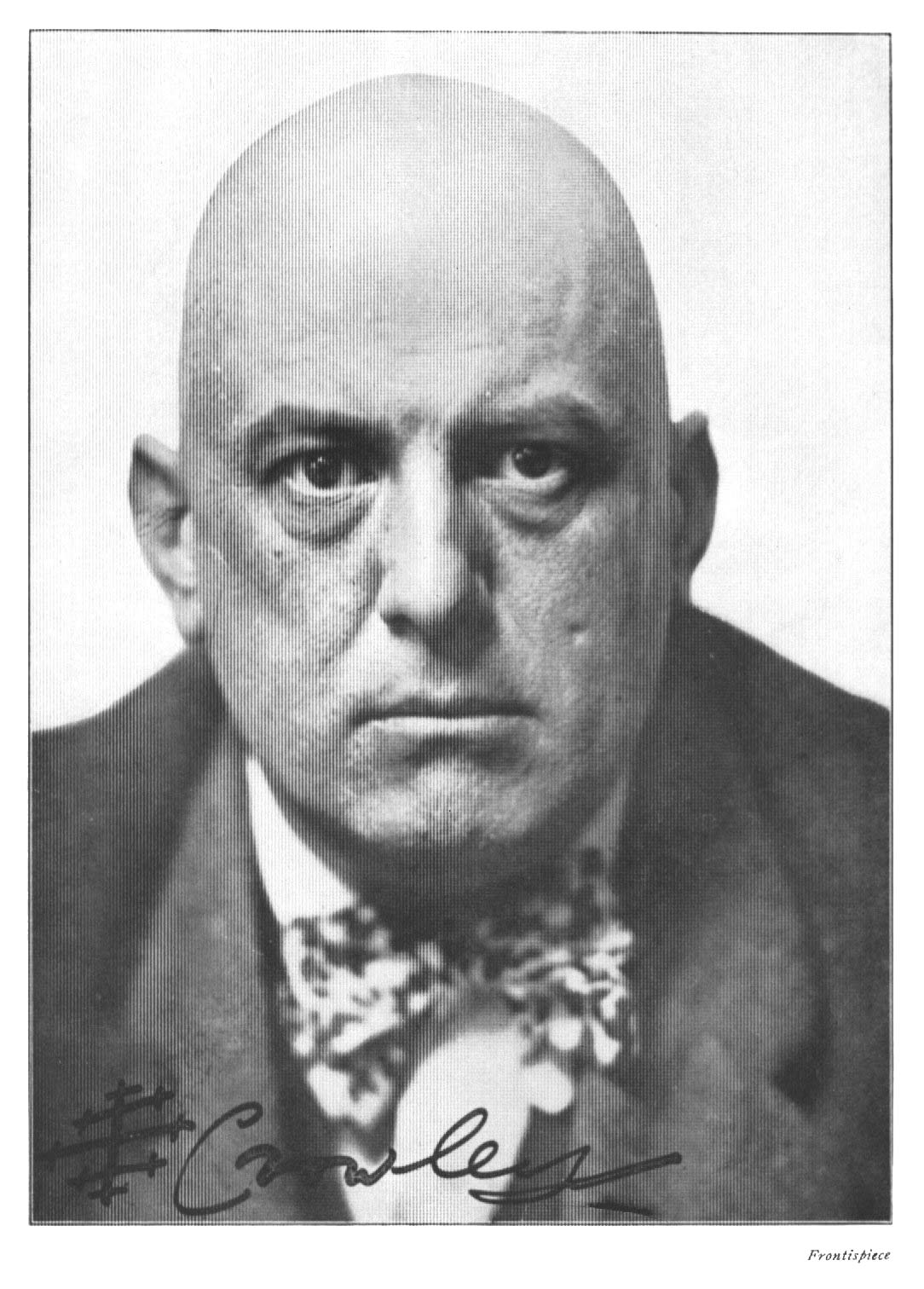
Crowley was born Edward Alexander Crowley in Royal Leamington Spa to a wealthy brewing family. He went to Trinity College, Cambridge, where he became interested in poetry, mountaineering, philosophy, and the occult. In 1898, he joined the Hermetic Order of the Golden Dawn, the leading magical society in Britain at the time, and studied ceremonial magic, Qabalah, alchemy, astrology, and ritual with leaders like Samuel Liddell MacGregor Mathers. After conflicts within the Order, Crowley spent years traveling through Europe, North Africa, India, China, Mexico, and Ceylon. He combined mountaineering with deep studies of yoga, meditation, and Eastern religions.
The most important event in Crowley’s career happened in Cairo in 1904, when he said he received a revelation from a spiritual being named Aiwass. Over three days, he dictated The Book of the Law, which became the foundation of Thelema. This philosophy is known for the statements, “Do what thou wilt shall be the whole of the Law” and “Love is the law, love under will.” Crowley explained that these ideas were not about doing whatever one wants, but about finding and following one’s unique “True Will,” or highest purpose in life.
A key part of Crowley’s teaching was the idea of “Magick,” which he spelled this way to set it apart from stage magic. He described Magick as “the Science and Art of causing Change to occur in conformity with Will.” For Crowley, Magick was a disciplined system that brought together ritual, meditation, symbolism, suggestion, and spiritual growth. He drew from Hermeticism, Qabalah, alchemy, Gnosticism, yoga, Tantra, and ancient mystery traditions, aiming to blend Eastern and Western esoteric teachings into one system.
Throughout his life, Crowley was involved in several occult groups, most notably becoming the leader of the Ordo Templi Orientis (O.T.O.), where he changed its teachings to focus on Thelema. In 1920, he founded the Abbey of Thelema in Cefalù, Sicily, as a place for spiritual and magical practice. The Abbey attracted widespread public attention and controversy, and after one resident died, the Italian government, led by Benito Mussolini, expelled Crowley from Italy in 1923.
Crowley was a very productive writer, publishing many books, essays, poetry collections, novels, plays, translations, and guides on ceremonial magick, yoga, Qabalah, mysticism, psychology, and comparative religion. Some of his most important works include The Book of the Law, Magick in Theory and Practice, The Book of Thoth, The Vision and the Voice, and the magazine The Equinox.
Besides his work in the occult, Crowley was a skilled mountaineer who took part in early expeditions to K2 in 1902 and Kangchenjunga in 1905, helping to start Himalayan climbing.
Crowley died in relative obscurity in 1947, but his influence grew immensely after his death. His ideas helped shape modern ceremonial magic, Wicca, contemporary occultism, and many alternative spiritual movements. His focus on personal spiritual freedom, symbolic psychology, and disciplined self-realization appealed to the counterculture of the 1960s and later. Crowley has become a lasting cultural figure, appearing on the cover of Sgt. Pepper’s Lonely Hearts Club Band and inspiring artists, writers, musicians, and many students of Western esotericism.