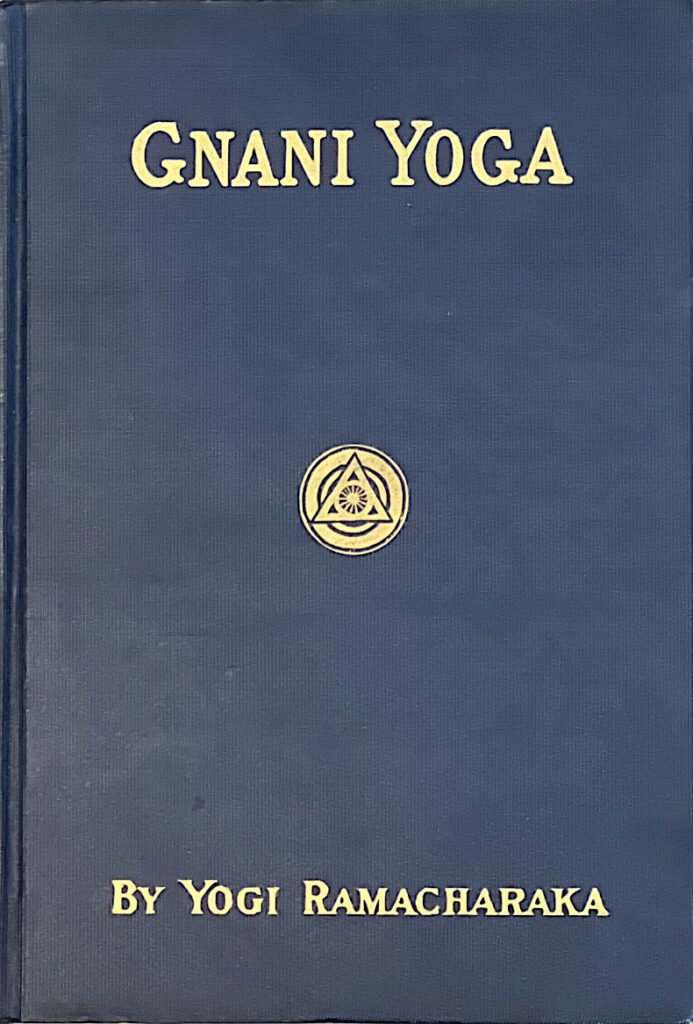
Published by the Yogi Publication Society as a series of twelve monthly lessons beginning in October 1906 and ending in September 1907, A Series of Lessons in Gnani Yoga (The Yoga of Wisdom), presents one of the most ambitious philosophical works in the Yogi Ramacharaka series. The lessons were subsequently collected into book form without changes to the original text, with the publishers describing them as unusually dense and recommending that students read them repeatedly. The title page describes the work as presenting the “highest Yogi teachings” concerning the Absolute and its manifestations, and this accurately describes the scope of the book: rather than concentrating primarily on physical health, breathing, mental discipline, or occult development, Gnani Yoga attempts to explain the nature of Reality itself and humanity’s place within it.
The central teaching of Gnani Yoga is that behind the apparently separate things of the universe exists a single ultimate Reality called the Absolute, the One, the Infinite Mind, or the One Life. Everything that exists is presented as a manifestation within this universal Reality. Matter, energy, life, mind, individual consciousness, evolution, birth, death, reincarnation, and spiritual development are not disconnected phenomena but different aspects of one immense process through which the One manifests itself as the Many. Human beings experience themselves as separate personalities because consciousness is temporarily centered within individual forms, yet beneath personality lies an enduring spiritual individuality whose deepest reality is inseparable from the universal Life from which it comes. The purpose of Gnani Yoga is to transform this proposition from an abstract philosophical statement into a progressively clearer realization of what existence means.
What Is Gnani Yoga?
Gnani Yoga defines Gnani Yoga as the path of knowledge or wisdom. The opening lesson distinguishes four principal Yogic paths: Hatha Yoga concerns the physical body, health, preservation, and bodily control; Raja Yoga concerns the mind, will, mental development, and latent faculties; Bhakti Yoga concerns love of the Absolute; and Gnani Yoga concerns knowledge of the fundamental truths underlying life. Yet the book does not present these as competing systems. They are different approaches toward the same end of human “unfoldment, development, and growth,” and the student is encouraged to understand something of all of them while naturally emphasizing the path most suited to his or her development.
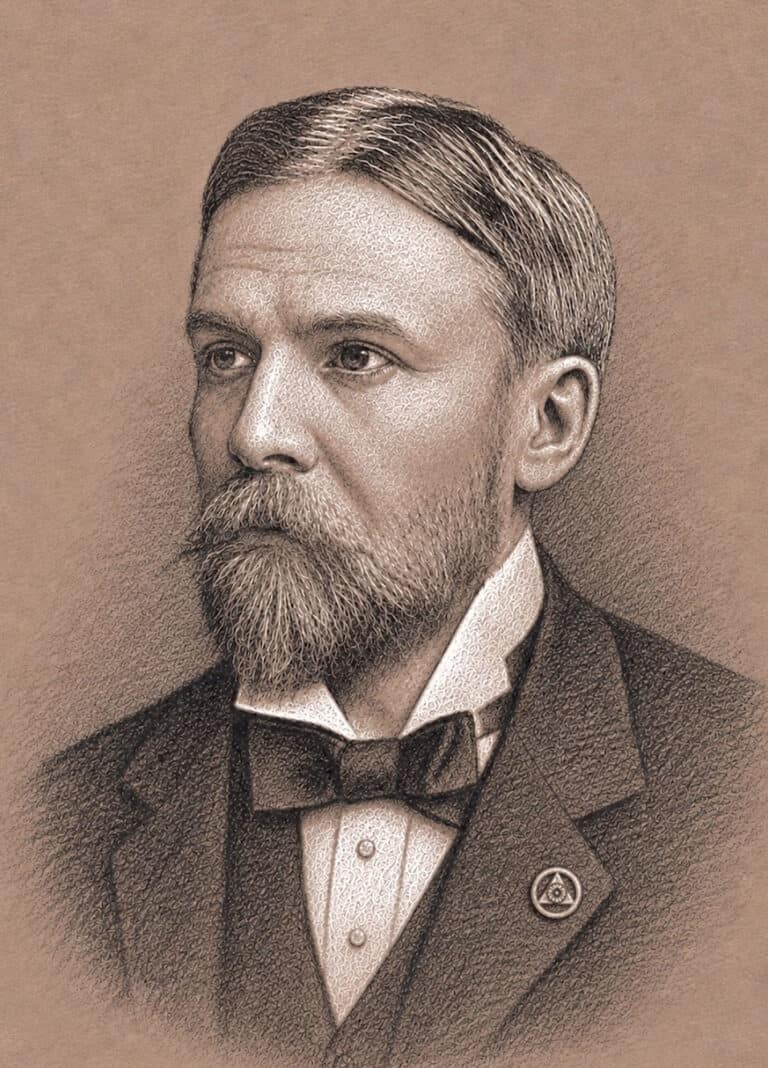
Yogi Ramacharaka
This distinction helps explain the unusual character of the book. Hatha Yoga asks how the human body should live according to natural law, while Raja Yoga asks how the mind can be understood, trained, and directed. Gnani Yoga moves behind both questions and asks what the body, mind, life, and universe ultimately are. Its fundamental question is stated near the beginning of the first lesson: “What is Reality?” The visible universe presents matter, force, living organisms, and mind, but each of these becomes increasingly mysterious when examined deeply. Matter can be reduced into more fundamental structures, force becomes another form of underlying activity, life cannot be completely explained by outward form, and mind itself appears to point beyond ordinary consciousness. The book argues that beneath all changing appearances there must exist something permanent and fundamental. That underlying Reality is the One.
What Is “The One” in Gnani Yoga?
The One is the name Gnani Yoga gives to the ultimate Reality underlying every form of existence. The book surveys materialism, energetic theories, idealism, theology, naturalism, and occult philosophy as different attempts to identify this underlying principle. Materialists may call it Matter, others Energy, idealists Mind, theologians God, and naturalistic philosophers Nature, but the philosophical problem remains essentially the same: if Reality is ultimate, infinite, and absolute, there cannot be another independent reality existing outside it. Whatever exists must exist within, through, or as some manifestation of the One.
For this reason, the Absolute cannot simply be imagined as a very powerful human-like being somewhere outside the universe. Nor can it adequately be represented as merely one object among other objects. It is the ground of existence itself. Space, time, magnitude, and limitation belong to the relative world instead of the Absolute. From the standpoint of human consciousness, a star may appear unimaginably enormous and an atom unimaginably small, yet these distinctions depend upon relative measurement. The book repeatedly asks the reader to move beyond ordinary categories of size, location, beginning, and ending when attempting to think about ultimate Reality.
At the same time, Gnani Yoga warns that the human intellect cannot completely define the Absolute. A finite mind cannot place the Infinite inside one of its concepts without reducing it. The intellectual path of Gnani Yoga has a paradox at its center: reason must be used as far as reason can carry the student, but reason ultimately points toward a Reality greater than intellectual definition. Knowledge prepares consciousness for realization.
Is Everything in the Universe Alive?
One of the most distinctive teachings of Gnani Yoga is its doctrine of omnipresent Life. If the Absolute is living and nothing can exist outside the Absolute, the book reasons, then there cannot ultimately be a genuinely dead portion of Reality. What human beings call dead matter must instead represent Life operating at levels where its activity is difficult to recognize. Death itself becomes a change of form instead of the destruction of the underlying Life.
The book attempts to support this occult teaching with the scientific discussions available at the beginning of the twentieth century. It moves downward from familiar organisms through microorganisms, diatoms, crystals, molecules, atoms, and the newly discussed electron, arguing that the boundary separating the living from the nonliving becomes increasingly uncertain as matter is examined more closely. Crystals grow and respond to environmental conditions; atoms combine and separate according to affinities; molecules form structured relationships; and subatomic activity suggests a universe of ceaseless motion instead of inert substance. The author interprets attraction, repulsion, organization, response, and movement as progressively simpler expressions of the same fundamental Life that becomes more recognizable in plants, animals, and human beings.
These scientific examples are historically important to the argument but should be understood within their early twentieth-century context rather than as statements of modern scientific consensus. Their purpose inside Gnani Yoga is philosophical: the book wants the reader to stop imagining the cosmos as a collection of dead objects occasionally inhabited by living creatures. Instead, it presents the universe as a living continuum in which Life exists everywhere but manifests through radically different degrees of organization and consciousness.
What Is the Creative Will?
If Life exists throughout the universe, Gnani Yoga next asks what causes it continually to organize, develop, reproduce, adapt, and seek increasingly complex expression. Its answer is the “Creative Will,” described as the active manifestation of the power of the One throughout Nature. The Creative Will is the pressure visible in growth, instinct, biological organization, healing, reproduction, adaptation, and evolution. A seed does not intellectually reason its way into becoming a plant, nor does the body consciously direct every process of digestion, assimilation, cellular repair, circulation, and growth. Beneath conscious personal will, the book sees a deeper universal activity continually working through living forms.
This Creative Will is closely associated with desire. Life presses toward expression. It seeks forms through which it can manifest more completely. The book modifies the evolutionary formula it attributes to contemporary science. Where biological thought might say that function precedes organization, Gnani Yoga adds another stage: desire precedes function. The desire here is not necessarily conscious human wanting. It is an elemental impulse toward fuller manifestation, an evolutionary urge operating through life itself. Form develops because Life presses toward functions for which existing forms are inadequate.
The Creative Will provides the connecting principle between the metaphysics of the first lessons and the evolutionary teaching that dominates the middle of the book. The universe is not presented as a finished creation. It is a continuing process of manifestation. Life presses outward into form, forms become increasingly capable of expressing mind, and mind eventually becomes capable of recognizing the spiritual Reality that has been present within the entire process from the beginning.
The Core Teachings of Gnani Yoga
The book’s philosophical system can be reduced to several interconnected propositions:
There is one ultimate Reality, called the Absolute or the One.
Nothing can exist outside the Absolute because an Absolute with something external to it would no longer be absolute.
Life is omnipresent and exists in varying degrees of manifestation throughout Nature.
The universe of forms exists within the Infinite Mind as a mental manifestation of the Absolute.
The Creative Will is the universal evolutionary pressure through which Life seeks increasingly adequate forms of expression.
Individual personalities are temporary expressions, while a deeper spiritual individuality continues through successive experiences.
Physical evolution and spiritual evolution are related aspects of one larger process of unfoldment.
Reincarnation, or metempsychosis, allows the soul to continue gathering experience through successive embodiments.
Desire helps determine the direction of rebirth, while character represents the accumulated result of experience.
Karma is the law through which causes produce corresponding consequences and through which the soul learns from its actions.
Spiritual evolution gradually expands consciousness beyond identification with the temporary personality.
The ultimate direction of the process is conscious realization of unity with the One.
These ideas are not presented as isolated doctrines. Each is intended to answer a problem created by the preceding one. If there is only one Reality, how can there be many beings? If all beings participate in one Life, why do they experience themselves separately? If Life is one, why are some forms simple and others complex? If human beings are spiritual, why do they develop gradually? If the personality dies, what continues? If something continues, what determines its future conditions? Gnani Yoga builds its system by answering these questions in succession.
How Can the One Become the Many?
The apparent contradiction between universal unity and individual existence occupies a major portion of the book. If everything is One, why does the universe contain countless apparently separate beings? Gnani Yoga answers by distinguishing individuality from personality. Personality is the temporary mask through which the deeper Self expresses itself. The book even draws attention to the historical meaning of persona as a mask or role, using the image of an actor speaking through a temporary character to explain the relationship between the enduring spiritual principle and its changing personalities.
This does not mean that individuality is meaningless. The book explicitly rejects the idea that spiritual realization simply annihilates consciousness. Instead, consciousness expands. The individual gradually ceases to identify exclusively with the temporary mask and recognizes increasingly larger levels of identity. The analogy repeatedly used is that of water arising from the ocean as vapor, forming clouds and raindrops, passing into rivers and streams, and eventually returning to the ocean. The drop possesses a temporary separate history without ever becoming something fundamentally different from water. Likewise, the individual soul passes through differentiated experience while remaining rooted in universal Being.
The goal is not “Nothingness” but what the book calls “Allness.” Spiritual growth enlarges rather than destroys identity. The ordinary person says, in effect, “I am this personality.” Greater development produces awareness of an enduring individuality behind personality. Still greater realization reveals the spiritual Self behind individuality, until consciousness ultimately recognizes its relationship with universal Life.
Are We Living Within the Mind of the One?
One of Gnani Yoga’s most important metaphysical claims is that the universe exists within the Infinite Mind. Matter is not presented as an independently existing substance standing outside the Absolute. The forms of the universe are described as mental creations or “Thought-Forms” held within Infinite Mind, with the Infinite Spirit existing within them and they within it.
This concept allows the book to preserve both unity and multiplicity. Countless forms can exist without requiring countless independent ultimate realities, just as many ideas can exist within one mind without becoming separate minds. Stars, worlds, bodies, organisms, and personalities belong to the manifested universe, while the Absolute remains the Reality within which manifestation occurs.
Human existence follows the same pattern. The body changes, personality changes, circumstances change, and even mental characteristics develop across experience. Behind these changing expressions lies the spiritual principle the book calls the Real Self. This Spirit is described as never being born and never dying because birth and death apply to forms, not to the underlying Reality expressed through them. Even the highest heavens or celestial planes remain relative states. Beyond them lies conscious unity with the One.
How Does Gnani Yoga Explain Cosmic Evolution?
The evolutionary sections of Gnani Yoga attempt to reconcile the emerging evolutionary science of the nineteenth and early twentieth centuries with an occult doctrine of spiritual unfoldment. The book accepts much of the broad physical picture of evolution: life progresses through increasingly complex biological forms, species arise and disappear, organisms adapt, and humanity emerges from the long history of terrestrial life. But it reverses what it considers the philosophical interpretation of these facts.
According to the book, matter does not accidentally become sufficiently complex to produce mind. Mind is involved in the process from the beginning. Biological forms evolve because the Life and Mind within them continually seek better instruments through which to express themselves. Matter is the instrument of consciousness rather than consciousness being merely a by-product of matter. The physical history of evolution becomes the outward record of an inward process of unfoldment.
This distinction is essential to the entire work. Evolution is not simply the transformation of bodies. Bodies are the machinery through which increasingly developed degrees of Life and Mind become manifest. As organization becomes more complex, consciousness gains a more capable instrument. The book thus treats biological evolution as one part of a much larger cosmic movement extending from elemental manifestation through life, mind, self-consciousness, and ultimately spiritual consciousness.
What Does the “Ascent of Man” Mean?
The discussion of human evolution continues this argument through a lengthy survey of biological forms. Gnani Yoga traces development through lower organisms and vertebrates toward primates and humanity, using contemporary evolutionary literature, embryology, comparative anatomy, and the scientific authorities available to its author. It rejects the simplistic claim that humans descended directly from existing apes and instead adopts the evolutionary position that humans and other primates developed along different branches from earlier ancestral forms.
Some of the book’s descriptions of human populations reflect racial classifications and assumptions common in early twentieth-century evolutionary literature that are scientifically obsolete and offensive by modern standards. They are not necessary to the book’s central metaphysical argument. What matters philosophically is its claim that physical evolution prepared increasingly sophisticated instruments for consciousness.
Humanity represents a crucial transition instead of the end of evolution. In the human form, Life has developed an organism capable not merely of sensation and instinct but of reflection, abstract thought, self-consciousness, moral choice, and eventually spiritual awareness. The evolutionary force that once built bodies increasingly turns inward toward the development of consciousness itself.
Physical Evolution Becomes Spiritual Evolution
Once a sufficiently developed human organism exists, Gnani Yoga shifts its attention from biological evolution to the evolution of the soul. The great story is no longer primarily the development of bodies but the development of consciousness through them. Instinct gives way to intellect; intellect makes self-conscious individuality possible; and self-conscious individuality eventually begins to perceive realities beyond ordinary material existence.
This is why the book treats humanity’s present condition as transitional. Human beings possess greater freedom than lower forms of life, but that freedom also creates greater responsibility. As consciousness develops, individuals become increasingly capable of choosing between actions that advance spiritual development and those that strengthen attachment to lower desires. Greater power produces greater responsibility. The spiritual path is not simply a process automatically imposed from outside. At higher stages, the individual becomes increasingly conscious of the evolutionary process and capable of cooperating with it.
The book interprets dissatisfaction with purely material explanations of existence as one sign of this awakening. People begin asking what consciousness is, whether life continues after death, what moral responsibility means, and whether existence has a deeper purpose. Spiritual unrest becomes evidence that consciousness has begun pressing against the limitations of an older worldview, just as biological Life earlier pressed against inadequate physical forms.
What Is Metempsychosis?
Gnani Yoga uses the older term “metempsychosis” for the continuing passage of the soul through successive embodiments. Reincarnation is not treated merely as repeated birth but as part of the mechanism of spiritual evolution. A single earthly lifetime cannot provide the enormous range of experience required for the development of consciousness, so the soul returns through successive lives, carrying forward the results of previous experience.
The personality itself is temporary. Names, bodies, social identities, and many surface characteristics belong to a particular incarnation. What persists is the deeper Ego or individuality, together with the essence extracted from experience. The book describes this accumulated essence as Character. Experiences disappear as events, but what they have made of the individual remains. In this sense, previous lives do not need to be consciously remembered for their results to continue influencing the present.
Desire plays a particularly important role in determining rebirth. Souls strongly attached to earthly experience are drawn back toward conditions suited to those desires. The book summarizes the principle by making desire the “key note” of metempsychosis: the accumulated direction of the soul’s wants, attachments, aspirations, and unfinished tendencies helps determine the environments in which further development can occur. At more advanced stages, it claims, reincarnation ceases to be an unconscious process and becomes increasingly conscious.
Why Don’t We Remember Previous Lives?
Within the logic of Gnani Yoga, the absence of ordinary conscious memories of previous lives does not disprove reincarnation because memory belongs largely to the mental apparatus associated with a particular personality. The enduring soul carries forward results instead of necessarily carrying a complete accessible record into ordinary waking consciousness.
The distinction between memory and character is crucial. A person may not remember the specific experiences that created a tendency, ability, fear, aspiration, or moral disposition, yet the resulting character remains. In the same way that countless forgotten events from childhood continue to shape an adult, forgotten incarnations are said to continue through their accumulated effects.
As spiritual consciousness develops, the book suggests that greater continuity of awareness becomes possible. Advanced individuals may eventually pass from life to life consciously rather than undergoing repeated breaks in ordinary memory. Reincarnation thus changes in character as the soul evolves: what begins as unconscious necessity gradually becomes conscious participation in spiritual development.
What Is Spiritual Evolution?
Spiritual evolution is the progressive development of consciousness through experience. Gnani Yoga presents humanity as moving through stages in which instinctive consciousness is gradually supplemented by intellectual consciousness, moral discrimination, self-awareness, and eventually direct spiritual perception. The spiritual individual does not abandon reason but develops faculties beyond the limitations of purely sensory and intellectual knowledge.
The process is both collective and individual. Humanity evolves as a race while individual souls progress at different rates. Some move more rapidly, others more slowly, but changing environments continually provide new opportunities for growth. The advanced individual also contributes to the development of others by introducing new ideals, knowledge, and ways of understanding existence.
The destination is not merely intellectual sophistication. Intellect itself is a stage. The deeper transformation occurs when the individual begins to experience unity instead of merely reason about it. The proposition “all Life is One” gradually becomes a lived spiritual perception. From this perspective, compassion, ethical behavior, and love are not arbitrary commandments imposed by an external authority. They follow naturally from the recognition that apparently separate beings participate in the same universal Life.
What Is the Law of Karma?
Karma is presented as the universal law of cause and consequence operating through the spiritual development of the individual. Thoughts, desires, choices, and actions generate effects, and those effects contribute to the conditions through which the soul continues its education. Karma is neither divine revenge nor arbitrary punishment. It is a law of adjustment and consequence.
The doctrine connects directly with reincarnation. If all consequences had to appear during one physical lifetime, human experience would seem profoundly inconsistent: people begin life under radically different conditions, possess different capacities, encounter different opportunities, and sometimes appear to suffer or prosper without causes visible within their present lives. Reincarnation extends the field across which karma operates, allowing causes generated in one incarnation to produce effects in another.
Yet Gnani Yoga does not teach passive fatalism. Present conditions may represent consequences of previous causes, but present actions are simultaneously creating future causes. The individual is both inheritor and creator. Character has been formed by the past, but character can be changed through present thought, desire, decision, and action. The meaning of karma is responsibility.
The book ultimately presents karma as educational rather than vindictive. Experience teaches the soul the consequences of its choices until wisdom replaces ignorance. Its lengthy concluding treatment of karma emphasizes the traditional principle that what is sown must eventually be reaped, while righteous action, purification of desire, mercy, truth, and spiritual development gradually release the individual from the cycle that ignorance sustains.
How Do Desire, Will, Karma, and Evolution Fit Together?
One of the strongest features of Gnani Yoga is that concepts introduced separately eventually form a single system. Desire produces movement. The Creative Will expresses the universal pressure toward manifestation. Individual desire shapes choices and experiences. Repeated experiences form character. Character influences future conditions. Karma connects causes with consequences. Reincarnation provides additional fields of experience. Through those experiences consciousness develops. Spiritual evolution gradually transforms desire itself, directing it away from temporary gratification and toward knowledge of the Real Self.
The same principle appears at multiple levels. Cosmically, the One manifests through Creative Will. Biologically, Life presses toward increasingly capable forms. Psychologically, desire motivates action. Morally, action generates consequences. Spiritually, consequences become experience and experience becomes wisdom.
What appears to be a collection of separate occult doctrines is thus presented as a continuous process: Life seeks expression, expression creates experience, experience develops consciousness, and developed consciousness eventually recognizes the Life from which it came.
Does Individuality Disappear When We Become One With the Absolute?
No, not in the sense of simple annihilation. Gnani Yoga repeatedly attempts to correct what it regards as a Western misunderstanding of Eastern ideas of unity and Nirvana. Realization of the One does not mean becoming unconscious or ceasing to exist. It means transcending the narrow identification of the Self with the temporary personality.
The book’s answer is expansion instead of extinction. Consciousness grows from the limited identity of the personality toward increasingly inclusive levels of being. The person who once believed “I am only this body and this personality” eventually recognizes an enduring individuality behind the personality and, deeper still, the universal Spirit behind individuality. The result is described not as Nothingness but as Allness.
This idea supplies the philosophical destination toward which nearly every other doctrine in the book points. Omnipresent Life explains why unity is possible. The Creative Will explains why manifestation develops. Evolution explains how increasingly complex centers of consciousness arise. Reincarnation explains how individual development continues. Karma explains how experience becomes education. Spiritual evolution explains how consciousness expands. Gnani Yoga explains how the individual eventually comes to know what has been true throughout the entire process: the Life within the individual and the Life within the universe have never been fundamentally separate.
Death as Transformation Rather Than Extinction
The doctrine of omnipresent Life also changes the meaning of death. If Life is fundamental and forms are temporary, death cannot represent the destruction of Life itself. It is the dissolution of one form through which Life has been expressing itself. The body returns to the material world, the temporary personality ceases in its familiar form, while the enduring results of experience remain associated with the developing individuality.
The analogy extends throughout Nature. Forms continually arise, persist for a period, break apart, and contribute their substance to new forms. Nothing in the manifested universe remains physically fixed, yet the underlying process continues. Human death becomes one instance of this universal law of transformation.
This is also why Gnani Yoga places relatively little ultimate importance upon even the “heaven-worlds.” Postmortem states may exist, according to the teaching, but they remain conditions within manifestation. They are not the Absolute itself. Even exalted celestial planes are relative compared with the ultimate realization of conscious identity with the One.
What Does Gnani Yoga Say About Masters and Occult Brotherhoods?
The final lesson, “Occult Miscellany,” changes format and answers questions about subjects that do not fit neatly into the preceding philosophical progression. Among them are occult brotherhoods, Masters, Adepts, and the transmission of esoteric knowledge.
The book warns readers against organizations claiming to sell secret spiritual initiation. Genuine occult knowledge, it argues, is not sold as a commodity, although books, magazines, instruction, lectures, and the legitimate expenses of organizations may reasonably cost money. It distinguishes those ordinary expenses from claims that spiritual secrets themselves can be purchased. Its guiding maxim is that when the pupil is ready, the teacher appears.
The book also affirms belief in highly developed human beings traditionally called Masters or Adepts, while simultaneously warning that many sensational stories told about them are exaggerations or inventions. These advanced souls are described as individuals who have progressed much farther along the same evolutionary path followed by humanity generally. Their significance within the system is evolutionary instead of supernatural: they represent possibilities of human spiritual development rather than an entirely separate order of creation.
The Relationship Between Science and Yogi Philosophy
A striking feature of Gnani Yoga is its persistent attempt to bring occult philosophy into conversation with contemporary science. The book cites developments in biology, chemistry, physics, microscopy, embryology, and evolutionary theory, frequently arguing that scientific discoveries are approaching conclusions long taught by ancient occult philosophy. Its discussions of atoms, electrons, crystals, microorganisms, biological evolution, and comparative anatomy were clearly intended to make Yogi philosophy intellectually credible to an early twentieth-century Western readership.
The book does not simply reject science when scientific conclusions differ from its philosophy. Instead, it accepts many scientific observations while reinterpreting their metaphysical meaning. Evolution occurred, it argues, but evolution is driven from within by Life and Mind. Organisms developed from simpler forms, but consciousness was not created by matter. Atoms and molecules behave according to physical laws, but those laws represent expressions of deeper universal activity. Science describes the machinery; occult philosophy claims to explain what is operating through the machinery.
This approach is historically important because it places Gnani Yoga within the larger turn-of-the-century effort to reconcile evolutionary science, psychology, metaphysics, and Eastern philosophy. Some of its scientific claims have inevitably become outdated, but the intellectual structure of the argument remains clear: scientific discovery and spiritual philosophy are presented not as enemies but as investigations of different dimensions of the same Reality.
The Complete Philosophical System of Gnani Yoga
Taken as a whole, Gnani Yoga presents the universe as a single living, mental, evolutionary Reality. The Absolute is the ultimate ground of existence. The manifested universe arises within Infinite Mind. Life is present everywhere because nothing can exist outside the One Life. The Creative Will provides the pressure toward expression and development. Matter supplies increasingly sophisticated instruments through which Life and Mind can manifest. Biological evolution culminates, at least within the present earthly stage, in the self-conscious human being. Human consciousness then continues its development through repeated experience, reincarnation, and karma until intellectual consciousness begins opening into spiritual consciousness.
The deepest problem of human existence is mistaken identification. The individual identifies the Self with the body, then with personality, then perhaps with intellect, without recognizing the deeper consciousness operating through them. Gnani Yoga seeks to reverse this process by knowledge. The student progressively distinguishes the temporary from the permanent, the personality from the individuality, the relative from the Absolute, and appearance from Reality.
Yet the final realization is not separation from the world. It is deeper unity with it. Once the individual understands that the same One Life exists throughout Nature, ethical and spiritual implications follow automatically. Harm done to another is no longer conceptually separate from harm within the larger Life to which both belong. Compassion becomes the natural consequence of expanded identity. Karma becomes intelligible as the balancing of activity within one interconnected Reality. Spiritual evolution becomes the gradual awakening of the Many to their underlying unity in the One.
What Is the Main Message of Gnani Yoga?
The main message of Gnani Yoga is that existence is fundamentally One, even though human consciousness experiences it through countless separate forms. The Absolute manifests through a living universe; the Creative Will drives Life toward fuller expression; physical evolution develops increasingly capable vehicles of consciousness; reincarnation and karma continue the education of the individual soul; and spiritual evolution gradually reveals that the apparent separation between self, others, Nature, and the Absolute belongs to the relative world of personality instead of to ultimate Reality.
For this reason, Gnani Yoga is called the Yoga of Wisdom. Its goal is not simply acquiring information about metaphysics. Knowledge is a method of awakening. The student begins by asking what Reality is and follows that question through matter, Life, mind, individuality, evolution, reincarnation, karma, and spiritual consciousness until all of those subjects converge upon a single proposition: beneath every changing form is the One Life.
The book’s intellectual journey returns to its beginning at a higher level. The first question is “What is Reality?” The final answer is not a definition but a transformation of identity. Reality is the One within which all things exist, the Life expressing itself through every form, the Spirit underlying the changing personality, and the ultimate Self toward which consciousness awakens. In the philosophy of Gnani Yoga, the path of wisdom is completed when the individual no longer merely believes in the unity of Life but increasingly knows himself or herself as an expression of that unity.
Related Research Articles
Herbert A. Parkyn’s Foundation in Eastern Philosophy
This article examines Dr. Herbert A. Parkyn's early study of Eastern philosophy and the network of individuals and ideas that helped lay the foundation for the Yogi Publication Society and its publishing program.
The Yogi Publication Society started in the offices of Herbert A. Parkyn on Cottage Grove Ave.
This article shows that 4000 Cottage Grove Avenue was where the Yogi Publication Society began and served as the main hub for Dr. Herbert A. Parkyn's publishing, educational, and mail-order activities.
Yogi Ramacharaka: The True Meaning and Origin of the Name
This article breaks down the hidden symbolism and meaning behind "Yogi Ramacharaka", the pen name that was created by the Yogi Publication Society and shows the allegory that reflected the ideas the books were…