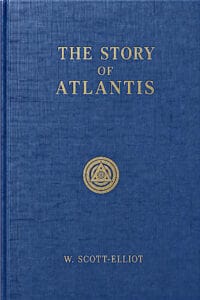

William Scott-Elliot (1849–1919) was a Scottish merchant banker, landowner, Theosophist, and esoteric writer best known for The Story of Atlantis and The Lost Lemuria, two influential works that greatly expanded the Theosophical conception of lost continents and prehistoric human civilization. Drawing upon the teachings of Helena P. Blavatsky and clairvoyant investigations associated particularly with C. W. Leadbeater, Scott-Elliot attempted to construct a detailed history of humanity extending far beyond the limits of conventional archaeology. His descriptions of Atlantis and Lemuria, accompanied by maps showing the supposed changing geography of the ancient world, became some of the most influential accounts of lost civilizations in modern Western esotericism.
Scott-Elliot was born in Edinburgh, Scotland, on March 24, 1849, into the Scott-Elliot family of Arkleton. He was educated at Rugby School before entering business and eventually establishing himself in London as a merchant banker. He became associated with Wallace Brothers & Co., a prominent London firm with extensive commercial interests in India and Southeast Asia. His professional background therefore differed considerably from that of many occult writers of the period. Scott-Elliot approached Theosophy as an educated Victorian businessman and attempted to combine its clairvoyant claims with the geological, anthropological, and archaeological theories then being debated by contemporary scholars.
He joined the Theosophical Society in the 1890s and became closely associated with its London circle. In 1893 he married Maude Louisa Boyle-Travers, who was herself active in Theosophical work and was known within the Society by the name “Mary.” Scott-Elliot became particularly interested in the enormous prehistoric chronology presented by Helena P. Blavatsky in The Secret Doctrine, especially her teachings concerning successive “Root Races” of humanity and the lost continents upon which they were believed to have developed.
The Story of Atlantis
Scott-Elliot’s most famous work, The Story of Atlantis, was published in 1896. The book attempted to transform the scattered references to Atlantis found in Theosophical literature into a coherent geographical and historical narrative. Although Plato had described Atlantis as an island civilization beyond the Pillars of Hercules, Scott-Elliot presented it as the surviving portion of a much larger prehistoric continent that had once occupied a substantial part of the Atlantic region.
Much of the information was attributed to clairvoyant investigation. Scott-Elliot worked particularly with information supplied through C. W. Leadbeater, who claimed that trained clairvoyance could provide access to events from the distant past. Scott-Elliot’s role was largely to organize this material, compare it with contemporary scientific theories, and present it as a continuous history.
One of the most distinctive features of The Story of Atlantis was its series of maps showing the supposed geographical transformation of the world during successive periods of Atlantean history. Rather than describing Atlantis as disappearing in a single catastrophe, Scott-Elliot proposed a long sequence of geological upheavals in which the original continent was gradually reduced. Large surviving portions known as Ruta and Daitya eventually disappeared, leaving the island of Poseidonis, which he identified with the final Atlantis of the classical tradition.
The result was a considerably more elaborate Atlantis than the civilization described by Plato. Scott-Elliot described its peoples, migrations, governments, religions, architecture, agriculture, education, transportation, occult knowledge, and everyday life. He also attempted to trace migrations from Atlantis into Africa, Europe, Asia, and the Americas, making Atlantean civilization an important ancestral source for later cultures throughout the world.
The Lost Lemuria
Scott-Elliot extended this reconstruction still further backward with The Lost Lemuria, published in 1904. Lemuria had originally been proposed by nineteenth-century scientists as a hypothetical landmass that might explain the geographical distribution of certain animals, particularly lemurs. The hypothesis was later rendered unnecessary by developments in geology, but Helena Blavatsky had already incorporated Lemuria into Theosophical cosmology as the home of an earlier stage of humanity.
Scott-Elliot developed this idea into a detailed prehistoric narrative. Within the Theosophical system, Lemuria belonged principally to the Third Root Race, while Atlantis became associated with the Fourth Root Race and the present stage of humanity with the Fifth. Human evolution was therefore presented not merely as biological development but as a combined physical, psychological, and spiritual process occurring across immense periods of time.
His account described enormous geological transformations, changing human physical forms, the gradual development of the sexes, migrations between continents, and the eventual disappearance of Lemuria. As with Atlantis, Scott-Elliot combined Theosophical teachings and claimed clairvoyant observations with scientific theories available during his lifetime.
The two works were eventually brought together as The Story of Atlantis and the Lost Lemuria, creating a continuous Theosophical prehistory extending from Lemurian humanity through the rise and destruction of Atlantis and into the civilizations of the recorded world.
.

The Great Law
Scott-Elliot’s interests extended beyond lost continents. In 1899 he published The Great Law: A Study of Religious Origins and of the Unity Underlying Them, an attempt to examine the common principles underlying different religious traditions. The work reflected one of the central ideas of the early Theosophical movement: that the world’s religions preserved different expressions of an older universal spiritual wisdom.
The Great Law received the Subba Row Medal from the Theosophical Society, an award given for significant contributions to Theosophical literature. The recognition established Scott-Elliot as more than simply an author on Atlantis and placed his work within the broader intellectual and religious program of the Society.
Scott-Elliot’s Method
An important feature of Scott-Elliot’s writing was his attempt to place occult investigation beside contemporary scholarship. He did not present The Story of Atlantis simply as imaginative fiction. The clairvoyant material was treated within the Theosophical framework as information about actual prehistoric events, while geology, archaeology, mythology, linguistics, and anthropology were brought forward wherever Scott-Elliot believed they provided supporting evidence.
This method reflected a larger tendency within late nineteenth-century Theosophy. Blavatsky and her successors argued that modern science possessed only fragments of humanity’s true history, while ancient traditions and occult investigation could recover portions that had been lost. Scott-Elliot applied this approach particularly to geography and human origins, attempting to create maps and chronological narratives for periods that conventional history could not reach.
The result was what might be described as a form of Theosophical occult history: an effort to reconstruct the remote past through a combination of esoteric teachings, claimed clairvoyant observation, mythology, and contemporary scientific speculation.
Influence and Legacy
Scott-Elliot died on September 2, 1919, but his accounts of Atlantis and Lemuria continued to circulate widely. His importance lies less in originating the Theosophical ideas of Root Races and lost continents, which had already been developed extensively by Blavatsky, than in giving those ideas a geographical and historical structure that readers could easily visualize.
His maps were particularly influential. They transformed abstract discussions of prehistoric continents into an apparently chronological sequence showing continents forming, breaking apart, and disappearing over immense periods of time. Combined with his detailed descriptions of Atlantean civilization, they helped establish a model of Atlantis as an advanced prehistoric society whose surviving populations carried fragments of its knowledge into later civilizations.
These ideas subsequently circulated far beyond the Theosophical Society. Rudolf Steiner incorporated extensive discussions of Atlantis and Lemuria into the spiritual history that developed within his own teachings, while later occult, metaphysical, and New Age writers continued to elaborate many of the same themes.
From a modern historical and scientific perspective, Scott-Elliot’s reconstructed continents and chronology are not accepted as archaeology or geology. Their significance instead lies in the history of Theosophy and Western esotericism. Through The Story of Atlantis and The Lost Lemuria, W. Scott-Elliot helped transform Atlantis and Lemuria into central elements of modern occult prehistory, creating a detailed vision of lost civilizations whose influence can still be seen throughout twentieth- and twenty-first-century esoteric literature.