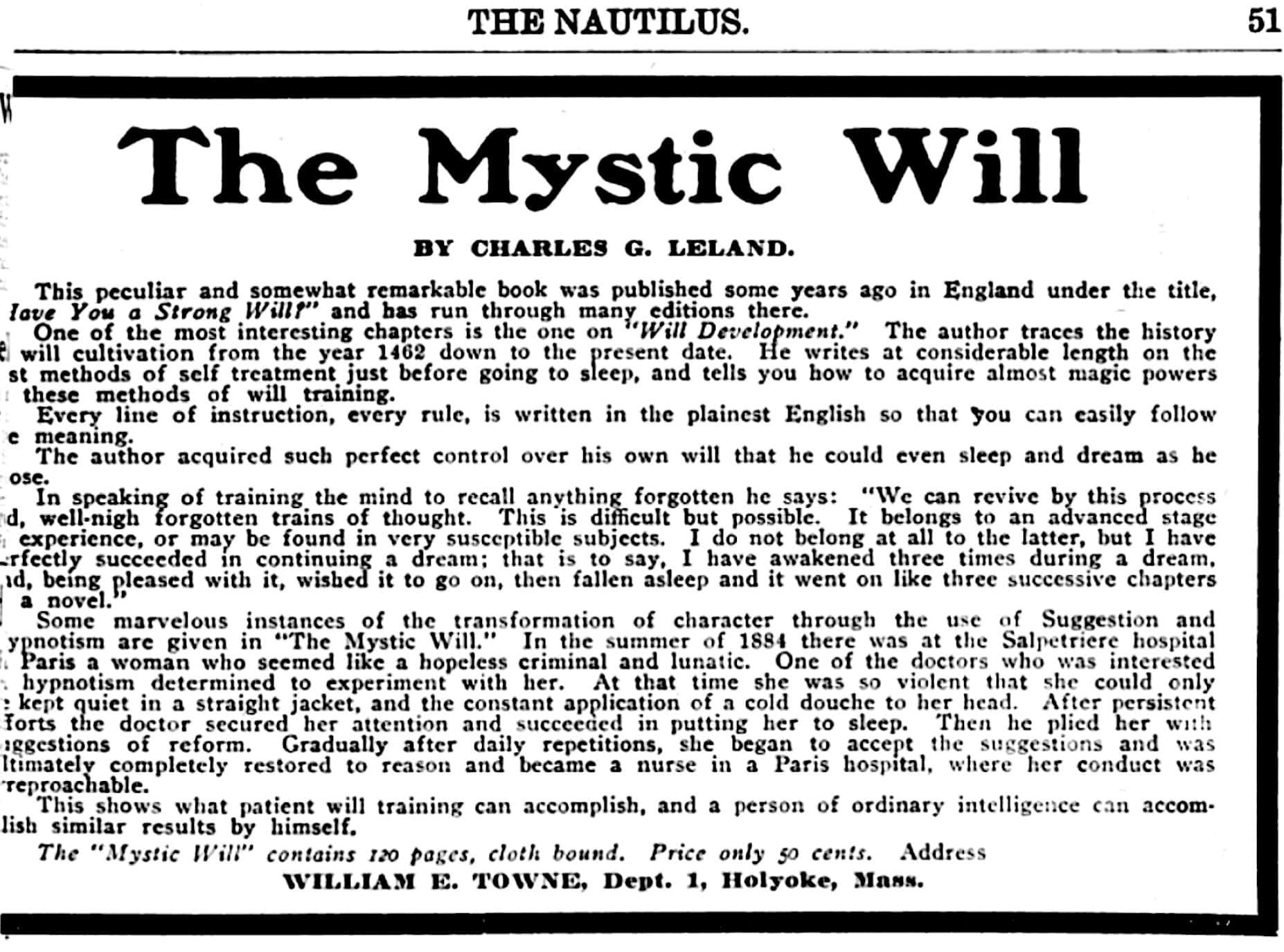
The Mystic Will by Charles Godfrey Leland, first published as Have You a Strong Will?, is a practical guide on building willpower through mental discipline and self-training. Leland combines new psychological ideas with mesmerism, folklore, and esoteric philosophy. He believes the human mind has great untapped power that can be awakened with simple, regular mental exercises. Instead of seeing willpower as a rare gift, he shows it can be developed by anyone through practice.
A key part of Leland’s approach is auto-suggestion. He explains that thoughts placed in the subconscious mind, especially right before sleep, keep working in the background and slowly change habits, attitudes, and character. By regularly repeating positive ideas and focusing on them, a person can build more self-control and mental strength.
Leland also highlights the importance of “forethought,” which means preparing your mind before starting any task or making a change. Instead of depending on bursts of motivation, he suggests setting clear intentions ahead of time and repeating them until they become habits. Leland says the subconscious mind keeps working on these intentions, even while you sleep, gradually building the qualities you want.
Leland compares building willpower to strengthening muscles—it gets stronger with regular use. He offers practical tips for improving focus, boosting memory, overcoming fear and bad habits, staying calm, and building endurance for both mind and body. The book stresses that real change comes from steady, disciplined effort over time, not from sudden bursts of inspiration.
“Will in its perfection is Genius, spontaneous originality, that is Voluntary; not merely a power to lift a weight, or push a load, or force others to yield, but the Thought itself which suggests the deed.”
The Mystic Will is more than just a guide to willpower. It offers a philosophy of self-mastery based on the idea that the subconscious mind is a powerful, often unused resource. By using auto-suggestion, focus, and building good habits, Leland believes people can unlock hidden abilities, change their character, and achieve much more.
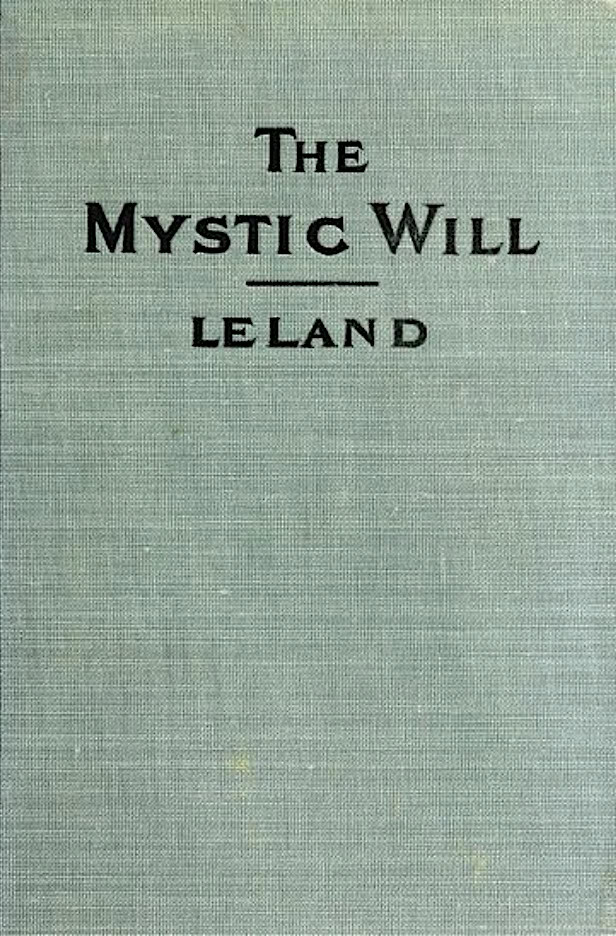
Original edition
Charles Godfrey Leland
Charles Godfrey Leland (1824–1903) was an American author, journalist, folklorist, educator, and occult scholar. He was among the first writers to connect folklore, psychology, and mental science. While he became internationally known as a humorist and poet, his deep interest in Hermeticism, Neoplatonism, folklore, and hypnotism made him a key influence on the New Thought movement and modern self-improvement literature.
Charles Godfrey Leland
Leland was born in Philadelphia and studied at Princeton University, then continued his education at Heidelberg, Munich, and the Sorbonne in Paris. Although Princeton gave him a classical education, his real interests grew outside the classroom. He later said he lived a “double life,” appearing to focus on his studies while privately reading Neoplatonists, the Hermetica, Gnostic texts, and Renaissance mysticism. He often went into the woods near Princeton to reflect on these ideas, believing that ancient philosophers held important psychological truths that had been forgotten. In Germany, he lived like a wandering scholar, searching for both academic knowledge and traces of old philosophical traditions across Europe.
During his time in Europe, Leland encountered many important ideas of the nineteenth century. At Heidelberg, he met Justinus Kerner, a German doctor and mystic, who studied mesmerism, spiritualism, and magnetic sleep. Kerner introduced Leland to new scientific ways of explaining things once thought to be supernatural. While studying in Paris, Leland’s education was interrupted by the Revolution of 1848, and he joined the student revolutionaries, serving as a captain during the uprising.
After returning to America, Leland briefly worked as a lawyer before moving into journalism and writing. During the Civil War, he strongly supported the Union, writing political commentary and satire for the Continental Monthly and helping to popularize the word “emancipation.” He also served with Union forces during the Gettysburg Campaign. His book The Breitmann Ballads (1871), a collection of humorous poems in a mix of English and Pennsylvania German dialect, made him famous in both America and Europe.
Once he was financially independent, Leland moved back to Europe for good and focused on studying folklore and comparative religion. He lived for many years in London, Germany, and finally Florence, Italy, where he learned about the traditions of Romani communities, Irish Travellers, Native American myths, and Italian folk religion. He was the first scholar to identify and record Shelta, the secret language of the Irish Travellers, and spent years gathering fading oral traditions across Europe. His meeting with an Italian folk practitioner named Maddalena led to his book Aradia, or the Gospel of the Witches (1899), which became a major influence on modern Paganism and Wicca. Link
Throughout his research, Leland became more convinced that the remarkable effects linked to magic, mesmerism, and occult practices could be explained by how the human mind works. He believed that what people once called enchantment or fascination was actually based on psychological principles now known as hypnotic suggestion. He was especially influenced by Scottish doctor James Braid, who argued that suggestion, not animal magnetism, worked through the nervous system and imagination.
Leland eventually turned from studying suggestion in others to training his own mind. Using ideas from ancient Hermetic philosophy and modern psychology, he created a practical system based on concentration, planning, repetition, and self-suggestion. He thought that focusing on certain thoughts right before sleep would help build habits, memory, willpower, and character overnight. These ideas became the foundation of his 1899 book Have You a Strong Will?, later called The Mystic Will in America. In the book, Leland said that willpower is not something you are simply born with, but a skill anyone can develop through regular mental practice.
Leland also made important contributions to public education. He strongly supported industrial arts and founded the Public School of Industrial Art in Philadelphia, where he brought woodworking, embroidery, metalwork, and other crafts into the classroom. Many people admired his educational reforms, including Oscar Wilde, who praised Leland for combining artistic creativity with everyday learning.
By the time of his death in Florence in 1903, Charles Godfrey Leland had produced an extraordinary body of work spanning literature, folklore, anthropology, education, occult philosophy, and psychology. His unique synthesis of Hermetic philosophy, hypnotic suggestion, folklore, and practical mental training made him one of the earliest writers to connect the mystical traditions of the past with the emerging psychological and self-help movements of the twentieth century.
The Science of Psychic Healing: A Bridge Between Yogi Philosophy and the Law of Suggestion
This article explores the book The Science of Psychic Healing and its close parallels with Herbert A. Parkyn's teachings and examines its role in connecting Eastern philosophy with the emerging science of mind.
The Sacred Geometry of the Yogi Publication Society Logo
This article examines the Yogi Publication Society logo and its sacred geometry meaning, comparing it with Hindu, Hermetic, Rosicrucian, Masonic, and Theosophical traditions to show the intention behind the publishing network.
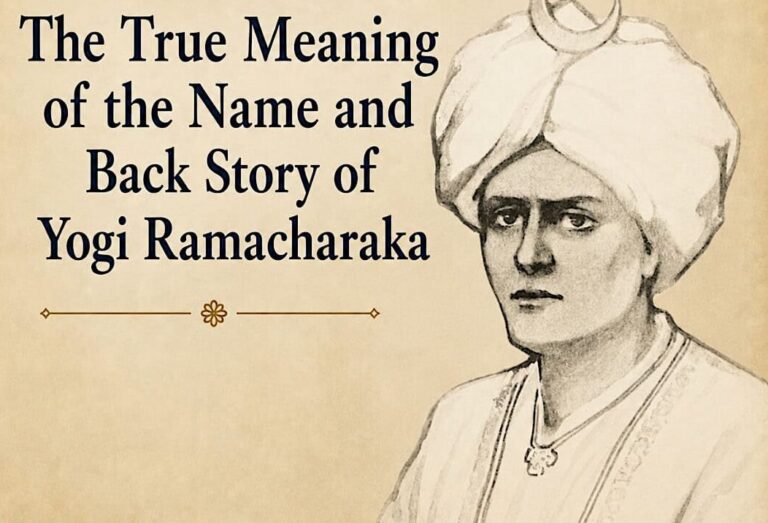
The True Meaning of the Name and Back Story of Yogi Ramacharaka
This article breaks down the hidden symbolism and meaning behind "Yogi Ramacharaka", the pen name that was created by the Yogi Publication Society and shows the allegory that reflected the ideas the books were…