Yoga Lessons for Developing Spiritual Consciousness by Swami A. P. Mukerji, first published in 1911, is a practical guide to spiritual growth. The book blends Vedanta and Yoga principles with ideas similar to the New Thought movement. Instead of treating spirituality as just theory, Mukerji gives readers a step-by-step approach to mental and moral discipline. His goal is to help people discover their higher nature, move past fear and limitation, and realize their own divine potential.
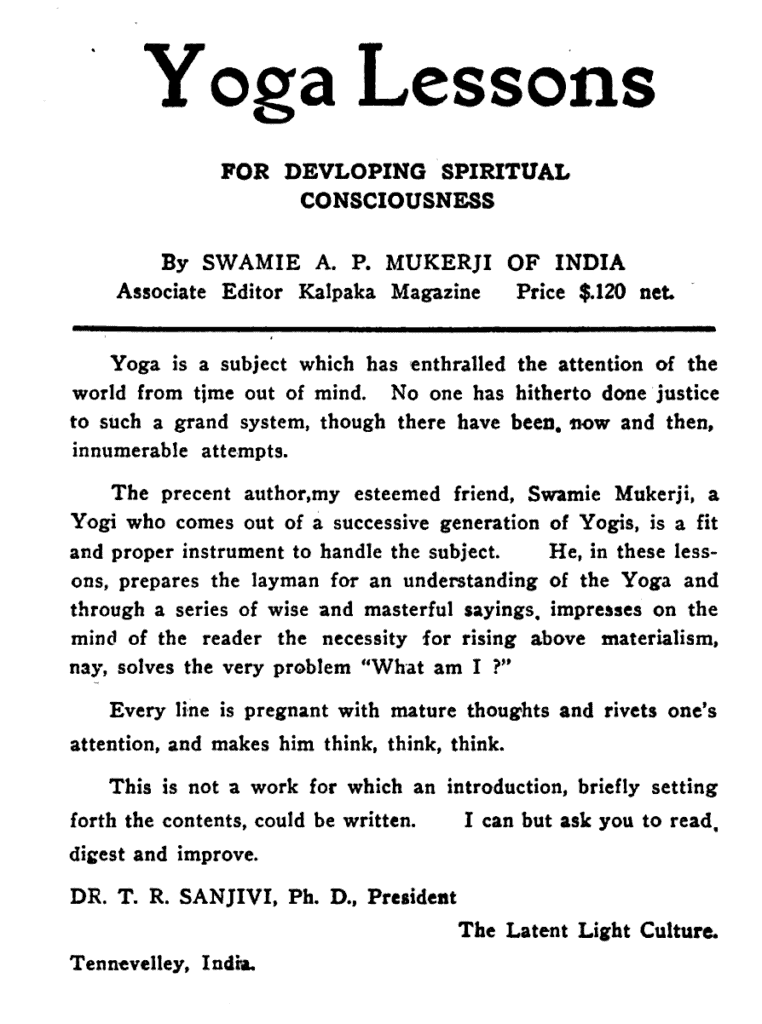
A. P. Mukerji Yoga Lessons ad
A key idea in the book is that everyone has two sides. The lower self is driven by instinct, desire, and attachment to the material world. The higher self is based on intuition, reason, and spiritual awareness. Mukerji says real progress comes from slowly moving your focus from the lower self to the higher self by practicing discipline, meditation, and self-control. The book often talks about the law of cause and effect. Mukerji explains that our character, life situations, and future are shaped by our usual ways of thinking and acting. This means each person is responsible for their own growth. By thinking positively, building willpower, and focusing on good goals, a person can change both their inner self and their life.
The book includes many practical exercises to help readers change and grow. It focuses on meditation, rhythmic breathing, visualization, concentration, and overcoming fear, which Mukerji sees as a major barrier to spiritual progress. He also talks about “self-de-hypnotization,” urging readers to break free from limiting beliefs, social pressures, and bad habits that hide their true selves.
Mukerji stresses that real spiritual awareness goes hand in hand with moral growth. He says qualities like self-control, courage, honesty, compassion, and clear thinking are needed to reach higher spiritual understanding. Prayer, meditation, and managing emotions are not goals by themselves, but tools to help awaken the divine consciousness that is already inside everyone.
Yoga Lessons for Developing Spiritual Consciousness is more than just a book about yoga philosophy. It offers a complete approach to personal change, combining mental discipline, ethical living, and spiritual growth to create lasting inner freedom. By blending traditional Eastern ideas with practical self-improvement, Mukerji shows readers a way to better understand themselves, control their minds, and live in harmony with higher principles.
Swami A. P. Mukerji
Swami A. P. Mukerji was an Indian spiritual teacher, author, associate editor of The Kalpaka, and member of the South India Order. His writings played a key role in introducing traditional yogic philosophy to Western readers when yoga was still unfamiliar outside India. Instead of focusing on physical exercise, Mukerji described yoga as a complete philosophy centered on mental discipline, moral growth, and spiritual awakening. He highlighted willpower, concentration, character, and higher consciousness as the main goals of yogic practice.
Some of his most well-known books include The Doctrine and Practice of Yoga, Yoga Lessons for Developing Spiritual Consciousness, The Yogi Conception of Character Building, and The Yogi Role of Prayer. These early twentieth-century works gave readers practical guidance on meditation, concentration, visualization, breath control, prayer, and training the mind. Mukerji aimed to make classical yoga principles easy to understand for Western readers and show how they could be used in daily life.
A key idea in Mukerji’s philosophy was what he called Will-Force. He believed that a person’s willpower shapes their life, and that mental training helps people control both their inner urges and the world around them. Instead of seeing fate as unchangeable, Mukerji taught that people can shape their own character and future by working hard, thinking positively, and practicing self-control.
Mukerji also stressed that people need to rise above their material desires to reach higher spiritual awareness. He saw life as a journey where every experience helps the soul grow. By practicing meditation, living ethically, and learning to control their thoughts, people can move beyond fear, selfishness, and illusion, and become more aware of the deeper spiritual reality behind daily life.
Mukerji combined traditional Vedantic philosophy with practical ways to develop the mind. His ideas were similar to those of the New Thought movement, but he stayed true to classical yoga teachings. His books were some of the first to introduce Indian spiritual philosophy to Western readers and are still valued today for their focus on self-mastery, building character, and developing spiritual awareness.
Related Research Articles
The Science of Psychic Healing: A Bridge Between Yogi Philosophy and the Law of Suggestion
This article explores the book The Science of Psychic Healing and its close parallels with Herbert A. Parkyn's teachings and examines its role in connecting Eastern philosophy with the emerging science of mind.
The Sacred Geometry of the Yogi Publication Society Logo
This article examines the Yogi Publication Society logo and its sacred geometry meaning, comparing it with Hindu, Hermetic, Rosicrucian, Masonic, and Theosophical traditions to show the intention behind the publishing network.
The True Meaning of the Name and Back Story of Yogi Ramacharaka
This article breaks down the hidden symbolism and meaning behind "Yogi Ramacharaka", the pen name that was created by the Yogi Publication Society and shows the allegory that reflected the ideas the books were…
The Yogi Publication Society started in the offices of Herbert A. Parkyn on Cottage Grove Ave.
This article shows that 4000 Cottage Grove Avenue was where the Yogi Publication Society began and served as the main hub for Dr. Herbert A. Parkyn's publishing, educational, and mail-order activities.