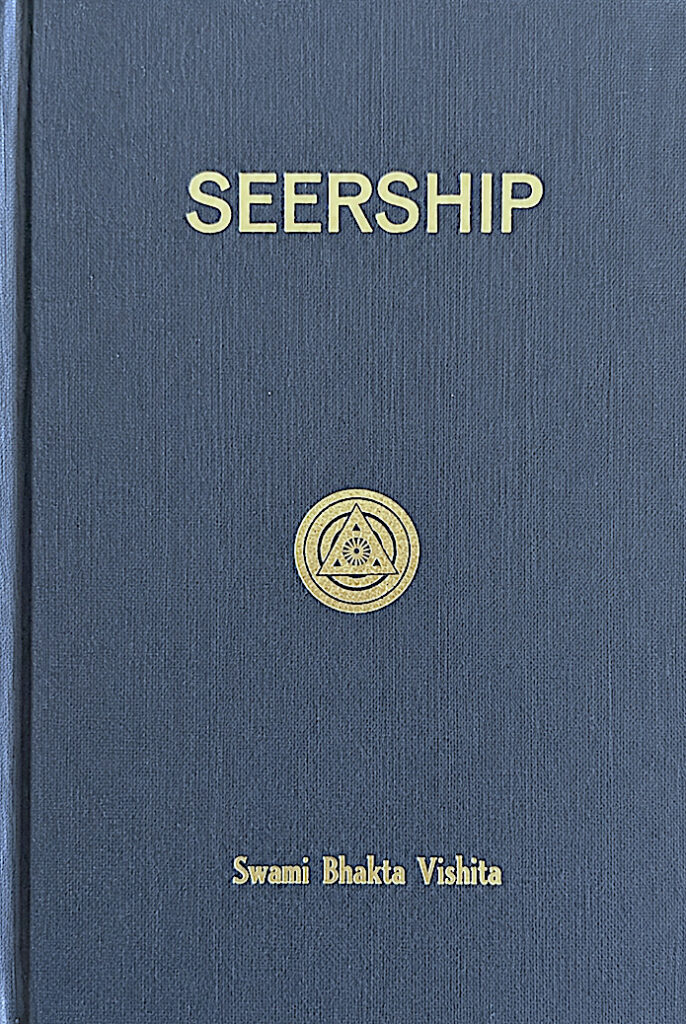
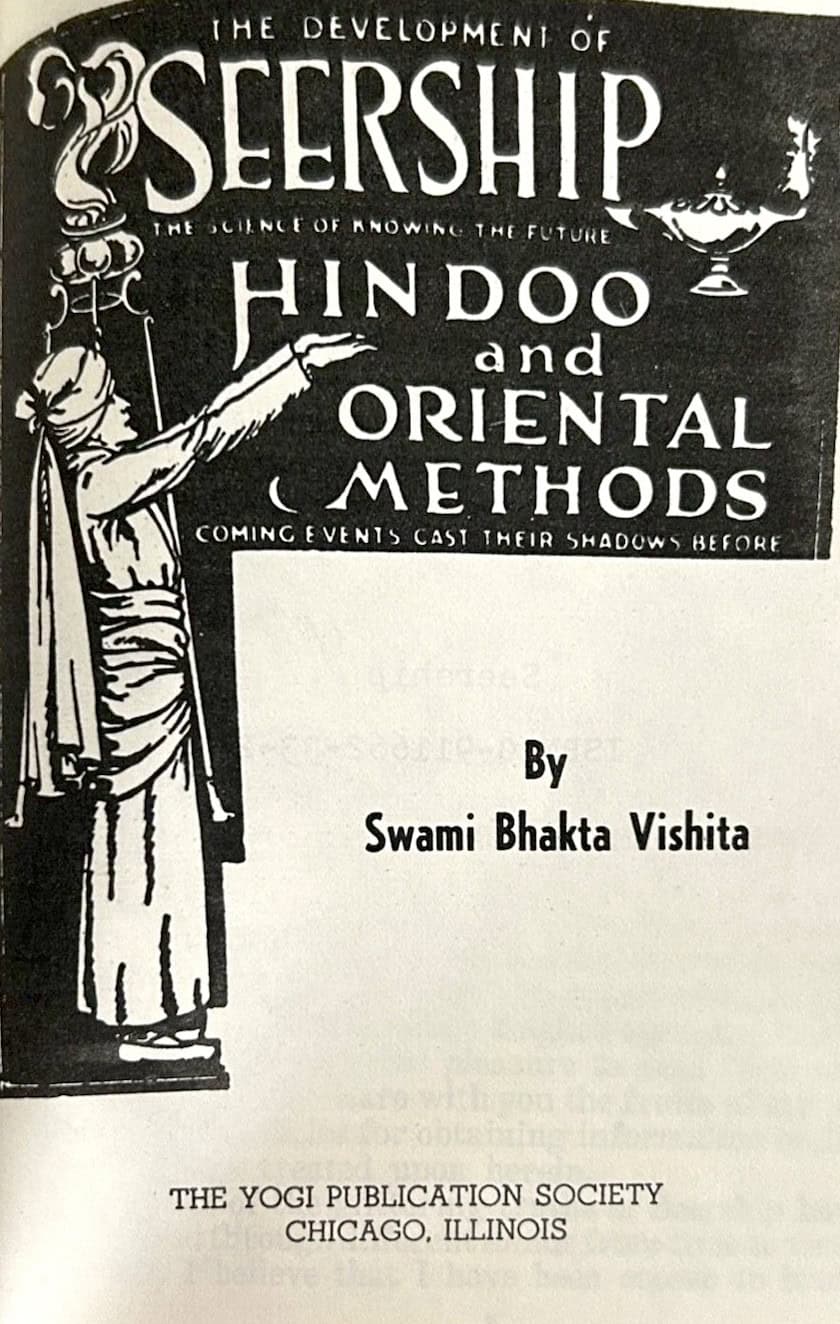
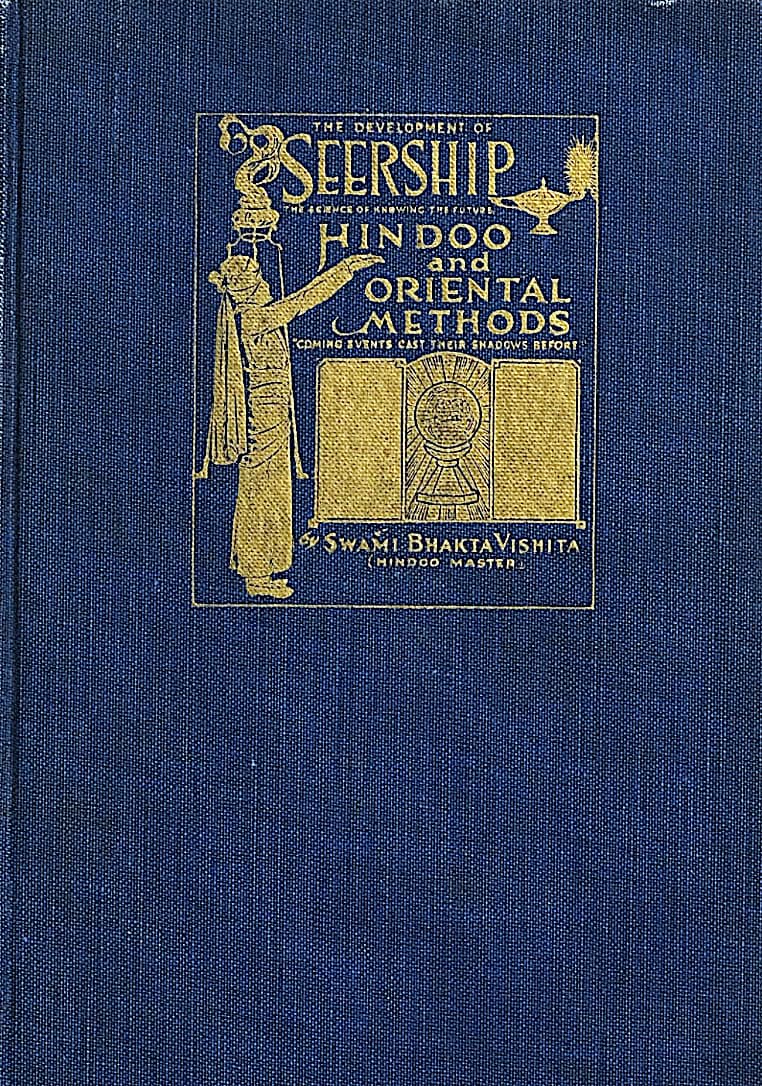
Published in 1915 under the pseudonym Swami Bhakta Vishita, The Development of Seership: The Science of Knowing the Future presents Seership as a latent faculty of human consciousness that can be deliberately awakened, trained, and eventually brought under conscious control. Although the title emphasizes knowing the future, the book uses the word “Seership” in a much broader sense. It encompasses clairvoyance, intuition, perception of invisible forces, communication with the spiritual world, knowledge of past and future events, psychic diagnosis, and the development of what Vishita repeatedly describes as the higher or inner senses.
The central argument of the book is that ordinary human consciousness reveals only a small portion of reality. Behind the physical world perceived through sight, hearing, touch, taste, and smell exists another realm that ordinarily remains invisible because the corresponding faculties of perception have not yet been sufficiently developed. Vishita does not present seership as a miraculous ability possessed by a handful of exceptional people. He calls it the “birthright of every soul” and maintains that the faculty exists latently in humanity as part of its continuing spiritual evolution.
From the beginning, Vishita attempts to separate his system from fortune-telling and fraudulent occultism. In the introduction he claims that the subject has been discredited by “pseudo-seers, charlatans, and rank imposters” and declares his intention to reconstruct it as a practical science. He presents the book as the result of years of travel, reading, investigation, and contact with teachers of occult traditions, even claiming membership in Pythagorean and Rosicrucian fraternities and assistance from adepts and masters associated with India, China, and Egypt. These claims establish the literary identity Vishita assumes throughout the book: not merely an author discussing psychic phenomena, but an initiated teacher revealing a previously guarded system of occult development.
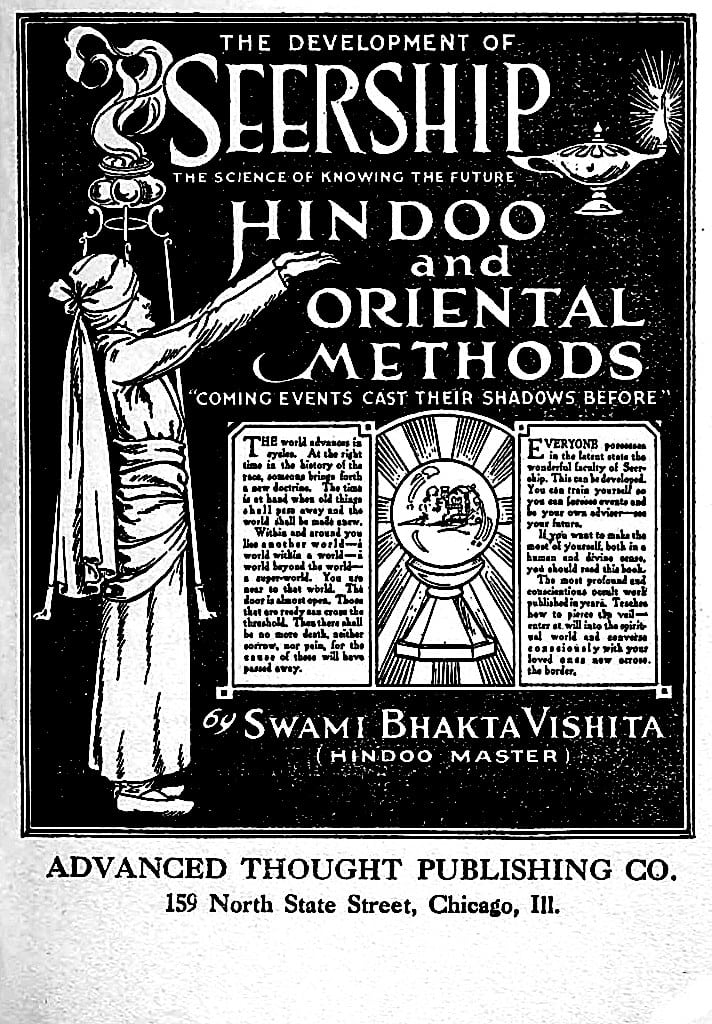
Seership released by both Advanced Thought Publishing and Yogi Publication Society
The Invisible World Behind the Visible
The foundation of Vishita’s system is the existence of what he calls the invisible or supersensible world. Human beings ordinarily identify reality with what their physical senses can detect, but Vishita argues that this is equivalent to assuming that nothing exists beyond the limited range of those senses. Seership begins when consciousness learns to receive information independently of the ordinary sensory channels. He describes the universe as permeated by an immense medium of subtle or magnetic light. The physical worlds exist within this greater field, and the human organism possesses corresponding inner faculties capable of becoming receptive to it. The secret of seership is described as becoming “en rapport” with this ocean of inner light. Once this relationship has been established, consciousness supposedly acquires access to information that cannot be obtained through ordinary physical perception.
This is an important distinction because Vishita does not define seership merely as seeing spirits or predicting future events. It becomes an additional means of knowing. The physical senses reveal the external surfaces of things; the inner senses supposedly reveal realities hidden beneath those surfaces. As the book develops, this faculty expands into what Vishita calls the “Sixth Sense.” It is described not simply as another sense alongside the other five, but in some respects as their synthesis and extension. Through it, the individual supposedly becomes capable of distinguishing appearance from underlying reality and perceiving information inaccessible to ordinary consciousness. Vishita associates it with intuition, imagination, prophecy, recollection, emotional perception, penetration, and direct spiritual cognition.
Seership as Human Evolution
Vishita places this development within a much larger theory of human evolution. Humanity, in his system, is not a completed form. Human consciousness is still developing, and faculties considered extraordinary in the present age are presented as anticipations of abilities that will eventually become normal. This explains one of the book’s most repeated claims: everyone possesses the potential for seership. Differences between individuals represent differences in development rather than completely different kinds of human beings. Some people experience only occasional intuitions, impressions, dreams, or premonitions. Others have developed these faculties sufficiently to receive clearer information. The advanced seer represents a further stage in the same process.
What initially appears as vague instinct may develop into intuition, then clearer psychic perception, and ultimately conscious participation in the spiritual world. Vishita treats these stages as points along a continuous evolutionary path. This also explains why he repeatedly connects seership with religion, morality, intellectual development, health, and character. The higher faculty is not supposed to exist separately from the rest of the individual. Its development changes the person’s understanding of life itself. According to Vishita, it supplies the intellect with information unavailable through ordinary reasoning, strengthens intuition, reveals the spiritual nature of the individual, and ultimately creates a bridge between physical existence and what he calls the “great beyond.”
Practical Seership
Despite the elaborate metaphysical framework, the book repeatedly returns to practical development. Vishita insists that simply reading about occult powers accomplishes very little. Seership must be cultivated through disciplined practice. The student is instructed to establish a definite routine and devote a regular portion of each day to development. A quiet location should be chosen where interruptions are unlikely. Vishita even recommends, where possible, creating a room or environment associated specifically with seership so that its surroundings reinforce the desired mental state.
More important is what he calls “Choice and Singleness.” The student must learn to direct attention deliberately rather than allowing the mind to scatter itself among competing interests. Vishita advises concentrating upon one system of development instead of simultaneously experimenting with numerous occult methods. This introduces one of the most psychologically important elements of the book. Vishita argues that people do not really see with their eyes alone. They see through attention. The physical eye receives impressions, but consciousness selects, organizes, and interprets them. Learning how to control attention becomes the first stage in learning how to perceive things that ordinarily escape awareness. The training of seership begins not with spectacular visions but with mastery of attention.
The Development of the Inner Senses
The second major stage concerns the actual development of what Vishita calls the clear-seeing faculty. The objective is to recognize facts and truths through means other than the five physical senses. According to the book, communication between visible and invisible planes becomes progressively easier once the first genuine connection has been established. At first, impressions may be uncertain. The student may receive an intuition without understanding its source or experience an image without knowing whether it is imagination or genuine perception. Continued practice is intended to sharpen the distinction.
Vishita recognizes an important problem here: even if someone perceives something psychically, that person must still learn to interpret and express what has been perceived. Spiritual perception and intellectual explanation are not identical abilities. He uses religious examples, including St. Paul, to illustrate the difficulty of translating experiences beyond ordinary consciousness into ordinary language. The development of seership requires two forms of education. The faculty itself must become sensitive enough to receive impressions, while the ordinary mind must become capable of interpreting them accurately.
Reading the Impressions Left by Events
One of Vishita’s explanations for clairvoyant knowledge is that events leave impressions behind them. Everything that occurs supposedly impresses itself upon the subtle environment in much the same way that light produces an image upon a photographic surface. The seer does not necessarily travel physically to another place or time. Instead, consciousness becomes receptive to the impressions associated with the person, object, location, or event being investigated.
This principle provides the theoretical basis for several phenomena discussed throughout the book, particularly psychometry and clairvoyant perception of the past. Objects are important because they supposedly retain subtle connections with the people and events surrounding them. Contact with an object can serve as a bridge between the seer’s consciousness and the impressions associated with its history. The same theory expands outward until nature itself becomes a kind of enormous repository of experience. Past events have not simply vanished; their subtle records remain potentially accessible to sufficiently developed perception.
Knowing the Future
Future perception presents a more complicated problem because an event that has not yet physically occurred cannot leave an ordinary historical impression. Vishita’s solution is to argue that future events frequently exist in developing chains of causes before their final physical manifestation. The phrase associated with the book—“Coming events cast their shadows before”—summarizes this principle. The future is not necessarily perceived as an absolutely fixed sequence of predetermined events. Rather, conditions developing upon subtler levels may become perceptible before their outward consequences appear.
The advanced seer can perceive tendencies, forces, causes, or partially formed events moving toward manifestation. What appears to ordinary consciousness as prediction is presented as perception of conditions that already exist but have not yet reached the physical stage. This also explains why Vishita connects seership with practical decision-making. The ability to “look ahead” supposedly gives the individual an advantage because consequences can be recognized while they are still developing. Seership thus becomes not merely a method for satisfying curiosity about the future but a means of consciously directing one’s life.
The Laws Governing Seership
Vishita next attempts to establish laws governing these phenomena. Different seers may employ different techniques, but the underlying faculty is presented as universal. Some require special conditions, objects, concentration exercises, or states of receptivity; others develop spontaneous perception. Vishita nevertheless insists that the underlying mechanism is the same.
He also rejects the idea that trance is necessary. The developed seer should ideally remain lucid and conscious. Indeed, one of the objectives of training is to replace uncontrolled psychic experiences with deliberate perception. This distinction becomes increasingly important because Vishita repeatedly warns against uncontrolled passivity. A person who simply opens himself to invisible influences without developing willpower, discrimination, and self-control may become vulnerable to forces he does not understand. The ideal seer is neither an unconscious trance medium nor a passive recipient. He is an active investigator who develops the ability to enter into psychic receptivity while retaining command of himself.
Invisible Influences and the Danger of Obsession
This leads into one of the darker aspects of the book. Vishita does not portray the invisible world as universally benevolent. He explicitly argues that invisible influences may be constructive or destructive. According to his system, similarity produces attraction. Mental and moral conditions place an individual in relationship with corresponding invisible influences. A person dominated by fear, hatred, selfishness, or destructive desires may attract forces of a similar character, while a disciplined and constructive person becomes aligned with higher influences.
Vishita even accepts the possibility of what he calls obsession—the domination of an individual by an external psychic influence. He treats traditional ideas concerning spells, charms, psychic projection, and magical influence more seriously than a purely psychological interpretation would allow. He draws upon experiences he claims to have encountered during travels through Africa, Egypt, India, Turkey, Arabia, and Syria, as well as practices attributed to magical and voodoo traditions. The practical lesson, however, remains consistent: psychic development without moral and mental discipline is dangerous.
The Ethical Law of Psychic Development
For this reason, Vishita places unusually strong ethical restrictions around his instructions. The introduction warns readers not to misuse what they learn. Psychic knowledge is not supposed to be employed to dominate, injure, deceive, or exploit others. His explanation is partly spiritual and partly occult. Actions supposedly create corresponding consequences, while invisible intelligences—described dramatically as “Astral Guards”—observe human conduct. Misuse of psychic power creates forces that eventually return upon the person who generated them.
This principle continues into the practical instructions. The student is told to begin development with constructive intentions and to use whatever abilities emerge for beneficial purposes. Vishita also discourages selfish accumulation of occult knowledge. The student who learns is expected eventually to assist others. The acquisition of psychic power and moral development are supposed to proceed together.
Seership and the Problem of Death
As the book expands beyond practical clairvoyance, seership becomes a means of answering the larger question of human survival after death. Vishita argues that materialism produces an incomplete understanding of existence because it identifies the individual with the temporary physical body. Seership supposedly provides direct experiential evidence that consciousness extends beyond physical matter. The advanced seer becomes aware of a world existing around and through the physical world and ultimately learns to communicate with beings inhabiting what Vishita calls the astral plane.
Death ceases to represent annihilation. Earthly existence becomes one episode within a much larger spiritual existence. Vishita tells the reader that the individual belongs to an eternal universe and has existed before the present earthly personality and will continue after it. The purpose of psychic development changes dramatically as the book progresses. Learning to see distant events or anticipate future circumstances becomes secondary to preparing consciousness for existence beyond physical death.
The Great Universe Beyond
This transition leads into the book’s larger cosmology. Vishita argues that physical existence cannot be understood in isolation because creation has a definite spiritual purpose. Everything in the material world changes and eventually disappears. Bodies age, possessions are lost, civilizations pass away, and physical circumstances are temporary.
The mistake of ordinary life, according to Vishita, is to devote nearly all effort to temporary material conditions while giving almost no attention to the development of the consciousness that supposedly survives them. Seership reverses those priorities. By developing awareness of the invisible world while still physically alive, the individual begins preparing for continued existence beyond the body. The seer is compared to someone learning the conditions of another country before emigrating there. This becomes one of the book’s strongest recurring themes: occult development is preparation for immortality.
Seership as Religion, Science, and Self-Knowledge
Vishita does not regard his teachings as belonging exclusively to occultism. He repeatedly tries to connect them with ancient religion, philosophy, Christianity, Hindu traditions, and what he considers the emerging science of psychic phenomena. He claims that the principles underlying seership can be found in the Hindu Vedas, the Bible, the teachings of Christ, and the doctrines of ancient philosophers and prophets. Rather than presenting these traditions as fundamentally opposed, he treats them as partial expressions of the same ancient knowledge.
The book attempts to occupy an unusual middle ground. It rejects materialism but also rejects what Vishita considers ignorant superstition. It accepts spirits, psychic forces, clairvoyance, prophecy, and invisible worlds while insisting that all of them operate according to laws. The supernatural, in this system, is simply the natural world extended beyond the boundaries presently recognized by conventional science.
The Larger Purpose of the Book
By the time Vishita’s complete argument is considered, The Development of Seership is much more ambitious than its title initially suggests. It begins by promising to teach clairvoyance and the ability to perceive future events, but gradually expands into a complete philosophy of consciousness. Seership becomes the faculty connecting the individual with every level of this system. It permits perception beyond the physical senses, access to impressions of past events, anticipation of developing future conditions, awareness of invisible influences, communication with spiritual beings, greater understanding of other people, and eventually direct knowledge of the continuation of consciousness beyond death.
The exercises serve a much larger objective. Concentration, controlled attention, receptivity, discrimination, and psychic perception are stages in the development of a new mode of consciousness. Vishita ultimately presents humanity as standing between two worlds. Ordinary consciousness remains concentrated almost entirely upon the physical world, while another world supposedly exists within and around it. The purpose of seership is to open the faculties through which that second world becomes consciously accessible.
In this sense, The Development of Seership is not fundamentally a book about fortune-telling. It is a manual for what its author considers the next stage of human perception. Knowing the future is only one manifestation of a much greater faculty: the ability to penetrate beyond appearances and consciously perceive the invisible dimensions of existence that Vishita believes have always surrounded humanity.
Related Research Articles
The Sacred Geometry of the Yogi Publication Society Logo
This article examines the Yogi Publication Society logo and its sacred geometry meaning, comparing it with Hindu, Hermetic, Rosicrucian, Masonic, and Theosophical traditions to show the intention behind the publishing network.