
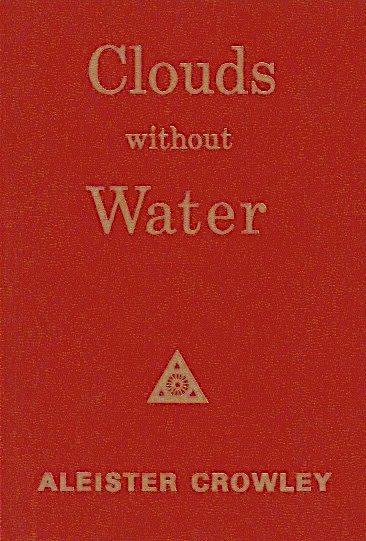
Clouds Without Water
About This Publication
Clouds Without Water, originally published in 1909, stands out as one of Aleister Crowley’s most unusual and controversial books. Unlike his more famous works on mysticism or philosophy, this book is mainly a collection of narrative poems about desire, obsession, passion, spiritual rebellion, and psychological decline. Crowley first released it anonymously, pretending it was a manuscript found and edited by a made-up clergyman, “The Rev. C. Verey.” This approach let him present the poems as someone else’s confessions and distance himself from their bold themes. The book combines romantic poetry, occult symbols, and psychological drama into one story.
The title comes from the Epistle of Jude in the New Testament, which warns about false teachers and bad spiritual influences. The phrase “clouds without water” describes something that seems to offer nourishment but gives nothing. Crowley uses this image as a main symbol in the book. His characters keep searching for fulfillment through love, passion, power, and spiritual experiences, but often end up facing emptiness, disappointment, or destruction. The title makes it clear from the start that appearances can be misleading and that people often look for satisfaction where it cannot be found.

The main story in the collection follows two lovers as their relationship grows more intense, both emotionally and spiritually. Instead of showing love as something that brings harmony or redemption, Crowley presents it as a force that can break normal moral rules and social expectations. The lovers experience desire, ecstasy, obsession, jealousy, devotion, and despair, making their story feel like a journey into the darker parts of the mind. Their experiences reflect themes from late-nineteenth-century Decadent literature and Dark Romanticism, in which beauty and destruction often go together.
Crowley often looks at the clash between traditional morality and personal desire in this collection. The lovers keep turning away from social rules, religious authority, and old ideas of virtue as they chase their own experiences. This idea would later become important in Crowley’s philosophy: true spiritual growth means finding and following your own deepest nature, not just obeying outside rules. Even though Clouds Without Water was written before Crowley developed Thelema, many of its themes hint at ideas he would explore more clearly in his later works.
A standout feature of the collection is how it deals with taboo subjects. The poems look at types of desire and strong emotions that were very controversial in Edwardian times. Themes like domination and submission, vampiric images, erotic obsession, free love, and breaking social taboos appear throughout. Crowley does not include these just to shock readers. Instead, he uses them to explore the hidden desires and fears beneath civilized behavior. The poems often suggest that the things society tries to suppress are some of the strongest forces shaping our minds.
The collection is full of occult symbols. Crowley builds parts of the book around classic figures from esoteric traditions, such as the Alchemist, the Thaumaturge, and the Adept. Each one is both a character and a symbol for a stage of spiritual growth. The Alchemist stands for transformation and the search to turn ordinary life into something greater. The Thaumaturge is the magician who wants power by mastering hidden forces. The Adept is the person who has moved beyond normal understanding to a deeper sense of reality. These figures connect the emotional stories in the poems with the language and symbols of Western occultism.
The collection also contains poems structured around ritual themes, including references to the Black Mass. Crowley uses these symbols not just to criticize Christianity but as tools to explore rebellion and challenges to authority. He was always interested in how symbols could trigger strong psychological and spiritual responses. In Clouds Without Water, he often flips religious images to make readers question their ideas about good and evil, purity and corruption, and what is sacred or profane. The lovers’ experiences often become so extreme that they blur the boundaries between joy and anguish. This reflects a mystical idea that appears throughout Crowley’s writings: that profound transformation often occurs when individuals are pushed beyond their ordinary limits. The poems suggest that spiritual and emotional growth may require confronting aspects of existence that most people prefer to avoid.
The Decadent movement’s influence shows up throughout the book. Like other writers from that tradition, Crowley was interested in excess, forbidden experiences, beauty, and rejecting normal moral rules. But there is also a deeper philosophical question in the poetry. The collection is not just about shocking behavior; it examines what happens when people try to live according to their desires without holding back. These experiences can be beautiful, tragic, destructive, and life-changing all at the same time.
Aleister Crowley
Aleister Crowley (1875–1947) was an English occultist, ceremonial magician, poet, novelist, mountaineer, and the founder of the religious philosophy called Thelema. He became one of the most influential and controversial figures in modern Western esotericism. Crowley turned away from the strict evangelical Christianity of his Plymouth Brethren upbringing and spent his life exploring mysticism, ceremonial magic, comparative religion, Eastern philosophy, and ancient traditions. The press often called him “the wickedest man in the world,” but his writings had a major impact on twentieth-century occultism and still influence modern magical, esoteric, and alternative spiritual movements.
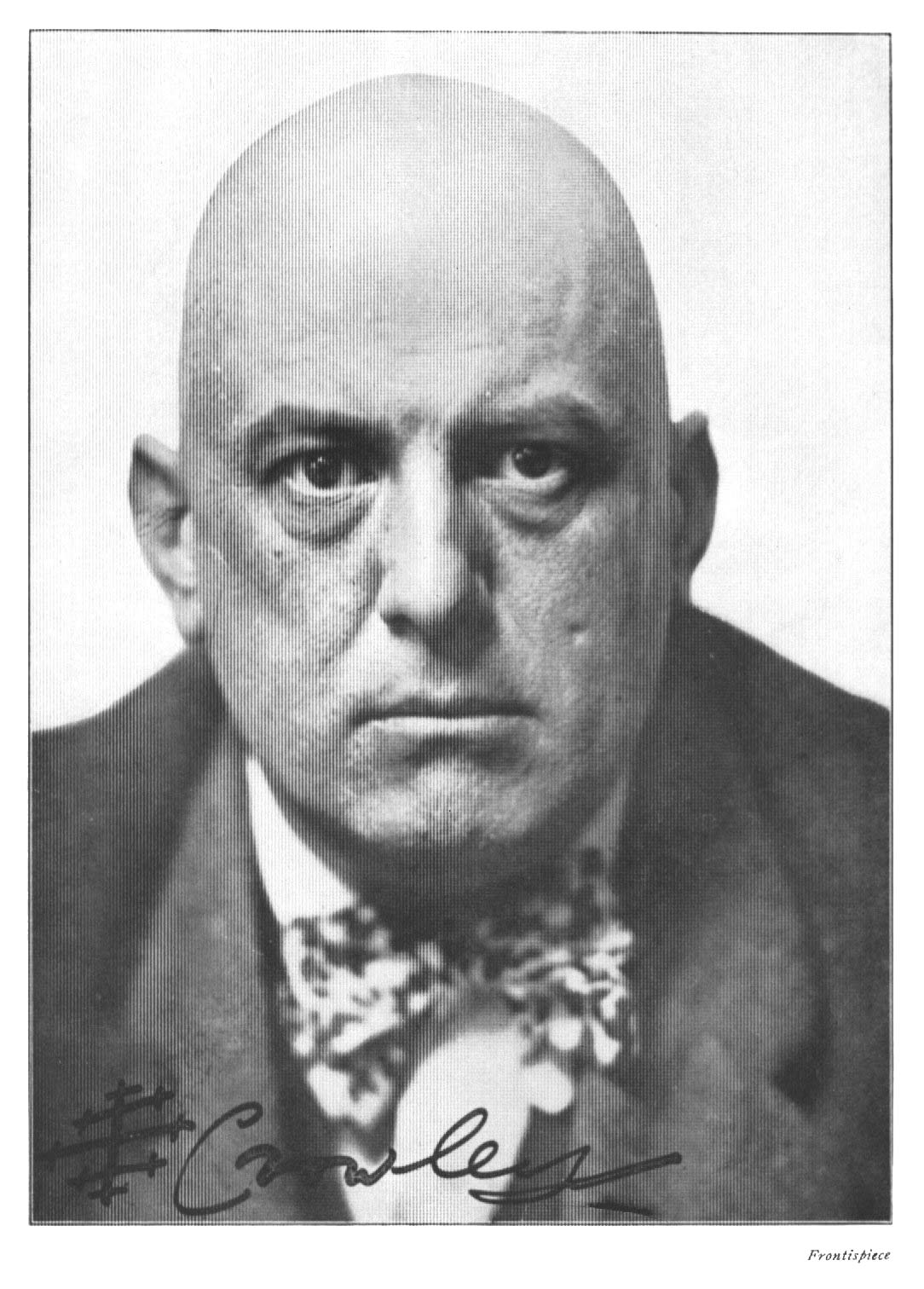
Crowley was born Edward Alexander Crowley in Royal Leamington Spa to a wealthy brewing family. He went to Trinity College, Cambridge, where he became interested in poetry, mountaineering, philosophy, and the occult. In 1898, he joined the Hermetic Order of the Golden Dawn, the leading magical society in Britain at the time, and studied ceremonial magic, Qabalah, alchemy, astrology, and ritual with leaders like Samuel Liddell MacGregor Mathers. After conflicts within the Order, Crowley spent years traveling through Europe, North Africa, India, China, Mexico, and Ceylon. He combined mountaineering with deep studies of yoga, meditation, and Eastern religions.
The most important event in Crowley’s career happened in Cairo in 1904, when he said he received a revelation from a spiritual being named Aiwass. Over three days, he dictated The Book of the Law, which became the foundation of Thelema. This philosophy is known for the statements, “Do what thou wilt shall be the whole of the Law” and “Love is the law, love under will.” Crowley explained that these ideas were not about doing whatever one wants, but about finding and following one’s unique “True Will,” or highest purpose in life.
A key part of Crowley’s teaching was the idea of “Magick,” which he spelled this way to set it apart from stage magic. He described Magick as “the Science and Art of causing Change to occur in conformity with Will.” For Crowley, Magick was a disciplined system that brought together ritual, meditation, symbolism, suggestion, and spiritual growth. He drew from Hermeticism, Qabalah, alchemy, Gnosticism, yoga, Tantra, and ancient mystery traditions, aiming to blend Eastern and Western esoteric teachings into one system.

Throughout his life, Crowley was involved in several occult groups, most notably becoming the leader of the Ordo Templi Orientis (O.T.O.), where he changed its teachings to focus on Thelema. In 1920, he founded the Abbey of Thelema in Cefalù, Sicily, as a place for spiritual and magical practice. The Abbey attracted widespread public attention and controversy, and after one resident died, the Italian government, led by Benito Mussolini, expelled Crowley from Italy in 1923.
Crowley was a very productive writer, publishing many books, essays, poetry collections, novels, plays, translations, and guides on ceremonial magick, yoga, Qabalah, mysticism, psychology, and comparative religion. Some of his most important works include The Book of the Law, Magick in Theory and Practice, The Book of Thoth, The Vision and the Voice, and the magazine The Equinox.
Besides his work in the occult, Crowley was a skilled mountaineer who took part in early expeditions to K2 in 1902 and Kangchenjunga in 1905, helping to start Himalayan climbing.
Crowley died in relative obscurity in 1947, but his influence grew immensely after his death. His ideas helped shape modern ceremonial magic, Wicca, contemporary occultism, and many alternative spiritual movements. His focus on personal spiritual freedom, symbolic psychology, and disciplined self-realization appealed to the counterculture of the 1960s and later. Crowley has become a lasting cultural figure, appearing on the cover of Sgt. Pepper’s Lonely Hearts Club Band and inspiring artists, writers, musicians, and many students of Western esotericism.