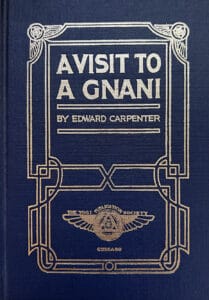
Edward Carpenter (1844–1929) was an English philosopher, poet, author, and social reformer. He grew up in Brighton, studied at Brighton College and Trinity Hall, Cambridge, and was first ordained as an Anglican clergyman. Later, he left the ministry to focus on social reform, writing, and spiritual ideas. Inspired by Christian Socialism and writers like John Ruskin, Ralph Waldo Emerson, and Henry David Thoreau, Carpenter became known for supporting socialism, vegetarianism, simple living, and humanitarian causes.

In the 1880s, Carpenter became a key figure in Britain’s socialist movement. He joined groups like the Social Democratic Federation, the Socialist League, and the Fabian Society, and later helped start the Independent Labour Party with Keir Hardie and Ramsay MacDonald. He spoke up for workers’ rights, opposed industrial capitalism, campaigned against vivisection and capital punishment, supported women’s right to vote, and stayed committed to pacifism during both the Boer War and World War I.
Carpenter was open about being gay and lived for many years with his partner George Merrill. He was one of the first English writers to say publicly that homosexuality is a natural part of human sexuality, not a moral problem. His ideas about sexual freedom influenced people like Havelock Ellis and later writers such as D. H. Lawrence, Siegfried Sassoon, and E. M. Forster.
Along with his social and political work, Carpenter became very interested in Eastern philosophy and Western mysticism. His travels in India and Ceylon led him to write several important books that introduced many Western readers to ideas like Vedanta, yoga, meditation, and universal consciousness. Carpenter kept writing until his death in 1929.