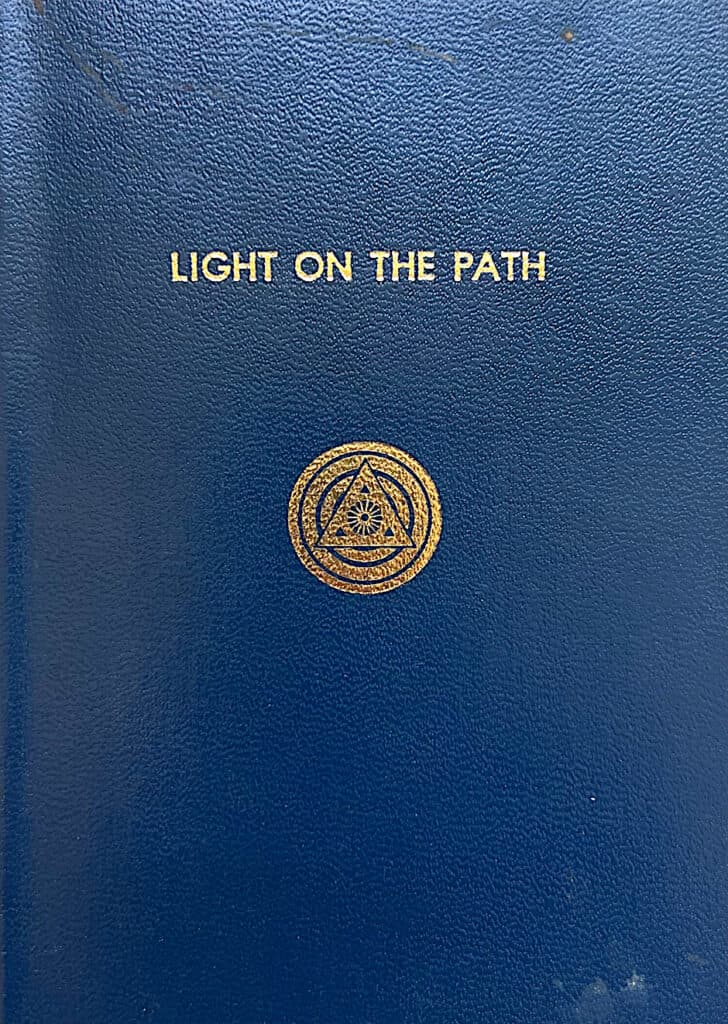
Light on the Path was first published in 1885 by the Theosophical Society and then in 1903 by the Yogi Publication Society. It is a short Theosophical treatise written down by Mabel Collins under the initials “M. C.” and presented as a practical guide for the spiritual disciple. The 1886 edition describes itself as “A Treatise Written for the Personal Use of Those Who Are Ignorant of the Eastern Wisdom, and Who Desire to Enter Within Its Influence,” making its purpose explicit: this is not primarily a theoretical explanation of Eastern religion, but a set of instructions intended to lead a Western reader into what the book calls the Path. Its teaching is built around a progression from ordinary personality and desire toward self-knowledge, spiritual perception, inner guidance, impersonality, unity with life, and ultimately a state beyond individual existence. The language is deliberately paradoxical. The disciple is told to kill ambition yet work as the ambitious work, to destroy the desire for life yet respect life, to abandon the desire for comfort yet remain happy, to stand alone while overcoming every sense of separateness, and eventually to desire power, peace, and possessions while understanding each of those words in an entirely different sense from ordinary personal desire. These apparent contradictions form the central method of the book. Light on the Path does not simply tell the reader to suppress human faculties; it attempts to redirect them away from the personal self and toward what it presents as an eternal spiritual life underlying individual existence.
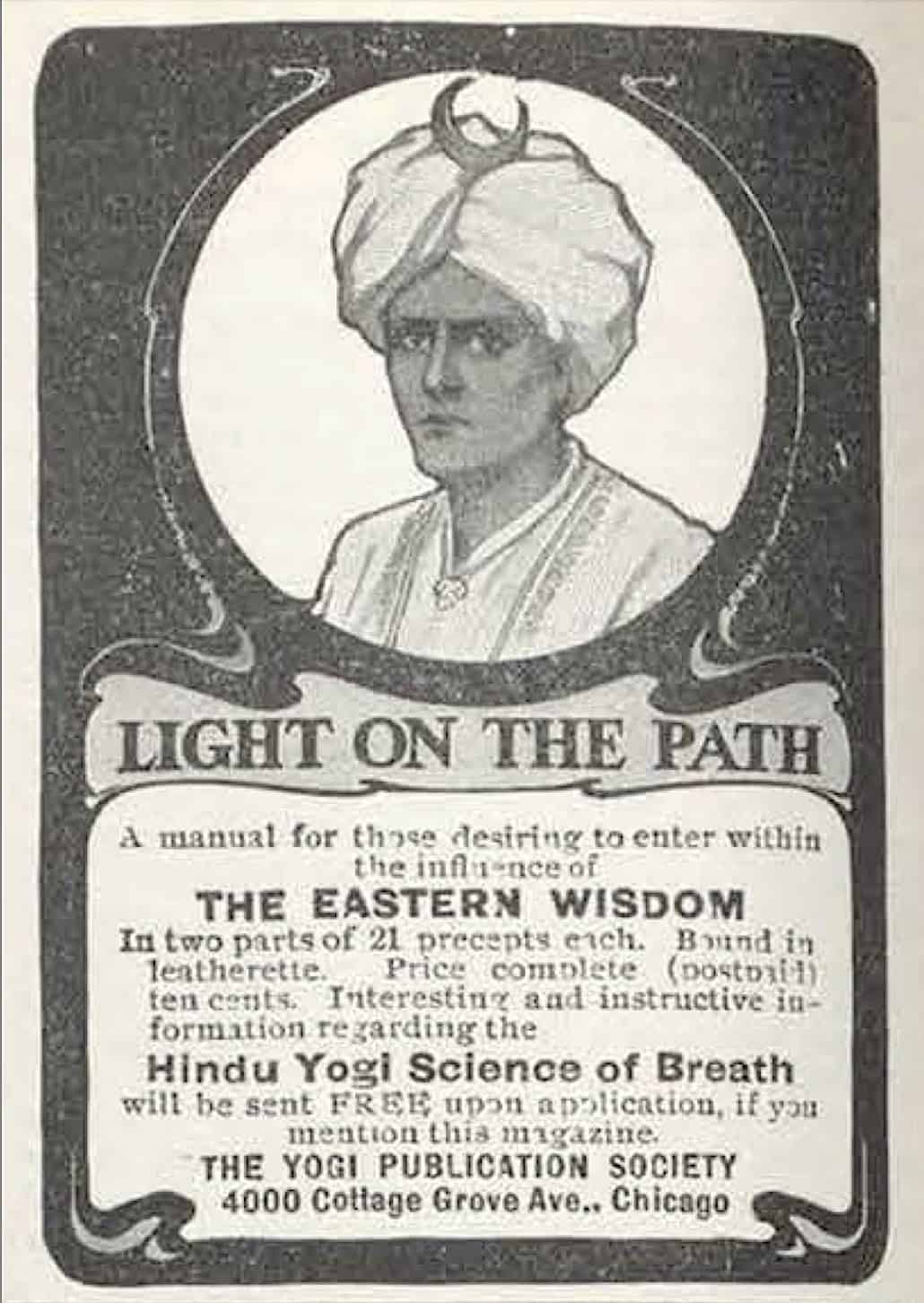
Vintage ad for Light on the Path by the Yogi Publication Society.
“For within you is the light of the world—the only light that can be shed upon the Path”
According to Theosophical tradition, the teachings in this book were passed down through Master Hilarion, an adept of the Great White Lodge. Hilarion noted that the original rules did not come from him but were preserved from a much older source. The thirty short sayings that form the foundation of the work were reportedly written in ancient Sanskrit. A Chohan, or advanced spiritual teacher, later added explanation to ensure clarity and prevent misunderstanding. Hilarion himself wrote the commentaries included in the published text, making these ancient teachings accessible to modern readers.
The work is divided principally into two series of twenty-one rules, followed by a separate discussion of Karma and explanatory notes on several of the rules. The first series concerns the purification and transformation necessary to discover the Path, while the second describes the disciple who has begun to perceive and act through a deeper spiritual principle. Throughout the text, Collins uses recurring images of light, silence, battle, the heart, the flower, the warrior, the Hall of Learning, the inner voice, and the eternal. These images describe stages of spiritual development rather than merely decorating the teaching. The “light” is the spiritual illumination discovered within; the “storm” and “battle” represent the struggle with personality and desire; the opening flower represents the awakening of spiritual perception; the “warrior” is the higher and eternal principle within the disciple; the “song of life” expresses the underlying harmony of existence; and the Hall of Learning represents the condition in which genuine spiritual knowledge becomes possible. The result is a compact initiatory system in which ethical purification, self-observation, inner perception, experience, knowledge, service, and union with a greater life are presented as successive dimensions of one process.
The First Requirement: Transformation of the Personal Self
Light on the Path begins with one of its most severe statements: before the eyes can truly see they must become “incapable of tears,” before the ear can hear it must lose its ordinary sensitiveness, before the voice can speak in the presence of the Masters it must lose the power to wound, and before the soul can stand before them its feet must be “washed in the blood of the heart.” The imagery establishes immediately that initiation requires a fundamental transformation of the ordinary emotional and personal nature. The book is not advocating literal insensibility or cruelty. Rather, it describes the development of a consciousness no longer ruled by personal injury, emotional reaction, vanity, resentment, or self-interest. Seeing, hearing, speaking, and standing become spiritual capacities that can emerge only after the personality ceases to dominate perception. The image of the heart bleeding is especially important because the Path is not portrayed as an easy withdrawal from life. The personal self must undergo an experience that can feel like dissolution before the disciple discovers the deeper identity that the book considers real.
The first three commands therefore strike directly at ordinary motivation: “Kill out ambition,” “Kill out desire of life,” and “Kill out desire of comfort.” Yet the fourth rule immediately prevents these instructions from becoming a doctrine of passivity: the disciple must work as ambitious people work, respect life as those who desire life respect it, and be happy as those who seek happiness are happy. What is to disappear is not action, vitality, discipline, or happiness, but attachment to their personal rewards. The book repeatedly returns to this distinction. A disciple may outwardly perform exactly the same vigorous actions as an ambitious person while inwardly acting from an entirely different center. Ambition is condemned because it seeks an enlargement of the personal self; spiritual work requires the same intensity without the demand that the results belong to oneself. The Path therefore does not consist of abandoning human powers but of separating those powers from personal possession.
Ambition, Desire, and the Hidden Search for Reward
The later note on the first rule makes the treatment of ambition more precise. Ambition is called the “first curse” because it is the simplest form of seeking reward. Intelligent and capable people are especially vulnerable because their abilities give ambition greater opportunities for expression. At the same time, ambition is described as a teacher: its rewards eventually turn to disappointment and reveal the inadequacy of working for oneself. The danger becomes greater after a person begins spiritual development, because ordinary ambition can return in a disguised form. Someone may abandon worldly advancement while becoming ambitious for occult knowledge, spiritual status, recognition by a Master, unusual powers, or an exalted future. The outward object changes while the underlying structure of desire remains intact. For that reason, Collins warns the disciple not to assume too quickly that ambition has been conquered merely because its worldly forms have disappeared.
This distinction is fundamental to the entire work. Light on the Path is concerned less with what a person appears to desire than with the hidden motive beneath the desire. The disciple is continually instructed to examine the heart because spiritual language itself can conceal ordinary self-interest. A person can imagine that he works for humanity while secretly desiring the spiritual consequences of being such a worker; he can reject material rewards while craving spiritual rewards; he can renounce ordinary ambition while imagining himself advancing toward greatness. The Path demands a deeper transformation in which the expectation of personal reward itself disappears. This explains why so many of the rules appear contradictory when read literally. The book is attempting to distinguish the faculty from the personal motive attached to it. Work remains, but ambition disappears; life remains, but attachment to life disappears; growth continues, but hunger for personal growth disappears; power is sought, but not power that magnifies the personality.
Destroying the Sense of Separateness
The next major requirement is expressed in the command to “Kill out all sense of separateness.” This teaching becomes one of the philosophical foundations of Light on the Path. The disciple must eventually recognize that individual existence is embedded within a greater spiritual unity and that no person can attain genuine knowledge while imagining himself fundamentally isolated from others. The later note on this rule makes the point forcefully: the disciple must not imagine himself separate from the foolish or wicked person, because humanity’s sin and shame belong to the world of which he is himself a part. To create an attitude of spiritual superiority toward another person is therefore to strengthen precisely the illusion that the Path is intended to overcome.
This teaching also explains the book’s hostility toward self-righteousness. The disciple is not instructed to approve wrongdoing, but neither may he define spiritual purity by separation from those he considers impure. Collins argues that one should abstain from wrongdoing because abstention is right, not because one wishes to preserve an image of personal cleanliness. The distinction is subtle but essential. If purity becomes something the individual possesses in contrast with the impurity of others, separateness has merely taken a spiritual form. The disciple instead learns to recognize every human being as participating in the same greater life and to understand that the conditions visible in another person are possibilities belonging to the human condition itself. The Path consequently combines severe personal discipline with an equally severe prohibition against spiritual pride.
Sensation, Experience, and Self-Knowledge
Light on the Path next commands the disciple to kill out the desire for sensation and the hunger for growth, but again immediately qualifies the instruction. The disciple must “learn from sensation and observe it,” because experience is necessary for self-knowledge. Growth should occur as a flower grows, naturally and unconsciously, opening itself to the eternal rather than constantly measuring its own progress. This distinction prevents the teaching from becoming simple ascetic repression. Sensation itself is not identified as the enemy. The problem is the personal craving for sensation and the attachment that follows it. Experience becomes useful when it can be observed, understood, and integrated without becoming the ruler of consciousness.
The later commentary reinforces this point by telling the disciple to test experience without surrendering to its seductions. Once the Path has been consciously chosen, the disciple is expected to observe temptation without either yielding to it or recoiling from it in horror. This produces a characteristic attitude found throughout the book: detached participation. The disciple remains in life, studies life, learns through the senses, examines other people, and experiences the struggle of existence, but gradually ceases to be controlled by personal reactions to those experiences. This is why the text rejects any single road to enlightenment. Religious contemplation alone is insufficient, as are devotion, intellectual study, self-sacrificing labor, or observation. Each may provide one step, but the whole nature of the human being must ultimately be brought into the process.
The Light Within and the Meaning of the Path
Rules nine through twelve present one of the clearest statements of the book’s spiritual psychology: the disciple is told to desire only that which is within, beyond, and unattainable, because “within you is the light of the world,” the only light capable of illuminating the Path. If it cannot be discovered within, the book says, looking elsewhere is useless. Yet this light is simultaneously “beyond” the disciple because reaching it entails losing the ordinary conception of oneself, and it is “unattainable” because spiritual reality continually transcends every level of attainment. The disciple may enter the light but can never possess the flame. Spiritual realization is therefore presented not as the acquisition of an object but as a progressive transformation of consciousness in which the distinction between seeker and sought gradually disappears.
This is also why the Path cannot ultimately be supplied by an external authority. Teachers and Masters exist within the symbolic and spiritual structure of the book, but their function does not eliminate inner discovery. The disciple must descend into the “mysterious and glorious depths” of the inmost being, test experience, understand individuality, study the laws of being and nature, and attend to the small inner light until it becomes infinite. The Path is simultaneously inward and outward. Collins explicitly instructs the reader to “Seek the way by retreating within” and “Seek the way by advancing boldly without.” Neither withdrawal nor external activity is sufficient by itself. Inner realization must be tested through life, while outward experience must be illuminated by the inner light.
Power, Peace, and Spiritual Possession
The commands to “Desire power ardently,” “Desire peace fervently,” and “Desire possessions above all” initially appear to reverse the earlier instructions against ambition and desire. The explanation reveals that these words have been redefined. The possessions worth seeking are those that belong not to one personality but to all pure souls; they become the property of the whole rather than the private wealth of the individual. The peace sought is a condition that external circumstances cannot disturb, and the power worth possessing is paradoxically the power that causes the disciple to appear as nothing in the eyes of others. Spiritual power therefore reaches its highest expression not in domination or recognition but in impersonality.
This transformation of meaning is one of the book’s principal techniques. Ordinary consciousness interprets power, possessions, peace, knowledge, and growth through the needs of the individual personality. The Path does not necessarily abolish these aims; it changes the level on which they are understood. Spiritual wealth is valuable because it can be shared by the whole. Spiritual peace is independent of circumstance. Spiritual power diminishes rather than enlarges the outward personality. The disciple’s true self is increasingly identified with what the book calls the “united spirit of life,” so that accumulation for the whole and accumulation for the deepest self ultimately become the same act.
There Is No Single Road to Spiritual Knowledge
One of the most significant teachings in Light on the Path appears in rule twenty: “Seek it not by any one road.” Different temperaments naturally favor different methods, but devotion alone, religious contemplation alone, intellectual progress alone, self-sacrificing labor alone, or observation alone cannot complete the journey. Every aspect of human nature must eventually become part of the ladder. Even vice can become a step when it is conquered, while virtue, although necessary, is insufficient if treated as the final goal. The Path demands the transformation of the whole person rather than the cultivation of one favored spiritual faculty.
The individual himself consequently becomes the field in which the Path is discovered. Collins writes that each person is to himself “the way, the truth, and the life,” but only after he has grasped his individuality and recognized that the personality is not the ultimate self. Individuality has been developed through experience and has an important purpose, but that purpose is to become an instrument through which consciousness reaches beyond individuality. The personal self is therefore neither simply glorified nor simply destroyed. It is understood, disciplined, used, and eventually transcended. Self-knowledge means discovering both the complexity of the personality and the deeper principle for which that personality exists.
The Storm, the Flower, and the Silence
The first series culminates in the image of a flower blooming after a storm. The spiritual flower may develop throughout the struggle, but it cannot fully open until the personality has yielded to the higher self. Then comes a profound calm in which an event occurs that cannot adequately be described. Collins calls it variously a voice without a speaker, a messenger without form or substance, and the opening of the flower of the soul. The metaphors differ because the experience itself is presented as beyond ordinary description. What matters is that the disciple has discovered a form of perception arising from a level deeper than ordinary thought.
The silence is not the permanent end of struggle. It may last briefly or, symbolically, for a thousand years, but eventually the battle resumes. What changes is that the disciple carries the strength of the silence back into activity. This becomes the bridge between the two halves of the book. The first series leads from desire and personality toward the discovery of the inner light; the second begins after that discovery and asks what the disciple must do with it. Spiritual realization is therefore not an escape into permanent contemplation. The one who has “reaped” must now “sow.”
The Warrior Within
The second series introduces another of the book’s central symbols: the warrior. The disciple is told to stand aside in the coming battle, to find the warrior within, allow him to fight, receive his commands, and obey him not as an external general but as his own deeper self. This warrior is described as simultaneously the disciple and something infinitely wiser and stronger than the ordinary personality. The finite self can make mistakes; the warrior is eternal and identified with truth. Once recognized, this principle provides an inner center from which the struggle of life can be endured without confusion.
The instruction to “stand aside” does not mean refusing to act. The disciple continues to participate in the battle but ceases to identify the whole self with the personal consciousness conducting it. The ordinary brain, emotions, and senses can become confused in the “dust of the battle-field,” even losing the ability to distinguish friend from enemy. The warrior represents the higher principle that remains steady amid this confusion. The goal is eventually a union in which the distinction between disciple and warrior disappears. What begins as obedience to an apparently higher voice becomes recognition that the voice expresses the deepest level of one’s own being.
Listening to the Song of Life
The disciple is next instructed to listen to the “song of life,” remember its melody, and learn its harmony. Life itself, Collins says, has speech and is never silent. The individual voice exists within a much greater voice, and spiritual hearing consists of learning to recognize oneself as part of that larger harmony. At first only fragments can be heard, but attentive observation gradually reveals the laws underlying the whole. The metaphor changes spiritual knowledge from the accumulation of propositions into an act of perception. The universe is already speaking; the problem is that ordinary consciousness has not learned how to hear.
This idea is extended into human relationships. The disciple must regard the life surrounding him, look intelligently into the hearts of other people, and most earnestly examine his own heart. The world in which a person lives is formed by the hearts of human beings, and understanding those hearts gradually teaches the disciple to read the “larger word of life.” The later note explains that this observation must become impersonal. No person should simply be categorized as friend or enemy; both become teachers and mysteries to be understood. Yet the hardest heart to understand remains one’s own. Only by loosening identification with personality can the disciple observe the self clearly enough to guide and use its powers.
Knowledge, Speech, and the Ability to Help Others
“Speech comes only with knowledge,” the book declares. The principle connects spiritual understanding directly with responsibility. True speech is not merely the ability to repeat doctrines. In the explanatory notes, the ability to speak is defined as the power to help others, and Collins insists that one cannot genuinely help until some degree of inner certainty has been attained. Intellectual recognition of truth is insufficient if the deeper nature has not assimilated it. The disciple must first develop perception, conquer personal desire, obtain self-knowledge, and enter the condition symbolized by the Hall of Learning. Only then can speech arise from an inner source rather than from borrowed ideas.
This teaching gives the Master-disciple relationship an important qualification. The famous principle that when the disciple is ready the Master is ready also appears explicitly in the notes. Readiness is not defined as merely wanting instruction. To “ask” in the occult sense is to experience genuine spiritual hunger; to “read” is to perceive with the inner as well as the outer sense. The ordinary mind may ask continually, but its questions remain on the mental plane. When the disciple has developed the necessary inner faculties, the teaching that was previously inaccessible becomes readable. Spiritual knowledge therefore depends as much upon the condition of the knower as upon the availability of information.
Nature, the Inner Senses, and the Final Secret
Having developed the inner senses, the disciple is instructed to inquire of earth, air, and water concerning the secrets they contain, then to inquire of the “holy ones,” and finally to inquire of “the inmost, the one” concerning its final secret. These instructions present knowledge as progressively deeper participation in reality. The conquest of outer desire makes new forms of perception possible, while the conquest of the desires of the individual soul leads toward knowledge that cannot be reached through ordinary sensation.
The book stresses that this is a work of ages. Spiritual attainment is not presented as an immediate reward for adopting a doctrine or performing a short series of exercises. When the disciple reaches the deepest stage, knowledge itself becomes a trust rather than a possession. It belongs to the individual only because the soul has become united with other pure souls and with the inmost principle. Knowledge can still be misused, and even advanced seekers can fall because they cannot bear the responsibility attached to what they have learned. Greater knowledge therefore produces greater responsibility rather than greater personal privilege.
Karma and the Continuity of Existence
The separate section titled “Karma” expands the philosophical framework of the rules. Collins asks the reader to imagine individual existence as an endless rope stretching “from the infinite to the infinite,” composed of innumerable living threads. These threads can become stained, pulled aside, or entangled, and disturbances affecting one thread are communicated through the whole. Eventually the strands pass from shadow into light, become golden, return to harmony with one another, and thereby perceive the greater harmony surrounding them. The image emphasizes continuity: present existence cannot be isolated from past or future, and actions cannot be understood as disconnected events.
The central point is that the future is not arbitrarily manufactured by isolated present actions. Rather, past, present, and future form an unbroken continuity. Karma is therefore presented less as an external system of reward and punishment than as the natural consequence of participation in a continuous living structure. Choices alter the direction and condition of the threads, and because those threads belong to a larger whole, their effects extend beyond the isolated moment in which the choice appears to occur.
Occult Knowledge and Increased Responsibility
According to Light on the Path, even a small degree of serious attention to occultism can produce significant karmic consequences because knowledge forces choice. Before approaching the “tree of knowledge,” people may live uncertainly, moving without a definite spiritual direction. Once knowledge begins to distinguish paths clearly, indecision becomes increasingly impossible. The student must choose, and conscious choice carries greater consequences than unconscious wandering. Spiritual knowledge therefore increases rather than decreases responsibility.
This is why the book repeatedly warns against approaching occultism as a source of personal advancement. The more conscious the disciple becomes, the more coherent the direction of thought, desire, and action becomes, and consequently the stronger their effects. The threshold of knowledge cannot simply be crossed and then forgotten. Collins compares this impossibility to an adult becoming a child again. Growth has created responsibility, and the individual cannot genuinely return to the innocence of ignorance once knowledge has been acquired.
Freedom from Karma and Action Without Reward
The Karma section reaches one of the book’s most radical teachings when it distinguishes between creating good Karma and becoming free from karmic bondage. The disciple who merely tries to accumulate good results may still be acting from personal desire. Even apparently benevolent work can conceal the hope of reward. Collins therefore tells the reader not to sow for a personal harvest but to sow seed whose fruit will “feed the world.” Because the individual is part of the world, nourishing the whole also nourishes the self, but without turning the action into a private spiritual investment.
The danger remains extraordinarily subtle. A person may consciously reject reward while secretly taking satisfaction in the very fact that he has rejected it. He may believe himself devoted to humanity while imagining the spiritual benefit that such devotion will eventually bring him. Light on the Path therefore insists that freedom cannot be produced merely by forcibly checking desire. Desire must eventually be transformed so completely that consciousness is fixed upon a state beyond reward and punishment, good and evil, gain and loss. The instruction again becomes: “Live in the eternal.” Freedom from Karma is achieved not by escaping existence but by raising consciousness beyond the level at which personal attachment binds the individual to the consequences of action.
Impersonality, Compassion, and the Rejection of Spiritual Superiority
The explanatory notes repeatedly return to impersonality as the foundation of genuine understanding. Intelligence must become impartial because personal attachment colors perception. Friend and enemy alike are teachers. The disciple must learn to study people rather than simply react to them. This principle also changes the attitude toward those who have not entered the Path. The disciple is specifically warned against imagining himself separate from the “mass” of humanity. Greater spiritual perception should reveal more clearly the darkness within oneself and therefore produce greater understanding of those who remain caught in it.
The appropriate response is service rather than condemnation. The disciple is instructed to extend a hand to the person who yields to temptation and to recognize him as a fellow pilgrim. The book goes so far as to tell the aspirant to help carry some portion of the “heavy Karma of the world.” Spiritual development thus moves in two directions simultaneously: inward toward self-knowledge and outward toward participation in the life of others. The more clearly unity is perceived, the less meaningful spiritual superiority becomes. The disciple does not withdraw from humanity because he has discovered the light; he becomes more deeply responsible for humanity because the illusion of separateness has weakened.
The Three Great Movements of Light on the Path
Taken as a whole, Light on the Path can be understood as describing three interconnected movements. The first is purification: ambition, personal desire, attachment to sensation, hunger for advancement, and the sense of separateness must be recognized and transformed. The second is awakening: the disciple discovers the light within, develops spiritual perception, hears the voice of silence, recognizes the warrior, and learns to perceive the harmony underlying life. The third is service and participation: knowledge becomes a trust, speech becomes the ability to help, action is performed without personal reward, and the disciple increasingly identifies with the greater life rather than the isolated personality.
These movements are not presented as a simple linear checklist. The book repeatedly warns that battles recur, desire can return in subtler forms, advanced disciples can fall, and apparent attainment may conceal personal ambition. The Path is therefore less a sequence of accomplishments than an increasingly complete transformation of motive and identity. Every apparent gain must eventually be surrendered as a personal possession. Knowledge, power, peace, virtue, and spiritual growth become genuine only when they cease to belong exclusively to the person seeking them.
The Central Teaching of Light on the Path
The central teaching of Light on the Path is that the spiritual Path is discovered through the transformation of the personal self rather than through the mere acquisition of doctrines, powers, or religious knowledge. The light being sought is already within, but ordinary desire, ambition, attachment, emotional reaction, and the illusion of separateness prevent it from being perceived. The disciple must therefore learn to act without seeking personal reward, experience without becoming enslaved by sensation, grow without craving spiritual stature, observe without condemnation, acquire knowledge without claiming ownership of it, and help others without constructing an identity around being their helper.
The destination is not simply a perfected personality. The personality becomes an instrument of something greater. The individual discovers the warrior within, hears the song of life, recognizes the same divine current in others, and gradually moves toward a consciousness in which the apparent separation between individual and universal life loses its authority. This is why the book’s final instructions become increasingly paradoxical: the disciple must hold to what has neither substance nor existence, listen to the soundless voice, and look upon what is invisible to both inner and outer sense. At the threshold described by the text, ordinary rules can no longer fully express what is being sought. The rules have prepared the disciple for a transformation that ultimately exceeds the language in which the rules themselves were written.
Why Light on the Path Became Important to the Yogi Publication Society
Light on the Path also holds a special place in the history of the Yogi Publication Society because it was among the earliest works issued by the Society as it began developing its publishing program in 1903. Originally written by Mabel Collins and already established within Theosophical literature, the work offered precisely the kind of bridge between Western readers and “Eastern Wisdom” that would become central to the early Yogi Publication Society catalog. Its original subtitle explicitly addresses readers unfamiliar with Eastern wisdom who nevertheless wished to “enter within its influence,” a description that closely anticipates the audience later addressed through the Yogi Ramacharaka books. Rather than beginning only with newly written instructional works, the Society could place an established Theosophical initiation text beside the emerging Ramacharaka material and present both within a developing body of literature concerned with inner development, self-mastery, spiritual law, occult knowledge, and Eastern philosophy.
That context makes Light on the Path especially important when examining the beginning of the Yogi Publication Society’s publishing identity. Its teachings repeatedly emphasize the discovery of power within, the disciplined control of desire, the development of self-knowledge, the awakening of spiritual will, the study of natural and spiritual law, the use of experience as instruction, and the transformation of the individual through directed inner development. The book also insists that truth cannot simply be handed to a passive reader: the person must become capable of perceiving it. This concept of progressive inner development would remain fundamental throughout much of the literature subsequently issued by the Society. Light on the Path therefore functions not merely as an early reprint in the YPS catalog, but as an unusually revealing introduction to the kind of spiritual education that the Society was preparing to develop across its later publications.
Light on the Path in the Development of Yogi Ramacharaka
The connection becomes even more significant because Light on the Path stood at the threshold of the Yogi Ramacharaka publishing project itself. The Yogi Publication Society’s early edition added new introductory material associated with Yogi Ramacharaka, helping introduce the name that would soon become central to the Society’s program. From there, the Ramacharaka books expanded many subjects that Light on the Path presents in compressed and symbolic form into extended systems of instruction: self-mastery, the distinction between the personal and higher self, concentration, spiritual will, inner perception, the unity underlying apparent separateness, the laws governing life, and the progressive awakening of consciousness.
Seen in this historical setting, Light on the Path serves as an appropriate doorway into the Yogi Publication Society’s larger body of work. Its own stated purpose was to introduce readers unfamiliar with Eastern wisdom to its influence, while the publications that followed would increasingly explain, organize, and apply ideas presented here as terse initiatory rules. The book begins with the disciple standing outside the Path and ends with that disciple approaching a condition beyond ordinary individuality. The early Yogi Publication Society would build an extensive literature around that same broad journey, translating ideas of inner development, mental discipline, spiritual law, Yoga, Vedanta, psychic development, healing, and self-mastery into books intended for a rapidly expanding Western readership. In that sense, Light on the Path was not simply one title among many at the beginning of the Society’s catalog. It was a fitting point of entry into the intellectual and spiritual program that followed.
Mabel Collins Biography
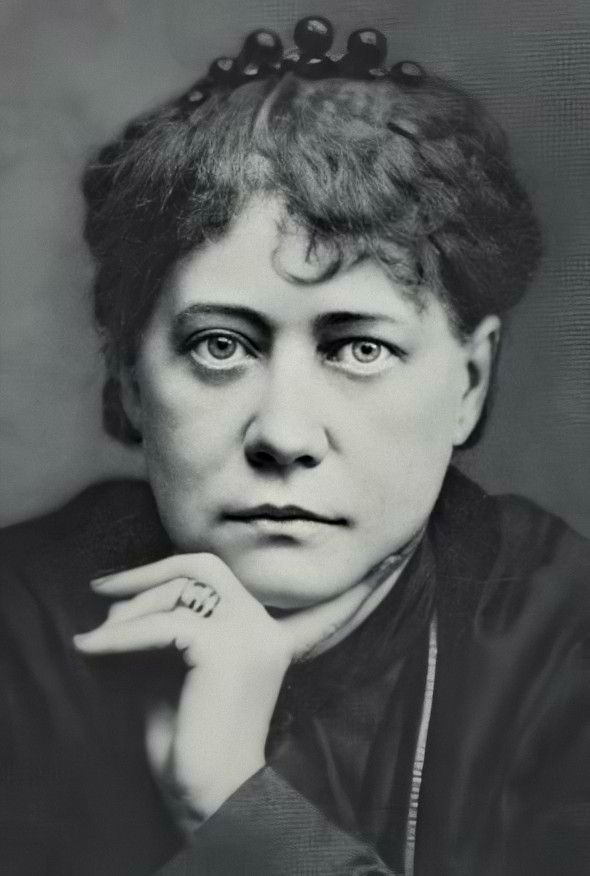
Mabel Collins (1851–1927) was a British author, occultist, and social reformer who emerged as a prominent literary figure in the early Theosophical movement. Throughout her career, she published more than forty-six books, including Victorian novels, romantic fiction, and influential works on mysticism and esoteric philosophy. She is best known for the spiritual classics The Idyll of the White Lotus (1884), Light on the Path (1885), The Illumined Way (1888), and Through the Gates of Gold, which became foundational texts in modern Western esotericism.
Mabel Collins
Collins was born in Guernsey, England, and married writer and stockbroker Keningale Robert Cook in 1871. In the 1880s, she became an active member of the Theosophical Society and collaborated closely with Helena Petrovna Blavatsky, serving as assistant editor of Lucifer magazine. While many Theosophists later asserted that her most notable works were dictated by spiritual “Masters” or adepts, Collins consistently refuted these claims, affirming her sole authorship despite acknowledging profound mystical experiences that influenced her writing. She reported that portions of Light on the Path were inspired during spiritual experiences in a “Hall of Learning,” where she perceived ancient teachings inscribed on its walls.
Collins departed from the Theosophical Society in 1889 after disagreements with Blavatsky and other leaders regarding doctrine and authority. Although she later criticized certain aspects of the Society, her writings remained widely read and influential, continuing to shape generations of students interested in Theosophy, Eastern philosophy, and Western mysticism.
Beyond her involvement in esotericism, Collins was a committed social reformer. As a lifelong vegetarian and vocal opponent of vivisection, she served as chairman of the Incorporated Parliamentary Association for the Abolition of Vivisection and actively promoted animal welfare throughout her life. She also supported women’s political activism, collaborating with suffragette Alice Chapin on the political play Outlawed, staged in London in 1911.
Collins sustained a successful literary career beyond her Theosophical involvement, contributing regularly to The Occult Review and continuing to publish novels, essays, and spiritual writings. Her life became associated with one of Victorian England’s enduring mysteries through her friendship with Robert Donston Stephenson, an occultist later identified by some researchers as a suspect in the Jack the Ripper murders. According to later accounts, both Collins and her close friend Vittoria Cremers developed suspicions regarding Stephenson’s possible involvement.
In her later years, Collins lived with her friend Catherine Metcalfe and continued to write until her death in 1927. Through her contributions to mystical literature, occult philosophy, social activism, and popular fiction, she became one of the most prominent female voices in the development of modern Theosophy and Western esoteric thought.