The Foundations of Suggestive Therapeutics: a full synthesis of Parkyn’s teaching.
Herbert A. Parkyn‘s 1898 Mail Course inSuggestive TherapeuticsandHypnotism was a forty-one-lesson course presenting the psychological and therapeutic system taught at his Chicago School of Psychology. The opening eight lessons establish the foundation upon which nearly everything that follows is constructed: Suggestion, the voluntary and involuntary operations of mind, attention, will, cerebral circulation, the suggestive condition, the formation and displacement of ideas, auto-suggestion, and the ability of mental impressions to produce physical effects throughout the body. Hypnotism is only one application of this much larger system. Parkyn’s real subject is the continuous relationship between thought and action and the degree to which that relationship can be consciously directed.
This distinction is important because Parkyn begins by greatly enlarging the meaning of the word “suggestion.” Suggestion is not restricted to a hypnotist issuing commands to a passive subject. It includes impressions entering consciousness through ordinary life and becoming part of the mental material from which future thought and action arise. Education itself is consequently treated as an accumulation of suggestions. Experiences, words, expectations, habits, sensations, beliefs, social influences, medical instructions, and repeated thoughts become stored impressions, and those impressions influence how later experiences are interpreted. Suggestion is therefore operating whether anyone deliberately recognizes it or not. The physician or psychologist does not create the law; he learns how a law already acting continually in human life may be deliberately employed.
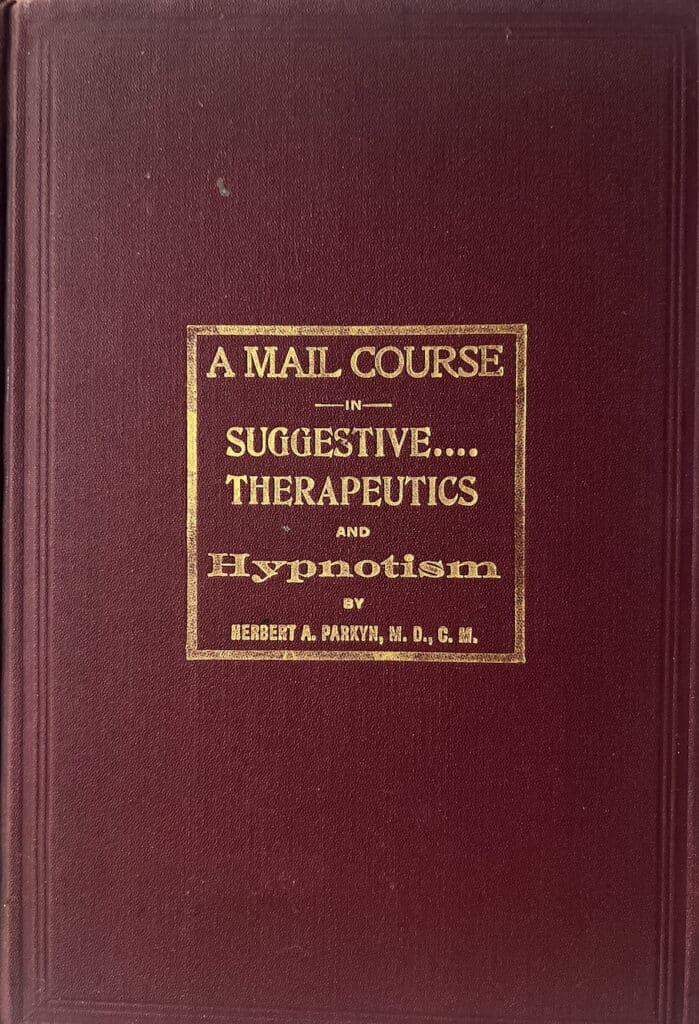
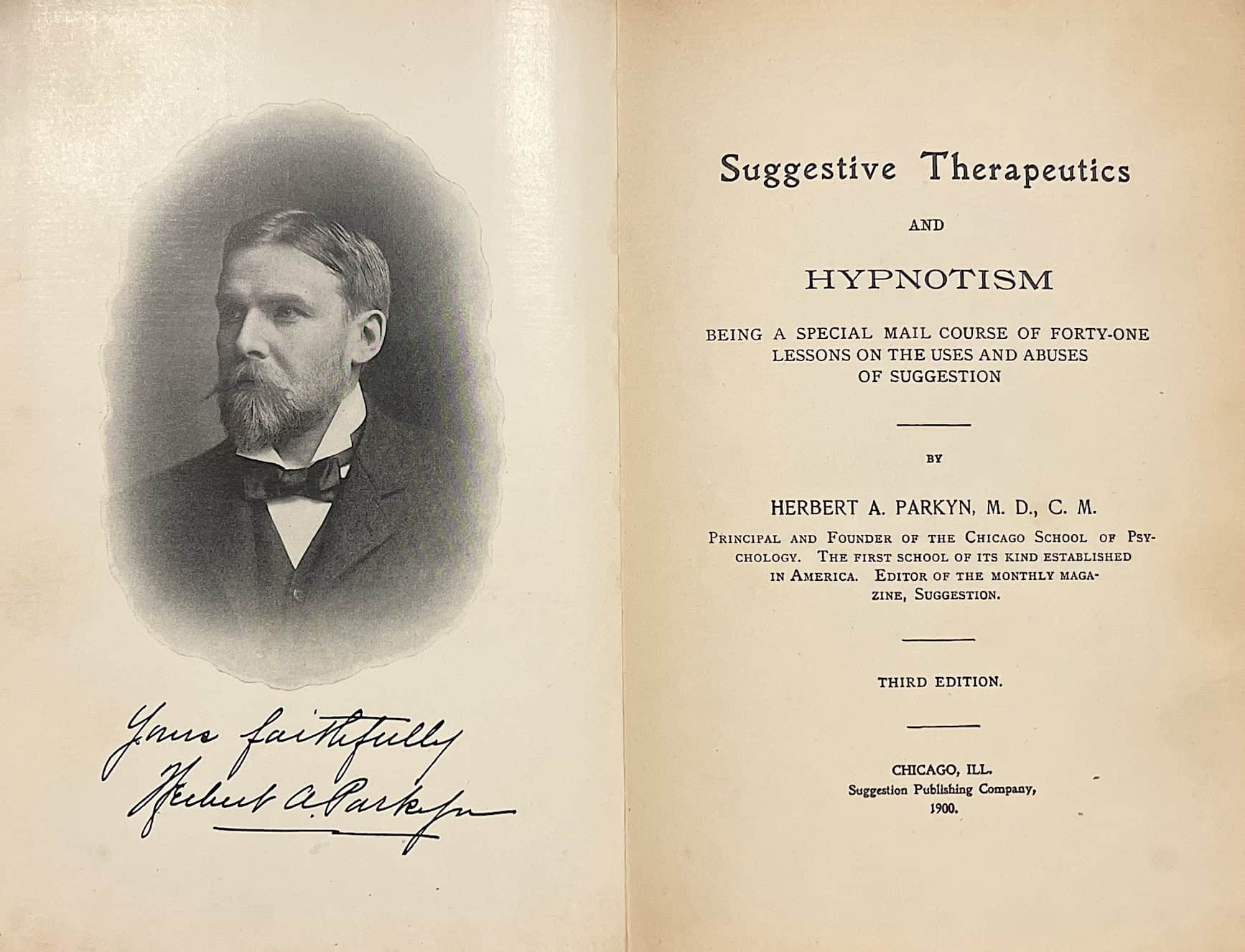
A Mail Course in Suggestive Therapeutics and Hypnotism by Herbert A. Parkyn, 1900 edition
Suggestion as a Universal Law
Parkyn’s first lesson attempts to remove suggestion from the narrow world of mesmerism and place it within ordinary psychology. The phenomena historically attributed to magnetic fluids, mysterious healing powers, religious miracles, hypnotic domination, and similar agencies can often, in his interpretation, be explained through suggestion and auto-suggestion. What changes from case to case is the setting in which the impression is received and the previous mental material with which it becomes associated. Two people can therefore receive the same external statement and respond differently because no two people possess precisely the same accumulation of previous experiences, ideas, expectations, and associations.
This principle of association becomes fundamental to the entire system. A new impression does not enter an empty mind. It encounters ideas already established there, and its effect depends upon what those existing ideas cause it to mean. A physician’s words may consequently become therapeutic or harmful according to the interpretation placed upon them by the patient. A physical sensation can awaken a chain of associated ideas that magnifies the sensation. A repeated fear may establish an expectation, and the expectation may contribute to the bodily condition that appears to confirm the fear. Conversely, a carefully chosen suggestion may establish a different line of thought and thereby alter the mental and physical response. Parkyn therefore places enormous importance upon controlling the ideas admitted to consciousness. The practical purpose of suggestive treatment is not merely to make someone temporarily obey a command. It is to establish a new mental direction strong enough to replace an undesirable one. The physician must understand what the patient already believes, what associations have become attached to the disorder, what expectations are continually reproducing it, and what form of suggestion can enter the patient’s mind without provoking resistance. The work is psychological before it is hypnotic.
The Voluntary and Involuntary Mind
The psychological machinery behind this process is Parkyn’s distinction between voluntary and involuntary mental activity. The voluntary mind is associated with conscious attention, comparison, judgment, reasoning, choice, and deliberate control. The involuntary mind contains the enormous field of automatic mental and bodily activity that proceeds without continuous conscious direction. Impressions may be received and retained without the individual being fully aware of them, and ideas once established may continue producing effects after conscious attention has moved elsewhere. The distinction is not presented as two literally separate minds inhabiting the same person. It is a functional division explaining two different modes of mental operation. The voluntary side can reason about an impression and decide whether to accept or reject it; the involuntary side responds much more automatically to ideas already admitted. The more highly developed the individual’s reason and voluntary attention become, the greater the capacity to regulate what is allowed to pass into automatic action.
This is one reason Parkyn’s psychology places such extraordinary emphasis upon self-control. The objective is not to make the individual more passive or more easily hypnotized. It is ultimately to strengthen the directing faculties sufficiently that undesirable automatic tendencies can be brought under intelligent control. The involuntary processes possess tremendous power, but without voluntary direction that power can work against the individual just as readily as for him. Fear, expectation, habit, imagination, and repeated adverse thoughts can become involuntary forces; deliberate thought and suggestion can establish different ones.
Parkyn consequently reverses one of the popular assumptions about hypnotism. Extreme suggestibility is not evidence of superior mental development. The person who instantly accepts almost any suggestion may actually possess poorly developed voluntary attention and weak powers of independent reasoning. Such a person can become an “automaton,” easily directed by whatever idea happens to dominate consciousness. The stronger individual is not necessarily the person who enters the deepest hypnotic condition, but the person capable of concentrating attention, reasoning clearly, and consciously directing the involuntary mechanisms rather than being directed by every passing impression.
Thought Takes Form in Action
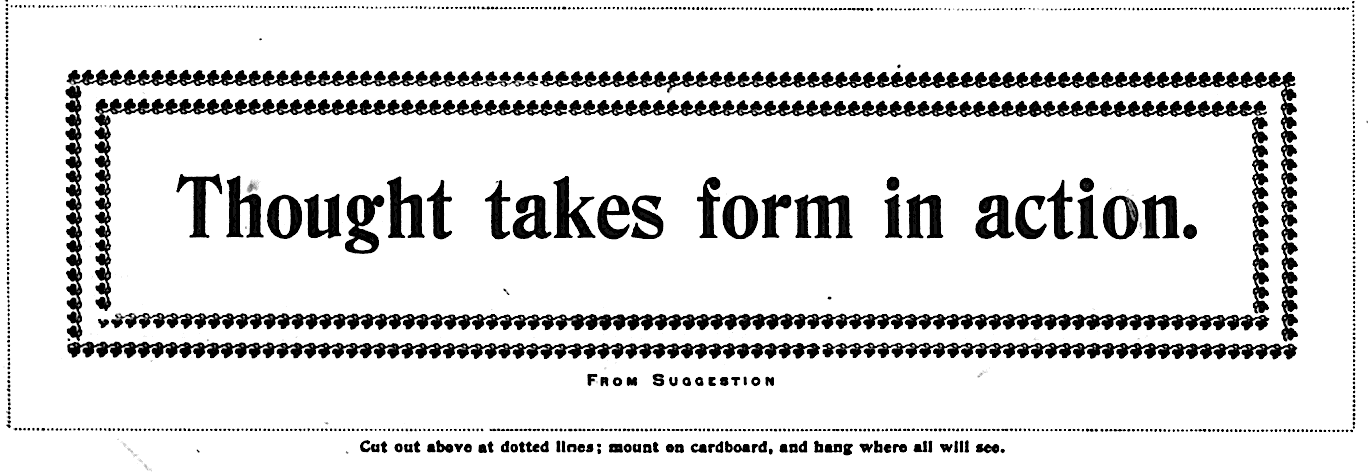
One of the most important principles established in these early lessons is Parkyn’s insistence that thought tends toward expression. Ideas are not inert objects existing separately from bodily activity. A thought reaching sufficient intensity produces action, whether the action is visible muscular movement, an alteration in expression, a physiological response, or some subtler change in bodily function. Parkyn summarizes the principle through the idea that all thoughts take form in action.
This is the bridge connecting psychology with therapeutics. If thought remained entirely inside an abstract mental realm, suggestion could have little medical importance. But if an idea can modify muscular action, circulation, secretion, appetite, sleep, pain, digestion, and other bodily processes, then changing the dominant thought may change the bodily response connected with it. Parkyn’s therapeutic system rests upon this conversion of mental impression into physical action.
Attention becomes the mechanism that increases the force of the process. Whatever occupies attention receives increased mental prominence. A slight sensation that would ordinarily pass unnoticed can become increasingly important when attention remains fixed upon it; an expectation repeatedly contemplated may grow until it begins organizing perception and behavior around itself. In the opposite direction, attention deliberately transferred to another idea can weaken the previous mental current. Suggestive treatment therefore works partly by changing what occupies the center of consciousness. This is why Parkyn calls attention a motor force. Attention is not merely passive observation. To attend strongly to an idea is already to begin directing mental and bodily activity toward it. The repeated concentration of consciousness upon weakness, pain, fear, failure, insomnia, illness, or inability can therefore reinforce the very condition the individual wishes to escape, while the systematic substitution of ideas associated with health, control, confidence, sleep, movement, or normal function can begin creating a different direction of action.
“Thought takes form in action” quote by Herbert A. Parkyn in Suggestion
Attention and the Development of Will
Lesson Four makes attention one of the central faculties of Parkyn’s entire psychology. He distinguishes natural or involuntary attention from voluntary attention. Natural attention is captured automatically by something sufficiently interesting, novel, pleasurable, threatening, or intense. Animals possess it, children display it constantly, and adults continue to experience it whenever something in the environment seizes consciousness without deliberate effort. Voluntary attention is different. It is the ability to hold consciousness upon a chosen object because one has decided to do so.
For Parkyn, developing voluntary attention is essentially developing the will. The person capable of directing attention can select the thought that is to occupy consciousness and maintain it despite competing impressions. This ability lies behind sustained study, responsible work, self-discipline, reasoning, and personal direction. Parkyn contrasts such people with those who never cultivate voluntary attention and therefore prefer continually to be directed rather than to direct. Mental laziness becomes, in this framework, not simply unwillingness to think but failure to develop the power by which consciousness can be deliberately concentrated.
The practical implications extend far beyond medical treatment. Education becomes a training of attention; character becomes partly the product of repeatedly attended ideas; will becomes the accumulated capacity to maintain a chosen direction despite competing impulses. The person who can deliberately select an idea, hold attention upon it, and allow it to pass into action possesses an increasingly powerful means of self-direction. The person whose attention is continually captured from outside remains correspondingly vulnerable to circumstances, habits, fears, other people’s assertions, and momentary impulses. Parkyn also insists that mental power cannot be separated from physical condition. A poorly nourished or exhausted person loses the ability to concentrate as effectively and consequently cannot reason or exercise voluntary control as efficiently as someone in good health. This becomes an important feature of the larger system: mental development requires attention to the physical organism supporting it. Suggestion does not eliminate physiology. Proper nourishment, circulation, rest, fluids, exercise, and other physical conditions help create the bodily foundation upon which effective thought and self-control depend.
Cerebral Circulation and Mental Activity
Lesson Three develops Parkyn’s physiological explanation for the relationship between attention, thought, and bodily condition. Mental activity requires cerebral activity, and cerebral activity is accompanied by changes in the circulation of blood through the brain. Increased activity in a particular direction brings increased circulation; conversely, changes in circulation influence the activity of the brain. Parkyn repeatedly treats this reciprocal relationship as one of the physiological foundations of psychological phenomena.
Sleep provides his clearest illustration. As waking activity decreases, the blood supply and activity of the brain diminish. During the transitional state between waking and sleep, voluntary mental activity becomes progressively less active until ordinary conscious control is largely suspended. Awakening reverses the process as sensory activity and cerebral circulation increase. Worry, prolonged study, emotional excitement, or continued fixation of attention can interfere with this natural reduction of activity and contribute to insomnia because the brain remains functionally active when it should be entering rest. The principle also explains why Parkyn repeatedly links attention with circulation. Concentrated attention upon a part of the body can alter the physiological activity associated with it because attention itself changes nervous and circulatory conditions. The old language of mysterious magnetic influence is unnecessary when the relationship can be approached through nervous activity, expectation, cerebral circulation, and suggestion. The mind and body are not independent machines accidentally influencing one another; they are parts of a single working organism in which mental activity continually produces physical consequences and physical conditions continually modify mental activity.
This is also why Parkyn refuses both extreme materialism and extreme mental healing. In the preface he explicitly rejects the position that every physical disorder requires a drug while equally rejecting the claim that mind alone should be used in every case. Food, water, medicine, surgery, hygiene, and physical treatment remain legitimate because the body cannot simply be ignored. Suggestion becomes powerful precisely because mental and physical processes interact, not because the physical organism is unreal.
The Suggestive Condition
By Lesson Five, Parkyn is prepared to redefine hypnosis itself. What matters therapeutically is not the mysterious production of sleep but the creation of a condition in which attention is sufficiently concentrated that a selected suggestion receives unusual force. He therefore prefers to think in terms of a suggestive condition rather than the popular conception of hypnotism. The essential mechanism is concentration of attention. Every waking person is continually receiving impressions through the senses, but consciousness cannot attend equally to all of them. When attention is strongly concentrated upon one line of thought, competing impressions become less prominent. The physician can use this principle by arranging the surroundings, position, manner of speaking, timing, and wording of the treatment so that the patient’s attention becomes directed toward the desired idea. Repetition then strengthens the impression.
The result does not require deep unconsciousness. Parkyn increasingly regards the dramatic hypnotic sleep associated with stage demonstrations as unnecessary for therapeutic purposes. A patient may remain awake, understand what is being said, and still enter a highly favorable condition for suggestion because attention has been concentrated and competing ideas temporarily reduced. The therapeutic problem is therefore not “How deeply can this person be hypnotized?” but “How effectively can the desired idea be brought into concentrated consciousness?” This also changes the relationship between physician and patient. Parkyn does not want the physician to overpower the patient’s reason. An intelligent patient who understands the process can cooperate with it. Indeed, Parkyn’s clinical conclusions lead him toward the position that intelligent, reasoning patients often obtain better permanent results than extremely suggestible somnambulists. The purpose of treatment is not to create dependence upon the operator but to establish ideas that the patient’s own mental processes can continue carrying into action.
Never Arouse Mental Resistance
One of the most practically important rules arising from this psychology is that a therapeutic suggestion should not unnecessarily contradict something the patient firmly believes. A suggestion that immediately provokes the response “That is not true” creates resistance instead of cooperation. Parkyn therefore argues that it is never necessary to give a patient a suggestion that arouses antagonism. The physician should instead begin with ideas the patient can accept and lead consciousness gradually toward the desired conclusion. This makes tact, logic, observation, and knowledge of the individual as important as the words of the suggestion itself. A skeptical patient does not need to be deceived or forced into belief. The law of suggestion can be explained rationally, and treatment can be arranged so that each accepted idea prepares the mind for the next.
This principle produces a much subtler form of suggestion than the stereotypical hypnotic command. An idea can be introduced indirectly through explanation, association, expectation, routine, physical action, or another thought with which the desired suggestion becomes connected. The patient may therefore begin repeatedly reproducing a therapeutic idea without sitting down and consciously reciting an affirmation. Ordinary behavior itself can be arranged to reactivate the suggestion. That mechanism becomes particularly important in Parkyn’s later use of what he calls involuntary auto-suggestion.
How to Suggest
Lesson Six moves from theory into the mechanics of constructing suggestions. Parkyn’s starting point is that impressions become stored and associated within the brain. A suggestion is effective when it stimulates the appropriate line of stored ideas strongly enough to produce the desired mental and physical response. The operator must therefore understand the existing condition of the patient’s mind rather than simply repeat standardized commands. Repetition is crucial because each recurrence strengthens the mental path. A suggestion heard once may be displaced by competing thoughts, but the same idea repeatedly presented under favorable conditions acquires increasing prominence. This is why therapeutic formulas are often simple, definite, and repeated. Complexity invites analysis and distraction; a clear idea allows attention to remain concentrated upon the intended result.
The tone and manner of the suggestion also matter because words do not arrive alone. The confidence, expectation, authority, and surrounding circumstances accompanying them become part of the impression. A hesitant statement can carry a different psychological effect from the same words delivered with calm certainty. Suggestion therefore includes much more than literal language. The entire setting may become suggestive. At the same time, Parkyn insists that therapeutic suggestion does not require falsehood. The physician does not need to tell a patient something known to be untrue merely because a dramatic command might appear more hypnotic. Suggestions can be framed around genuine possibilities and progressive improvement. The objective is to organize attention and expectation around normal function rather than create an artificial fantasy.
Auto-Suggestion and the Formation of the Self
Lesson Seven brings the system inward. Parkyn defines auto-suggestion as a suggestion arising within one’s own mind from a thought or bodily sensation, whether the originating sensation is real or imaginary. This immediately expands the significance of suggestion because the individual is not merely receiving impressions from other people. He is continuously suggesting to himself. Parkyn makes the remarkable statement that one’s whole education is a great aggregation of auto-suggestions. Because human beings act in accordance with what has become established in their minds, the character of those accumulated suggestions becomes one of the determining forces of life. A person’s habitual expectations, interpretations, fears, convictions, and self-conceptions continually reproduce themselves. The self that appears fixed may therefore contain enormous amounts of acquired mental material that have become automatic through repetition.
This creates both the problem and the possibility at the center of Parkyn’s system. Harmful auto-suggestions can perpetuate disorders, but beneficial auto-suggestions can be deliberately established. The patient must learn not merely to receive treatment from the physician but eventually to cooperate in directing his own mental processes. Suggestive therapeutics consequently moves naturally toward self-treatment. Parkyn divides auto-suggestion into voluntary and involuntary forms. Voluntary auto-suggestion occurs when the individual deliberately introduces and repeats an idea to himself. What later systems would commonly call an affirmation falls within this category. Parkyn explicitly identifies the affirmations used by Christian Scientists as voluntary auto-suggestions, stripping them of their special theological explanation and placing them within his general psychological law.
The significance of repetition again becomes clear. The voluntary mind deliberately selects an idea and repeatedly presents it until the involuntary processes begin responding to it. The conscious act eventually becomes automatic. A person therefore uses the reasoning and directing portion of mind to educate the involuntary portion. Self-mastery is not accomplished by a single heroic exertion of will but by repeatedly establishing the desired idea until it becomes part of the automatic mental organization.
Involuntary Auto-Suggestion
Involuntary auto-suggestion is even more pervasive. It occurs when an external event, physical sensation, object, routine, or associated idea automatically starts a chain of thought within the individual. Parkyn gives the simple example of telling a man that it is one o’clock when it is actually eleven. If one o’clock is normally associated with lunch, the suggestion of the time may produce a sensation of hunger. The body responds not because food has appeared but because an established association has activated an expected physiological response.
Parkyn sees the same mechanism operating throughout healing. A dose of medicine does more than deliver a chemical substance. Each time the patient takes it, the act can recall the physician’s statements about what the medicine will accomplish. The medicine consequently becomes a physical cue that repeatedly reactivates the therapeutic suggestion. The patient may believe the effect belongs entirely to the drug while part of the response may arise from the associated expectation. This gives Parkyn a way to explain the successes attributed to divine healers, shrines, magnetists, Christian Scientists, quacks, and even ordinary physicians. He does not conclude that every cure attributed to these agencies is imaginary. Instead, he argues that real effects may occur while the explanation given for them is wrong. The ritual, healer, medicine, religious expectation, or magnetic procedure may establish an involuntary auto-suggestion powerful enough to affect bodily function. A physician who does not understand suggestion may therefore successfully employ it without realizing that he has done so.
Two Quarts of Water and Turning Habits into Suggestions
One of the clearest practical examples in the entire opening section concerns water. Parkyn states that most patients drink too little fluid and says he generally “lays down the law” that they consume what he considers necessary for a healthy individual—not less than two quarts per day. But the instruction is psychologically designed as well as hygienic. He tells patients to sip their fluids very frequently during the day and gives them a reason for doing so. Every time they take a sip, the action recalls the explanation and the expected result. The physical health rule has therefore been converted into a repeated mechanism of involuntary auto-suggestion.
For the intelligent cooperative patient, Parkyn goes one step further: each drink becomes an opportunity for a self-treatment. Instead of reserving mental treatment for a special hypnotic session, ordinary daily behavior becomes the trigger for repeated therapeutic thought. The patient may encounter the suggestion dozens of times during the day simply because the act of drinking has been deliberately associated with it.
This is an important feature of Parkyn’s method. He is not merely teaching people to repeat positive sentences. He is attempting to build desirable ideas into the structure of daily life. Physical routines become psychological cues; psychological cues awaken suggestions; repeated suggestions strengthen associations; strengthened associations increasingly produce automatic action. In this way a consciously selected thought can gradually become an involuntary habit. The larger principle extends far beyond water. Any repeated action can theoretically become attached to an idea and thereby serve as a reminder for self-direction. Parkyn’s psychology is therefore a psychology of conditioning long before that language became standard. The environment, bodily routines, words, objects, sensations, and repeated behaviors can all be arranged so that they automatically call forth selected states of mind.
Suggestion, Habit, and Character
The opening lessons consequently begin dissolving the boundary between therapy and character development. If repeated suggestions become automatic, then habit itself can be understood as thought repeatedly passing into action until the process no longer requires the same conscious effort. The individual initially directs the thought; repetition establishes the pathway; eventually the behavior tends to reproduce itself.
This is where the development of attention and will becomes essential. The person must first become capable of selecting the thought that is to be strengthened. Voluntary attention holds it in consciousness; repetition reinforces it; action gives it physical expression; repeated action establishes habit; and habit becomes increasingly automatic. What begins as deliberate self-direction can therefore become part of the individual’s ordinary mode of functioning.
The opposite process explains how undesirable traits can become entrenched. Repeated fear strengthens fearful expectation; repeated thoughts of incapacity reinforce hesitation; continual attention to symptoms magnifies them; repeated surrender to an impulse makes the impulse increasingly automatic. The person may eventually experience the resulting pattern as part of his natural self even though it has been constructed through accumulated suggestions and repetitions. Parkyn’s system therefore implies a distinction between the individual capable of directing consciousness and the acquired mental material that consciousness has accumulated. The accumulated habits, fears, associations, bodily expectations, and automatic reactions are powerful, but they need not constitute an unchangeable identity. Voluntary attention provides the point from which they can be examined and gradually redirected.
The Will as Directed Attention
Will, in this system, is not primarily brute mental force. Parkyn repeatedly brings it back to the ability to direct and maintain attention. A person develops will by learning to keep consciousness upon the chosen line rather than allowing every external impression or internal impulse to redirect it. This makes concentration a practical instrument of character.
The distinction also explains why simply wishing for a result is insufficient. Desire may fluctuate, but directed attention repeatedly applied toward action establishes a stronger mental tendency. The individual must not merely want to change; he must learn to hold the idea of the desired action sufficiently steadily that it begins expressing itself through conduct. Thought is valuable because thought tends toward action. The resulting ideal is an individual who can say, in effect, that he is capable of directing himself and then demonstrate that conviction through action. Confidence, will, and self-control are therefore not isolated virtues added to Parkyn’s psychology. They arise naturally from his theory of attention. The person who can choose the dominant thought and maintain it possesses increasing control over what eventually becomes automatic.
Mind Acting Upon the Body
Lesson Eight draws the preceding ideas together by examining the physical effects of mental states. If thoughts take form in action, and if the involuntary mind participates in the regulation of bodily functions, then suggestion and auto-suggestion can influence physical processes without the patient consciously commanding each individual organ. Everyday experience already demonstrates the principle. An embarrassing thought may produce blushing; fear may alter the heartbeat, respiration, muscular tension, digestion, or secretion; the thought of appetizing food may stimulate saliva; anxiety may disturb sleep; expectation may alter the perception of pain. No person consciously orders each of these physiological responses. The idea initiates a chain of involuntary bodily activity.
Therapeutic suggestion attempts to employ the same law deliberately. Rather than continually allowing fear, expectation, and adverse associations to produce undesirable physical reactions, the physician introduces thoughts associated with normal function and allows the involuntary mechanisms to respond. The patient does not need consciously to understand how every physiological process occurs. Just as fear can accelerate the heart without knowledge of cardiac physiology, a therapeutic mental state can influence bodily function without conscious control of the intervening mechanism. This also places auto-suggestion at the center of health. A patient’s own thoughts may continually reinforce or oppose treatment. The physician who ignores this fact may prescribe correctly while simultaneously allowing fear, pessimism, expectation of failure, or misunderstanding to undo part of the work. Parkyn’s ideal treatment therefore combines physical knowledge with psychological management.
From External Suggestion to Self-Direction
The progression of the first eight lessons is deliberate. Parkyn begins with suggestion coming from the outside, but gradually moves the center of power toward the individual. First the student learns that impressions influence thought and action. Then he learns that voluntary and involuntary processes respond differently to those impressions. Attention determines which ideas receive force. Voluntary attention develops into will. Concentrated attention creates the suggestive condition. Repetition strengthens selected ideas. Auto-suggestion allows the individual to apply the same law internally. Finally, the mind-body relationship explains how these mental processes can become physical effects.
The system therefore does not culminate in submission to a hypnotist. It moves toward intelligent cooperation and eventually self-treatment. The physician may initially supply the suggestion, but the patient learns to reproduce it. The treatment becomes more permanent when the desired idea no longer depends upon the presence of the operator but has been incorporated into the patient’s own habitual thinking. This is why Parkyn places greater value on the intelligent cooperative patient than on the spectacular somnambulist. The deepest hypnotic subject may obey dramatically while the operator is present yet lack the voluntary development necessary for lasting self-direction. The reasoning patient can understand the principle, participate consciously, practice auto-suggestion, regulate attention, and convert the therapeutic instruction into a new habit.
The System Established in the Opening Lessons
By the end of Lesson Eight, nearly the entire psychological foundation of Parkyn’s later teaching is already in place. Human beings live within a continuous field of suggestion. Every experience leaves impressions; impressions become associated; repeated ideas gain strength; attention concentrates mental force; voluntary attention develops the will; thought tends toward action; action repeated becomes automatic; auto-suggestion allows thought to act from within; and mental states can influence bodily functions through the involuntary nervous mechanisms.
Health and self-development consequently require more than eliminating disease. They require learning how to direct the mental processes continually operating whether the individual understands them or not. The person who does not direct them remains exposed to accidental suggestion, adverse expectation, habit, fear, social influence, bodily sensations, and the accumulated ideas of the past. The person who learns the law can begin choosing which ideas are repeatedly placed before the involuntary mind. At the same time, Parkyn never separates this mental discipline from physical life. The brain requires nourishment; exhaustion weakens attention; circulation affects mental activity; sleep depends upon physiological conditions; adequate fluids are necessary; bodily habits can become vehicles for therapeutic suggestion. The system is therefore neither purely mental nor purely physical. It is an attempt to coordinate the two.
The practical pattern established here is remarkably consistent: select the desired idea, secure attention, prevent unnecessary resistance, repeat the suggestion, connect it whenever possible with ordinary actions, allow repetition to establish an automatic response, and strengthen the individual’s ability eventually to direct the process himself. The physician’s suggestion becomes the patient’s auto-suggestion; the auto-suggestion becomes action; repeated action becomes habit; and habit becomes part of character. This is the real foundation of Suggestive Therapeutics and Hypnotism. Beneath the medical terminology and discussions of hypnosis is a much larger system of self-direction built around suggestion, attention, will, repetition, expectation, habit, and the conversion of thought into action. The remaining lessons apply this machinery to disease, sleep, pain, nervous disorders, destructive habits, education, personality, personal influence, magnetic healing, hypnotism, and eventually the problem of how a person can consciously participate in the formation of his own mental and physical life.
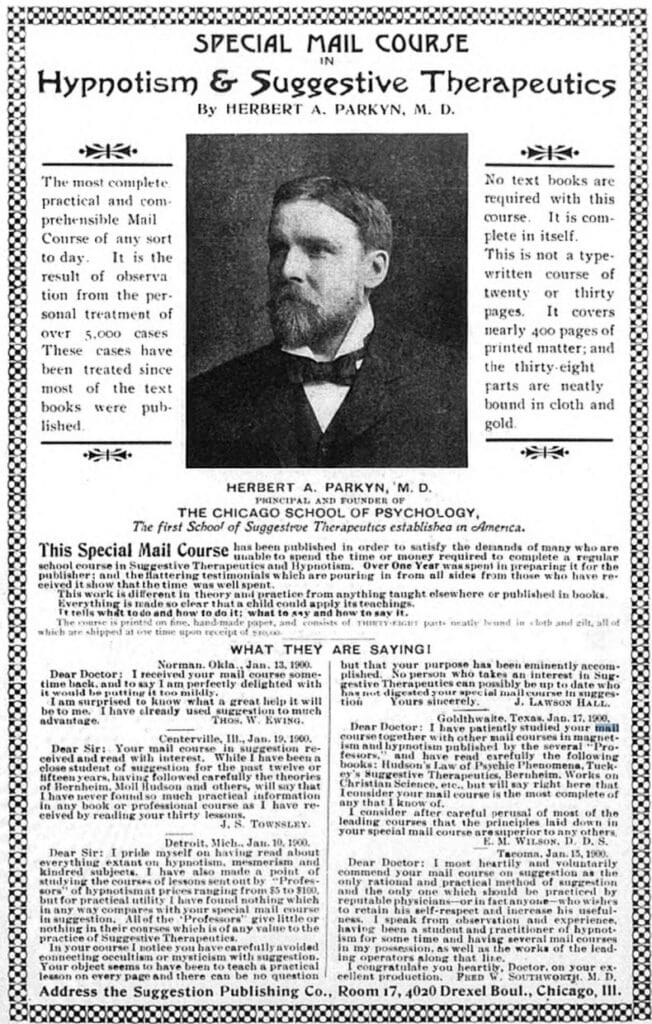
Ad for Dr. Parkyn’s book Special Mail Course in Hypnotism and Suggestive Therapeutics
Suggestion as a System of Health and Healing
With Lesson Nine, Suggestive Therapeutics and Hypnotism moves from the psychological principles established in the opening lessons into their systematic application to health and disease. Lessons IX through XVIII cover an enormous range of conditions from digestive disorders, constipation, diarrhea, insomnia, headaches, migraine, rheumatism, hypochondria, nervous symptoms, functional disturbances, and conditions commonly regarded as difficult or incurable, but the underlying method changes surprisingly little from one disorder to another. Parkyn’s purpose is not to provide a separate psychological theory for every disease. He is attempting to demonstrate that many apparently unrelated complaints arise from the same interaction between nutrition, circulation, nervous activity, expectation, habit, attention, and suggestion.
The central distinction is between structural disease and functional disorder. Parkyn does not claim that suggestion can rebuild destroyed tissue or make physical pathology disappear simply because a patient thinks differently. His strongest claims concern functions: digestion, appetite, elimination, circulation, sleep, muscular action, pain, secretion, menstruation, and other processes governed largely through involuntary mechanisms. Because mental states can alter these functions, and because prolonged functional disturbance can eventually contribute to more serious physical deterioration, he believes suggestion can intervene at an unusually important point in the development of disease. The physician’s task is therefore to restore normal function while simultaneously removing the thoughts, fears, habits, expectations, and physical conditions that continually interfere with it.
This makes the middle portion of the course much more than a collection of medical case studies. It is here that Parkyn begins turning his psychology into a philosophy of everyday health. The patient must eat properly, drink sufficient water, breathe properly, sleep normally, exercise, maintain adequate nutrition and circulation, stop continually watching symptoms, cease expecting disease, and learn to direct attention toward the condition that is wanted rather than the one that is feared. The same law governs all of it: thought tends toward action, and the involuntary processes respond to the dominant ideas repeatedly impressed upon them.
Functional Disorders and the Involuntary Mind
Lesson Nine begins by dividing bodily functions into broad physiological groups and concentrating especially upon the functions of nutrition. Digestion, absorption, assimilation, circulation, secretion, and elimination are not normally directed by conscious will. A person does not consciously order the stomach to digest, the glands to secrete, or the intestines to move. These activities proceed through involuntary nervous mechanisms, yet everyone has experienced how rapidly they can be altered by mental conditions.
Grief may destroy appetite. Anxiety may interfere with digestion. Fright may suddenly stimulate the bowels. Embarrassment may change circulation in the skin. Anticipation of food may produce saliva before food reaches the mouth. Nervousness may interfere with bodily functions that ordinarily occur without difficulty. For Parkyn, these familiar experiences provide some of the strongest evidence for suggestive therapeutics. If adverse thoughts can disturb involuntary functions, there is no logical reason why appropriately directed thoughts cannot help restore them.
The physician must consequently look beyond the organ in which the symptom appears. A digestive complaint may involve improper food, insufficient fluid, weak circulation, nervous exhaustion, worry, fear, or a fixed expectation that certain foods cannot be tolerated. A bowel disorder may have become partly habitual. Menstrual pain may be intensified by expectation established through previous experience or inherited beliefs about what menstruation is supposed to involve. The physical symptom is real, but the chain of causes producing or maintaining it may contain both physical and mental elements.
Parkyn repeatedly returns to nutrition because he regards adequate nourishment as indispensable to healthy mental and nervous function. The brain cannot exercise strong voluntary attention when the organism supporting it is badly nourished. Weakness of digestion can therefore contribute to weakness of nervous control, while nervous disturbance can further impair digestion, producing a cycle in which physical and mental causes continually reinforce one another. Treatment must interrupt the cycle rather than choose arbitrarily between “mind” and “body.”
The Positive Form of Suggestion: “I Can and I Will”
One of the most important practical rules in Parkyn’s entire system appears at the point where he explains what should actually be suggested to a patient. The operator should concentrate attention upon the condition to be produced. In insomnia, suggest sleep. In malnutrition, suggest hunger and appetite. In disturbed function, repeatedly present the idea of normal function. The correct suggestion is the one that changes the existing condition toward the condition desired. From this principle Parkyn derives an extremely important rule: avoid negative suggestion. He warns against continually telling a person what he “cannot” do or what he “will not” do. Pointing repeatedly toward the undesirable condition keeps precisely that condition before the mind. Instead, the suggestion should state positively what the person is able and intends to do. Parkyn gives the principle in its simplest form: “I can and I will do this or that.”
The importance of this formula is much greater than the words themselves. It condenses Parkyn’s psychology into a usable mental command. “I can” establishes capacity. “I will” adds voluntary direction. The first attacks the mental picture of inability; the second places the will behind the desired action. Together they turn attention away from limitation and toward accomplishment. The formula therefore joins the two faculties Parkyn has spent the opening lessons developing: an idea impressed upon the involuntary mind and a voluntary mind capable of selecting the idea to be impressed.
This is also why merely saying “I won’t fail,” “I can’t be afraid,” “I won’t be sick,” or similar negative statements is defective within Parkyn’s system. The unwanted idea of failure, fear, sickness, or inability remains the mental picture receiving attention. His method is substitution rather than mental combat. Do not continually fight the negative idea on its own ground. Establish its constructive opposite and repeatedly direct consciousness toward that.
“I Can and I Will” is therefore not an isolated motivational slogan added to Parkyn’s work from outside. It emerges directly from his clinical rule for constructing therapeutic suggestions. The phrase reduces an entire method to four words: remove the mental representation of incapacity, substitute ability, add determination, repeat the new idea, and allow thought to take form in action.
Expectant Attention
Parkyn’s treatment method also depends heavily upon what he calls expectant attention. The patient should have a reason to expect the desired result. Suggestion becomes more powerful when attention is not only directed toward a condition but begins watching for that condition to occur. Expectation becomes a continuing form of suggestion. The physician therefore does more than pronounce commands. He explains enough physiology and psychology to make improvement appear reasonable. A skeptical patient may actually benefit from understanding why the treatment should work because the explanation creates a logical basis for expectation. Parkyn repeatedly insists that intelligent patients need not surrender their judgment. Their reasoning faculties can be enlisted in treatment.
Once expectation has been established, ordinary events can continually reinforce it. Medicine may become a reminder of what the physician said it would accomplish. Drinking water can recall a suggestion about digestion or elimination. Going to bed can become associated with the expectation of sleep. Eating can become associated with appetite and normal digestion. Each repetition renews the idea until the desired response becomes increasingly automatic. The patient is consequently being educated into health. Treatment is successful when the physician no longer has to recreate the desired mental state from the beginning at every visit. The patient’s own expectations, habits, and auto-suggestions begin continuing the work.
Nutrition as the Physical Foundation
Throughout these lessons Parkyn refuses to separate mental treatment from nutrition. Blood is repeatedly treated as the body’s great nutritive and restorative medium. Organs function properly when they receive adequate nourishment and circulation; nervous and mental efficiency similarly depend upon the condition of the brain and nervous system. Suggestion can influence function, but the organism must still receive the materials required to function.
This is why Parkyn objects to systems of mental healing that attempt to ignore food, water, or physical law. Hunger cannot be permanently abolished by declaring that matter is unreal. The body requires nourishment. Likewise, a patient suffering from chronic digestive weakness cannot necessarily be restored simply by taking a drug while continuing the habits that produced the weakness. The rational system combines physical requirements with psychological direction.
Food consequently occupies an important place in treatment. Parkyn is suspicious of highly restrictive diets imposed upon chronic sufferers without sufficient reason. Such diets can become suggestions of weakness. The patient begins believing that ordinary food is dangerous, that the digestive system is unusually delicate, and that a slight departure from a rigid regimen will produce suffering. Instead of restoring confidence in normal function, treatment may accidentally educate the patient into chronic invalidism.
Parkyn’s objective is generally movement back toward normal living. Where possible, the patient should gradually become capable of eating an ordinary nourishing diet without fear. The psychological result matters almost as much as the nutritional one. Eating normally becomes evidence of health, and each successful meal becomes another suggestion that the digestive organs can perform their natural functions.
Water, Elimination, and the Daily Health Routine
Water remains one of Parkyn’s most consistent practical prescriptions. As established earlier in the course, he considers inadequate fluid intake extremely common and generally requires patients to consume not less than two quarts of fluid daily. The instruction is tied directly to nutrition and elimination. The body must receive sufficient fluid to support its ordinary physiological processes, and the organs responsible for removing waste must be encouraged to function normally. Yet Parkyn turns even this physical prescription into psychological treatment. The patient is encouraged to drink frequently rather than regard the day’s water as an isolated medical dose. Each drink can become associated with the idea of improved function. A simple act repeated throughout the day therefore becomes both hygienic and suggestive.
This reveals one of the characteristic patterns of the system: health is constructed through repeated ordinary acts. Drinking, eating, breathing, sleeping, exercising, and thinking are not separate subjects. Each can become part of a coordinated routine in which the body receives what it needs while the mind repeatedly receives suggestions of normality, strength, and control. The resulting health program is deliberately simple. Parkyn repeatedly moves away from elaborate cures and toward restoration of ordinary physiological life. Adequate nourishment, sufficient fluid, proper elimination, circulation, rest, and mental confidence become the foundations upon which more specific treatments are built.
Constipation and the Re-Education of Function
Constipation provides one of Parkyn’s clearest examples of a functional disorder becoming habitual. The bowel is not merely a mechanical tube requiring continual external stimulation. Its activity is connected with nervous regulation, food, fluid, exercise, routine, and expectation. Chronic reliance upon cathartics can therefore become part of the problem by teaching the patient that normal elimination cannot occur without artificial assistance. Parkyn’s alternative is essentially re-education. Physical conditions must first be improved through appropriate food, fluids, and general health measures. At the same time, suggestion is used to establish the expectation of regular normal action. A regular time and routine help convert conscious effort into automatic habit.
This fits perfectly with the theory of the involuntary mind established earlier. The desired function is repeatedly associated with particular conditions until the association becomes sufficiently strong that conscious effort is no longer required. The person initially constructs the habit voluntarily; the involuntary mechanisms eventually carry it forward. Diarrhea is treated through the same general law in the opposite direction. Instead of stimulating sluggish function, the objective is to quiet excessive activity and remove the mental and physical conditions contributing to it. Suggestive therapeutics therefore does not consist of one universal command. The law remains the same, while the direction of the suggestion changes according to the condition desired.
Dyspepsia and the Psychology of the Invalid
Dyspepsia becomes particularly important because Parkyn sees chronic digestive sufferers as vulnerable to a whole system of adverse suggestion. A person experiences indigestion, becomes anxious about food, begins eliminating foods from the diet, receives increasingly restrictive instructions, watches every sensation after eating, and gradually develops the conviction that the digestive organs are fundamentally weak.
The more attention the patient gives the stomach, the more every sensation becomes significant. Ordinary variations are interpreted as symptoms. The expectation of discomfort accompanies the meal before digestion has even begun. Fear alters the very functions the patient is attempting to protect. The result is a self-reinforcing loop of symptom, attention, expectation, physiological disturbance, and renewed symptom.
Parkyn strongly objects to physicians who unintentionally strengthen this condition by treating the patient as permanently fragile. Endless restrictions can become suggestions of incapacity. The patient may eventually possess a long list of foods that supposedly cannot be eaten and a correspondingly strong mental picture of a defective digestive system. Treatment must therefore restore both function and confidence. Nutrition is improved, unnecessary restrictions are gradually removed, and the patient’s attention is redirected from the expectation of indigestion toward the expectation of normal digestion. The patient learns again to live like a healthy person rather than continually organize life around disease.
Insomnia and the Problem of Trying to Sleep
The treatment of insomnia provides another especially clear demonstration of Parkyn’s psychology. Sleep is fundamentally involuntary. A person cannot force himself to sleep through direct muscular or intellectual effort. Indeed, the more anxiously he attempts to make sleep occur, the more mental activity he creates and the further he may move from the physiological condition required for sleep. The insomniac often develops a powerful negative auto-suggestion before reaching bed. He wonders whether he will sleep, remembers previous sleepless nights, watches the clock, notices every sound, calculates how many hours remain before morning, and becomes increasingly alert through the very effort to become unconscious. The bed itself may eventually become associated with wakefulness and anxiety.
Parkyn’s treatment therefore seeks to reverse the association. The patient must stop treating sleep as an achievement that requires effort. Relaxation, reduction of attention, and repeated suggestions of drowsiness and sleep replace the expectation of wakefulness. The mental picture presented to the involuntary mind is not “I will not remain awake,” but sleep itself. The distinction again illustrates the importance of positive formulation. The mind is directed toward what it is to do rather than what it is to stop doing. The same principle underlying “I Can and I Will” therefore operates in the treatment of sleep: establish the desired condition as the dominant idea and allow the involuntary mechanisms to carry it into action.
Headache, Attention, and the Pain Habit
Parkyn’s treatment of headaches divides them according to probable physical and psychological causes rather than treating every headache as the same disease. Congestion, exhaustion, digestive disturbance, neuralgia, exposure to cold, and other conditions may all produce pain. Treatment must therefore begin by understanding what is actually occurring.
But Parkyn also identifies what he calls suggested headaches and the development of a pain habit. A person who has repeatedly experienced pain under certain conditions may begin expecting its return. The expectation directs attention toward the relevant region of the body. Minor sensations become magnified, and the familiar sequence of thought and bodily response begins again.
Such cases are especially likely among highly suggestible people. The pain is not necessarily conscious pretense. The individual genuinely experiences it because the established mental and nervous habit has become capable of reproducing the sensation. Suggestion is particularly appropriate in these cases because the disorder itself is being maintained partly through suggestion. The treatment again requires substitution. The patient should not continually search for the pain, discuss it, anticipate it, and organize the day around preventing it. Attention must be removed from the old pathway while suggestions of comfort, relaxation, normal circulation, and freedom from the established habit are strengthened.
Migraine and the Whole Organism
Parkyn’s discussion of sick headache or migraine shows how thoroughly he combines physical and psychological treatment. He associates attacks with functional disturbances, particularly the organs of nutrition and elimination, and therefore refuses to treat the headache as an isolated event occurring only in the head. The entire condition of the organism must be considered.
During an attack, quiet, darkness, and measures directed toward comfort may be appropriate, but lasting treatment requires correction of the underlying functional disturbances. Suggestion is used to control pain and encourage normal action of organs whose impaired function Parkyn believes contributes to the attacks. Improvement may consequently be gradual because the patient’s general physical condition must be rebuilt rather than merely suppressing a symptom.
Here again Parkyn criticizes unnecessarily restrictive living. A sufferer may be placed upon such a narrow diet and surrounded by so many prohibitions that life itself becomes organized around the disease. Every meal and ordinary activity becomes another reminder of abnormality. Parkyn recognizes that such a regimen can produce a hypochondriacal mental state even when originally prescribed with good intentions. His desired direction is restoration rather than permanent invalidism. The successful patient should become increasingly capable of ordinary food, ordinary activity, ordinary expectations, and ordinary life.
Rheumatism and the Importance of Nutrition
Rheumatism allows Parkyn to return to what he calls one of the great secrets of medical practice: nutrition. He regards the condition of the blood and the efficiency of digestion and elimination as essential factors in many rheumatic complaints. Cold or damp weather may aggravate symptoms, but susceptibility depends upon the physical condition already present.
Pain once again introduces the psychological element. Genuine rheumatic pain can become accompanied by remembered and expected pain. After repeated attacks, the individual may interpret every sensation through the established rheumatic pattern. Some pains may continue after the original physical cause has diminished because a pain habit has been created. Treatment must therefore distinguish between active physical disorder and the mental continuation of symptoms. Suggestion cannot be substituted for physical care when physical causes remain, but neither should a persistent suggested pain be treated endlessly as though new tissue damage must be occurring each time it appears. This distinction becomes increasingly important throughout the course. Parkyn’s system continually asks whether a symptom is being produced by current structural disease, current functional disorder, established nervous habit, expectation, or some combination of these. The answer determines where treatment should be directed.
The Problem of Fear
Fear emerges throughout these medical lessons as one of the most destructive forms of auto-suggestion. Fear concentrates attention upon the anticipated danger and simultaneously produces physiological changes of its own. The patient who fears disease therefore does more than entertain an unpleasant thought. He repeatedly stimulates the nervous and bodily conditions associated with that thought.
Medical language can intensify the problem. A careless diagnosis, gloomy prognosis, dramatic description of symptoms, or warning delivered without regard for the patient’s suggestibility may become an adverse suggestion. Once accepted, the idea can dominate attention and alter behavior long after the physician has forgotten saying it.
Parkyn consequently places responsibility upon the physician’s language. Words are part of treatment. The doctor who understands suggestion must avoid unnecessarily planting mental pictures of deterioration, helplessness, or inevitable suffering. This does not mean lying to the patient. It means understanding that truth can be communicated without creating destructive expectations. The same principle applies to the patient’s own language. Repeatedly announcing inability, weakness, fear, or anticipated failure rehearses the very mental condition that is to be overcome. The positive formulation of suggestion therefore becomes a discipline extending beyond formal treatment sessions.
Hypochondria and the Disease of Attention
Hypochondria represents an extreme form of the process Parkyn has been describing throughout the preceding lessons. The hypochondriacal patient continually watches the body, interprets sensations as evidence of disease, reads or hears descriptions of illnesses, recognizes those symptoms in himself, and strengthens the resulting conviction through repeated attention. The problem is not simply imagination in the dismissive sense. The mental state can produce genuine physiological effects. Worry interferes with digestion and sleep; fear changes circulation; inactivity weakens the body; restrictive diets impair nutrition; continual symptom watching magnifies sensation. An imagined disease can therefore begin producing real functional disturbances.
This creates a circular process. The patient fears disease, the fear alters bodily function, the altered function produces sensations, the sensations are interpreted as proof of disease, and the supposed proof increases the fear. The original suggestion has generated physical evidence that appears to validate itself. Breaking this circle requires much more than telling the patient that nothing is wrong. Such a statement may directly contradict the patient’s experience and therefore provoke resistance. The physician instead redirects attention, corrects genuine physical deficiencies, restores ordinary habits, creates reasonable expectations of improvement, and gradually establishes a different interpretation of bodily sensations. The patient must eventually stop living as an invalid. Normal activity itself becomes therapeutic because every successfully performed action contradicts the old picture of incapacity. The cure is consequently behavioral as well as mental. Thought takes form in action, but action also supplies new suggestions to thought.
Christian Science, Mental Healing, and Misinterpreted Cures
Throughout these lessons Parkyn repeatedly addresses Christian Science and other forms of mental healing. His criticism is not that their practitioners never obtain results. On the contrary, the existence of genuine improvement is part of the problem he is attempting to explain. He believes successful cases can often be accounted for through suggestion and auto-suggestion without accepting the metaphysical explanations offered by the healers.
A patient who possesses complete confidence in a healer may enter treatment with powerful expectant attention. Ritual, prayer, authoritative statements, repeated affirmations, and the surrounding belief system reinforce the expectation. If the disorder is largely functional, the resulting mental change may produce substantial physical improvement. Parkyn therefore attempts to separate the observed effect from the explanation attached to it. The Christian Scientist may attribute recovery to spiritual realization, the magnetic healer to a transmitted force, the physician to a medicine, and the patient to some particular ritual. Parkyn asks whether suggestion and auto-suggestion may be operating beneath all of them.
This allows him to incorporate apparently competing healing systems into a single psychological framework. The important question is not what the healer calls the power but what ideas are being impressed upon the patient’s mind, how strongly they are believed, what expectation they create, and what bodily functions can respond to them.
The Physician as a Source of Suggestion
The conventional physician is no exception. Parkyn repeatedly points out that medicine itself is surrounded by suggestion. The doctor’s reputation, confidence, diagnosis, manner, prescription, instructions, office, and even the act of taking a dose can influence expectation. A physician who understands this possesses two therapeutic instruments rather than one. The physical remedy can act according to its physiological properties while the circumstances surrounding it create a favorable mental response. The two need not be enemies.
This is one of Parkyn’s most consistent attempts to position suggestive therapeutics within medicine rather than outside it. He does not require the physician to abandon drugs or become a metaphysical healer. He asks the physician to recognize a psychological force already present in every medical encounter and learn to employ it intelligently. The reverse is equally important. A physician ignorant of suggestion can accidentally injure a patient psychologically even while prescribing correctly. Statements of hopelessness, unnecessary restrictions, frightening diagnoses, or continual warnings can become involuntary auto-suggestions that persist after the consultation.
The Patient Must Become an Active Participant
As these clinical lessons accumulate, Parkyn’s ideal patient becomes increasingly clear. The patient is not supposed to remain a passive recipient waiting for the physician to impose health from outside. Treatment should gradually teach the patient how his own attention, expectations, habits, and auto-suggestions influence his condition. The physician may begin by creating the desired mental state, but the patient must learn to maintain it. Water, meals, bedtime, exercise, work, and other repeated daily activities can all become cues for constructive auto-suggestion. Each successful bodily function provides evidence for the new mental picture. Each repeated action strengthens the habit. The result is a continuous treatment extending beyond the doctor’s office. Suggestion becomes a way of organizing daily life.
“Incurable” Disease and the Limits of Suggestion
Parkyn’s treatment of supposedly incurable conditions is important because it clarifies both the ambition and the limits of his method. He does not argue that every disease can be eliminated through mental power. Structural destruction cannot simply be reversed by commanding it away, and he repeatedly distinguishes conditions in which suggestion can affect the disease itself from those in which it can only improve function, comfort, sleep, appetite, pain, or general strength. But he also objects to the careless use of the word “incurable.” A diagnosis can become a devastating suggestion when the patient interprets it as meaning that nothing can be improved. Even where structural disease remains, functional conditions surrounding it may still be altered. Appetite can improve, sleep can improve, fear can diminish, pain can sometimes be controlled, digestion and elimination can function better, and the patient’s general vitality may increase.
The psychological consequences of hope therefore become medically relevant without requiring a claim of miraculous cure. The patient who believes that useful improvement remains possible behaves differently from the patient who has accepted complete helplessness. One expectation encourages action; the other encourages surrender. Parkyn’s objection is ultimately to the unnecessary creation of incapacity. Whether it comes from a physician, healer, family member, social belief, or the patient’s own repeated thoughts, the suggestion “you cannot” tends to establish precisely the mental condition that treatment should be trying to remove.
From “I Cannot” to “I Can”
This makes the movement from negative to positive suggestion one of the central themes of the entire medical section. The patient arrives with a collection of established statements: I cannot sleep. I cannot digest this food. I cannot control my bowels. I cannot work. I cannot stop thinking about the pain. I cannot recover. My stomach is weak. My nerves are weak. This always makes me sick. I always get a headache when this happens. Parkyn’s method systematically attacks that structure by refusing to keep repeating it. The unwanted condition is recognized for purposes of diagnosis, but treatment concentrates upon the function that is to replace it. Sleep rather than sleeplessness. Appetite rather than lack of appetite. Normal digestion rather than dyspepsia. Regular elimination rather than constipation. Strength rather than weakness. Control rather than helplessness. Action rather than inability.
The essential transformation can therefore be expressed in the movement from “I cannot” to “I can,” and from passive possibility to the further assertion “I will.” The formula “I Can and I Will” contains both halves of the psychology: confidence in the capacity to act and voluntary determination to direct that capacity. Once repeatedly impressed, the positive idea is expected to pass into the involuntary mind. Once established there, it begins seeking expression. Thought takes form in action.
Health as a Mental and Physical Habit
The deeper argument running through Lessons IX through XVIII is that health itself contains a large habitual component. Parkyn does not mean that all disease is imaginary. He means that the daily functioning of the organism is shaped by thousands of repeated physical and mental actions. Eating, drinking, sleeping, breathing, eliminating, moving, working, thinking, worrying, expecting, and attending gradually establish patterns.
Disease can become incorporated into those patterns. The patient may eat like an invalid, move like an invalid, talk like an invalid, expect the experiences of an invalid, and interpret ordinary sensations through an invalid’s mental framework. Even after the original physical cause improves, the habits built around it may remain.
Recovery therefore requires the construction of a different mode of living. The patient must increasingly think, eat, drink, sleep, move, and act according to the model of health rather than continually according to the model of disease. Each successful action supplies a new suggestion. Repetition turns those suggestions into habits, and the habits gradually become automatic. This is the larger significance of Parkyn’s insistence upon normal food, sufficient water, ordinary activity, adequate nutrition, proper circulation, healthy sleep, constructive expectation, and positive auto-suggestion. None of these is an isolated cure. Together they form an environment in which the mind and body are repeatedly being educated in the same direction.
The System Taking Practical Form
By the end of this portion of Suggestive Therapeutics and Hypnotism, Parkyn has transformed the abstract principles of the opening lessons into a recognizable system of self-culture and health. The law remains that thought takes form in action, but the medical lessons demonstrate what that means in practice. Fear becomes bodily disturbance. Expectation becomes physiological preparation. Repetition becomes habit. Attention magnifies the object upon which it rests. Words become mental pictures. Physical routines become cues for auto-suggestion. Confidence encourages action, while the repeated declaration of incapacity encourages surrender.
The physician’s task is therefore to identify the direction in which the patient’s mind and body are already being educated and reverse it when necessary. Negative suggestions are replaced with positive ones. The expectation of failure is replaced with expectant attention toward success. Restrictive habits are replaced with normal ones. Dependence upon external treatment is gradually replaced by self-direction. The patient is taught not merely to receive suggestions but to become capable of selecting and maintaining his own.
The formula “I Can and I Will” is the natural expression of this entire process. It is positive rather than negative, directed toward action rather than avoidance, and constructed to unite thought with will. It does not ask the involuntary mind to contemplate inability while somehow producing ability. It places the desired condition directly before consciousness and repeats it until the new mental direction begins to express itself.
The importance of these lessons therefore extends far beyond the individual diseases Parkyn discusses. Constipation, dyspepsia, insomnia, migraine, rheumatism, pain, hypochondria, and the other clinical examples function as demonstrations of a general law. The same psychological machinery operates in health, habit, confidence, fear, work, and character. What is repeatedly thought tends to become what is expected; what is expected influences what is done; what is repeatedly done becomes habitual; and what becomes habitual increasingly operates without conscious effort.
By this point in the course, suggestive therapeutics is becoming something considerably larger than psychotherapy in the medical sense. It is becoming a system for consciously directing the formation of the individual. The patient is being taught to replace “I cannot” with “I can,” to add the directing force of “I will,” to stop continually rehearsing unwanted conditions, to build desired conditions through repetition and action, and to organize physical life so that healthful habits continually reinforce healthful thoughts. The principle introduced at the beginning of the course that “thought takes form in action” has now become a practical method for reconstructing both mental and physical life.
Nervous Prostration, Habit, and the Reconstruction of the Individual
Lessons XIX through XXVII bring Suggestive Therapeutics and Hypnotism into one of its most important stages. Parkyn has already established that thoughts tend toward action, attention strengthens ideas, repeated suggestions become automatic, and bodily functions can be influenced through the involuntary mind. He now applies those principles to something considerably larger than the relief of individual symptoms: the reconstruction of the patient’s habitual mental and physical life. Nervous disease, exhaustion, destructive habits, fear, melancholy, stammering, alcoholism, and other disorders are repeatedly approached as conditions in which particular patterns of thought and action have become established and are reproducing themselves. Treatment therefore requires more than suppressing a symptom. The old pattern must be displaced by another until normal thought and action become the easier and eventually automatic course.
The sequence begins with nervous disorders and reaches its clearest expression in Lesson XXII on Habit and Lesson XXVII on “The Study of the Healthy Man.” Between them Parkyn develops a remarkably unified conception of self-development. The body and mind continually adapt themselves to repeated activity. Every repetition makes another repetition easier. Thought habits can become as automatic as physical habits, while physical habits can continually reinforce particular states of mind. Fear may become habitual, nervousness habitual, invalidism habitual, drinking habitual, stammering habitual, and even a person’s conception of himself may become habitual. But the same law operates constructively. Confidence, self-control, regularity, normal bodily function, useful activity, and healthy ways of thinking can also be established by repetition. The problem is therefore not simply how to destroy a bad habit, but how to replace it with a better one.
Nervous Disease and the Direction of Thought
Lesson XIX examines nervous diseases through the same distinction Parkyn has maintained throughout the course between structural and functional conditions. Paralysis, tremors, weakness, loss of muscular control, and other nervous symptoms may arise from actual physical damage, but they may also continue after the original physical cause has disappeared or arise largely through functional and psychological mechanisms. The practitioner must therefore determine whether there remains an organic obstruction to normal action or whether the nervous system has simply ceased performing a function that it is physically capable of performing.
In the latter situation, suggestion becomes a method of re-establishing the connection between idea and action. Parkyn’s earlier principle that thought tends toward muscular expression now becomes directly therapeutic. The patient is instructed to hold the thought of the desired movement, direct attention toward the affected part, and imagine the movement occurring. In treating paralysis where the physical cause has been removed, Parkyn advises directing the patient’s attention strongly toward the affected part and having him imagine that he actually sees it in operation. Where an organic cause still remains, suggestion cannot remove the structural obstruction, but Parkyn still recommends improving general circulation and elimination while repeatedly directing thought toward the normal function.
This makes visualization a natural extension of his theory of suggestion. The patient does not merely wish vaguely to improve. He creates as definite a mental representation as possible of the action that is to occur. Attention holds that representation before consciousness; repetition strengthens it; and the involuntary mechanisms are repeatedly stimulated in the direction of the desired movement. The mental picture is treated as the beginning of action. The larger implication is that the individual should continually hold before the mind the condition to be produced rather than the condition to be escaped. Parkyn’s positive formulation of suggestion therefore extends directly into mental imagery. The patient is not to sit staring at a useless limb while continually thinking, “It will not remain paralyzed.” He is to imagine movement. The same rule applies throughout the system: think in terms of the desired action.
Nervous Prostration and the Loss of Vital Force
Lessons XX and XXI contain Parkyn’s most extensive treatment of nervous prostration, a condition he regards as one of the characteristic diseases of modern civilization. His discussion is not confined to medicine. He portrays nervous exhaustion as the consequence of an entire way of living in which individuals continually expend energy without obeying what he calls the law of compensation. Businessmen work under relentless pressure, worry continuously, neglect food, rest, and recreation, and gradually exhaust the physical resources upon which continued mental effort depends. Women may reach the same state through different social pressures, domestic burdens, emotional strain, irregular living, and the demands of social life. The symptoms differ from person to person, but Parkyn believes the underlying process is essentially the same: vital expenditure exceeds restoration.
The phrase “vital force” is central to this explanation, but Parkyn ties it closely to physiology. Loss of blood or inadequate nutrition means loss of the physical resources through which nervous energy is expressed. Poor digestion reduces nourishment; poor nourishment weakens the circulation and nervous system; weakened nervous function further disturbs digestion, sleep, and mental control; worry then intensifies the entire process. Nervous prostration therefore develops as a downward cycle in which physical depletion and adverse mental activity continually reinforce each other. Parkyn regards ignorance of natural law as one of the principal causes of this condition. The individual expects the body to continue producing indefinitely while continually withdrawing energy from it. His “law of compensation” is therefore fundamentally a law of balance: expenditure must be followed by restoration. Work requires nourishment and rest; nervous activity requires adequate circulation; mental concentration requires a properly supplied brain. The person who continually violates these requirements eventually loses the ability to perform the very work for which health was sacrificed.
This conception of health is much broader than the absence of disease. Health requires intelligent regulation of life. Food, fluids, sleep, work, recreation, circulation, elimination, exercise, and mental state must all participate in a sustainable balance. Parkyn’s psychology therefore becomes inseparable from a program of personal conduct. The individual who wants control of mind must first stop continually exhausting the physical instrument through which mind operates.
The Downward Spiral of Nervous Exhaustion
Nervous prostration becomes especially severe because the physical depletion eventually alters the patient’s mental state. A poorly nourished brain cannot exercise attention, reason, and self-control with normal efficiency. The person becomes irritable, anxious, fearful, sleepless, emotionally unstable, and increasingly unable to direct thought voluntarily. Those mental symptoms then become new causes of physical exhaustion.
Parkyn’s model is therefore circular rather than linear. Malnutrition contributes to nervousness; nervousness interferes with digestion; impaired digestion reduces nutrition; reduced nutrition further weakens the nervous system. Insomnia increases exhaustion; exhaustion increases anxiety about sleep; anxiety prevents sleep. Fear of collapse produces physiological excitement that consumes still more energy. The patient becomes trapped inside a self-reinforcing system. This is precisely the kind of condition in which suggestion assumes unusual importance because it can interrupt the cycle at the mental level while physical treatment begins restoring the body. A successful suggestion that relieves anxiety may permit sleep; sleep assists restoration; improved restoration strengthens digestion and circulation; improved physical condition strengthens voluntary attention; stronger attention makes further constructive auto-suggestion easier. A positive cycle can therefore replace the negative one.
Parkyn makes extremely strong claims for his results. He reports sixteen consecutive cases of nervous prostration treated successfully at the Chicago School of Psychology and states that the combination of directed suggestion, restoration of cerebral circulation, digestion, assimilation, and general nutrition had convinced him that suggestion offered a rapid method of treating the disorder. He emphasizes that hope itself, once awakened after the first treatments, becomes a powerful stimulant toward recovery.
A Complete Case of Nervous Prostration
Lesson XXI is particularly revealing because Parkyn follows a case of severe nervous prostration through diagnosis and treatment rather than merely describing general principles. The patient had reached a state in which nervousness, physical weakness, digestive disturbance, irregular bodily functions, insomnia, and mental distress had become interwoven. Previous medical treatment had failed, and the patient’s entire life had increasingly become organized around the illness.
Parkyn’s approach is to restore normality piece by piece. Suggestion is first used to reduce the extreme nervous condition and establish confidence. Physical functions are then addressed according to their actual requirements. Digestion must be restored rather than continually bypassed; natural bodily functions must be encouraged rather than unnecessarily replaced by artificial measures; regular habits must replace irregular ones; sleep must be re-established; and adequate nourishment must rebuild the depleted organism.
One of the underlying principles is Parkyn’s confidence in what he repeatedly calls Nature’s tendency toward repair. The physician does not manufacture health from nothing. The organism is already attempting to restore equilibrium. Treatment should remove obstacles and provide the conditions under which that restorative tendency can operate. Drugs or artificial interventions become objectionable when they unnecessarily substitute for a natural function that should instead be re-educated.
The case therefore becomes a model of the entire therapeutic philosophy. Suggestion does not stand alone. It changes the patient’s mental state sufficiently that ordinary physiological processes can again operate effectively. Improved physical function then strengthens the mental state. The patient gradually ceases being organized around illness and resumes the habits of ordinary health.
Habit as the Law of Repetition
Lesson XXII, simply titled “Habits,” is one of the most important lessons in the entire course because it extends Parkyn’s theory beyond disease into the formation of behavior and character. Habit is defined through the tendency toward unconscious repetition. An action repeatedly performed becomes progressively easier until it can eventually occur with little or no conscious attention. The nervous system follows what Parkyn describes as the line of least resistance: a pathway used repeatedly becomes the pathway most readily used again.
This principle applies to bodily action, thought, emotion, and everyday conduct. A physical movement can become habitual, but so can a way of thinking. Continual stimulation of the same mental pathways creates habits of thought. Worry can become a habit. Fear can become a habit. Attention to symptoms can become a habit. Pessimistic interpretation can become a habit. The individual eventually performs the mental operation automatically and may no longer recognize that it was acquired through repetition. Parkyn’s earlier theory of auto-suggestion therefore becomes a theory of character formation. Every repeated thought is not merely a passing mental event. It contributes to the formation of a pathway that makes similar thoughts easier in the future. Every repeated action similarly prepares the organism to repeat it again. Thought and action continually educate the individual into becoming a particular kind of person. This gives enormous significance to the direction of repetition. If the same law creates both desirable and undesirable habits, the solution is not to fight habit itself. The solution is to use the law intelligently.
A Bad Habit Must Be Replaced
Parkyn’s fundamental rule for breaking a habit is that an undesirable habit should not merely be suppressed; another habit must be formed to take its place. This is the behavioral counterpart of his rule against negative suggestion. Just as the mind should not continually dwell upon what it is not supposed to think, the individual should not organize behavior around the repeated effort not to perform an unwanted action. A new action must occupy the pathway.
This is why “I will not” is weaker within Parkyn’s system than a positive statement of what one will do. “I will not be nervous” still organizes attention around nervousness. “I will not perform this habit” continually reproduces the mental representation of the habit. Parkyn instead directs consciousness toward the substitute. The desired behavior must be thought, imagined, suggested, and performed until repetition makes it easier than the old response. The method contains a remarkably consistent sequence. First, identify the unwanted automatic response. Then determine the normal or desirable action that should replace it. Establish a clear mental representation of that action. Strengthen it through suggestion and auto-suggestion. Perform it whenever the old stimulus appears. Repeat it until the new response becomes increasingly automatic.
The principle “thought takes form in action” therefore develops into a complete theory of habit. Thought prepares action; action repeated establishes habit; habit becomes automatic; automatic behavior shapes the individual’s life. Change the thought and action repeatedly enough and the person gradually changes the automatic pattern.
Habits of Motion and St. Vitus’ Dance
Parkyn illustrates the principle through disorders involving repeated bodily movements. Facial twitching and other movements may begin through genuine nervous disturbance but continue as habits after the original cause has diminished. Once the movement has been repeated sufficiently often, the nervous system has learned it. Treatment therefore requires more than identifying the original cause. The habitual movement itself must be unlearned. Suggestion and auto-suggestion are used to establish muscular control, quietness, and a competing normal response. The patient practices the absence of the old movement not as an abstract negation but through positive control of the muscles and attention.
Parkyn applies similar reasoning to stammering later in the sequence. Speech is a learned coordination of breathing, vocalization, tongue, lips, and other muscular movements. When fear, expectation, or faulty habit interferes with this coordination, the speaker may become increasingly conscious of the difficulty. Every anticipated failure intensifies tension, and every actual failure supplies another suggestion that the next attempt will also fail. The resulting disorder becomes partly a habit of expectation and partly a habit of muscular action. Treatment therefore involves both physical retraining and mental re-education. The speaker must establish the expectation and experience of successful speech rather than continually rehearsing failure internally before speaking.
Habits of Thought
The extension from muscular habit to thought habit is one of Parkyn’s most consequential moves. A person may repeatedly stimulate one group of ideas until the sequence becomes nearly automatic. One thought calls forth another, which calls forth another, until a familiar mental chain proceeds with little voluntary direction. Worry provides an obvious example. A problem enters consciousness; attention remains upon it; possible dangers are imagined; those imagined dangers create emotional and physiological responses; the responses provide additional sensations to worry about; and the cycle repeats. Eventually the person may begin worrying whenever there is an opportunity for thought, even when no immediate problem demands it.
Parkyn treats such mental habits in essentially the same way as physical habits. The unwanted chain must be interrupted and replaced. Voluntary attention selects another line of thought. Suggestion strengthens it. Repetition gradually establishes the alternative pathway. The person learns to think differently by repeatedly practicing a different thought sequence. This is why the training of attention introduced near the beginning of the course becomes so important. Without voluntary attention, the individual cannot reliably choose which mental pathway is to be strengthened. The person is simply carried along the line of least resistance established by previous repetition. Will is therefore the power to intervene in habit by directing attention toward another course.
From Habit to Character
The implications extend directly into character. If actions and thoughts become automatic through repetition, then much of what appears to be fixed personality may actually consist of established habits. Courage and timidity, confidence and hesitation, industriousness and idleness, self-control and impulsiveness can all be strengthened by repeated action. Parkyn does not imply that every individual begins with identical tendencies. Heredity, temperament, physical condition, environment, and previous experience all matter. But tendencies are not necessarily destiny. A tendency develops when conditions repeatedly encourage its expression, while another tendency may remain weak because it is rarely exercised.
The practical task is therefore to exercise deliberately the quality that is to become stronger. One does not acquire self-control merely by admiring self-control. One practices controlled action. One does not develop courage by continually contemplating fear. One performs courageous acts appropriate to the situation. Thought supplies the direction, but action completes the suggestion. This creates a continuous loop between mind and conduct. Thought takes form in action, but the action then returns as evidence to the mind. Every successful act strengthens the belief that similar action is possible. “I can” becomes more convincing because the person has done it; “I will” becomes more powerful because the will has been exercised. Repetition transforms possibility into expectation and expectation into habit.
The Healthy Man as the Mental Model
Parkyn concludes his discussion of habits with one of the clearest statements of his entire method. To correct unhealthy habits of life, the practitioner should compare the patient’s habits with those of a normal healthy person and identify the deficiencies. The patient is then taught how the healthy person lives and how auto-suggestion can be used. During suggestive treatment, Parkyn tells the practitioner to imagine that he is addressing the healthy man rather than the invalid in front of him and repeatedly describe what that healthy person does to maintain health. The patient, he says, will act upon those suggestions until he is gradually “transformed into the healthy man.”
This is a remarkably complete expression of Parkyn’s positive method. The physician does not continually describe the diseased personality. He constructs a model of the desired personality and addresses that model. Instead of telling the patient endlessly what is wrong, he describes how the healthy person eats, drinks, sleeps, works, exercises, thinks, and acts. The mental image of disease is progressively displaced by the mental image of health. The method is essentially constructive. Parkyn is not trying to erase the patient and leave a blank space. He is replacing one organized pattern of life with another. The invalid has habits; the healthy person has habits. The task is to exchange the first set for the second. His summary is equally direct: the body is controlled by the involuntary mind, and the involuntary mind may be controlled by suggestion. Therefore, he instructs the practitioner to “suggest and think” only in the direction in which control is desired.
Mental Troubles and the Physical Brain
Lesson XXIII carries these principles into mental disorders. Parkyn again refuses to separate mind from physiology. Fear, nervousness, delusions, melancholy, and other mental disturbances frequently accompany impaired nutrition and lowered physical condition. He observes that such symptoms are seldom present in well-nourished individuals without some additional cause and argues that a healthy person is generally better able to throw off disturbing thoughts before they become fixed. Reason itself is treated as a brain function requiring adequate physical support. When nutrition to the brain is impaired, the ability to reason about disturbing ideas may weaken. An intrusive thought that a healthy person would examine and dismiss may then remain in consciousness, gather associations, and become increasingly dominant.
This is especially important because Parkyn treats many forms of mental disturbance as disorders of attention. A single idea may absorb an abnormal proportion of consciousness. The person cannot voluntarily move attention away from it, and continual repetition strengthens the idea still further. The mental disorder becomes partly a pathological concentration of attention. Treatment must therefore operate simultaneously upon physical vitality and mental direction. Nutrition, circulation, elimination, sleep, exercise, and other bodily conditions are improved while suggestion is used to redirect attention, reduce fear, establish self-control, and prevent the disturbing idea from remaining the permanent center of consciousness.
Nervousness and Self-Control
Nervousness receives particularly extensive treatment because Parkyn sees it as both a symptom and a cause. Acute emotional excitement can temporarily overwhelm self-control even in a healthy person, but chronic nervousness usually indicates lowered vitality or an established mental habit. The mistake is to treat the emotional symptom alone while ignoring the physical condition supporting it. Parkyn repeatedly reverses the assumption that nervous people simply need to “control themselves.” Self-control requires nervous energy. A person whose body is exhausted and whose brain is poorly nourished may genuinely possess less available power of voluntary attention than when healthy. Telling such a person simply to exercise willpower may therefore be putting what Parkyn calls the cart before the horse.
The first task may be to restore the physical conditions that make self-control possible. Once vitality increases, the individual becomes better able to direct attention and resist involuntary emotional reactions. Suggestion can assist throughout the process by reducing fear, encouraging rest, establishing confidence, and preventing the patient from continually reinforcing the idea of nervous weakness. The final goal, however, remains self-direction. The patient should not permanently depend upon another person’s suggestions. Improved vitality makes stronger voluntary attention possible; stronger attention increases control of thought; controlled thought prevents unnecessary nervous expenditure. The system once again becomes self-reinforcing in the positive direction.
Fear, Dread, and Depression
Parkyn’s treatment of chronic nervousness leads directly into dread, anxiety, and depression. These conditions are especially destructive because they continually direct consciousness toward anticipated evil. The feared event may never occur, but the body repeatedly experiences the physiological consequences of fear as though danger were present.
Dread therefore becomes an adverse form of expectant attention. The patient expects something undesirable and continually searches for evidence that it is approaching. The mechanism is exactly the same as constructive expectation but directed toward the opposite pole. Attention strengthens the feared idea, imagination supplies detail, and bodily response gives the fear additional reality. The therapeutic task is not simply to argue intellectually that the patient should cheer up. The entire cycle must be changed. Physical vitality is restored where deficient; attention is redirected; the feared mental picture is deprived of continual rehearsal; and constructive ideas are repeatedly substituted until another mental habit begins forming. The underlying law remains neutral. Expectation itself is neither good nor bad. Repetition itself is neither good nor bad. Habit itself is neither good nor bad. Their value depends upon the direction in which they are employed.
Melancholia and the Domination of a Single Idea
Parkyn’s discussion of melancholia develops the problem of mental fixation even further. In severe cases, consciousness may become absorbed by a single gloomy idea or cluster of ideas until ordinary reasoning has little power to displace it. Religious fears, guilt, hopelessness, imagined unforgivable sins, or suicidal ideas can dominate the mental field. The condition again illustrates the danger of repeated thought. An idea continually rehearsed acquires associations and emotional force until it becomes increasingly difficult to interrupt. The patient may eventually interpret every experience through it. A religiously anxious person, for example, may take ordinary events as evidence of condemnation because the dominant idea supplies the framework through which everything is interpreted.
Parkyn’s treatment attempts to break the monopoly. Suggestion introduces competing ideas strongly enough to occupy attention and weaken the established pathway. Physical treatment improves the condition of the brain and nervous system so that voluntary reasoning can gradually recover. Change of scene and activity may also help because the old environment contains countless cues capable of reawakening the habitual thought. The principle is therefore similar to the treatment of any other habit, though the stakes are far higher. An idea has become automatic and dominant; another must be repeatedly established until consciousness regains flexibility.
Stammering and the Expectation of Failure
Lesson XXV develops stammering as another striking example of the interaction between expectation, attention, and muscular habit. Speech normally proceeds automatically. A person thinks of what he wants to say and the complicated coordination of respiration, vocal cords, tongue, lips, and facial muscles occurs without conscious supervision. The stammerer, however, may become intensely conscious of the mechanics of speaking. Previous difficulty creates fear of future difficulty. Certain letters, words, people, or situations become associated with failure. Before speaking, the person anticipates the obstruction, muscular tension increases, and the expected difficulty appears. The failure then becomes another suggestion for the next attempt.
Parkyn’s treatment seeks to destroy this expectation by rebuilding normal speech habits. Breathing and articulation are trained deliberately, but the psychological objective is equally important. The patient must accumulate experiences of successful speech until success rather than failure becomes the expected response. Once again the healthy function becomes the model. The person who speaks normally does not continually think about avoiding a stammer. He simply speaks. Treatment therefore moves the patient away from obsessive attention to the defect and toward automatic normal action.
Dipsomania and Periodic Desire
Lesson XXVI applies the same framework to dipsomania, which Parkyn distinguishes from ordinary habitual drunkenness. The dipsomaniac may remain sober for substantial periods and then experience an intense recurring desire for alcohol. Parkyn considers heredity and natural tendencies important but refuses to treat them as unavoidable destiny. A tendency requires conditions under which it can develop.
He also rejects the simplistic assumption that dipsomaniacs necessarily possess weak wills. Many, he observes, are successful professional people capable of considerable determination in other areas of life. The problem is that a particular desire has become established within a recurring nervous and mental pattern. Once the cycle begins, the ordinary will may be overwhelmed.
Treatment must therefore begin before the desire reaches its strongest point whenever possible. The practitioner learns the premonitory signs and uses suggestion to interrupt the cycle. Physical exhaustion is corrected, alternative forms of stimulation may be provided, and the expectation of the coming drinking period is replaced with suggestions of control and normal conduct. Parkyn is cautious about substituting drugs for alcohol because the substitute itself can become another habit. His aim is not merely to change the substance upon which the patient depends but to remove the underlying automatic cycle. The lesson consequently extends his theory of habit into addiction. Heredity may provide a predisposition; repetition strengthens the response; bodily condition influences susceptibility; expectation announces the return of desire; and suggestion can be used to establish a competing response before the old one becomes dominant.
The Study of the Healthy Man
Lesson XXVII brings the entire section to its logical conclusion by arguing that medicine has devoted too much attention to disease and too little to health. Parkyn contrasts the enormous study of pathology, bacteria, diseased organs, and dead bodies with what he considers insufficient investigation of the living healthy person. Understanding disease is necessary, but medicine should also understand the conditions that allow the organism to resist disease in the first place. This changes the central medical question. Instead of asking only what organism or pathological process produces a disease, Parkyn also asks why one person succumbs while another exposed to similar conditions remains healthy. The answer lies partly in the resisting power of the body. Nutrition, circulation, elimination, nervous condition, general vitality, and healthy function determine how effectively the organism can respond to adverse influences.
Minor functional disturbances therefore become important warning signs. Long before severe structural disease appears, the body may show changes in digestion, elimination, circulation, sleep, appetite, energy, or nervous function. If these early disturbances are corrected, Parkyn believes more serious pathological changes may often be prevented. The physician’s highest work consequently becomes preventive rather than merely reparative. Health should be actively maintained by strengthening the conditions that allow the body to resist disease. This means studying the healthy person just as carefully as the sick one.
Becoming the Healthy Man
The deepest theme connecting these lessons is Parkyn’s movement from treatment of disease toward construction of health. Nervous prostration is treated by rebuilding vitality rather than merely suppressing nervous symptoms. Habits are changed by establishing replacement habits. Mental disorders are approached by restoring physical support and redirecting attention. Stammering is corrected by building normal speech. Dipsomania is treated by establishing control before the old cycle becomes dominant. The final lesson then asks medicine to make the healthy person, rather than the diseased organ, its model. This makes Parkyn’s instruction to address the patient as though addressing the “healthy man” particularly important. The healthy man functions as a positive mental ideal. He eats normally, drinks sufficient water, sleeps naturally, works without exhausting himself, exercises, eliminates properly, directs his attention, controls his thoughts, and does not continually organize consciousness around symptoms. Treatment consists of progressively establishing those same patterns in the patient until they become habitual.
The method is therefore very different from continually telling a person what not to do. Do not think about nervousness; establish calmness. Do not continually rehearse the drinking habit; establish sobriety and self-control. Do not center consciousness upon stammering; practice normal speech. Do not repeatedly describe yourself as weak; perform the actions of strength that are presently possible and allow each successful action to become evidence for the next. The same movement from negative to positive suggestion that produced “I Can and I Will” now expands into an entire conception of personality. A person becomes increasingly like the thoughts and actions that are repeatedly practiced. The involuntary mind accepts repeated patterns; the body follows them; repetition establishes the line of least resistance; and the line of least resistance becomes habit.
Parkyn therefore reduces the practical treatment of unhealthy habits to a remarkably direct method: compare the patient’s life with that of a normal healthy person, identify what is missing, explain how the healthy person lives, teach auto-suggestion, and then repeatedly suggest the thoughts and actions of the healthy model until the patient begins reproducing them automatically. His conclusion is explicit: “the body is controlled by the involuntary mind,” the involuntary mind can be controlled through suggestion, and the practitioner should therefore “suggest and think” only in the direction in which control is desired.
By this point Suggestive Therapeutics and Hypnotism has clearly moved beyond the narrow treatment of disease. Parkyn has constructed a theory of personal transformation. Thought becomes action; repeated action becomes habit; habit shapes character and physical life; voluntary attention allows the individual to choose what is repeatedly impressed; and suggestion and auto-suggestion provide the means by which a different pattern can gradually be established. The object is no longer simply to remove the sick condition. It is to replace the entire pattern of the invalid with the mental, physical, and behavioral habits of the healthy individual.
The “healthy man” is therefore more than a medical comparison. He becomes the positive image around which the whole system can be organized. Instead of asking consciousness to remain perpetually occupied with what must be eliminated, Parkyn directs it toward what is to be created. Health, confidence, self-control, regularity, constructive thought, useful action, and intelligent obedience to natural law become habits deliberately cultivated until they cease requiring constant conscious effort. In Parkyn’s system, the ultimate success of suggestion occurs when the desired thought no longer feels like a suggestion at all. It has become the person’s ordinary way of thinking, acting, and living.
Psychology Applied to Medicine, Surgery, Dentistry, and Education
Lessons XXVIII through XXXIII represent a major expansion of Parkyn’s system. Having established suggestion as a law governing thought, bodily function, habit, and character, he now argues that its practical importance extends far beyond the treatment of nervous disease. The dentist dealing with pain, the surgeon preparing a patient for an operation, the physician administering medicine, the mother training a child, and the teacher developing attention are all working with suggestion whether they understand the law or not. For Parkyn, this is precisely why psychology must cease being treated as an isolated or mysterious subject. Suggestion is already operating throughout ordinary life. The real question is whether it will operate accidentally or be consciously understood and directed.
This portion of the course also makes Parkyn’s rejection of traditional hypnotism unmistakable. In Lesson XXVIII he states that the word “suggestion” has acquired a much broader meaning: any impression received through the senses can constitute a suggestion, and because thought arises from impressions and their associations, education and reason themselves depend upon suggestion. He then goes further and argues that what has historically been called hypnotism is “nothing more nor less than suggestion.” He even rejects hypnosis as a distinct condition, calling the term a misnomer that perpetuates false ideas inherited from Mesmer, Braid, stage hypnotists, and older theories of trance.
This is an important turning point in the book. Parkyn began with a medical specialty commonly identified with hypnotism, but his investigation has gradually dissolved hypnotism into a much larger psychology. The dramatic trance becomes only one manifestation of suggestibility. Suggestion itself becomes universal. Every person is continuously receiving impressions, associating ideas, developing expectations, forming habits, responding to surroundings, and unconsciously educating the involuntary mind. Once the principle is understood in this broader sense, its applications become almost unlimited.
Suggestion in Dentistry
Lesson XXVIII was originally presented as a paper before the Odontographic Society of Chicago and uses dentistry to demonstrate how widely suggestion operates even in a profession concerned with apparently mechanical physical procedures. Parkyn begins by dismantling the assumption that suggestion in dentistry means merely hypnotizing a patient before extracting a tooth. Everything surrounding the dental experience can become suggestive: the dentist’s words, manner, confidence, instruments, surroundings, noises, expectations created before treatment, and the patient’s previous experiences.
Pain itself is not treated as a simple physical quantity. There is an injury or physical stimulus, but there is also the individual’s perception and interpretation of that stimulus. Fear can magnify pain before an instrument even touches the patient. Previous painful experiences establish associations, and those associations may begin producing anxiety as soon as the patient enters the office. The sight of an instrument, the sound of a dental procedure, or even the characteristic surroundings may reactivate the entire chain. The dentist who understands suggestion therefore begins treating the patient before the actual procedure begins. Calmness, confidence, distraction, explanation, and the direction of attention can reduce the mental contribution to suffering. Conversely, careless remarks can increase it. Telling a frightened patient repeatedly that something is going to hurt, discussing difficult operations within hearing, or displaying uncertainty can become adverse suggestions that prepare the patient for precisely the response the dentist wishes to avoid.
Parkyn connects this to his law of compensation. Consciousness has a limited capacity for concentrated attention, and the more completely the senses and attention can be occupied in other directions, the less mental force remains available for concentrating upon pain. He therefore recommends making intelligent use of surroundings and sensory impressions in the dental office. The environment itself becomes part of treatment. This is the same principle that has appeared throughout the course in different forms. Attention magnifies whatever occupies it. Direct attention toward pain and pain assumes greater mental importance; occupy attention elsewhere and its relative importance may diminish. The practitioner is therefore continually dealing with attention even when the treatment appears entirely physical.
Hypnotism Becomes Suggestion
Parkyn uses the dental lesson to state explicitly what the previous twenty-seven lessons have gradually demonstrated. Hypnotism, as traditionally conceived, is unnecessary to explain the phenomena. There is no mysterious magnetic fluid passing from operator to subject and no special supernatural state in which ordinary psychological laws cease to operate. The phenomena can be explained through attention, association, expectation, auto-suggestion, and varying degrees of suggestibility. Sleep itself is not the essential condition. What looks like hypnotic sleep may accompany extreme suggestibility, but Parkyn insists that therapeutic effects do not depend upon producing it. Indeed, he again argues that highly suggestible somnambulists are frequently among the least satisfactory therapeutic patients because they accept ideas indiscriminately and may lack the voluntary attention and reasoning necessary for permanent self-direction.
The implication is profound. If suggestion does not require sleep, trance, or extraordinary susceptibility, then the law applies to the ordinary waking individual. The physician does not need to overpower consciousness. The patient can hear, reason, cooperate, understand, and consciously participate while suggestion acts through concentrated attention and auto-suggestion. Parkyn is therefore moving steadily toward a psychology of conscious self-control rather than unconscious submission. The strongest person is not the one who can be made into the deepest somnambulist. The stronger person is increasingly the one who can understand the operation of suggestion and eventually direct it within himself.
Suggestive Anesthesia
Lessons XXVIII through XXXI devote considerable attention to suggestive anesthesia because Parkyn considers it one of the strongest practical demonstrations that an idea can alter bodily experience. If pain can be reduced or eliminated through suggestion without necessarily producing unconsciousness, then the relationship between mental interpretation and physical sensation becomes impossible to dismiss as merely theoretical. Parkyn rejects the belief that only highly hypnotizable somnambulists can be anesthetized by suggestion. He states that high suggestibility and sleep are not necessary and criticizes operators who waste enormous amounts of time attempting to force every patient into what they imagine to be a deep hypnotic state before testing for anesthesia.
His procedure instead begins with a limited test. Rather than attempting immediately to anesthetize the entire body, the operator concentrates the patient’s attention upon a small region, such as the hand, and repeatedly suggests numbness and loss of sensation. If the response occurs, the anesthesia can then be extended. The method again follows Parkyn’s larger psychological strategy: establish one demonstrable result, allow that result to become evidence supporting expectation, and use the strengthened expectation to produce the next result.
The first successful experience is psychologically powerful because the patient no longer has to believe the operator solely on authority. He has experienced the phenomenon himself. Auto-suggestion then becomes increasingly important. The patient’s own conviction that anesthesia is occurring helps continue and extend the condition. Parkyn explicitly lists success as dependent upon auto-suggestion and notes that even some excellent somnambulists are not necessarily anesthetic subjects. This distinction further weakens the old conception of a single hypnotic state producing a fixed collection of phenomena. Suggestibility is individual. A person may respond strongly to one suggestion and weakly to another. The operator must understand the patient’s particular associations and expectations rather than mechanically perform a standard hypnotic ritual.
Pain as Perception
The discussion of anesthesia forces Parkyn into a deeper consideration of pain. Physical injury and conscious suffering are related, but they are not identical. The nervous system receives stimulation, while the mind interprets the stimulation. Attention, expectation, fear, previous experience, and individual constitution affect how intensely the resulting sensation is perceived.
This does not mean Parkyn considers pain imaginary. Rather, pain demonstrates his larger principle that bodily experience reaches consciousness through psychological processes. A physical event occurs, but what that event becomes in conscious experience depends partly upon the brain and mind receiving it. Suggestion can therefore intervene between stimulus and conscious interpretation. By concentrating attention upon numbness, altering expectation, and establishing the conviction that sensation is diminishing, the patient may experience a substantial change in pain without any corresponding change in the physical procedure being performed.
The same principle explains why two people can experience the same physical event differently. Their previous suggestions, associations, expectations, fears, attention, and nervous conditions are different. The external stimulus may be similar, but the mental interpretation is individual. Parkyn consequently treats pain as another demonstration of the broader law established at the beginning of the course: no suggestion enters an empty mind. Every new impression is interpreted through the accumulated suggestions already present.
The Mind Does Not Require a Trance
One of the most significant ideas running through these anesthesia lessons is Parkyn’s insistence that extraordinary mental phenomena can occur while the patient remains conscious. The old hypnotic model encouraged operators to search for visible signs of sleep or trance. Parkyn considers this a distraction.
The real objective is subjectivity toward the particular suggestion being given. Attention must become sufficiently concentrated that the desired idea receives dominance over competing impressions. A patient may therefore remain awake and responsive while a particular portion of the body becomes insensitive. This reinforces a principle that becomes increasingly important throughout the course: suggestion is selective. The entire personality does not have to become passive. One particular idea can temporarily dominate one particular field of experience. The practical consequence is that suggestion becomes far more widely applicable than hypnotism. If deep trance were necessary, only a limited percentage of people could benefit. If concentrated attention, expectation, and auto-suggestion are the essential mechanisms, then the same principles can operate in ordinary waking consciousness.
The Physical Coward and the Mental Picture of Pain
Parkyn is especially interested in patients who approach operations with intense fear. The fear itself becomes part of the problem because the patient mentally rehearses suffering before it occurs. Imagination creates the anticipated scene, attention becomes fixed upon it, and the body responds with tension and nervous excitement. The patient has effectively begun the painful experience in advance through auto-suggestion. The solution again is not merely to tell the person not to be afraid. That would violate Parkyn’s repeated rule against concentrating attention upon the unwanted condition. Instead, the practitioner constructs another expectation: numbness, control, confidence, successful completion of the procedure, and freedom from the anticipated suffering. The mechanism is exactly the same as “I Can and I Will.” Do not continually reproduce the mental picture of what must not occur. Establish the mental picture of what is to occur.
Psychology and Medicine
Lesson XXXII brings the argument into its broadest medical form. Parkyn defines psychology as a practical science whose laws must eventually become part of ordinary medicine. Mental conditions produce physical changes; physical conditions produce mental changes; and any system of healing that recognizes only one side of the relationship is incomplete. The lesson’s contents move deliberately between psychological healing, drugs, physiological action, faith, miracles, mental healers, natural recuperation, and the physical organs of the body, showing Parkyn’s determination to unite fields that were usually presented as competitors.
This is the same middle position announced in the preface. Parkyn rejects the extreme materialist who sees medicine only in chemical or surgical terms, but he equally rejects the metaphysician who imagines that physical law can simply be ignored. The body exists and must be nourished, repaired, and treated. At the same time, the mind is continually affecting the body and therefore cannot rationally be excluded from treatment. The physician who knows anatomy, physiology, pathology, and pharmacology but knows nothing about suggestion is consequently missing an important part of human function. The physician who understands suggestion but ignores anatomy and pathology is equally incomplete. Parkyn’s ideal is integration.
Faith Healing and the Law Behind the Miracle
Parkyn’s discussion of religious healing is particularly revealing because he does not simply dismiss reported cures at shrines or under faith healers. He asks what psychological condition exists in the sufferer and whether that condition can awaken the body’s own recuperative forces. Pilgrimages, relics, sacred places, miracle workers, mental healers, and metaphysical systems may produce intense expectation. The believer approaches the experience with concentrated attention and faith, often after prolonged anticipation. Every surrounding symbol reinforces the expected result. The psychological conditions for powerful suggestion have therefore been created.
If a functional disorder improves, the believer may attribute the result to supernatural intervention. Parkyn instead looks for the natural law operating through the experience. The cure can be genuine without the explanation attached to it necessarily being correct. This position allows Parkyn to absorb the successes claimed by competing schools without accepting their theology. Christian Science, magnetic healing, faith healing, medicine, and suggestion may all obtain results because the human organism contains recuperative powers capable of being influenced through expectation and mental state. The important question becomes not “Which creed owns the healing force?” but “What law of human nature is operating?”
The Inherent Healing Force
Parkyn repeatedly returns to the body’s natural power of recuperation. The organism is not a passive machine waiting for a physician to repair every malfunction. It is continually attempting to maintain and restore itself. Wounds heal, tissues repair, functions seek equilibrium, and the body resists disease through processes that occur without conscious direction.
The physician’s role is therefore often to assist rather than replace this inherent activity. Nutrition supplies the materials. Medicine may remove an obstacle or alter a physiological condition. Surgery may make a necessary local repair. Suggestion may change the mental state interfering with normal function. None of these alone constitutes the entire healing process. Parkyn’s psychological treatment is designed to rouse this recuperative tendency into more effective action. The idea of health is impressed upon the involuntary mind, and through the nervous system the organism is encouraged toward normal function. This is why he can simultaneously advocate suggestion and insist upon food, water, physical treatment, and specific remedies where appropriate. Suggestion directs; Nature repairs; physical treatment supplies conditions or removes obstacles.
Drugs and Suggestion
Parkyn also argues that the administration of medicine itself contains a psychological component. A patient rarely receives a drug as a chemically neutral event. The physician has described what it will do. The label, dosage, routine, and act of taking it reinforce the expectation. Every dose may therefore repeat the original suggestion. This does not mean the physiological action of the medicine is unreal. Parkyn’s point is that chemical action and suggestion can occur simultaneously.
The distinction becomes particularly obvious when substances produce effects disproportionate to their pharmacological properties or when patients respond to inert or unexpected treatments because they believe strongly in them. Parkyn sees such cases as evidence that the involuntary mind is participating in the therapeutic response. The intelligent physician should therefore use both forces rather than accidentally setting them against each other. If medicine is necessary, the psychological circumstances surrounding its administration should strengthen rather than weaken the treatment.
The Latent Force Within the Individual
Lesson XXXII also broadens the language of the system beyond disease. Parkyn speaks of a fundamental principle in human nature, an inherent or latent force capable of development. The lesson’s own outline describes the “divine nature inherent in all men,” the “development of latent force,” and the normal condition of man alongside the study of suggestive therapeutics.
Within Parkyn’s framework, this does not require abandoning physiology. The human being already possesses capacities that remain undeveloped because they have not been trained. Voluntary attention is latent until cultivated. Self-control is latent until exercised. The involuntary processes possess enormous power but may operate blindly until brought under intelligent direction. Recuperative forces exist but may be hindered by fear, poor nutrition, destructive habits, or adverse suggestion. Education therefore becomes the development of capacities already present. That principle creates the transition into Lesson XXXIII. If suggestion can develop latent capacities in the adult, its influence must be even greater in the child, whose habits, associations, attention, self-control, and conception of self are still being formed.
The Suggestive Education of Children
Lesson XXXIII is one of the most important non-medical sections of the entire course because Parkyn applies his psychology directly to childhood development. The child is continually receiving suggestions long before possessing the reasoning ability to evaluate them. Words, examples, emotional reactions, praise, criticism, commands, family habits, school routines, and social expectations become part of the accumulated mental material from which the adult personality develops. Education in Parkyn’s sense is therefore much larger than classroom instruction. Every repeated impression educates.
The purpose of education should be to develop the child’s natural endowments and capabilities into a harmoniously coordinated mind and body. Attention again occupies the central position. A young child naturally possesses involuntary attention: something interesting captures consciousness. But the power to direct attention voluntarily must be developed through training. Parkyn treats this development of voluntary attention as the development of will itself. The child who learns to remain with a task despite competing impulses is not simply acquiring academic discipline. He is building the faculty that will later allow him to direct his own thought and conduct.
Voluntary Attention and Success
Parkyn is remarkably emphatic about the long-term importance of this training. Children may progress through elementary education by interest, memory, or what he calls absorption, but later intellectual work requires deliberate application. The child who has never developed the habit of sustained voluntary attention may fail when study ceases to be automatically interesting.
He therefore regards application as necessary to success. The habit of applying attention must be formed while young, just as other habits are formed through repetition. The implications reach far beyond school. A person unable to hold attention upon a chosen task is easily redirected by impulse, pleasure, distraction, fear, and outside influence. The adult’s apparent lack of will may therefore have its origin in childhood failure to develop voluntary attention. Once again Parkyn’s system produces the same chain: attention develops will; will directs thought; thought produces action; repeated action forms habit; and habit contributes to character.
Reason Instead of Blind Domination
Parkyn’s approach to obedience is especially revealing. He does not advocate simply allowing children to follow every impulse, but neither does he regard arbitrary domination as desirable. The child should be taught to obey within reasonable limits, and when an inclination must be restrained, a reason should accompany the restraint whenever possible.
Until the child has developed sufficient reasoning and willpower, the parent’s reason and will temporarily operate in their place. But this authority is supposed to prepare the child for eventual self-government, not permanent dependence. Parkyn explains that even when a young child cannot fully understand the reason given, the impression is retained. Later development may allow the child to understand the logic that originally accompanied the rule. This is a crucial distinction. The object of discipline is not to produce an adult who automatically submits to stronger personalities. It is to develop an adult capable of reasoning and directing himself.
The Danger of the “Spoiled Child”
Parkyn uses the “spoiled child” as an example of what occurs when impulses are never required to yield to voluntary control. A child who is continually permitted to follow immediate inclination receives little training in directing attention or restraining desire. The result, Parkyn argues, may be poor application in school and failure of self-control later in life.
He makes the striking observation that this can occur particularly among children of wealthy families whose circumstances allow every desire to be satisfied. Without the necessity of overcoming impulses, voluntary attention remains undeveloped. Parkyn connects this directly with later excess and failure, arguing that undeveloped willpower allows the person to follow unreasoning impulse until life is effectively without direction. The same law of habit established earlier is operating here. Each time an impulse is immediately obeyed, obedience to impulse becomes easier. Each time voluntary attention holds the individual to a chosen course despite impulse, self-control becomes stronger. Character is being constructed through repetition.
Repetition and the Formation of Character
Parkyn’s theory of education is fundamentally a theory of repeated suggestion. The child continually receives impressions, and repeated impressions become associations and habits. Manners, obedience, memory, emotional responses, moral conduct, self-control, and attitudes toward other people can all be strengthened through repetition. This gives parents and teachers enormous responsibility. A child repeatedly called stupid, weak, cowardly, bad, lazy, or incapable is not simply hearing a description. The words may become suggestions contributing to the very character being condemned.
The same law works constructively. Recognition of desirable behavior strengthens the child’s association between that action and his developing conception of himself. Encouragement can become a suggestion of capacity. Successful performance becomes evidence supporting further successful performance. Parkyn’s earlier rule against negative suggestion therefore has obvious educational consequences. Continually presenting the child with the mental picture of the undesirable trait may reinforce it. The educator should instead strengthen the quality that is to take its place. The child must be shown what to do, not merely what not to do.
The Development of the Inner Self
The outline of Lesson XXXIII describes character education as the “evolving of the inner self.” This fits naturally with Parkyn’s earlier distinction between the directing faculties and the accumulated habits that gradually become automatic. Education should bring the individual’s latent capacities into conscious development rather than merely impose an external pattern. Domineering methods can therefore damage individuality. If every action is determined by another person’s will, the child may learn obedience without learning self-direction. The parent’s authority should progressively give way to the child’s own reason and voluntary attention. The ultimate goal is self-control.
This is the same destination Parkyn has pursued in therapeutic suggestion. The physician initially supplies suggestions but wants the patient eventually to employ auto-suggestion. The parent initially supplies reason and control but wants the child eventually to reason and control himself. In both cases external direction is a temporary instrument for developing internal direction.
Emotion, Sympathy, and Association
Parkyn also gives considerable importance to emotional education. Feelings and impulses cannot simply be crushed indiscriminately. Desirable emotions should be strengthened while harmful impulses are checked and redirected. Sympathy is especially powerful because emotional association influences conduct. A child learns not only from abstract rules but from the feelings attached to people, actions, and consequences. An act associated with approval, affection, usefulness, and consideration produces a different internal response from one associated only with fear of punishment. The educator therefore works with association of ideas just as the therapist does. Experiences are arranged so that desirable conduct becomes connected with desirable emotional states. Repetition strengthens the connection until moral behavior increasingly arises from within rather than from external compulsion. Parkyn’s objective is what the lesson calls an “educated conscience.” Morality should eventually become self-regulating.
Self-Control as the Goal of Education
The educational lesson ultimately returns to the faculty that has been present since the beginning of the course: voluntary attention. The ability to choose what consciousness will attend to is the foundation of self-control. Without it, the individual is continually directed by external impressions and internal impulses. Education should therefore produce a person capable of directing himself.
The child begins largely under the control of instinct, reflex, sensation, immediate desire, and the suggestions of surrounding adults. Gradually, conscious personality develops. Attention can be voluntarily focused. Reason can evaluate impulses. One desire can be restrained in favor of a more distant purpose. Habit can be consciously formed. This is the developmental version of Parkyn’s entire psychology. Human growth is the movement from automatic response toward conscious direction.
Health, Happiness, and the Complete Individual
Parkyn does not separate moral, intellectual, emotional, and physical education. The child has a body as well as a mind, and hygiene is therefore part of character development. Proper physical habits help create the conditions under which attention, reason, and self-control can develop. Likewise, happiness is not treated as an irrelevant luxury. Emotional well-being influences development. A child educated entirely through fear, domination, humiliation, or continual negative suggestion may obey externally while acquiring destructive internal associations. Parkyn instead calls for respectful treatment of children. The child is an individual in the process of becoming capable of self-government and should be treated accordingly. The same positive orientation that governs his therapy governs his education. Build the desired condition. Strengthen the desired faculty. Practice the desired action. Allow repetition to establish the habit.
Suggestion as the Essence of Education
By the end of Lesson XXXIII, Parkyn has carried suggestion almost as far as it can go without entering the explicitly occult and magnetic subjects of the following lessons. What began as a method of therapeutic hypnotism has become a general explanation of human development. Every education is an education by suggestion because every education consists of impressions received, interpreted, associated, remembered, and eventually expressed in thought and action. The question is not whether a person will be influenced by suggestion. That is unavoidable. The question is what suggestions will be received, how they will be interpreted, and whether the individual will eventually develop enough voluntary attention to choose among them.
The child demonstrates the entire process in its clearest form. At first the environment supplies most of the suggestions. Parents and teachers provide direction because the child’s reasoning powers are incomplete. Repetition creates habits. Habits establish pathways of action. Voluntary attention gradually develops. Reason becomes stronger. The individual becomes increasingly capable of examining suggestions instead of automatically following them. The ultimate product of education is therefore not obedience but self-direction. The same structure appears in Parkyn’s medicine. The sick patient begins under the direction of the physician. The physician controls the therapeutic environment, supplies suggestions, corrects habits, and directs attention. But the patient eventually learns auto-suggestion and becomes increasingly capable of directing himself. In both education and therapy, external suggestion is the bridge toward internal control.
From Healing the Body to Building the Person
Lessons XXVIII through XXXIII therefore reveal the true scale of Parkyn’s system. Suggestion is no longer merely a therapeutic technique. It is a general law explaining how people experience pain, respond to medicine, develop faith, form expectations, acquire habits, educate their senses, develop attention, build willpower, form moral character, and gradually acquire control over themselves.
The dentist employs it when directing attention away from pain. The surgeon employs it when establishing confidence and anesthesia. The physician employs it whenever his words create expectation. The healer employs it through faith, whether or not he recognizes the psychological mechanism. The parent employs it through every repeated instruction and example. The teacher employs it while developing attention and application. The individual eventually employs the same law upon himself through auto-suggestion.
Parkyn’s repeated distinction between external and internal control consequently becomes one of the deepest themes of the course. The undeveloped person is governed largely by impressions, circumstances, impulses, habits, fears, and other people. The developed person increasingly selects the impressions that will dominate consciousness and directs them toward chosen action. The movement is always from involuntary control toward voluntary control. This also explains why Parkyn places so much importance on attention. Attention is the point at which the individual begins taking possession of the process. Whatever receives sustained attention gains psychological force. The ability to choose the object of attention therefore becomes the ability to influence the direction in which thought develops. Thought then tends toward action; repeated action becomes habit; and habit contributes to character.
By Lesson XXXIII, the individual who appeared in the opening lessons as a passive recipient of suggestions has become something very different. Parkyn’s goal is a person capable of understanding suggestion, directing attention, forming habits deliberately, controlling impulses, maintaining physical health, reasoning independently, and ultimately supplying his own constructive suggestions. The system that began as suggestive therapeutics has become a method of self-development. Medicine, education, character formation, and personal success are no longer separate subjects. They are different applications of the same law: impressions become ideas, ideas direct action, repeated actions become habits, and consciously directing that process allows the individual to participate in the construction of his own character and life.
Personal Magnetism, Magnetic Healing, and Distant Treatment
Lessons XXXIV through XXXVI move Suggestive Therapeutics and Hypnotism into the territory that most directly overlaps with the language of New Thought, occultism, mental influence, and later Yogi literature. Parkyn now addresses three subjects that were enormously popular at the turn of the century: personal magnetism, magnetic healing, and absent or distant treatment. Yet instead of accepting the common claim that these phenomena depend upon a mysterious invisible fluid possessed by unusually gifted individuals, he repeatedly attempts to reduce them to principles already established throughout the course. Personal magnetism becomes the effect a personality produces through appearance, voice, health, manners, emotional control, tact, thought, and action. Magnetic healing becomes a combination of suggestion, confidence, touch, attention, expectation, circulation, and auto-suggestion, while distant treatment is largely explained through the patient’s own concentration, relaxation, health habits, and repeated mental expectation, with telepathy left open as a possible additional force.
These lessons are therefore not a departure from Parkyn’s earlier teaching but an expansion of it. The same principles reappear in a more obviously metaphysical setting: thought takes form in action; actions in turn create impressions in the minds of others; personality communicates suggestion through every sensory channel; confidence in the operator influences the patient; repetition strengthens expectation; bodily health affects mental power; relaxation increases receptivity; and the person who repeatedly directs thought toward health, strength, courage, and success gradually establishes those ideas as dominant mental tendencies. The vocabulary of magnetism may be different, but the psychological mechanism remains familiar.
Personal Magnetism as the Total Impression of Personality
Lesson XXXIV begins by acknowledging the enormous popular fascination with “personal magnetism.” Parkyn notes the number of advertisements promising secret methods for acquiring a mysterious influence over others and criticizes systems that attribute magnetism to special diets, occult exercises, or hidden forces without examining ordinary human psychology. His own explanation begins with the simple fact that people continually form impressions of one another through the senses. Appearance, expression, voice, movement, manner, physical condition, emotional tone, and behavior all become suggestions affecting how one personality is interpreted by another.
Personal magnetism is therefore not one isolated force. It is the accumulated effect of the entire person upon those with whom he comes into contact. A physically attractive appearance may help create a favorable first impression, but Parkyn does not consider handsome features necessary. Facial expression can outweigh physical beauty. A pleasant voice can make an otherwise ordinary person attractive, while an unpleasant manner can destroy the advantage of appearance. Good health contributes because vitality, expression, movement, warmth, and energy themselves create impressions. Affable manners matter because the “magnetic” individual makes other people feel comfortable rather than forcing continual friction into social contact. This conception immediately links personal magnetism with Parkyn’s earlier law of suggestion. A person’s presence is a collection of suggestions. The face suggests friendliness or hostility, confidence or uncertainty. The voice suggests calmness, nervousness, sincerity, irritation, authority, or weakness. The body suggests vitality or exhaustion. Manners suggest consideration or selfishness. Other people receive these impressions before conscious analysis necessarily occurs. The magnetic individual therefore exerts influence partly because the total impression is harmonious. No single quality has to be extraordinary. The voice, expression, health, manner, and thought reinforce one another in the same direction.
The Voice as an Instrument of Influence
Parkyn gives particular importance to the voice because speech communicates far more than literal words. Pitch, modulation, force, pace, and tone qualify the suggestion contained in the sentence. Two people may pronounce precisely the same words while creating completely different effects because the manner of delivery changes how the listener interprets them. The soothing voice therefore becomes a genuine psychological instrument. A calm, controlled tone can reduce tension and invite confidence; a sharp or strained tone can create resistance. The lesson fits directly with Parkyn’s earlier instructions on therapeutic suggestion, where the operator’s confidence and manner form part of the suggestion itself.
Personal magnetism consequently requires more than knowing what to say. One must learn how one’s speech is being experienced by another person. The magnetic speaker adapts rather than mechanically delivering the same manner to everyone. A forceful tone appropriate for one person may antagonize another, while a gentle approach effective with a sensitive individual may appear weak to someone else. This ability to read the person being addressed and adjust without unnecessary friction becomes one of Parkyn’s principal definitions of social power.
Facial Expression, Health, and the Body as Suggestion
The face becomes another continual source of suggestion. A sour, suspicious, anxious, or contemptuous expression communicates those states before any deliberate statement is made. A pleasant and controlled expression produces another kind of impression. Parkyn’s earlier principle that thoughts take form in action therefore becomes visible socially: habitual thought eventually appears in facial expression, posture, voice, behavior, and manner. This gives personal magnetism an internal as well as external dimension. One cannot permanently manufacture a magnetic personality merely by memorizing gestures. If the habitual thought is hostile, fearful, resentful, or continually critical, those states tend eventually to find expression. Parkyn therefore ties social influence to thought control.
Good health plays the same role. The physically healthy person tends to possess better circulation, clearer expression, greater energy, warmer hands, stronger voice, and more natural movement. Personal hygiene is consequently part of magnetism not because cleanliness possesses an occult vibration but because the entire physical condition affects the impressions made upon others. This is consistent with Parkyn’s system throughout the course. Mental force and physical condition are never entirely separated. The brain, nervous system, circulation, body, voice, and expression all contribute to the effectiveness of thought.
Tact, Adaptation, and Avoiding Friction
Parkyn’s most sophisticated explanation of personal magnetism centers on tact. The magnetic person recognizes the mental status of the person with whom he is dealing and adapts accordingly. He knows how to agree without servility and disagree without creating unnecessary antagonism. He controls the temper, avoids needless criticism, and learns to move around another person’s prejudices rather than continually colliding with them. This is precisely the social equivalent of Parkyn’s rule that a therapeutic suggestion should not unnecessarily arouse resistance. In treatment, one begins with ideas the patient can accept and gradually leads consciousness toward the desired conclusion. In social influence, the same principle means understanding the other person’s position well enough to communicate without instantly triggering opposition.
Personal magnetism is therefore not brute domination. The person who attempts to overpower everyone may actually be less influential because he continually creates resistance. The more effective person understands how another mind is organized and introduces himself into that mental environment with minimal friction. Parkyn describes this as delicate consideration for others. The magnetic person is attentive to the needs, sensitivities, and mental condition of those around him. This consideration may appear merely polite, but within Parkyn’s psychology it has a practical effect: people become more receptive in the presence of someone who does not continually injure their self-esteem or provoke defensive resistance.
Cheerfulness and Geniality
Cheerfulness receives unusual emphasis because emotional states are socially contagious. A chronically gloomy person repeatedly communicates discouraging impressions, while a genial person creates a different mental atmosphere. Parkyn does not present cheerfulness merely as good manners. It becomes part of personal influence because emotion takes form in expression and action, and those actions become suggestions in the minds of others.
A person’s habitual emotional state therefore affects not only himself but everyone with whom he interacts. Irritability produces reactions; cheerfulness produces reactions. Suspicion tends to call forth guarded behavior; friendliness tends to invite openness. The person is constantly helping create the social environment to which he then responds. This develops the earlier law of thought and action into an interpersonal cycle. Thought becomes action. Action creates an impression upon another mind. That impression influences the other person’s thought and behavior. The resulting behavior then returns as a new suggestion to the first person. Human relationships therefore become systems of reciprocal suggestion.
Thoughts Take Form in Action and Actions Become Thoughts in Others
Lesson XXXIV explicitly returns to one of Parkyn’s central formulas: thoughts take form in action. But here he adds the reverse social consequence—our actions take form in the thoughts of other people. This is one of the most important expansions of the principle in the entire course. A thought of resentment may appear as a facial expression, tone, gesture, or act. Another person receives that action through the senses and interprets it as an impression. The original thought has therefore left one mind, taken physical form, entered another person’s consciousness, and become part of that person’s thought. The process works equally well with confidence, friendliness, courage, kindness, or enthusiasm. Internal thought is continually externalizing itself, while externalized thought is continually entering other people through perception.
Personal magnetism is therefore the practical art of ensuring that the thoughts taking form in one’s conduct create desirable impressions. The person must begin with the thought itself because the action is its expression. Parkyn consequently advises the selection of right thoughts in order to produce desirable actions. This again makes personal magnetism a form of self-culture before it becomes a method of influencing anyone else. Control the thought, and the thought alters expression. Alter expression, and the impression upon others changes. The resulting social response changes the environment in which the individual is living.
Magnetism Without a Mysterious Fluid
Parkyn does not entirely deny that some unknown force may ultimately exist, but he considers it unnecessary to invoke one where ordinary psychological principles already explain the phenomena. Personal magnetism can be accounted for through the impressions continuously communicated by the person. Appearance, health, voice, facial expression, tact, warmth, thought, manner, and emotional state provide enough explanatory material without assuming an invisible magnetic current. This methodological rule becomes even stronger in the next lesson on magnetic healing. Parkyn repeatedly favors the simplest explanation capable of accounting for the result. If suggestion explains a phenomenon, one should not multiply invisible forces merely because the mysterious explanation sounds more impressive. Yet he also remains more open than a strict skeptic. If future investigation reveals phenomena that suggestion cannot explain, he is willing to reconsider magnetic theories. This produces the characteristic position running through these lessons: skepticism toward mystical explanation combined with openness toward unexplained phenomena.
Magnetic Healing
Lesson XXXV applies these principles directly to healing by touch and magnetic passes. Parkyn acknowledges that people have been treated successfully by practitioners calling themselves magnetic healers and that patients often report feeling warmth, currents, cold, breezes, tingling, drowsiness, or other sensations when the healer’s hands pass over the body. His question is not whether the patient experiences something, but what produces and interprets the sensation. The mental attitude of both healer and patient becomes central. The healer must possess confidence, and the patient must be receptive. The healer’s personality, expression, voice, manner, and touch all contribute suggestions of power and expected improvement. The physical act of placing hands near or upon the body concentrates the patient’s attention upon the region being treated and creates a sensory experience that can become associated with the expectation of healing.
The passes themselves may therefore operate partly through the same mechanism as any other repeated therapeutic ritual. Each pass renews attention. Each sensation is interpreted through the expectation established by the healer. The patient who expects magnetism may interpret warmth as a magnetic current, while another person receiving the same physical stimulus may describe a breeze, cold, drowsiness, irritation, or nothing unusual at all. Parkyn reports precisely this range of reactions from patients upon whom he performed ordinary head-to-foot passes without telling them what they were expected to feel. His experiment is important because the variation in response becomes evidence for the role of interpretation. If the same action produces six different subjective experiences, Parkyn argues that the sensation alone cannot prove the existence of one specific magnetic substance. Suggestion may determine how the experience is classified.
The Healer’s Confidence
Confidence is particularly important because the healer himself becomes a source of suggestion. The person who approaches the patient hesitantly and doubts every action communicates uncertainty. The healer who acts with calm conviction communicates another impression entirely. This does not mean the healer should make claims known to be false. Parkyn’s earlier insistence upon truthful suggestion remains. But confidence in the method, confidence in the patient’s ability to improve, and confidence in normal physiological function can all strengthen expectant attention. The healer’s physical manner also matters. Warm hands, controlled movement, soothing tone, and deliberate attention create a treatment environment in which the patient can relax and become receptive. The magnetic treatment therefore resembles Parkyn’s earlier suggestive condition: competing impressions are reduced, attention becomes concentrated, and the desired idea receives greater force.
Touch as a Suggestive Channel
Touch occupies an especially important position because it is one of the senses through which suggestion can be received. A hand placed upon a painful region may become associated with relief. A repeated pass may become a cue for relaxation. Manipulation of a body part may focus attention there and create the expectation of increased circulation or restored function. Parkyn therefore does not need to deny the usefulness of magnetic passes merely because he questions the explanation given for them. A procedure can work psychologically even if the theory attached to it is mistaken. This is a recurring theme throughout the entire course. A religious ritual, medicine, magnetic pass, shrine, hypnotic ceremony, or other treatment may all produce results because they organize attention, confidence, expectation, association, and auto-suggestion. The operator may misunderstand why the procedure works while still obtaining a real result.
The Graduate Who Became a Magnetic Healer
Parkyn includes a revealing letter from a physician who had graduated from the Chicago School of Psychology and subsequently established himself publicly as a “Magnetic Healer.” The graduate admits that he dislikes the title but uses it because the public expects magnetic terminology. He jokes that he speaks so often about “Vital Magnetism” that he almost begins believing in it himself, while simultaneously thanking Parkyn for teaching him what he considers the real psychological principles behind the work.
The letter is unusually important because it shows Parkyn’s system being deliberately repackaged in the language of magnetic healing by one of his own trained physicians. The graduate reports rapid therapeutic success, including a patient with long-standing constipation whose bowels began moving normally after treatment, and states that his Chicago School training gives him an advantage over healers who do not understand the force they are using. The significance lies not in the individual cure claim but in the structure of the practice. The public hears “magnetism,” while the practitioner internally interprets the work through suggestion, auto-suggestion, physiology, and attention. The same practical procedures can therefore be presented through very different explanatory languages.
Vital Force and the Healing Process
Parkyn is willing to use the language of vital force, but he generally tries to connect it with normal physiological activity rather than an occult substance. Health depends upon nutrition, circulation, nervous function, and the body’s inherent restorative power. Suggestion can influence these processes by changing mental conditions and directing attention.
Magnetic healing, in his explanation, becomes another method of awakening this healing force. The passes, touch, confidence, and concentrated treatment help create the mental condition under which the patient expects normal function. The resulting auto-suggestion may then alter circulation, muscular action, digestion, elimination, or pain. This is why Parkyn repeatedly insists that the source of healing is not necessarily the healer’s hands. The patient’s own organism contains the restorative mechanisms. The healer helps bring them into action. The practitioner who understands this does not need to imagine himself as an inexhaustible battery pouring a mysterious fluid into the sick person. He uses suggestion and sensory impressions to stimulate the patient’s own physiological resources.
Relaxation and Concentration
Relaxation appears repeatedly in the magnetic treatment because it reduces competing muscular and mental activity. A tense patient is continually sending and receiving conflicting impressions. Relaxation creates a condition in which attention can be more easily directed and the desired suggestion more readily received. This combination of relaxation and concentration becomes one of the recurring methods throughout Parkyn’s later work. The body becomes passive while the mind is directed toward a particular idea. The person is not necessarily asleep. He is simply reducing unnecessary activity while concentrating consciousness upon the desired condition. The same pattern will become central to distant treatment.
Distant Treatment and Telepathy
Lesson XXXVI moves into the most overtly psychic subject of the three: treatment at a distance. Parkyn acknowledges substantial contemporary evidence for telepathy and cites Thomson Jay Hudson’s The Law of Psychic Phenomena as an important authority. He accepts telepathy as sufficiently plausible to remain open to the possibility that therapeutic suggestions might be transmitted mentally, particularly during sleep. Hudson’s view, which Parkyn summarizes, is that natural sleep may provide favorable conditions for telepathic communication because the ordinary voluntary mind is less active. Parkyn nevertheless refuses to attribute every reported absent cure to telepathy. He examines the actual instructions sent by distant healers and notices that these instructions themselves contain an extensive treatment system. Patients are told to increase fluids, eat heartily, rest after meals, relax the muscles, concentrate attention, maintain hope, think frequently about the benefits desired, and set aside regular periods during which they become mentally receptive to treatment.
In other words, the patient receiving “distant treatment” is simultaneously being placed on a program of hygiene, auto-suggestion, concentration, relaxation, expectation, and repeated mental rehearsal. Parkyn argues that these known factors are already sufficient to explain a considerable portion of the improvement. The supposed distant magnetic force may therefore be unnecessary to explain the result.
The Patient Treating Himself While Believing the Healer Is Treating Him
This becomes one of Parkyn’s most penetrating criticisms of absent healing. A patient pays a distant healer and receives instructions to lie down at a particular hour, relax every muscle, close the eyes, concentrate upon the healer, think repeatedly about health, increase fluids, improve nourishment, and maintain the expectation of improvement. The patient may then recover and attribute the change entirely to an invisible force transmitted across hundreds of miles. Parkyn points out that the patient has in fact been performing a powerful system of self-treatment.
The ritual of the appointed hour strengthens the expectation. The belief that the healer is concentrating simultaneously increases confidence. Relaxation produces a receptive condition. Concentration excludes competing ideas. Repeated thought about health functions as auto-suggestion. Improved diet and increased fluid intake improve the physical condition. Rest after meals assists digestion and circulation. The supposed mystery may therefore consist largely of known psychological and physiological laws operating together. This explanation does not require Parkyn to accuse every healer of conscious fraud. Some may sincerely believe they are transmitting force. His point is that they may achieve results without understanding the actual mechanism.
The Mystery of the Appointed Hour
The appointed hour of treatment is especially significant because it creates a powerful psychological structure. The patient knows that at a specific time the healer will supposedly be directing mental force toward him. As the hour approaches, expectation increases. The patient withdraws from ordinary activity, enters a quiet room, lies down, relaxes, closes the eyes, and concentrates. The entire procedure resembles the suggestive condition Parkyn has been teaching since Lesson Five. The healer may be hundreds of miles away, but the patient has created the psychological treatment environment locally. The time itself becomes a suggestion. Every day when the appointed hour arrives, the previous associations return automatically. This is involuntary auto-suggestion in almost perfect form. A clock time has been converted into a cue for entering a particular mental and physical condition.
Health Impressions
Parkyn reproduces instructions in which the distant patient is told to concentrate upon the benefits desired and repeatedly think in terms of health. This is again the positive formulation of suggestion. The patient is not instructed merely to think “my disease will disappear.” He is directed toward the conditions that are supposed to replace it. Health, strength, courage, and good become the mental objects. The importance of these words lies in their breadth. The treatment is no longer narrowly medical. The patient is being taught to organize consciousness around a desired state of being. Physical health, emotional courage, mental confidence, and general well-being are combined. This is the same movement seen earlier in “I Can and I Will.” The patient is being moved from a negative definition based upon what is wrong toward a positive definition based upon what is to be developed.
Eat, Drink, Breathe, and Rest for a Purpose
One of the most striking passages in the distant-treatment material tells the patient, in effect, to eat, drink, breathe, and rest for the purpose of bringing health, strength, courage, and good into life. The instructions then tell the patient that once this purpose has been consciously established, subsequent acts can carry that purpose with them automatically. This is an especially clear extension of the mechanism Parkyn established earlier with water. A physical act becomes associated with a mental purpose. After the association is formed, repeating the physical act automatically recalls and reinforces the mental suggestion. Eating is no longer merely eating; it becomes a suggestion of nourishment and strength. Drinking becomes a suggestion of health and elimination. Breathing becomes associated with vitality. Rest becomes associated with restoration. Ordinary biological actions are converted into repeated exercises in auto-suggestion. This is one of the deepest practical ideas in Parkyn’s system because it turns the entire day into treatment. The individual does not have to set aside hours for artificial affirmations. Ordinary acts become reminders of the chosen mental direction. Once established, the habit can operate largely automatically.
Breathing as Health Suggestion
Breathing assumes increasing importance in this context because it is both involuntary and partly subject to voluntary control. The individual breathes automatically, yet can consciously alter depth, rhythm, and attention. It therefore forms a natural bridge between voluntary intention and involuntary bodily function. When breathing is deliberately associated with health, strength, calmness, or vitality, the act itself becomes a repeated suggestion. Each conscious breath can renew the chosen mental state, while the physical effects of deeper or calmer breathing may reinforce the subjective experience. Parkyn does not yet build the elaborate Pranic theory later attached to breathing in other literature. His explanation remains primarily physiological and psychological. But the practical structure is already complete: control the breath, direct attention, associate the act with a desired state, repeat it, and allow the association to become habitual.
Pure Air, Pure Water, and Food
Parkyn repeatedly strips the mystery from distant treatment by pointing out how much of the supposed cure can be explained through sensible hygienic instructions. Pure air, sufficient water, adequate food, rest, and a hopeful mental attitude are all explicitly emphasized. This continuity is important because the same physical rules have appeared throughout the entire course. Water supports elimination and nutrition. Food supplies the body. Air and breathing support normal physiological function. Rest restores what activity expends. Suggestion influences how the organism uses those conditions. Distant healing therefore does not introduce an entirely new system. It repackages the old one inside a more mysterious narrative.
Suggestion Before Magnetism
Parkyn states his methodological conclusion clearly: where suggestion accounts for everything magnetic healing is supposed to accomplish, suggestion should be accepted as the simpler explanation. He remains willing to recognize a genuinely magnetic force if future evidence requires it, but he sees no reason to surround ordinary psychological phenomena with unnecessary mystery. This is perhaps the defining intellectual position of the three lessons. Parkyn stands on the boundary between psychology and occultism. He is willing to investigate telepathy, magnetism, distant influence, and unusual healing phenomena, but he continually asks whether known laws of attention, suggestion, association, expectation, physiology, and auto-suggestion already explain them. The result is a system that can easily be translated into occult vocabulary without changing the practical method. Replace “nervous force” with “vital magnetism,” or later “Prana,” and the exercises remain recognizable: cultivate health, increase vitality, breathe properly, concentrate, project a positive idea, create confidence, relax the recipient, direct attention, and allow the patient’s involuntary processes to respond.
Personal Magnetism as Self-Mastery
Taken as a whole, Lesson XXXIV makes clear that personal magnetism begins with control of oneself rather than domination of others. The person must control thought because thought shapes expression. He must control temper because anger destroys tact. He must cultivate health because vitality affects presence. He must develop the voice because tone qualifies every spoken suggestion. He must understand other personalities because influence requires adaptation rather than constant collision. The magnetic individual is therefore not simply someone who possesses an invisible force. He is a person whose inner state and outward behavior consistently produce favorable impressions. This places personal magnetism within the same trajectory as the rest of Parkyn’s course. Voluntary attention develops will; will directs thought; thought forms action; repeated action forms habit; habit shapes character; character produces a social impression. Personal magnetism becomes the outward social consequence of internal self-direction.
Magnetic Healing as Directed Suggestion
Lesson XXXV performs the same transformation for healing. The magnetic healer’s confidence, voice, hands, passes, manner, and ritual create a field of suggestion around the patient. The patient enters a receptive state, focuses attention upon the expected result, experiences bodily sensations, interprets those sensations in the light of the healer’s explanation, and develops stronger auto-suggestion. The actual healing force remains within the patient. The operator’s task is to awaken and direct it. This does not make the healer irrelevant. A skilled operator may create a psychological condition that the patient cannot initially create alone. But the ultimate direction remains toward self-treatment. Once the patient understands the process, the mystery becomes unnecessary.
Distant Treatment as Organized Auto-Suggestion
Lesson XXXVI carries the same logic one step farther. Even when healer and patient are physically separated, the patient can be taught to create the therapeutic condition through expectation, relaxation, concentration, repeated health thoughts, breathing, water, food, and rest. Telepathy may or may not add something to the process. Parkyn leaves the possibility open. But the demonstrable part of the treatment is already powerful enough to explain much of what occurs. The remarkable result is that “distant treatment” becomes a method for organizing the patient’s entire daily life around health. Every meal, drink, breath, rest period, and appointed treatment hour can reinforce the same mental direction.
From Magnetism to Thought-Force
By the end of Lessons XXXIV through XXXVI, Parkyn has taken some of the most mysterious subjects in popular occultism and placed them inside the same psychological machinery developed at the beginning of the course. Personal magnetism is the influence created when thought becomes character and character becomes expression. Magnetic healing is the use of personality, touch, confidence, attention, and suggestion to awaken the patient’s own restorative processes. Distant treatment is the organization of expectation, relaxation, concentration, health habits, and auto-suggestion around the belief that healing influence is being received from afar.
The same central formulas remain untouched. Thought takes form in action. The desired condition must be kept before consciousness rather than the unwanted one. Repetition strengthens association. Physical actions can be deliberately connected with mental purposes until they become automatic suggestions. Confidence and expectation influence bodily function. The individual can increasingly learn to direct these processes for himself. The new vocabulary of magnetism, vital force, telepathy, and distant influence does not displace Parkyn’s original psychology. It sits on top of it.
This is why the practical advice in these lessons is so consistent with everything that came before. Cultivate the right thoughts because they appear in conduct. Maintain health because physical vitality strengthens mental influence. Control the voice and expression because every sensory impression becomes a suggestion. Adapt to other minds instead of provoking resistance. Use touch, passes, and ritual to focus attention. Relax the body. Concentrate the mind. Think repeatedly of the state desired. Eat, drink, breathe, and rest with that purpose in mind. Allow each repeated action to become another reminder of health, strength, courage, and good. What looks at first like a separate occult section of Suggestive Therapeutics and Hypnotism is therefore one of the clearest demonstrations of the unity of Parkyn’s system. The language may move from psychology into magnetism and telepathy, but the practical method remains the same: control the impression, control the attention, control the thought, repeat the desired pattern, and allow thought to take form in action until the action itself becomes a new source of suggestion.
Hypnotism Stripped of Mystery: Stage Phenomena, Rapport, Post-Hypnotic Suggestion, and the Seven Days’ Sleep
Lessons XXXVII through XLI form the final major section of Suggestive Therapeutics and Hypnotism, and Parkyn uses them to do something very deliberate: take the most spectacular, mysterious, and commercially exploited phenomena associated with hypnotism and reduce them to the same laws of attention, expectancy, auto-suggestion, habit, and concentrated suggestion developed throughout the rest of the course. He does not include these lessons because he wants physicians or students to become stage performers. In the preface he explicitly explains that the enlarged treatment of stage hypnotism was added because students of the earlier edition understood therapeutic suggestion but still believed that traveling hypnotists possessed some additional secret or mysterious power that had not been explained. His answer is essentially that they do not. The apparently extraordinary feats of stage hypnotism depend upon selecting extremely suggestible subjects, gaining their whole attention, establishing strong expectations, using rapid positive suggestions, and then exploiting the subject’s existing beliefs about what hypnosis is supposed to do. Instantaneous hypnotism, post-hypnotic suggestion, rapport, sensory inhibition, catalepsy, apparent clairvoyance, thought reading, mesmeric passes, and even the famous performance in which a hypnotized subject supposedly sleeps for seven days are all brought back to a handful of psychological principles. The subject already expects hypnosis to involve surrender, sleep, obedience, mysterious influence, and altered sensation; the operator deliberately strengthens those expectations; and the resulting performance appears to confirm the very theory that helped produce it.
Instantaneous Hypnotism and the Power of Whole Attention
Lesson XXXVII begins with the heavily advertised subject of “instantaneous hypnotism.” Parkyn mocks commercial teachers who charge large sums for supposedly secret methods of hypnotizing another person instantly and points out that some of these methods amount to little more than conditioning a previously hypnotized subject to respond automatically to a clap of the hands, a look, or a card bearing the word “sleep.” The secret appears impressive only because the student has been encouraged to believe that some hidden force is involved. Parkyn’s own explanation is far simpler and returns directly to the principle established much earlier in the course: the moment an individual’s whole attention is gained, the suggestive or hypnotic condition has already been produced. Hypnosis is therefore not fundamentally a sleep state. It is a condition in which suggestion acquires exaggerated influence because attention has become concentrated, while the degree to which the person then accepts particular suggestions depends upon individuality, previous education, expectation, and auto-suggestion.
This distinction is essential because Parkyn does not mean that every person will instantly become a theatrical somnambulist the moment attention is concentrated. Everyone can enter a condition of increased suggestibility, but not everyone will accept absurd suggestions. The extreme stage subject represents a special class of highly suggestible individuals whose voluntary attention and independent resistance are weak enough that rapid positive suggestions can be translated immediately into action. External suggestion therefore does not operate upon a completely empty or helpless mind. The extent to which a suggestion is accepted depends upon the individuality and auto-suggestions of the person receiving it. Even the highly suggestible subject possesses pre-existing convictions, expectations, habits, and lines of association that influence what he will accept. Some suggestions pass easily because they fit existing expectations; others encounter resistance. The same person may accept a muscular suggestion but reject a sensory illusion, while the true somnambulist accepts a much broader range of absurdities. The operator’s suggestion always meets the subject’s existing mental organization.
The Stage Subject as a Special Type
Lesson XXXVIII makes the distinction between ordinary suggestibility and somnambulism even sharper. Parkyn states that everyone is not a somnambulist and that stage exhibitions depend upon finding the relatively small number of people who are extraordinarily suggestible. Somnambulists are valuable to entertainers precisely because they accept suggestions rapidly and consistently, allowing the operator to move from one spectacular experiment to another without continually stopping to explain or persuade. This is why the stage is a poor place from which to construct a general theory of human suggestibility. The entertainer does not select a random cross-section of humanity. He calls for volunteers and immediately begins testing them, dismissing those who resist and retaining those who respond strongly. Within minutes the operator has concentrated the most suggestible individuals in the room upon the platform, creating the false impression that the same results could be produced with everyone.
The subject also comes to the stage with a preconceived idea of hypnosis. He expects the operator to possess unusual influence and often already knows what hypnotized people are supposed to do. He may have watched previous demonstrations or heard stories of subjects becoming rigid, forgetting their names, seeing imaginary objects, or becoming unable to move. Those expectations are themselves suggestions operating before the hypnotist speaks. Parkyn is unusually frank about the theatrical side of the process. The successful performer must impress the audience with the mysterious character of hypnotism and create the appearance that he possesses a remarkable power capable of subjugating the will of others. The performance therefore depends not merely upon psychology but upon presentation. The audience’s belief feeds the subjects’ belief; the subjects’ responses convince the audience; and the entire room becomes increasingly suggestive. A good stage hypnotist must understand crowd psychology even if he does not understand scientific psychology. Confidence, versatility, rapid decision, theatrical instinct, and the ability to keep control of attention all strengthen the performance.
Positive Suggestion and the Dominant Idea
With extremely suggestible subjects, Parkyn emphasizes rapid and positive suggestions. There is little value in allowing the somnambulist time to analyze the absurdity of what is being proposed. The operator gives the idea firmly and moves immediately into the action expected from it. He does not discuss at length why the subject’s hands might become locked; he tells him they are locked. He does not ask whether the arm might become rigid; he states that it is rigid. The dominant mental picture is supplied directly, and the subject’s expectation helps convert the idea into action. The same mechanism produces falling backward, locked hands, stiff limbs, altered names, imaginary marks, and other stage demonstrations. The content changes, but the structure remains the same: secure attention, deliver the idea, establish expectation, and allow thought to take form in action.
The theatrical experiments therefore become extreme demonstrations of the same law Parkyn applies to health, habit, and character. In one setting, the suggestion is that the arm is rigid; in another, that the stomach will digest normally; in another, that the person can and will perform the desired action. The moral and practical purposes differ enormously, but the psychological principle is identical. Parkyn’s discussion also reveals that successful performances frequently depend upon cooperation that the audience mistakes for unconscious domination. The somnambulist is not necessarily asleep in the ordinary sense and does not necessarily lose awareness of what is happening. He accepts the role established by the operator and follows the line of suggestion. Familiar stage subjects may become even more responsive through repetition because they know what is expected, understand the operator’s style, and possess previous successful responses that become auto-suggestions for the next performance. Stage hypnotism can therefore become habitual in exactly the same sense that Parkyn has already described habits of thought and action.
One Hundred Methods, One Psychological Principle
Lesson XXXIX famously includes a large collection of methods for inducing hypnosis, but Parkyn’s purpose is not to claim that each method possesses a unique occult power. Quite the opposite. The sheer variety of methods demonstrates that the specific ritual is secondary. Whether the subject stares at an object, follows a movement, listens to repeated commands, concentrates upon a sensation, or responds to some other device, the primary object is to gain and concentrate attention. The many techniques are therefore variations upon one law. One teacher may advertise a special gaze, another a magnetic pass, another a formula, another a disc, another a light, but the apparatus itself is not the source of power. The device works because it helps concentrate attention and arouse expectation.
This becomes especially clear in Parkyn’s treatment of suggestibility tests. The volunteer knows that something is supposed to happen, focuses attention upon the operator’s instruction, and then experiences a physical or mental response. The response itself becomes evidence. Once the subject’s hands appear difficult to separate, or the body begins to sway, or some other simple test succeeds, the subject now possesses personal proof that the operator’s suggestions affect him. Expectation grows stronger, and the first successful suggestion prepares the second, the second prepares the third, and the entire process becomes cumulative. This is the same progressive strategy Parkyn uses therapeutically: one successful result strengthens confidence in the next. The difference is that the stage performer uses the process to produce spectacle while the physician uses it to produce health.
Post-Hypnotic Suggestion and Habit
One of the most important phenomena discussed in Lesson XXXIX is post-hypnotic suggestion. Parkyn distinguishes between suggestions that continue immediately after the subject is “awakened” and those designed to take effect after a delay. A subject might be told that upon arousing his leg will remain stiff or his tooth will ache, or that ten minutes after awakening one of these conditions will begin. Traditional hypnotic literature treats this as evidence that a command has been implanted deeply within the unconscious mind and later forces itself into action, but Parkyn gives a much less mysterious explanation. The subject has essentially accepted an engagement that he is willing to keep. The suggestion remains as an expectation, and the subject later carries it out.
Yet this apparently simple explanation has enormous implications for the rest of Parkyn’s psychology. A suggestion can be accepted now and produce action later when an appropriate time or cue arrives. That is exactly how habit and involuntary auto-suggestion have already operated throughout the course. An act, word, place, sensation, hour, or circumstance can become associated with an idea and later reactivate it automatically. Post-hypnotic suggestion is therefore not an isolated hypnotic curiosity. It is an exaggerated demonstration of the same associative mechanism Parkyn uses when a glass of water becomes a reminder of health, bedtime becomes associated with sleep, or an appointed hour becomes a cue for distant treatment. Once an idea has been connected strongly enough with a later condition, the arrival of that condition can automatically revive the idea and bring the expected action with it.
Rapport and the Power of Prior Belief
Rapport is another phenomenon that Parkyn strips of its traditional mystery. A subject “en rapport” appears to hear only the hypnotist, obey only that person, and remain inaccessible to suggestions from everyone else. Older mesmerists treated this special connection as evidence of a magnetic relationship between operator and subject, but Parkyn argues that rapport can be created directly through suggestion, indirectly by the subject overhearing an explanation of rapport, or simply because the subject already believes hypnosis naturally produces exclusive control by one operator. The phenomenon is therefore often an auto-suggestion produced by prior education.
This is one of the most revealing passages in the course because it demonstrates how a theory about hypnotism can create the very phenomenon later cited as evidence for the theory. Tell a subject that hypnotized people hear only the operator, and he may behave accordingly. Allow him to hear stories of exclusive rapport before the experiment, and the expectation may already be established. Parkyn consequently warns that anyone seeking the real facts of hypnotism should not rely too heavily upon subjects who already know what hypnotized people are “supposed” to do. The investigator’s own theory can contaminate the experiment through suggestion. Leading questions, demonstrations of what is expected, discussion of theories in the subject’s hearing, or repeated tests can all train the subject into producing the desired result. The phenomenon then appears to confirm the theory that helped create it.
Sensory Inhibition and the Organization of Perception
Parkyn uses stage experiments involving the senses to demonstrate how completely an accepted idea can alter conscious experience. A subject may be told that he cannot see, cannot hear, cannot feel a particular object, or that an imaginary perception is present. In a sufficiently suggestible somnambulist, the expected response may occur dramatically. Parkyn does not interpret this as evidence that the physical eyes or ears have ceased functioning. The sensory organs may continue receiving stimulation, while consciousness refuses or fails to interpret it in the ordinary manner because a dominant suggestion has organized perception differently.
This provides another extreme example of the relationship between attention and experience. Consciousness does not simply reproduce every sensory impression mechanically. Mental state influences which impressions reach awareness and what meaning they receive. The lesson therefore connects stage illusion with Parkyn’s earlier treatment of pain, hypochondria, and symptom attention. In each case, the physical stimulus and the conscious interpretation of that stimulus are not identical. Expectation, attention, association, and previous experience help determine what the sensation becomes in consciousness.
Clairvoyance, Thought Reading, and the Occult Interpretation
Lesson XXXIX also enters subjects commonly regarded as occult: clairvoyance, second sight, telepathy, and thought reading. Parkyn does not simply accept every apparent demonstration as genuine psychic perception. Stage conditions are especially unreliable because the subject is highly suggestible, the operator is actively directing attention, and the audience expects extraordinary results. An apparent case of seeing at a distance may therefore contain suggestion, conscious or unconscious cueing, prior information, cooperation, or some other ordinary mechanism. His general rule remains the same as in magnetic healing: exhaust the known psychological explanations before introducing an unknown force.
At the same time, he does not entirely dismiss telepathy. Elsewhere in the course he leaves open the possibility that genuine thought transmission may occur. The stage lesson is therefore not an argument that all psychic phenomena are fraudulent, but a warning that hypnotic demonstrations cannot be treated as clean evidence of them. The same distinction becomes important wherever later systems combine clairvoyance, telepathy, thought reading, personal magnetism, and mental influence into a larger metaphysical system. Parkyn’s course already contains the phenomena, but he refuses to give the mysterious explanation priority over suggestion, attention, expectation, and association.
Mesmerism Reinterpreted Through Suggestion
Lesson XL deliberately reproduces material from the older mesmerist Dr. James Coates to demonstrate how the same stage results can be obtained under completely different theories. Coates explains phenomena through magnetism and mesmeric influence, whereas Parkyn argues that modern operators can produce essentially the same effects upon the same class of subjects through positive directed suggestion. For Parkyn this is powerful evidence. If one operator obtains catalepsy while believing he is transmitting magnetic fluid and another obtains identical catalepsy through suggestion, magnetism is not necessary to explain the result. The old mesmerists may have been successful practitioners while misunderstanding the cause of their own success.
This repeats the argument Parkyn has already made about Christian Science, magnetic healing, shrines, medicines, faith healing, and distant treatment. A method can work without the practitioner correctly identifying why it works. The old mesmeric language of currents, passes, influence, and magnetic power may therefore be a theoretical shell around psychological processes of attention, expectation, dominant ideas, and auto-suggestion. Parkyn’s broader position is that the practical law belongs to human psychology, not to whatever explanation happens to be wrapped around it.
Dominant Idea, Expectancy, and the Power of Suggestion
The older mesmeric demonstrations quoted in Lesson XL repeatedly return to what Parkyn interprets as the dominant idea and expectancy. A subject who firmly expects a particular physical or sensory result may begin displaying it. Mesmeric passes, commanding gestures, dramatic surroundings, and the operator’s confidence strengthen that expectation. The “dominant idea” is therefore the thought that has acquired temporary control of consciousness. Once established strongly enough, competing ideas are weakened and action follows the dominant mental direction.
This term sits naturally beside nearly every major principle already developed in the book. Attention selects the idea. Repetition strengthens it. Expectation prepares for its fulfillment. Auto-suggestion accepts it internally. Thought takes form in action. The final stage lessons are therefore not introducing a new psychology but showing the earlier psychology under conditions where its effects become theatrical and exaggerated.
The same reasoning is applied to older demonstrations such as phreno-manipulation, in which touching supposedly significant areas of the head was believed to activate corresponding mental faculties. To a believer in phrenology, the resulting behavior seemed to prove that the correct cerebral faculty had been stimulated. Parkyn’s system supplies the simpler explanation that the subject’s knowledge, expectation, or inference about what the touch is supposed to produce may be sufficient to create the response. Once again, a demonstration can appear to validate a doctrine while actually revealing the power of suggestion.
The Stage as a Psychological Laboratory
Despite his criticism of public hypnotism, Parkyn does not regard stage phenomena as scientifically worthless. Properly understood, they can reveal a great deal about attention, expectation, association, perception, habit, and auto-suggestion. What he rejects is the interpretation that attributes the result to a supernatural will or magnetic power possessed by the performer. A subject whose hands remain locked demonstrates the conversion of idea into muscular action. A person who cannot remember a name demonstrates the ability of a dominant suggestion to inhibit ordinary recall. An imaginary flower garden demonstrates the power of expectation to organize perception and emotional response. A post-hypnotic act demonstrates the persistence of accepted suggestion. Rapport demonstrates how prior beliefs can structure behavior. Apparent clairvoyance demonstrates the need to separate genuinely unexplained perception from cueing and suggestion.
The stage therefore becomes valuable when the mystery is removed. Each trick becomes a psychological experiment showing in exaggerated form the same laws that operate more quietly in ordinary life. The great mistake is to suppose that because the phenomena are dramatic, their underlying principles must also be mysterious.
The Seven Days’ Sleep
The final lesson turns to one of the most sensational attractions of traveling hypnotists: placing a subject into an apparent hypnotic sleep for several days, sometimes publicly displayed in a coffin or enclosed case while committees watch to ensure that no fraud occurs. The performance is designed to suggest extraordinary control over life itself. The subject appears completely unconscious, respiration slows, nourishment may appear unnecessary, and the operator eventually returns to awaken him. Parkyn again strips away the mysticism. The key is selection of an experienced somnambulist, careful preparation, expectation, confidence in the operator, and the creation of a prolonged condition that contains large amounts of ordinary sleep. The subject is not simply suspended in a mysterious hypnotic state for seven uninterrupted days. Natural sleep and hypnotic suggestion interact throughout the period.
The operator also prepares the subject psychologically before the performance. Confidence must be established. The subject must expect the experiment to succeed and believe that remaining in the coffin or enclosure is safe. The entire public ceremony reinforces the idea. The supposed miracle therefore begins long before the coffin closes. Parkyn’s investigation becomes especially revealing when he discusses conversations with traveling hypnotists and their subjects. Good stage subjects may be paid substantial salaries because reliable somnambulists are essential to the performer’s business. The audience imagines that random volunteers have been placed under irresistible control, while experienced subjects may actually travel with the hypnotist and perform the same phenomena repeatedly. This does not necessarily mean every response is consciously faked. A trained somnambulist can be genuinely highly suggestible while simultaneously understanding the theatrical routine and enjoying the approval received from successful performance.
Praise, Identity, and the Training of the Subject
Parkyn repeatedly notes the importance of approbation. Somnambulists enjoy being told that they are excellent subjects and may return night after night because the role provides attention and praise. Lesson XL makes this point directly when Parkyn advises the operator to tell good subjects that they are splendid, strong-willed, and a source of pride. If treated this way, he says, they will return and submit to test after test. This is striking because it reproduces the same positive method used throughout the medical and educational portions of the course. Tell the person what you want strengthened. Provide a positive conception of identity. Allow the person’s desire to live up to that conception to assist the behavior.
Even the stage somnambulist is therefore being educated through suggestion. The subject is not told he is weak-willed and foolishly suggestible. He is told he is an excellent subject with a strong will. The contradiction does not trouble the stage operator because the purpose is to create cooperation. The words form identity, and identity influences action. This reinforces an idea running quietly through Parkyn’s entire course: people partly become what they are repeatedly treated as being. The child called incapable may develop incapacity. The patient continually treated as an invalid may develop the habits of invalidism. The stage subject praised as exceptionally responsive becomes increasingly responsive. External suggestion contributes to self-conception; self-conception becomes auto-suggestion; auto-suggestion shapes action.
Natural Sleep, Hypnosis, and Physical Law
The seven-day experiment also allows Parkyn to return to his original attack upon the identification of hypnosis with sleep. The subject may pass between suggestive states and natural sleep, making it misleading to describe the entire period as one continuous hypnotic trance. This distinction reinforces the argument established in Lesson I. Hypnosis is not a mysterious form of unconsciousness fundamentally separate from ordinary mental life. Suggestion may continue to organize behavior before, during, and after natural sleep, while expectation and habit help maintain the larger performance.
Even in the most sensational lesson of the course, Parkyn refuses to abandon physiology. A person enclosed for days still has physical requirements. Respiration, circulation, nutrition, bodily position, temperature, and the risks of prolonged immobility must be considered. He discusses precautions and the need to turn or attend to the subject during the extended period. Psychological power never makes physical law disappear. Suggestion may alter experience and function, but the body remains a body. The same principle distinguished his work from extreme mental healing at the beginning of the course and remains intact at the end.
Awakening and the Myth of Irresistible Power
The final lesson includes stories of operators having difficulty arousing subjects and sensational accounts of physicians being unable to awaken someone whom the hypnotist later revives. These stories contributed greatly to public fear of hypnotism because they suggested that the operator possessed a unique power capable of trapping another person in an unnatural state. Parkyn interprets them through the same framework of expectation and suggestion. If the subject believes that only the original operator can awaken him, the belief itself may become a form of rapport or auto-suggestion. Attempts by outsiders fail partly because they conflict with the established expectation, while the original operator returns, gives the expected cue, and the subject responds.
The event then appears to prove the operator’s mysterious power, when in fact the belief in that power may be the principal reason the operator succeeds. This is one of the most important ideas contained in the final lessons. The hypnotist’s reputation creates expectation. Expectation creates responsiveness. Responsiveness appears to demonstrate the hypnotist’s power. The demonstration enlarges the reputation, which strengthens expectation in future subjects. A self-reinforcing mythology develops around the operator. The same process can occur around healers, gurus, mentalists, mesmerists, miracle workers, and systems of personal influence. Once the public believes a person possesses extraordinary power, the belief itself becomes one of the forces helping produce extraordinary responses.
From Hypnotism to Mental Influence
The final five lessons make clear how easily the vocabulary of stage hypnotism can be translated into the vocabulary of mental influence. Whole attention becomes concentration. Dominant idea becomes focused thought. Rapport becomes a special mental connection. Post-hypnotic suggestion becomes delayed mental influence. Magnetic passes become outward expressions of directed will. Telepathy becomes thought transmission. The subject’s expectation becomes receptivity. The practical structure remains surprisingly stable even when the explanation becomes more occult.
This is precisely why Parkyn spends so much time stripping away terminology. To him, the words mesmerism, hypnotism, magnetism, and suggestion frequently describe overlapping phenomena that have been separated artificially by theories attached to them. Once the underlying laws are recognized, the apparent divisions begin disappearing. At the same time, these lessons do not support the crude idea that one mind can simply overpower another without limit. The subject’s individuality and auto-suggestions remain important. Stage performers deliberately search for the people who are easiest to influence. Rapport itself often depends upon prior belief. Post-hypnotic responses depend upon accepted suggestions. Dramatic effects flourish where expectation is strongest. The hypnotist’s power is therefore conditional.
The Final Demonstration of the Law of Suggestion
Together, Lessons XXXVII through XLI function as the final demonstration of the law Parkyn introduced at the very beginning of the course. Suggestion is not a mysterious force restricted to hypnosis. It is a general law of mental life. Stage hypnotism merely exaggerates its operation by placing highly suggestible people under unusually concentrated conditions. Attention is captured, expectation is created, a dominant idea is introduced, the subject’s existing auto-suggestions determine how completely it is accepted, repetition strengthens the response, and action provides evidence that the suggestion is working. That evidence then strengthens expectation still further, making the process self-reinforcing.
This is why Parkyn can explain instantaneous hypnotism, rapport, post-hypnotic suggestion, sensory inhibition, catalepsy, apparent loss of memory, and many other phenomena without introducing an additional mysterious force. They represent intense examples of the same mental machinery operating more quietly in health, education, habit, social influence, and ordinary daily life. Mesmer’s magnetic sleep becomes suggestive somnambulism. Braid’s hypnosis becomes concentrated attention. The hypnotist’s irresistible will becomes the subject’s expectation and suggestibility. Rapport becomes an accepted idea. Post-hypnotic command becomes persistent suggestion. Stage miracles become carefully selected demonstrations performed by unusually responsive subjects. Magnetic phenomena become possible effects of suggestion, expectation, touch, and perhaps, where evidence genuinely requires it, telepathy. The entire course has therefore moved from mystery toward law.
From the Hypnotized Subject to the Self-Directed Individual
Seen in the context of all forty-one lessons, the stage somnambulist represents almost the opposite of Parkyn’s ideal individual. The somnambulist is highly responsive to external suggestion, follows the line of least resistance, accepts dominant ideas without sufficient independent reasoning, and becomes an excellent instrument in the hands of another person. The developed individual cultivates voluntary attention, reason, self-control, positive auto-suggestion, healthy habits, and the ability to select the ideas that will guide action. The entire course can therefore be understood as a movement from hetero-suggestion to auto-suggestion, from outside control toward self-direction. The physician initially directs the patient; the patient eventually learns self-treatment. The parent directs the child; the child eventually develops self-control. The teacher develops attention; the student eventually applies it independently. The hypnotist demonstrates what occurs when external suggestion dominates; the psychologist teaches how the individual can prevent that domination by directing his own thought.
This is why the final stage-hypnotism lessons belong in the same book as “I Can and I Will,” the healthy man, voluntary attention, habit formation, personal magnetism, and auto-suggestion. They are not unrelated curiosities. They reveal what occurs when the law of suggestion is allowed to operate almost entirely from outside, while the rest of the course has been teaching the reader how to bring that same law increasingly under conscious internal control. Parkyn’s conclusion is therefore much larger than the exposure of stage tricks. He has constructed a unified system in which attention determines the force of ideas, ideas tend toward action, repeated action becomes habit, habits form character, expectation shapes experience, personality influences other personalities, and self-directed suggestion provides a means of deliberately participating in that process. Hypnotism is simply the most dramatic demonstration of the law. The real subject of the course is the development of a human being capable of understanding that law and using it consciously rather than remaining an unconscious subject of it.
Psychology Applied to Medicine, Surgery, Dentistry, and Education
Lessons XXVIII through XXXIII represent a major expansion of Parkyn’s system. Having established suggestion as a law governing thought, bodily function, habit, and character, he now argues that its practical importance extends far beyond the treatment of nervous disease. The dentist dealing with pain, the surgeon preparing a patient for an operation, the physician administering medicine, the mother training a child, and the teacher developing attention are all working with suggestion whether they understand the law or not. For Parkyn, this is precisely why psychology must cease being treated as an isolated or mysterious subject. Suggestion is already operating throughout ordinary life. The real question is whether it will operate accidentally or be consciously understood and directed.
This portion of the course also makes Parkyn’s rejection of traditional hypnotism unmistakable. In Lesson XXVIII he states that the word “suggestion” has acquired a much broader meaning: any impression received through the senses can constitute a suggestion, and because thought arises from impressions and their associations, education and reason themselves depend upon suggestion. He then goes further and argues that what has historically been called hypnotism is “nothing more nor less than suggestion.” He even rejects hypnosis as a distinct condition, calling the term a misnomer that perpetuates false ideas inherited from Mesmer, Braid, stage hypnotists, and older theories of trance.
This is an important turning point in the book. Parkyn began with a medical specialty commonly identified with hypnotism, but his investigation has gradually dissolved hypnotism into a much larger psychology. The dramatic trance becomes only one manifestation of suggestibility. Suggestion itself becomes universal. Every person is continuously receiving impressions, associating ideas, developing expectations, forming habits, responding to surroundings, and unconsciously educating the involuntary mind. Once the principle is understood in this broader sense, its applications become almost unlimited.
Suggestion in Dentistry
Lesson XXVIII was originally presented as a paper before the Odontographic Society of Chicago and uses dentistry to demonstrate how widely suggestion operates even in a profession concerned with apparently mechanical physical procedures. Parkyn begins by dismantling the assumption that suggestion in dentistry means merely hypnotizing a patient before extracting a tooth. Everything surrounding the dental experience can become suggestive: the dentist’s words, manner, confidence, instruments, surroundings, noises, expectations created before treatment, and the patient’s previous experiences.
Pain itself is not treated as a simple physical quantity. There is an injury or physical stimulus, but there is also the individual’s perception and interpretation of that stimulus. Fear can magnify pain before an instrument even touches the patient. Previous painful experiences establish associations, and those associations may begin producing anxiety as soon as the patient enters the office. The sight of an instrument, the sound of a dental procedure, or even the characteristic surroundings may reactivate the entire chain. The dentist who understands suggestion therefore begins treating the patient before the actual procedure begins. Calmness, confidence, distraction, explanation, and the direction of attention can reduce the mental contribution to suffering. Conversely, careless remarks can increase it. Telling a frightened patient repeatedly that something is going to hurt, discussing difficult operations within hearing, or displaying uncertainty can become adverse suggestions that prepare the patient for precisely the response the dentist wishes to avoid.
Parkyn connects this to his law of compensation. Consciousness has a limited capacity for concentrated attention, and the more completely the senses and attention can be occupied in other directions, the less mental force remains available for concentrating upon pain. He therefore recommends making intelligent use of surroundings and sensory impressions in the dental office. The environment itself becomes part of treatment. This is the same principle that has appeared throughout the course in different forms. Attention magnifies whatever occupies it. Direct attention toward pain and pain assumes greater mental importance; occupy attention elsewhere and its relative importance may diminish. The practitioner is therefore continually dealing with attention even when the treatment appears entirely physical.
Hypnotism Becomes Suggestion
Parkyn uses the dental lesson to state explicitly what the previous twenty-seven lessons have gradually demonstrated. Hypnotism, as traditionally conceived, is unnecessary to explain the phenomena. There is no mysterious magnetic fluid passing from operator to subject and no special supernatural state in which ordinary psychological laws cease to operate. The phenomena can be explained through attention, association, expectation, auto-suggestion, and varying degrees of suggestibility. Sleep itself is not the essential condition. What looks like hypnotic sleep may accompany extreme suggestibility, but Parkyn insists that therapeutic effects do not depend upon producing it. Indeed, he again argues that highly suggestible somnambulists are frequently among the least satisfactory therapeutic patients because they accept ideas indiscriminately and may lack the voluntary attention and reasoning necessary for permanent self-direction.
The implication is profound. If suggestion does not require sleep, trance, or extraordinary susceptibility, then the law applies to the ordinary waking individual. The physician does not need to overpower consciousness. The patient can hear, reason, cooperate, understand, and consciously participate while suggestion acts through concentrated attention and auto-suggestion. Parkyn is therefore moving steadily toward a psychology of conscious self-control rather than unconscious submission. The strongest person is not the one who can be made into the deepest somnambulist. The stronger person is increasingly the one who can understand the operation of suggestion and eventually direct it within himself.
Suggestive Anesthesia
Lessons XXVIII through XXXI devote considerable attention to suggestive anesthesia because Parkyn considers it one of the strongest practical demonstrations that an idea can alter bodily experience. If pain can be reduced or eliminated through suggestion without necessarily producing unconsciousness, then the relationship between mental interpretation and physical sensation becomes impossible to dismiss as merely theoretical. Parkyn rejects the belief that only highly hypnotizable somnambulists can be anesthetized by suggestion. He states that high suggestibility and sleep are not necessary and criticizes operators who waste enormous amounts of time attempting to force every patient into what they imagine to be a deep hypnotic state before testing for anesthesia.
His procedure instead begins with a limited test. Rather than attempting immediately to anesthetize the entire body, the operator concentrates the patient’s attention upon a small region, such as the hand, and repeatedly suggests numbness and loss of sensation. If the response occurs, the anesthesia can then be extended. The method again follows Parkyn’s larger psychological strategy: establish one demonstrable result, allow that result to become evidence supporting expectation, and use the strengthened expectation to produce the next result.
The first successful experience is psychologically powerful because the patient no longer has to believe the operator solely on authority. He has experienced the phenomenon himself. Auto-suggestion then becomes increasingly important. The patient’s own conviction that anesthesia is occurring helps continue and extend the condition. Parkyn explicitly lists success as dependent upon auto-suggestion and notes that even some excellent somnambulists are not necessarily anesthetic subjects. This distinction further weakens the old conception of a single hypnotic state producing a fixed collection of phenomena. Suggestibility is individual. A person may respond strongly to one suggestion and weakly to another. The operator must understand the patient’s particular associations and expectations rather than mechanically perform a standard hypnotic ritual.
Pain as Perception
The discussion of anesthesia forces Parkyn into a deeper consideration of pain. Physical injury and conscious suffering are related, but they are not identical. The nervous system receives stimulation, while the mind interprets the stimulation. Attention, expectation, fear, previous experience, and individual constitution affect how intensely the resulting sensation is perceived.
This does not mean Parkyn considers pain imaginary. Rather, pain demonstrates his larger principle that bodily experience reaches consciousness through psychological processes. A physical event occurs, but what that event becomes in conscious experience depends partly upon the brain and mind receiving it. Suggestion can therefore intervene between stimulus and conscious interpretation. By concentrating attention upon numbness, altering expectation, and establishing the conviction that sensation is diminishing, the patient may experience a substantial change in pain without any corresponding change in the physical procedure being performed.
The same principle explains why two people can experience the same physical event differently. Their previous suggestions, associations, expectations, fears, attention, and nervous conditions are different. The external stimulus may be similar, but the mental interpretation is individual. Parkyn consequently treats pain as another demonstration of the broader law established at the beginning of the course: no suggestion enters an empty mind. Every new impression is interpreted through the accumulated suggestions already present.
The Mind Does Not Require a Trance
One of the most significant ideas running through these anesthesia lessons is Parkyn’s insistence that extraordinary mental phenomena can occur while the patient remains conscious. The old hypnotic model encouraged operators to search for visible signs of sleep or trance. Parkyn considers this a distraction.
The real objective is subjectivity toward the particular suggestion being given. Attention must become sufficiently concentrated that the desired idea receives dominance over competing impressions. A patient may therefore remain awake and responsive while a particular portion of the body becomes insensitive. This reinforces a principle that becomes increasingly important throughout the course: suggestion is selective. The entire personality does not have to become passive. One particular idea can temporarily dominate one particular field of experience. The practical consequence is that suggestion becomes far more widely applicable than hypnotism. If deep trance were necessary, only a limited percentage of people could benefit. If concentrated attention, expectation, and auto-suggestion are the essential mechanisms, then the same principles can operate in ordinary waking consciousness.
The Physical Coward and the Mental Picture of Pain
Parkyn is especially interested in patients who approach operations with intense fear. The fear itself becomes part of the problem because the patient mentally rehearses suffering before it occurs. Imagination creates the anticipated scene, attention becomes fixed upon it, and the body responds with tension and nervous excitement. The patient has effectively begun the painful experience in advance through auto-suggestion. The solution again is not merely to tell the person not to be afraid. That would violate Parkyn’s repeated rule against concentrating attention upon the unwanted condition. Instead, the practitioner constructs another expectation: numbness, control, confidence, successful completion of the procedure, and freedom from the anticipated suffering. The mechanism is exactly the same as “I Can and I Will.” Do not continually reproduce the mental picture of what must not occur. Establish the mental picture of what is to occur.
Psychology and Medicine
Lesson XXXII brings the argument into its broadest medical form. Parkyn defines psychology as a practical science whose laws must eventually become part of ordinary medicine. Mental conditions produce physical changes; physical conditions produce mental changes; and any system of healing that recognizes only one side of the relationship is incomplete. The lesson’s contents move deliberately between psychological healing, drugs, physiological action, faith, miracles, mental healers, natural recuperation, and the physical organs of the body, showing Parkyn’s determination to unite fields that were usually presented as competitors.
This is the same middle position announced in the preface. Parkyn rejects the extreme materialist who sees medicine only in chemical or surgical terms, but he equally rejects the metaphysician who imagines that physical law can simply be ignored. The body exists and must be nourished, repaired, and treated. At the same time, the mind is continually affecting the body and therefore cannot rationally be excluded from treatment. The physician who knows anatomy, physiology, pathology, and pharmacology but knows nothing about suggestion is consequently missing an important part of human function. The physician who understands suggestion but ignores anatomy and pathology is equally incomplete. Parkyn’s ideal is integration.
Faith Healing and the Law Behind the Miracle
Parkyn’s discussion of religious healing is particularly revealing because he does not simply dismiss reported cures at shrines or under faith healers. He asks what psychological condition exists in the sufferer and whether that condition can awaken the body’s own recuperative forces. Pilgrimages, relics, sacred places, miracle workers, mental healers, and metaphysical systems may produce intense expectation. The believer approaches the experience with concentrated attention and faith, often after prolonged anticipation. Every surrounding symbol reinforces the expected result. The psychological conditions for powerful suggestion have therefore been created.
If a functional disorder improves, the believer may attribute the result to supernatural intervention. Parkyn instead looks for the natural law operating through the experience. The cure can be genuine without the explanation attached to it necessarily being correct. This position allows Parkyn to absorb the successes claimed by competing schools without accepting their theology. Christian Science, magnetic healing, faith healing, medicine, and suggestion may all obtain results because the human organism contains recuperative powers capable of being influenced through expectation and mental state. The important question becomes not “Which creed owns the healing force?” but “What law of human nature is operating?”
The Inherent Healing Force
Parkyn repeatedly returns to the body’s natural power of recuperation. The organism is not a passive machine waiting for a physician to repair every malfunction. It is continually attempting to maintain and restore itself. Wounds heal, tissues repair, functions seek equilibrium, and the body resists disease through processes that occur without conscious direction.
The physician’s role is therefore often to assist rather than replace this inherent activity. Nutrition supplies the materials. Medicine may remove an obstacle or alter a physiological condition. Surgery may make a necessary local repair. Suggestion may change the mental state interfering with normal function. None of these alone constitutes the entire healing process. Parkyn’s psychological treatment is designed to rouse this recuperative tendency into more effective action. The idea of health is impressed upon the involuntary mind, and through the nervous system the organism is encouraged toward normal function. This is why he can simultaneously advocate suggestion and insist upon food, water, physical treatment, and specific remedies where appropriate. Suggestion directs; Nature repairs; physical treatment supplies conditions or removes obstacles.
Drugs and Suggestion
Parkyn also argues that the administration of medicine itself contains a psychological component. A patient rarely receives a drug as a chemically neutral event. The physician has described what it will do. The label, dosage, routine, and act of taking it reinforce the expectation. Every dose may therefore repeat the original suggestion. This does not mean the physiological action of the medicine is unreal. Parkyn’s point is that chemical action and suggestion can occur simultaneously.
The distinction becomes particularly obvious when substances produce effects disproportionate to their pharmacological properties or when patients respond to inert or unexpected treatments because they believe strongly in them. Parkyn sees such cases as evidence that the involuntary mind is participating in the therapeutic response. The intelligent physician should therefore use both forces rather than accidentally setting them against each other. If medicine is necessary, the psychological circumstances surrounding its administration should strengthen rather than weaken the treatment.
The Latent Force Within the Individual
Lesson XXXII also broadens the language of the system beyond disease. Parkyn speaks of a fundamental principle in human nature, an inherent or latent force capable of development. The lesson’s own outline describes the “divine nature inherent in all men,” the “development of latent force,” and the normal condition of man alongside the study of suggestive therapeutics.
Within Parkyn’s framework, this does not require abandoning physiology. The human being already possesses capacities that remain undeveloped because they have not been trained. Voluntary attention is latent until cultivated. Self-control is latent until exercised. The involuntary processes possess enormous power but may operate blindly until brought under intelligent direction. Recuperative forces exist but may be hindered by fear, poor nutrition, destructive habits, or adverse suggestion. Education therefore becomes the development of capacities already present. That principle creates the transition into Lesson XXXIII. If suggestion can develop latent capacities in the adult, its influence must be even greater in the child, whose habits, associations, attention, self-control, and conception of self are still being formed.
The Suggestive Education of Children
Lesson XXXIII is one of the most important non-medical sections of the entire course because Parkyn applies his psychology directly to childhood development. The child is continually receiving suggestions long before possessing the reasoning ability to evaluate them. Words, examples, emotional reactions, praise, criticism, commands, family habits, school routines, and social expectations become part of the accumulated mental material from which the adult personality develops. Education in Parkyn’s sense is therefore much larger than classroom instruction. Every repeated impression educates.
The purpose of education should be to develop the child’s natural endowments and capabilities into a harmoniously coordinated mind and body. Attention again occupies the central position. A young child naturally possesses involuntary attention: something interesting captures consciousness. But the power to direct attention voluntarily must be developed through training. Parkyn treats this development of voluntary attention as the development of will itself. The child who learns to remain with a task despite competing impulses is not simply acquiring academic discipline. He is building the faculty that will later allow him to direct his own thought and conduct.
Voluntary Attention and Success
Parkyn is remarkably emphatic about the long-term importance of this training. Children may progress through elementary education by interest, memory, or what he calls absorption, but later intellectual work requires deliberate application. The child who has never developed the habit of sustained voluntary attention may fail when study ceases to be automatically interesting.
He therefore regards application as necessary to success. The habit of applying attention must be formed while young, just as other habits are formed through repetition. The implications reach far beyond school. A person unable to hold attention upon a chosen task is easily redirected by impulse, pleasure, distraction, fear, and outside influence. The adult’s apparent lack of will may therefore have its origin in childhood failure to develop voluntary attention. Once again Parkyn’s system produces the same chain: attention develops will; will directs thought; thought produces action; repeated action forms habit; and habit contributes to character.
Reason Instead of Blind Domination
Parkyn’s approach to obedience is especially revealing. He does not advocate simply allowing children to follow every impulse, but neither does he regard arbitrary domination as desirable. The child should be taught to obey within reasonable limits, and when an inclination must be restrained, a reason should accompany the restraint whenever possible.
Until the child has developed sufficient reasoning and willpower, the parent’s reason and will temporarily operate in their place. But this authority is supposed to prepare the child for eventual self-government, not permanent dependence. Parkyn explains that even when a young child cannot fully understand the reason given, the impression is retained. Later development may allow the child to understand the logic that originally accompanied the rule. This is a crucial distinction. The object of discipline is not to produce an adult who automatically submits to stronger personalities. It is to develop an adult capable of reasoning and directing himself.
The Danger of the “Spoiled Child”
Parkyn uses the “spoiled child” as an example of what occurs when impulses are never required to yield to voluntary control. A child who is continually permitted to follow immediate inclination receives little training in directing attention or restraining desire. The result, Parkyn argues, may be poor application in school and failure of self-control later in life.
He makes the striking observation that this can occur particularly among children of wealthy families whose circumstances allow every desire to be satisfied. Without the necessity of overcoming impulses, voluntary attention remains undeveloped. Parkyn connects this directly with later excess and failure, arguing that undeveloped willpower allows the person to follow unreasoning impulse until life is effectively without direction. The same law of habit established earlier is operating here. Each time an impulse is immediately obeyed, obedience to impulse becomes easier. Each time voluntary attention holds the individual to a chosen course despite impulse, self-control becomes stronger. Character is being constructed through repetition.
Repetition and the Formation of Character
Parkyn’s theory of education is fundamentally a theory of repeated suggestion. The child continually receives impressions, and repeated impressions become associations and habits. Manners, obedience, memory, emotional responses, moral conduct, self-control, and attitudes toward other people can all be strengthened through repetition. This gives parents and teachers enormous responsibility. A child repeatedly called stupid, weak, cowardly, bad, lazy, or incapable is not simply hearing a description. The words may become suggestions contributing to the very character being condemned.
The same law works constructively. Recognition of desirable behavior strengthens the child’s association between that action and his developing conception of himself. Encouragement can become a suggestion of capacity. Successful performance becomes evidence supporting further successful performance. Parkyn’s earlier rule against negative suggestion therefore has obvious educational consequences. Continually presenting the child with the mental picture of the undesirable trait may reinforce it. The educator should instead strengthen the quality that is to take its place. The child must be shown what to do, not merely what not to do.
The Development of the Inner Self
The outline of Lesson XXXIII describes character education as the “evolving of the inner self.” This fits naturally with Parkyn’s earlier distinction between the directing faculties and the accumulated habits that gradually become automatic. Education should bring the individual’s latent capacities into conscious development rather than merely impose an external pattern. Domineering methods can therefore damage individuality. If every action is determined by another person’s will, the child may learn obedience without learning self-direction. The parent’s authority should progressively give way to the child’s own reason and voluntary attention. The ultimate goal is self-control.
This is the same destination Parkyn has pursued in therapeutic suggestion. The physician initially supplies suggestions but wants the patient eventually to employ auto-suggestion. The parent initially supplies reason and control but wants the child eventually to reason and control himself. In both cases external direction is a temporary instrument for developing internal direction.
Emotion, Sympathy, and Association
Parkyn also gives considerable importance to emotional education. Feelings and impulses cannot simply be crushed indiscriminately. Desirable emotions should be strengthened while harmful impulses are checked and redirected. Sympathy is especially powerful because emotional association influences conduct. A child learns not only from abstract rules but from the feelings attached to people, actions, and consequences. An act associated with approval, affection, usefulness, and consideration produces a different internal response from one associated only with fear of punishment. The educator therefore works with association of ideas just as the therapist does. Experiences are arranged so that desirable conduct becomes connected with desirable emotional states. Repetition strengthens the connection until moral behavior increasingly arises from within rather than from external compulsion. Parkyn’s objective is what the lesson calls an “educated conscience.” Morality should eventually become self-regulating.
Self-Control as the Goal of Education
The educational lesson ultimately returns to the faculty that has been present since the beginning of the course: voluntary attention. The ability to choose what consciousness will attend to is the foundation of self-control. Without it, the individual is continually directed by external impressions and internal impulses. Education should therefore produce a person capable of directing himself.
The child begins largely under the control of instinct, reflex, sensation, immediate desire, and the suggestions of surrounding adults. Gradually, conscious personality develops. Attention can be voluntarily focused. Reason can evaluate impulses. One desire can be restrained in favor of a more distant purpose. Habit can be consciously formed. This is the developmental version of Parkyn’s entire psychology. Human growth is the movement from automatic response toward conscious direction.
Health, Happiness, and the Complete Individual
Parkyn does not separate moral, intellectual, emotional, and physical education. The child has a body as well as a mind, and hygiene is therefore part of character development. Proper physical habits help create the conditions under which attention, reason, and self-control can develop. Likewise, happiness is not treated as an irrelevant luxury. Emotional well-being influences development. A child educated entirely through fear, domination, humiliation, or continual negative suggestion may obey externally while acquiring destructive internal associations. Parkyn instead calls for respectful treatment of children. The child is an individual in the process of becoming capable of self-government and should be treated accordingly. The same positive orientation that governs his therapy governs his education. Build the desired condition. Strengthen the desired faculty. Practice the desired action. Allow repetition to establish the habit.
Suggestion as the Essence of Education
By the end of Lesson XXXIII, Parkyn has carried suggestion almost as far as it can go without entering the explicitly occult and magnetic subjects of the following lessons. What began as a method of therapeutic hypnotism has become a general explanation of human development. Every education is an education by suggestion because every education consists of impressions received, interpreted, associated, remembered, and eventually expressed in thought and action. The question is not whether a person will be influenced by suggestion. That is unavoidable. The question is what suggestions will be received, how they will be interpreted, and whether the individual will eventually develop enough voluntary attention to choose among them.
The child demonstrates the entire process in its clearest form. At first the environment supplies most of the suggestions. Parents and teachers provide direction because the child’s reasoning powers are incomplete. Repetition creates habits. Habits establish pathways of action. Voluntary attention gradually develops. Reason becomes stronger. The individual becomes increasingly capable of examining suggestions instead of automatically following them. The ultimate product of education is therefore not obedience but self-direction. The same structure appears in Parkyn’s medicine. The sick patient begins under the direction of the physician. The physician controls the therapeutic environment, supplies suggestions, corrects habits, and directs attention. But the patient eventually learns auto-suggestion and becomes increasingly capable of directing himself. In both education and therapy, external suggestion is the bridge toward internal control.
From Healing the Body to Building the Person
Lessons XXVIII through XXXIII therefore reveal the true scale of Parkyn’s system. Suggestion is no longer merely a therapeutic technique. It is a general law explaining how people experience pain, respond to medicine, develop faith, form expectations, acquire habits, educate their senses, develop attention, build willpower, form moral character, and gradually acquire control over themselves.
The dentist employs it when directing attention away from pain. The surgeon employs it when establishing confidence and anesthesia. The physician employs it whenever his words create expectation. The healer employs it through faith, whether or not he recognizes the psychological mechanism. The parent employs it through every repeated instruction and example. The teacher employs it while developing attention and application. The individual eventually employs the same law upon himself through auto-suggestion.
Parkyn’s repeated distinction between external and internal control consequently becomes one of the deepest themes of the course. The undeveloped person is governed largely by impressions, circumstances, impulses, habits, fears, and other people. The developed person increasingly selects the impressions that will dominate consciousness and directs them toward chosen action. The movement is always from involuntary control toward voluntary control. This also explains why Parkyn places so much importance on attention. Attention is the point at which the individual begins taking possession of the process. Whatever receives sustained attention gains psychological force. The ability to choose the object of attention therefore becomes the ability to influence the direction in which thought develops. Thought then tends toward action; repeated action becomes habit; and habit contributes to character.
By Lesson XXXIII, the individual who appeared in the opening lessons as a passive recipient of suggestions has become something very different. Parkyn’s goal is a person capable of understanding suggestion, directing attention, forming habits deliberately, controlling impulses, maintaining physical health, reasoning independently, and ultimately supplying his own constructive suggestions. The system that began as suggestive therapeutics has become a method of self-development. Medicine, education, character formation, and personal success are no longer separate subjects. They are different applications of the same law: impressions become ideas, ideas direct action, repeated actions become habits, and consciously directing that process allows the individual to participate in the construction of his own character and life.
Personal Magnetism, Magnetic Healing, and Distant Treatment
Lessons XXXIV through XXXVI move Suggestive Therapeutics and Hypnotism into the territory that most directly overlaps with the language of New Thought, occultism, mental influence, and later Yogi literature. Parkyn now addresses three subjects that were enormously popular at the turn of the century: personal magnetism, magnetic healing, and absent or distant treatment. Yet instead of accepting the common claim that these phenomena depend upon a mysterious invisible fluid possessed by unusually gifted individuals, he repeatedly attempts to reduce them to principles already established throughout the course. Personal magnetism becomes the effect a personality produces through appearance, voice, health, manners, emotional control, tact, thought, and action. Magnetic healing becomes a combination of suggestion, confidence, touch, attention, expectation, circulation, and auto-suggestion, while distant treatment is largely explained through the patient’s own concentration, relaxation, health habits, and repeated mental expectation, with telepathy left open as a possible additional force.
These lessons are therefore not a departure from Parkyn’s earlier teaching but an expansion of it. The same principles reappear in a more obviously metaphysical setting: thought takes form in action; actions in turn create impressions in the minds of others; personality communicates suggestion through every sensory channel; confidence in the operator influences the patient; repetition strengthens expectation; bodily health affects mental power; relaxation increases receptivity; and the person who repeatedly directs thought toward health, strength, courage, and success gradually establishes those ideas as dominant mental tendencies. The vocabulary of magnetism may be different, but the psychological mechanism remains familiar.
Personal Magnetism as the Total Impression of Personality
Lesson XXXIV begins by acknowledging the enormous popular fascination with “personal magnetism.” Parkyn notes the number of advertisements promising secret methods for acquiring a mysterious influence over others and criticizes systems that attribute magnetism to special diets, occult exercises, or hidden forces without examining ordinary human psychology. His own explanation begins with the simple fact that people continually form impressions of one another through the senses. Appearance, expression, voice, movement, manner, physical condition, emotional tone, and behavior all become suggestions affecting how one personality is interpreted by another.
Personal magnetism is therefore not one isolated force. It is the accumulated effect of the entire person upon those with whom he comes into contact. A physically attractive appearance may help create a favorable first impression, but Parkyn does not consider handsome features necessary. Facial expression can outweigh physical beauty. A pleasant voice can make an otherwise ordinary person attractive, while an unpleasant manner can destroy the advantage of appearance. Good health contributes because vitality, expression, movement, warmth, and energy themselves create impressions. Affable manners matter because the “magnetic” individual makes other people feel comfortable rather than forcing continual friction into social contact. This conception immediately links personal magnetism with Parkyn’s earlier law of suggestion. A person’s presence is a collection of suggestions. The face suggests friendliness or hostility, confidence or uncertainty. The voice suggests calmness, nervousness, sincerity, irritation, authority, or weakness. The body suggests vitality or exhaustion. Manners suggest consideration or selfishness. Other people receive these impressions before conscious analysis necessarily occurs. The magnetic individual therefore exerts influence partly because the total impression is harmonious. No single quality has to be extraordinary. The voice, expression, health, manner, and thought reinforce one another in the same direction.
The Voice as an Instrument of Influence
Parkyn gives particular importance to the voice because speech communicates far more than literal words. Pitch, modulation, force, pace, and tone qualify the suggestion contained in the sentence. Two people may pronounce precisely the same words while creating completely different effects because the manner of delivery changes how the listener interprets them. The soothing voice therefore becomes a genuine psychological instrument. A calm, controlled tone can reduce tension and invite confidence; a sharp or strained tone can create resistance. The lesson fits directly with Parkyn’s earlier instructions on therapeutic suggestion, where the operator’s confidence and manner form part of the suggestion itself.
Personal magnetism consequently requires more than knowing what to say. One must learn how one’s speech is being experienced by another person. The magnetic speaker adapts rather than mechanically delivering the same manner to everyone. A forceful tone appropriate for one person may antagonize another, while a gentle approach effective with a sensitive individual may appear weak to someone else. This ability to read the person being addressed and adjust without unnecessary friction becomes one of Parkyn’s principal definitions of social power.
Facial Expression, Health, and the Body as Suggestion
The face becomes another continual source of suggestion. A sour, suspicious, anxious, or contemptuous expression communicates those states before any deliberate statement is made. A pleasant and controlled expression produces another kind of impression. Parkyn’s earlier principle that thoughts take form in action therefore becomes visible socially: habitual thought eventually appears in facial expression, posture, voice, behavior, and manner. This gives personal magnetism an internal as well as external dimension. One cannot permanently manufacture a magnetic personality merely by memorizing gestures. If the habitual thought is hostile, fearful, resentful, or continually critical, those states tend eventually to find expression. Parkyn therefore ties social influence to thought control.
Good health plays the same role. The physically healthy person tends to possess better circulation, clearer expression, greater energy, warmer hands, stronger voice, and more natural movement. Personal hygiene is consequently part of magnetism not because cleanliness possesses an occult vibration but because the entire physical condition affects the impressions made upon others. This is consistent with Parkyn’s system throughout the course. Mental force and physical condition are never entirely separated. The brain, nervous system, circulation, body, voice, and expression all contribute to the effectiveness of thought.
Tact, Adaptation, and Avoiding Friction
Parkyn’s most sophisticated explanation of personal magnetism centers on tact. The magnetic person recognizes the mental status of the person with whom he is dealing and adapts accordingly. He knows how to agree without servility and disagree without creating unnecessary antagonism. He controls the temper, avoids needless criticism, and learns to move around another person’s prejudices rather than continually colliding with them. This is precisely the social equivalent of Parkyn’s rule that a therapeutic suggestion should not unnecessarily arouse resistance. In treatment, one begins with ideas the patient can accept and gradually leads consciousness toward the desired conclusion. In social influence, the same principle means understanding the other person’s position well enough to communicate without instantly triggering opposition.
Personal magnetism is therefore not brute domination. The person who attempts to overpower everyone may actually be less influential because he continually creates resistance. The more effective person understands how another mind is organized and introduces himself into that mental environment with minimal friction. Parkyn describes this as delicate consideration for others. The magnetic person is attentive to the needs, sensitivities, and mental condition of those around him. This consideration may appear merely polite, but within Parkyn’s psychology it has a practical effect: people become more receptive in the presence of someone who does not continually injure their self-esteem or provoke defensive resistance.
Cheerfulness and Geniality
Cheerfulness receives unusual emphasis because emotional states are socially contagious. A chronically gloomy person repeatedly communicates discouraging impressions, while a genial person creates a different mental atmosphere. Parkyn does not present cheerfulness merely as good manners. It becomes part of personal influence because emotion takes form in expression and action, and those actions become suggestions in the minds of others.
A person’s habitual emotional state therefore affects not only himself but everyone with whom he interacts. Irritability produces reactions; cheerfulness produces reactions. Suspicion tends to call forth guarded behavior; friendliness tends to invite openness. The person is constantly helping create the social environment to which he then responds. This develops the earlier law of thought and action into an interpersonal cycle. Thought becomes action. Action creates an impression upon another mind. That impression influences the other person’s thought and behavior. The resulting behavior then returns as a new suggestion to the first person. Human relationships therefore become systems of reciprocal suggestion.
Thoughts Take Form in Action and Actions Become Thoughts in Others
Lesson XXXIV explicitly returns to one of Parkyn’s central formulas: thoughts take form in action. But here he adds the reverse social consequence—our actions take form in the thoughts of other people. This is one of the most important expansions of the principle in the entire course. A thought of resentment may appear as a facial expression, tone, gesture, or act. Another person receives that action through the senses and interprets it as an impression. The original thought has therefore left one mind, taken physical form, entered another person’s consciousness, and become part of that person’s thought. The process works equally well with confidence, friendliness, courage, kindness, or enthusiasm. Internal thought is continually externalizing itself, while externalized thought is continually entering other people through perception.
Personal magnetism is therefore the practical art of ensuring that the thoughts taking form in one’s conduct create desirable impressions. The person must begin with the thought itself because the action is its expression. Parkyn consequently advises the selection of right thoughts in order to produce desirable actions. This again makes personal magnetism a form of self-culture before it becomes a method of influencing anyone else. Control the thought, and the thought alters expression. Alter expression, and the impression upon others changes. The resulting social response changes the environment in which the individual is living.
Magnetism Without a Mysterious Fluid
Parkyn does not entirely deny that some unknown force may ultimately exist, but he considers it unnecessary to invoke one where ordinary psychological principles already explain the phenomena. Personal magnetism can be accounted for through the impressions continuously communicated by the person. Appearance, health, voice, facial expression, tact, warmth, thought, manner, and emotional state provide enough explanatory material without assuming an invisible magnetic current. This methodological rule becomes even stronger in the next lesson on magnetic healing. Parkyn repeatedly favors the simplest explanation capable of accounting for the result. If suggestion explains a phenomenon, one should not multiply invisible forces merely because the mysterious explanation sounds more impressive. Yet he also remains more open than a strict skeptic. If future investigation reveals phenomena that suggestion cannot explain, he is willing to reconsider magnetic theories. This produces the characteristic position running through these lessons: skepticism toward mystical explanation combined with openness toward unexplained phenomena.
Magnetic Healing
Lesson XXXV applies these principles directly to healing by touch and magnetic passes. Parkyn acknowledges that people have been treated successfully by practitioners calling themselves magnetic healers and that patients often report feeling warmth, currents, cold, breezes, tingling, drowsiness, or other sensations when the healer’s hands pass over the body. His question is not whether the patient experiences something, but what produces and interprets the sensation. The mental attitude of both healer and patient becomes central. The healer must possess confidence, and the patient must be receptive. The healer’s personality, expression, voice, manner, and touch all contribute suggestions of power and expected improvement. The physical act of placing hands near or upon the body concentrates the patient’s attention upon the region being treated and creates a sensory experience that can become associated with the expectation of healing.
The passes themselves may therefore operate partly through the same mechanism as any other repeated therapeutic ritual. Each pass renews attention. Each sensation is interpreted through the expectation established by the healer. The patient who expects magnetism may interpret warmth as a magnetic current, while another person receiving the same physical stimulus may describe a breeze, cold, drowsiness, irritation, or nothing unusual at all. Parkyn reports precisely this range of reactions from patients upon whom he performed ordinary head-to-foot passes without telling them what they were expected to feel. His experiment is important because the variation in response becomes evidence for the role of interpretation. If the same action produces six different subjective experiences, Parkyn argues that the sensation alone cannot prove the existence of one specific magnetic substance. Suggestion may determine how the experience is classified.
The Healer’s Confidence
Confidence is particularly important because the healer himself becomes a source of suggestion. The person who approaches the patient hesitantly and doubts every action communicates uncertainty. The healer who acts with calm conviction communicates another impression entirely. This does not mean the healer should make claims known to be false. Parkyn’s earlier insistence upon truthful suggestion remains. But confidence in the method, confidence in the patient’s ability to improve, and confidence in normal physiological function can all strengthen expectant attention. The healer’s physical manner also matters. Warm hands, controlled movement, soothing tone, and deliberate attention create a treatment environment in which the patient can relax and become receptive. The magnetic treatment therefore resembles Parkyn’s earlier suggestive condition: competing impressions are reduced, attention becomes concentrated, and the desired idea receives greater force.
Touch as a Suggestive Channel
Touch occupies an especially important position because it is one of the senses through which suggestion can be received. A hand placed upon a painful region may become associated with relief. A repeated pass may become a cue for relaxation. Manipulation of a body part may focus attention there and create the expectation of increased circulation or restored function. Parkyn therefore does not need to deny the usefulness of magnetic passes merely because he questions the explanation given for them. A procedure can work psychologically even if the theory attached to it is mistaken. This is a recurring theme throughout the entire course. A religious ritual, medicine, magnetic pass, shrine, hypnotic ceremony, or other treatment may all produce results because they organize attention, confidence, expectation, association, and auto-suggestion. The operator may misunderstand why the procedure works while still obtaining a real result.
The Graduate Who Became a Magnetic Healer
Parkyn includes a revealing letter from a physician who had graduated from the Chicago School of Psychology and subsequently established himself publicly as a “Magnetic Healer.” The graduate admits that he dislikes the title but uses it because the public expects magnetic terminology. He jokes that he speaks so often about “Vital Magnetism” that he almost begins believing in it himself, while simultaneously thanking Parkyn for teaching him what he considers the real psychological principles behind the work.
The letter is unusually important because it shows Parkyn’s system being deliberately repackaged in the language of magnetic healing by one of his own trained physicians. The graduate reports rapid therapeutic success, including a patient with long-standing constipation whose bowels began moving normally after treatment, and states that his Chicago School training gives him an advantage over healers who do not understand the force they are using. The significance lies not in the individual cure claim but in the structure of the practice. The public hears “magnetism,” while the practitioner internally interprets the work through suggestion, auto-suggestion, physiology, and attention. The same practical procedures can therefore be presented through very different explanatory languages.
Vital Force and the Healing Process
Parkyn is willing to use the language of vital force, but he generally tries to connect it with normal physiological activity rather than an occult substance. Health depends upon nutrition, circulation, nervous function, and the body’s inherent restorative power. Suggestion can influence these processes by changing mental conditions and directing attention.
Magnetic healing, in his explanation, becomes another method of awakening this healing force. The passes, touch, confidence, and concentrated treatment help create the mental condition under which the patient expects normal function. The resulting auto-suggestion may then alter circulation, muscular action, digestion, elimination, or pain. This is why Parkyn repeatedly insists that the source of healing is not necessarily the healer’s hands. The patient’s own organism contains the restorative mechanisms. The healer helps bring them into action. The practitioner who understands this does not need to imagine himself as an inexhaustible battery pouring a mysterious fluid into the sick person. He uses suggestion and sensory impressions to stimulate the patient’s own physiological resources.
Relaxation and Concentration
Relaxation appears repeatedly in the magnetic treatment because it reduces competing muscular and mental activity. A tense patient is continually sending and receiving conflicting impressions. Relaxation creates a condition in which attention can be more easily directed and the desired suggestion more readily received. This combination of relaxation and concentration becomes one of the recurring methods throughout Parkyn’s later work. The body becomes passive while the mind is directed toward a particular idea. The person is not necessarily asleep. He is simply reducing unnecessary activity while concentrating consciousness upon the desired condition. The same pattern will become central to distant treatment.
Distant Treatment and Telepathy
Lesson XXXVI moves into the most overtly psychic subject of the three: treatment at a distance. Parkyn acknowledges substantial contemporary evidence for telepathy and cites Thomson Jay Hudson’s The Law of Psychic Phenomena as an important authority. He accepts telepathy as sufficiently plausible to remain open to the possibility that therapeutic suggestions might be transmitted mentally, particularly during sleep. Hudson’s view, which Parkyn summarizes, is that natural sleep may provide favorable conditions for telepathic communication because the ordinary voluntary mind is less active. Parkyn nevertheless refuses to attribute every reported absent cure to telepathy. He examines the actual instructions sent by distant healers and notices that these instructions themselves contain an extensive treatment system. Patients are told to increase fluids, eat heartily, rest after meals, relax the muscles, concentrate attention, maintain hope, think frequently about the benefits desired, and set aside regular periods during which they become mentally receptive to treatment.
In other words, the patient receiving “distant treatment” is simultaneously being placed on a program of hygiene, auto-suggestion, concentration, relaxation, expectation, and repeated mental rehearsal. Parkyn argues that these known factors are already sufficient to explain a considerable portion of the improvement. The supposed distant magnetic force may therefore be unnecessary to explain the result.
The Patient Treating Himself While Believing the Healer Is Treating Him
This becomes one of Parkyn’s most penetrating criticisms of absent healing. A patient pays a distant healer and receives instructions to lie down at a particular hour, relax every muscle, close the eyes, concentrate upon the healer, think repeatedly about health, increase fluids, improve nourishment, and maintain the expectation of improvement. The patient may then recover and attribute the change entirely to an invisible force transmitted across hundreds of miles. Parkyn points out that the patient has in fact been performing a powerful system of self-treatment.
The ritual of the appointed hour strengthens the expectation. The belief that the healer is concentrating simultaneously increases confidence. Relaxation produces a receptive condition. Concentration excludes competing ideas. Repeated thought about health functions as auto-suggestion. Improved diet and increased fluid intake improve the physical condition. Rest after meals assists digestion and circulation. The supposed mystery may therefore consist largely of known psychological and physiological laws operating together. This explanation does not require Parkyn to accuse every healer of conscious fraud. Some may sincerely believe they are transmitting force. His point is that they may achieve results without understanding the actual mechanism.
The Mystery of the Appointed Hour
The appointed hour of treatment is especially significant because it creates a powerful psychological structure. The patient knows that at a specific time the healer will supposedly be directing mental force toward him. As the hour approaches, expectation increases. The patient withdraws from ordinary activity, enters a quiet room, lies down, relaxes, closes the eyes, and concentrates. The entire procedure resembles the suggestive condition Parkyn has been teaching since Lesson Five. The healer may be hundreds of miles away, but the patient has created the psychological treatment environment locally. The time itself becomes a suggestion. Every day when the appointed hour arrives, the previous associations return automatically. This is involuntary auto-suggestion in almost perfect form. A clock time has been converted into a cue for entering a particular mental and physical condition.
Health Impressions
Parkyn reproduces instructions in which the distant patient is told to concentrate upon the benefits desired and repeatedly think in terms of health. This is again the positive formulation of suggestion. The patient is not instructed merely to think “my disease will disappear.” He is directed toward the conditions that are supposed to replace it. Health, strength, courage, and good become the mental objects. The importance of these words lies in their breadth. The treatment is no longer narrowly medical. The patient is being taught to organize consciousness around a desired state of being. Physical health, emotional courage, mental confidence, and general well-being are combined. This is the same movement seen earlier in “I Can and I Will.” The patient is being moved from a negative definition based upon what is wrong toward a positive definition based upon what is to be developed.
Eat, Drink, Breathe, and Rest for a Purpose
One of the most striking passages in the distant-treatment material tells the patient, in effect, to eat, drink, breathe, and rest for the purpose of bringing health, strength, courage, and good into life. The instructions then tell the patient that once this purpose has been consciously established, subsequent acts can carry that purpose with them automatically. This is an especially clear extension of the mechanism Parkyn established earlier with water. A physical act becomes associated with a mental purpose. After the association is formed, repeating the physical act automatically recalls and reinforces the mental suggestion. Eating is no longer merely eating; it becomes a suggestion of nourishment and strength. Drinking becomes a suggestion of health and elimination. Breathing becomes associated with vitality. Rest becomes associated with restoration. Ordinary biological actions are converted into repeated exercises in auto-suggestion. This is one of the deepest practical ideas in Parkyn’s system because it turns the entire day into treatment. The individual does not have to set aside hours for artificial affirmations. Ordinary acts become reminders of the chosen mental direction. Once established, the habit can operate largely automatically.
Breathing as Health Suggestion
Breathing assumes increasing importance in this context because it is both involuntary and partly subject to voluntary control. The individual breathes automatically, yet can consciously alter depth, rhythm, and attention. It therefore forms a natural bridge between voluntary intention and involuntary bodily function. When breathing is deliberately associated with health, strength, calmness, or vitality, the act itself becomes a repeated suggestion. Each conscious breath can renew the chosen mental state, while the physical effects of deeper or calmer breathing may reinforce the subjective experience. Parkyn does not yet build the elaborate Pranic theory later attached to breathing in other literature. His explanation remains primarily physiological and psychological. But the practical structure is already complete: control the breath, direct attention, associate the act with a desired state, repeat it, and allow the association to become habitual.
Pure Air, Pure Water, and Food
Parkyn repeatedly strips the mystery from distant treatment by pointing out how much of the supposed cure can be explained through sensible hygienic instructions. Pure air, sufficient water, adequate food, rest, and a hopeful mental attitude are all explicitly emphasized. This continuity is important because the same physical rules have appeared throughout the entire course. Water supports elimination and nutrition. Food supplies the body. Air and breathing support normal physiological function. Rest restores what activity expends. Suggestion influences how the organism uses those conditions. Distant healing therefore does not introduce an entirely new system. It repackages the old one inside a more mysterious narrative.
Suggestion Before Magnetism
Parkyn states his methodological conclusion clearly: where suggestion accounts for everything magnetic healing is supposed to accomplish, suggestion should be accepted as the simpler explanation. He remains willing to recognize a genuinely magnetic force if future evidence requires it, but he sees no reason to surround ordinary psychological phenomena with unnecessary mystery. This is perhaps the defining intellectual position of the three lessons. Parkyn stands on the boundary between psychology and occultism. He is willing to investigate telepathy, magnetism, distant influence, and unusual healing phenomena, but he continually asks whether known laws of attention, suggestion, association, expectation, physiology, and auto-suggestion already explain them. The result is a system that can easily be translated into occult vocabulary without changing the practical method. Replace “nervous force” with “vital magnetism,” or later “Prana,” and the exercises remain recognizable: cultivate health, increase vitality, breathe properly, concentrate, project a positive idea, create confidence, relax the recipient, direct attention, and allow the patient’s involuntary processes to respond.
Personal Magnetism as Self-Mastery
Taken as a whole, Lesson XXXIV makes clear that personal magnetism begins with control of oneself rather than domination of others. The person must control thought because thought shapes expression. He must control temper because anger destroys tact. He must cultivate health because vitality affects presence. He must develop the voice because tone qualifies every spoken suggestion. He must understand other personalities because influence requires adaptation rather than constant collision. The magnetic individual is therefore not simply someone who possesses an invisible force. He is a person whose inner state and outward behavior consistently produce favorable impressions. This places personal magnetism within the same trajectory as the rest of Parkyn’s course. Voluntary attention develops will; will directs thought; thought forms action; repeated action forms habit; habit shapes character; character produces a social impression. Personal magnetism becomes the outward social consequence of internal self-direction.
Magnetic Healing as Directed Suggestion
Lesson XXXV performs the same transformation for healing. The magnetic healer’s confidence, voice, hands, passes, manner, and ritual create a field of suggestion around the patient. The patient enters a receptive state, focuses attention upon the expected result, experiences bodily sensations, interprets those sensations in the light of the healer’s explanation, and develops stronger auto-suggestion. The actual healing force remains within the patient. The operator’s task is to awaken and direct it. This does not make the healer irrelevant. A skilled operator may create a psychological condition that the patient cannot initially create alone. But the ultimate direction remains toward self-treatment. Once the patient understands the process, the mystery becomes unnecessary.
Distant Treatment as Organized Auto-Suggestion
Lesson XXXVI carries the same logic one step farther. Even when healer and patient are physically separated, the patient can be taught to create the therapeutic condition through expectation, relaxation, concentration, repeated health thoughts, breathing, water, food, and rest. Telepathy may or may not add something to the process. Parkyn leaves the possibility open. But the demonstrable part of the treatment is already powerful enough to explain much of what occurs. The remarkable result is that “distant treatment” becomes a method for organizing the patient’s entire daily life around health. Every meal, drink, breath, rest period, and appointed treatment hour can reinforce the same mental direction.
From Magnetism to Thought-Force
By the end of Lessons XXXIV through XXXVI, Parkyn has taken some of the most mysterious subjects in popular occultism and placed them inside the same psychological machinery developed at the beginning of the course. Personal magnetism is the influence created when thought becomes character and character becomes expression. Magnetic healing is the use of personality, touch, confidence, attention, and suggestion to awaken the patient’s own restorative processes. Distant treatment is the organization of expectation, relaxation, concentration, health habits, and auto-suggestion around the belief that healing influence is being received from afar.
The same central formulas remain untouched. Thought takes form in action. The desired condition must be kept before consciousness rather than the unwanted one. Repetition strengthens association. Physical actions can be deliberately connected with mental purposes until they become automatic suggestions. Confidence and expectation influence bodily function. The individual can increasingly learn to direct these processes for himself. The new vocabulary of magnetism, vital force, telepathy, and distant influence does not displace Parkyn’s original psychology. It sits on top of it.
This is why the practical advice in these lessons is so consistent with everything that came before. Cultivate the right thoughts because they appear in conduct. Maintain health because physical vitality strengthens mental influence. Control the voice and expression because every sensory impression becomes a suggestion. Adapt to other minds instead of provoking resistance. Use touch, passes, and ritual to focus attention. Relax the body. Concentrate the mind. Think repeatedly of the state desired. Eat, drink, breathe, and rest with that purpose in mind. Allow each repeated action to become another reminder of health, strength, courage, and good. What looks at first like a separate occult section of Suggestive Therapeutics and Hypnotism is therefore one of the clearest demonstrations of the unity of Parkyn’s system. The language may move from psychology into magnetism and telepathy, but the practical method remains the same: control the impression, control the attention, control the thought, repeat the desired pattern, and allow thought to take form in action until the action itself becomes a new source of suggestion.
Hypnotism Stripped of Mystery: Stage Phenomena, Rapport, Post-Hypnotic Suggestion, and the Seven Days’ Sleep
Lessons XXXVII through XLI form the final major section of Suggestive Therapeutics and Hypnotism, and Parkyn uses them to do something very deliberate: take the most spectacular, mysterious, and commercially exploited phenomena associated with hypnotism and reduce them to the same laws of attention, expectancy, auto-suggestion, habit, and concentrated suggestion developed throughout the rest of the course. He does not include these lessons because he wants physicians or students to become stage performers. In the preface he explicitly explains that the enlarged treatment of stage hypnotism was added because students of the earlier edition understood therapeutic suggestion but still believed that traveling hypnotists possessed some additional secret or mysterious power that had not been explained. His answer is essentially that they do not. The apparently extraordinary feats of stage hypnotism depend upon selecting extremely suggestible subjects, gaining their whole attention, establishing strong expectations, using rapid positive suggestions, and then exploiting the subject’s existing beliefs about what hypnosis is supposed to do. Instantaneous hypnotism, post-hypnotic suggestion, rapport, sensory inhibition, catalepsy, apparent clairvoyance, thought reading, mesmeric passes, and even the famous performance in which a hypnotized subject supposedly sleeps for seven days are all brought back to a handful of psychological principles. The subject already expects hypnosis to involve surrender, sleep, obedience, mysterious influence, and altered sensation; the operator deliberately strengthens those expectations; and the resulting performance appears to confirm the very theory that helped produce it.
Instantaneous Hypnotism and the Power of Whole Attention
Lesson XXXVII begins with the heavily advertised subject of “instantaneous hypnotism.” Parkyn mocks commercial teachers who charge large sums for supposedly secret methods of hypnotizing another person instantly and points out that some of these methods amount to little more than conditioning a previously hypnotized subject to respond automatically to a clap of the hands, a look, or a card bearing the word “sleep.” The secret appears impressive only because the student has been encouraged to believe that some hidden force is involved. Parkyn’s own explanation is far simpler and returns directly to the principle established much earlier in the course: the moment an individual’s whole attention is gained, the suggestive or hypnotic condition has already been produced. Hypnosis is therefore not fundamentally a sleep state. It is a condition in which suggestion acquires exaggerated influence because attention has become concentrated, while the degree to which the person then accepts particular suggestions depends upon individuality, previous education, expectation, and auto-suggestion.
This distinction is essential because Parkyn does not mean that every person will instantly become a theatrical somnambulist the moment attention is concentrated. Everyone can enter a condition of increased suggestibility, but not everyone will accept absurd suggestions. The extreme stage subject represents a special class of highly suggestible individuals whose voluntary attention and independent resistance are weak enough that rapid positive suggestions can be translated immediately into action. External suggestion therefore does not operate upon a completely empty or helpless mind. The extent to which a suggestion is accepted depends upon the individuality and auto-suggestions of the person receiving it. Even the highly suggestible subject possesses pre-existing convictions, expectations, habits, and lines of association that influence what he will accept. Some suggestions pass easily because they fit existing expectations; others encounter resistance. The same person may accept a muscular suggestion but reject a sensory illusion, while the true somnambulist accepts a much broader range of absurdities. The operator’s suggestion always meets the subject’s existing mental organization.
The Stage Subject as a Special Type
Lesson XXXVIII makes the distinction between ordinary suggestibility and somnambulism even sharper. Parkyn states that everyone is not a somnambulist and that stage exhibitions depend upon finding the relatively small number of people who are extraordinarily suggestible. Somnambulists are valuable to entertainers precisely because they accept suggestions rapidly and consistently, allowing the operator to move from one spectacular experiment to another without continually stopping to explain or persuade. This is why the stage is a poor place from which to construct a general theory of human suggestibility. The entertainer does not select a random cross-section of humanity. He calls for volunteers and immediately begins testing them, dismissing those who resist and retaining those who respond strongly. Within minutes the operator has concentrated the most suggestible individuals in the room upon the platform, creating the false impression that the same results could be produced with everyone.
The subject also comes to the stage with a preconceived idea of hypnosis. He expects the operator to possess unusual influence and often already knows what hypnotized people are supposed to do. He may have watched previous demonstrations or heard stories of subjects becoming rigid, forgetting their names, seeing imaginary objects, or becoming unable to move. Those expectations are themselves suggestions operating before the hypnotist speaks. Parkyn is unusually frank about the theatrical side of the process. The successful performer must impress the audience with the mysterious character of hypnotism and create the appearance that he possesses a remarkable power capable of subjugating the will of others. The performance therefore depends not merely upon psychology but upon presentation. The audience’s belief feeds the subjects’ belief; the subjects’ responses convince the audience; and the entire room becomes increasingly suggestive. A good stage hypnotist must understand crowd psychology even if he does not understand scientific psychology. Confidence, versatility, rapid decision, theatrical instinct, and the ability to keep control of attention all strengthen the performance.
Positive Suggestion and the Dominant Idea
With extremely suggestible subjects, Parkyn emphasizes rapid and positive suggestions. There is little value in allowing the somnambulist time to analyze the absurdity of what is being proposed. The operator gives the idea firmly and moves immediately into the action expected from it. He does not discuss at length why the subject’s hands might become locked; he tells him they are locked. He does not ask whether the arm might become rigid; he states that it is rigid. The dominant mental picture is supplied directly, and the subject’s expectation helps convert the idea into action. The same mechanism produces falling backward, locked hands, stiff limbs, altered names, imaginary marks, and other stage demonstrations. The content changes, but the structure remains the same: secure attention, deliver the idea, establish expectation, and allow thought to take form in action.
The theatrical experiments therefore become extreme demonstrations of the same law Parkyn applies to health, habit, and character. In one setting, the suggestion is that the arm is rigid; in another, that the stomach will digest normally; in another, that the person can and will perform the desired action. The moral and practical purposes differ enormously, but the psychological principle is identical. Parkyn’s discussion also reveals that successful performances frequently depend upon cooperation that the audience mistakes for unconscious domination. The somnambulist is not necessarily asleep in the ordinary sense and does not necessarily lose awareness of what is happening. He accepts the role established by the operator and follows the line of suggestion. Familiar stage subjects may become even more responsive through repetition because they know what is expected, understand the operator’s style, and possess previous successful responses that become auto-suggestions for the next performance. Stage hypnotism can therefore become habitual in exactly the same sense that Parkyn has already described habits of thought and action.
One Hundred Methods, One Psychological Principle
Lesson XXXIX famously includes a large collection of methods for inducing hypnosis, but Parkyn’s purpose is not to claim that each method possesses a unique occult power. Quite the opposite. The sheer variety of methods demonstrates that the specific ritual is secondary. Whether the subject stares at an object, follows a movement, listens to repeated commands, concentrates upon a sensation, or responds to some other device, the primary object is to gain and concentrate attention. The many techniques are therefore variations upon one law. One teacher may advertise a special gaze, another a magnetic pass, another a formula, another a disc, another a light, but the apparatus itself is not the source of power. The device works because it helps concentrate attention and arouse expectation.
This becomes especially clear in Parkyn’s treatment of suggestibility tests. The volunteer knows that something is supposed to happen, focuses attention upon the operator’s instruction, and then experiences a physical or mental response. The response itself becomes evidence. Once the subject’s hands appear difficult to separate, or the body begins to sway, or some other simple test succeeds, the subject now possesses personal proof that the operator’s suggestions affect him. Expectation grows stronger, and the first successful suggestion prepares the second, the second prepares the third, and the entire process becomes cumulative. This is the same progressive strategy Parkyn uses therapeutically: one successful result strengthens confidence in the next. The difference is that the stage performer uses the process to produce spectacle while the physician uses it to produce health.
Post-Hypnotic Suggestion and Habit
One of the most important phenomena discussed in Lesson XXXIX is post-hypnotic suggestion. Parkyn distinguishes between suggestions that continue immediately after the subject is “awakened” and those designed to take effect after a delay. A subject might be told that upon arousing his leg will remain stiff or his tooth will ache, or that ten minutes after awakening one of these conditions will begin. Traditional hypnotic literature treats this as evidence that a command has been implanted deeply within the unconscious mind and later forces itself into action, but Parkyn gives a much less mysterious explanation. The subject has essentially accepted an engagement that he is willing to keep. The suggestion remains as an expectation, and the subject later carries it out.
Yet this apparently simple explanation has enormous implications for the rest of Parkyn’s psychology. A suggestion can be accepted now and produce action later when an appropriate time or cue arrives. That is exactly how habit and involuntary auto-suggestion have already operated throughout the course. An act, word, place, sensation, hour, or circumstance can become associated with an idea and later reactivate it automatically. Post-hypnotic suggestion is therefore not an isolated hypnotic curiosity. It is an exaggerated demonstration of the same associative mechanism Parkyn uses when a glass of water becomes a reminder of health, bedtime becomes associated with sleep, or an appointed hour becomes a cue for distant treatment. Once an idea has been connected strongly enough with a later condition, the arrival of that condition can automatically revive the idea and bring the expected action with it.
Rapport and the Power of Prior Belief
Rapport is another phenomenon that Parkyn strips of its traditional mystery. A subject “en rapport” appears to hear only the hypnotist, obey only that person, and remain inaccessible to suggestions from everyone else. Older mesmerists treated this special connection as evidence of a magnetic relationship between operator and subject, but Parkyn argues that rapport can be created directly through suggestion, indirectly by the subject overhearing an explanation of rapport, or simply because the subject already believes hypnosis naturally produces exclusive control by one operator. The phenomenon is therefore often an auto-suggestion produced by prior education.
This is one of the most revealing passages in the course because it demonstrates how a theory about hypnotism can create the very phenomenon later cited as evidence for the theory. Tell a subject that hypnotized people hear only the operator, and he may behave accordingly. Allow him to hear stories of exclusive rapport before the experiment, and the expectation may already be established. Parkyn consequently warns that anyone seeking the real facts of hypnotism should not rely too heavily upon subjects who already know what hypnotized people are “supposed” to do. The investigator’s own theory can contaminate the experiment through suggestion. Leading questions, demonstrations of what is expected, discussion of theories in the subject’s hearing, or repeated tests can all train the subject into producing the desired result. The phenomenon then appears to confirm the theory that helped create it.
Sensory Inhibition and the Organization of Perception
Parkyn uses stage experiments involving the senses to demonstrate how completely an accepted idea can alter conscious experience. A subject may be told that he cannot see, cannot hear, cannot feel a particular object, or that an imaginary perception is present. In a sufficiently suggestible somnambulist, the expected response may occur dramatically. Parkyn does not interpret this as evidence that the physical eyes or ears have ceased functioning. The sensory organs may continue receiving stimulation, while consciousness refuses or fails to interpret it in the ordinary manner because a dominant suggestion has organized perception differently.
This provides another extreme example of the relationship between attention and experience. Consciousness does not simply reproduce every sensory impression mechanically. Mental state influences which impressions reach awareness and what meaning they receive. The lesson therefore connects stage illusion with Parkyn’s earlier treatment of pain, hypochondria, and symptom attention. In each case, the physical stimulus and the conscious interpretation of that stimulus are not identical. Expectation, attention, association, and previous experience help determine what the sensation becomes in consciousness.
Clairvoyance, Thought Reading, and the Occult Interpretation
Lesson XXXIX also enters subjects commonly regarded as occult: clairvoyance, second sight, telepathy, and thought reading. Parkyn does not simply accept every apparent demonstration as genuine psychic perception. Stage conditions are especially unreliable because the subject is highly suggestible, the operator is actively directing attention, and the audience expects extraordinary results. An apparent case of seeing at a distance may therefore contain suggestion, conscious or unconscious cueing, prior information, cooperation, or some other ordinary mechanism. His general rule remains the same as in magnetic healing: exhaust the known psychological explanations before introducing an unknown force.
At the same time, he does not entirely dismiss telepathy. Elsewhere in the course he leaves open the possibility that genuine thought transmission may occur. The stage lesson is therefore not an argument that all psychic phenomena are fraudulent, but a warning that hypnotic demonstrations cannot be treated as clean evidence of them. The same distinction becomes important wherever later systems combine clairvoyance, telepathy, thought reading, personal magnetism, and mental influence into a larger metaphysical system. Parkyn’s course already contains the phenomena, but he refuses to give the mysterious explanation priority over suggestion, attention, expectation, and association.
Mesmerism Reinterpreted Through Suggestion
Lesson XL deliberately reproduces material from the older mesmerist Dr. James Coates to demonstrate how the same stage results can be obtained under completely different theories. Coates explains phenomena through magnetism and mesmeric influence, whereas Parkyn argues that modern operators can produce essentially the same effects upon the same class of subjects through positive directed suggestion. For Parkyn this is powerful evidence. If one operator obtains catalepsy while believing he is transmitting magnetic fluid and another obtains identical catalepsy through suggestion, magnetism is not necessary to explain the result. The old mesmerists may have been successful practitioners while misunderstanding the cause of their own success.
This repeats the argument Parkyn has already made about Christian Science, magnetic healing, shrines, medicines, faith healing, and distant treatment. A method can work without the practitioner correctly identifying why it works. The old mesmeric language of currents, passes, influence, and magnetic power may therefore be a theoretical shell around psychological processes of attention, expectation, dominant ideas, and auto-suggestion. Parkyn’s broader position is that the practical law belongs to human psychology, not to whatever explanation happens to be wrapped around it.
Dominant Idea, Expectancy, and the Power of Suggestion
The older mesmeric demonstrations quoted in Lesson XL repeatedly return to what Parkyn interprets as the dominant idea and expectancy. A subject who firmly expects a particular physical or sensory result may begin displaying it. Mesmeric passes, commanding gestures, dramatic surroundings, and the operator’s confidence strengthen that expectation. The “dominant idea” is therefore the thought that has acquired temporary control of consciousness. Once established strongly enough, competing ideas are weakened and action follows the dominant mental direction.
This term sits naturally beside nearly every major principle already developed in the book. Attention selects the idea. Repetition strengthens it. Expectation prepares for its fulfillment. Auto-suggestion accepts it internally. Thought takes form in action. The final stage lessons are therefore not introducing a new psychology but showing the earlier psychology under conditions where its effects become theatrical and exaggerated.
The same reasoning is applied to older demonstrations such as phreno-manipulation, in which touching supposedly significant areas of the head was believed to activate corresponding mental faculties. To a believer in phrenology, the resulting behavior seemed to prove that the correct cerebral faculty had been stimulated. Parkyn’s system supplies the simpler explanation that the subject’s knowledge, expectation, or inference about what the touch is supposed to produce may be sufficient to create the response. Once again, a demonstration can appear to validate a doctrine while actually revealing the power of suggestion.
The Stage as a Psychological Laboratory
Despite his criticism of public hypnotism, Parkyn does not regard stage phenomena as scientifically worthless. Properly understood, they can reveal a great deal about attention, expectation, association, perception, habit, and auto-suggestion. What he rejects is the interpretation that attributes the result to a supernatural will or magnetic power possessed by the performer. A subject whose hands remain locked demonstrates the conversion of idea into muscular action. A person who cannot remember a name demonstrates the ability of a dominant suggestion to inhibit ordinary recall. An imaginary flower garden demonstrates the power of expectation to organize perception and emotional response. A post-hypnotic act demonstrates the persistence of accepted suggestion. Rapport demonstrates how prior beliefs can structure behavior. Apparent clairvoyance demonstrates the need to separate genuinely unexplained perception from cueing and suggestion.
The stage therefore becomes valuable when the mystery is removed. Each trick becomes a psychological experiment showing in exaggerated form the same laws that operate more quietly in ordinary life. The great mistake is to suppose that because the phenomena are dramatic, their underlying principles must also be mysterious.
The Seven Days’ Sleep
The final lesson turns to one of the most sensational attractions of traveling hypnotists: placing a subject into an apparent hypnotic sleep for several days, sometimes publicly displayed in a coffin or enclosed case while committees watch to ensure that no fraud occurs. The performance is designed to suggest extraordinary control over life itself. The subject appears completely unconscious, respiration slows, nourishment may appear unnecessary, and the operator eventually returns to awaken him. Parkyn again strips away the mysticism. The key is selection of an experienced somnambulist, careful preparation, expectation, confidence in the operator, and the creation of a prolonged condition that contains large amounts of ordinary sleep. The subject is not simply suspended in a mysterious hypnotic state for seven uninterrupted days. Natural sleep and hypnotic suggestion interact throughout the period.
The operator also prepares the subject psychologically before the performance. Confidence must be established. The subject must expect the experiment to succeed and believe that remaining in the coffin or enclosure is safe. The entire public ceremony reinforces the idea. The supposed miracle therefore begins long before the coffin closes. Parkyn’s investigation becomes especially revealing when he discusses conversations with traveling hypnotists and their subjects. Good stage subjects may be paid substantial salaries because reliable somnambulists are essential to the performer’s business. The audience imagines that random volunteers have been placed under irresistible control, while experienced subjects may actually travel with the hypnotist and perform the same phenomena repeatedly. This does not necessarily mean every response is consciously faked. A trained somnambulist can be genuinely highly suggestible while simultaneously understanding the theatrical routine and enjoying the approval received from successful performance.
Praise, Identity, and the Training of the Subject
Parkyn repeatedly notes the importance of approbation. Somnambulists enjoy being told that they are excellent subjects and may return night after night because the role provides attention and praise. Lesson XL makes this point directly when Parkyn advises the operator to tell good subjects that they are splendid, strong-willed, and a source of pride. If treated this way, he says, they will return and submit to test after test. This is striking because it reproduces the same positive method used throughout the medical and educational portions of the course. Tell the person what you want strengthened. Provide a positive conception of identity. Allow the person’s desire to live up to that conception to assist the behavior.
Even the stage somnambulist is therefore being educated through suggestion. The subject is not told he is weak-willed and foolishly suggestible. He is told he is an excellent subject with a strong will. The contradiction does not trouble the stage operator because the purpose is to create cooperation. The words form identity, and identity influences action. This reinforces an idea running quietly through Parkyn’s entire course: people partly become what they are repeatedly treated as being. The child called incapable may develop incapacity. The patient continually treated as an invalid may develop the habits of invalidism. The stage subject praised as exceptionally responsive becomes increasingly responsive. External suggestion contributes to self-conception; self-conception becomes auto-suggestion; auto-suggestion shapes action.
Natural Sleep, Hypnosis, and Physical Law
The seven-day experiment also allows Parkyn to return to his original attack upon the identification of hypnosis with sleep. The subject may pass between suggestive states and natural sleep, making it misleading to describe the entire period as one continuous hypnotic trance. This distinction reinforces the argument established in Lesson I. Hypnosis is not a mysterious form of unconsciousness fundamentally separate from ordinary mental life. Suggestion may continue to organize behavior before, during, and after natural sleep, while expectation and habit help maintain the larger performance.
Even in the most sensational lesson of the course, Parkyn refuses to abandon physiology. A person enclosed for days still has physical requirements. Respiration, circulation, nutrition, bodily position, temperature, and the risks of prolonged immobility must be considered. He discusses precautions and the need to turn or attend to the subject during the extended period. Psychological power never makes physical law disappear. Suggestion may alter experience and function, but the body remains a body. The same principle distinguished his work from extreme mental healing at the beginning of the course and remains intact at the end.
Awakening and the Myth of Irresistible Power
The final lesson includes stories of operators having difficulty arousing subjects and sensational accounts of physicians being unable to awaken someone whom the hypnotist later revives. These stories contributed greatly to public fear of hypnotism because they suggested that the operator possessed a unique power capable of trapping another person in an unnatural state. Parkyn interprets them through the same framework of expectation and suggestion. If the subject believes that only the original operator can awaken him, the belief itself may become a form of rapport or auto-suggestion. Attempts by outsiders fail partly because they conflict with the established expectation, while the original operator returns, gives the expected cue, and the subject responds.
The event then appears to prove the operator’s mysterious power, when in fact the belief in that power may be the principal reason the operator succeeds. This is one of the most important ideas contained in the final lessons. The hypnotist’s reputation creates expectation. Expectation creates responsiveness. Responsiveness appears to demonstrate the hypnotist’s power. The demonstration enlarges the reputation, which strengthens expectation in future subjects. A self-reinforcing mythology develops around the operator. The same process can occur around healers, gurus, mentalists, mesmerists, miracle workers, and systems of personal influence. Once the public believes a person possesses extraordinary power, the belief itself becomes one of the forces helping produce extraordinary responses.
From Hypnotism to Mental Influence
The final five lessons make clear how easily the vocabulary of stage hypnotism can be translated into the vocabulary of mental influence. Whole attention becomes concentration. Dominant idea becomes focused thought. Rapport becomes a special mental connection. Post-hypnotic suggestion becomes delayed mental influence. Magnetic passes become outward expressions of directed will. Telepathy becomes thought transmission. The subject’s expectation becomes receptivity. The practical structure remains surprisingly stable even when the explanation becomes more occult.
This is precisely why Parkyn spends so much time stripping away terminology. To him, the words mesmerism, hypnotism, magnetism, and suggestion frequently describe overlapping phenomena that have been separated artificially by theories attached to them. Once the underlying laws are recognized, the apparent divisions begin disappearing. At the same time, these lessons do not support the crude idea that one mind can simply overpower another without limit. The subject’s individuality and auto-suggestions remain important. Stage performers deliberately search for the people who are easiest to influence. Rapport itself often depends upon prior belief. Post-hypnotic responses depend upon accepted suggestions. Dramatic effects flourish where expectation is strongest. The hypnotist’s power is therefore conditional.
The Final Demonstration of the Law of Suggestion
Together, Lessons XXXVII through XLI function as the final demonstration of the law Parkyn introduced at the very beginning of the course. Suggestion is not a mysterious force restricted to hypnosis. It is a general law of mental life. Stage hypnotism merely exaggerates its operation by placing highly suggestible people under unusually concentrated conditions. Attention is captured, expectation is created, a dominant idea is introduced, the subject’s existing auto-suggestions determine how completely it is accepted, repetition strengthens the response, and action provides evidence that the suggestion is working. That evidence then strengthens expectation still further, making the process self-reinforcing.
This is why Parkyn can explain instantaneous hypnotism, rapport, post-hypnotic suggestion, sensory inhibition, catalepsy, apparent loss of memory, and many other phenomena without introducing an additional mysterious force. They represent intense examples of the same mental machinery operating more quietly in health, education, habit, social influence, and ordinary daily life. Mesmer’s magnetic sleep becomes suggestive somnambulism. Braid’s hypnosis becomes concentrated attention. The hypnotist’s irresistible will becomes the subject’s expectation and suggestibility. Rapport becomes an accepted idea. Post-hypnotic command becomes persistent suggestion. Stage miracles become carefully selected demonstrations performed by unusually responsive subjects. Magnetic phenomena become possible effects of suggestion, expectation, touch, and perhaps, where evidence genuinely requires it, telepathy. The entire course has therefore moved from mystery toward law.
From the Hypnotized Subject to the Self-Directed Individual
Seen in the context of all forty-one lessons, the stage somnambulist represents almost the opposite of Parkyn’s ideal individual. The somnambulist is highly responsive to external suggestion, follows the line of least resistance, accepts dominant ideas without sufficient independent reasoning, and becomes an excellent instrument in the hands of another person. The developed individual cultivates voluntary attention, reason, self-control, positive auto-suggestion, healthy habits, and the ability to select the ideas that will guide action. The entire course can therefore be understood as a movement from hetero-suggestion to auto-suggestion, from outside control toward self-direction. The physician initially directs the patient; the patient eventually learns self-treatment. The parent directs the child; the child eventually develops self-control. The teacher develops attention; the student eventually applies it independently. The hypnotist demonstrates what occurs when external suggestion dominates; the psychologist teaches how the individual can prevent that domination by directing his own thought.
This is why the final stage-hypnotism lessons belong in the same book as “I Can and I Will,” the healthy man, voluntary attention, habit formation, personal magnetism, and auto-suggestion. They are not unrelated curiosities. They reveal what occurs when the law of suggestion is allowed to operate almost entirely from outside, while the rest of the course has been teaching the reader how to bring that same law increasingly under conscious internal control. Parkyn’s conclusion is therefore much larger than the exposure of stage tricks. He has constructed a unified system in which attention determines the force of ideas, ideas tend toward action, repeated action becomes habit, habits form character, expectation shapes experience, personality influences other personalities, and self-directed suggestion provides a means of deliberately participating in that process. Hypnotism is simply the most dramatic demonstration of the law. The real subject of the course is the development of a human being capable of understanding that law and using it consciously rather than remaining an unconscious subject of it.