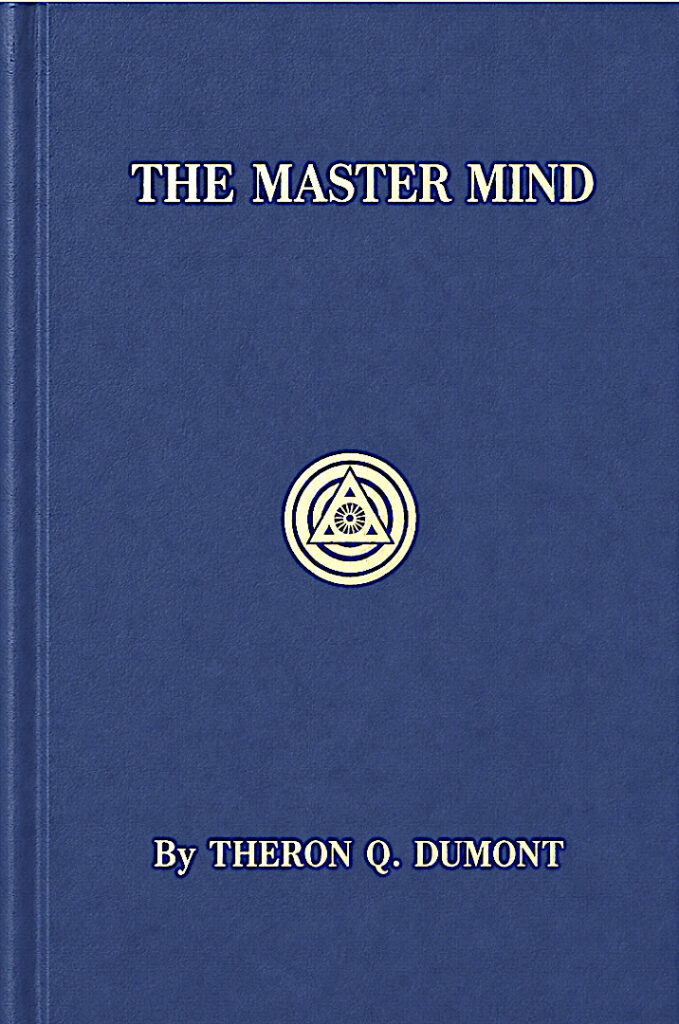
About This Publication
The Master Mind: Or, The Key to Mental Power Development and Efficiency by Theron Q. Dumont is a practical guide to developing willpower, mental discipline, and psychological self-mastery. Written in the tradition of the New Thought movement, the book emphasizes applied psychology over abstract philosophy, arguing that success and personal efficiency are achieved through the conscious control of thought, emotion, and habit. Dumont presents the mind as a faculty that can be deliberately trained, enabling the individual to direct life rather than merely react to circumstances.
Central to the book is the distinction between the ordinary mind and the Master Mind. The ordinary mind passively responds to habit, emotion, and external conditions, while the Master Mind exercises deliberate control through intelligence, purpose, and a disciplined will. According to Dumont, true mental development consists of replacing unconscious reaction with conscious direction until the individual becomes the master rather than the servant of his own thoughts.
The author further describes three stages of mental development. At the lowest level is mental slavery, in which a person’s thoughts and actions are almost entirely governed by outside influences. This is followed by partial freedom, where some degree of self-control has been achieved but external circumstances continue to exert considerable influence. The highest stage is mental mastery, in which the individual consciously governs thoughts, emotions, and behavior through disciplined attention and developed willpower.
A recurring theme throughout the book is the importance of thought control. Dumont argues that negative emotions, fears, and destructive mental habits should never be accepted as unavoidable. Instead, unwanted thoughts are to be recognized, rejected, and replaced with constructive patterns of thinking. He compares negative thoughts to a pebble in one’s shoe—an irritation that should be removed immediately rather than tolerated.
To achieve this level of mastery, the book emphasizes the systematic practice of visualization, concentration, and habit formation. Readers are encouraged to create clear mental pictures of their desired goals, focus attention upon those objectives with unwavering concentration, and gradually replace harmful habits with constructive ones through repetition and disciplined effort. In doing so, Dumont argues, individuals develop the mental efficiency necessary to shape both character and circumstance, transforming purposeful thought into purposeful action.