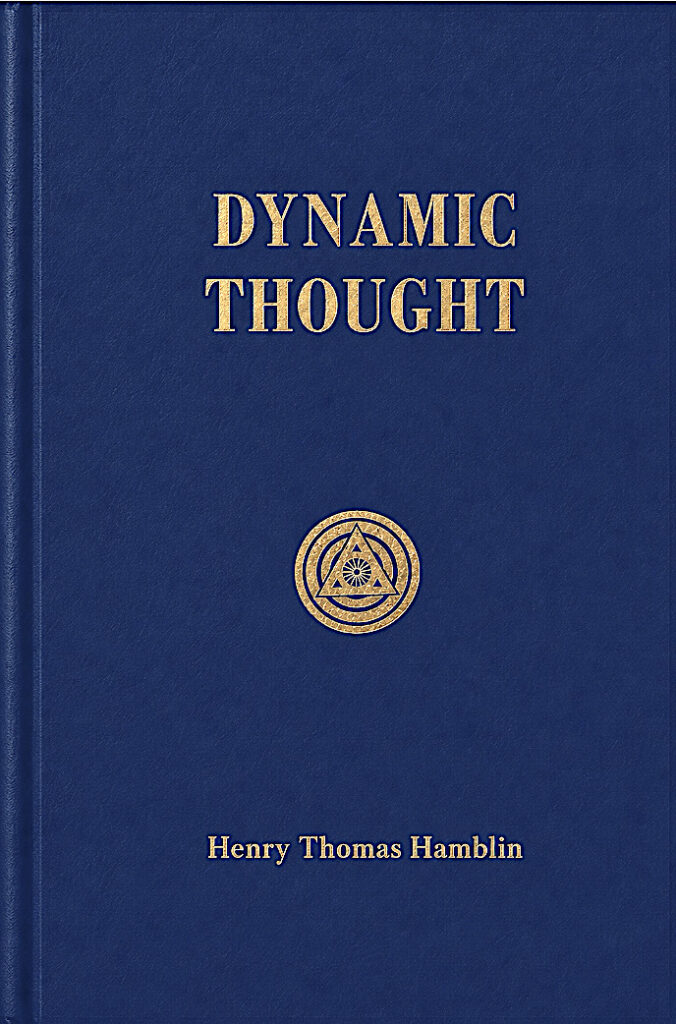
Dynamic Thought by Henry Thomas Hamblin is a classic New Thought work that presents a practical twelve-week course in mental and spiritual development. Drawing upon the principles of the Law of Attraction, the book teaches that harmony, health, success, and peace of mind are achieved by bringing one’s thoughts into alignment with universal spiritual laws. Through a combination of meditation, affirmations, visualization, and disciplined self-examination, Hamblin argues that individuals can transform both their inner character and outward circumstances.
At the heart of the book is the principle of right thinking. Hamblin maintains that thoughts are creative forces that shape every aspect of life, and that lasting change begins by changing one’s habitual patterns of thought. By cultivating constructive mental attitudes and replacing fear, doubt, and negativity with confidence and faith, the individual gradually reshapes both character and experience.
A central practice throughout the course is meditation, which Hamblin refers to as “the Silence.” He recommends entering a quiet, meditative state twice each day as a means of turning away from external distractions and establishing a conscious connection with the Divine Mind. This inward practice is presented as the foundation for spiritual growth, mental clarity, and personal transformation.
The book also emphasizes the regular use of affirmations and denials to retrain the subconscious mind. Positive affirmations are used to strengthen desirable qualities and establish new patterns of thought, while denials reject limiting beliefs and negative mental habits that hinder personal development. Closely connected to this practice is visualization, in which the student is encouraged to consistently picture the good, the beautiful, and the true until those qualities become reflected in daily life.
Dynamic Thought teaches that lasting success begins with self-mastery. Through disciplined control of the mind and will, the individual learns to overcome destructive habits, strengthen character, and align with the universal laws governing spiritual and material life. Hamblin presents personal transformation not as a matter of chance, but as the natural result of consciously directing thought in harmony with higher spiritual principles.
Henry Thomas Hamblin
Henry Thomas Hamblin
Henry Thomas Hamblin (1873–1958) was one of the leading British voices of the New Thought movement, combining mysticism, practical psychology, and spiritual philosophy into a system he called “Applied Right Thinking.” Born into modest circumstances in London, Hamblin overcame financial hardship to establish a successful career as an optician. Although materially prosperous, he later wrote that neither wealth nor business success brought lasting fulfillment. Personal struggles with depression, together with the death of his young son, prompted a lifelong search for spiritual truth that ultimately shaped both his philosophy and his writing.
Hamblin taught that the universe operates according to unchanging spiritual laws and that human thoughts are the primary cause of outward circumstances. Strongly influenced by the teachings of Dr. Herbert A. Parkyn and the Chicago School of Psychology, he emphasized the disciplined direction of thought, the power of suggestion, and the creative role of the subconscious mind. According to Hamblin, health, prosperity, happiness, and success arise naturally when an individual brings thought and character into harmony with what he called Cosmic Law. He stressed, however, that positive thinking alone was not enough; lasting achievement required disciplined action, perseverance, and moral character.
Beginning in the early 1920s, Hamblin became one of the most widely read New Thought authors in Britain. He wrote more than forty books and booklets, including the influential Within You Is the Power, and founded both the Science of Thought Institute in London and The Science of Thought Review, a magazine devoted to practical spiritual philosophy that remained in publication under successor titles for more than a century. His teachings reached an even broader audience through his regular contributions to Arthur F. Sheldon‘s Business Philosopher magazine, where he explored the relationship between spiritual principles, character development, and business success.
Over the course of his career, Hamblin’s writings gradually shifted from practical methods of self-improvement toward a deeper emphasis on direct spiritual realization and the experience of God’s indwelling presence. Through his books, magazines, and lectures, he became one of the principal figures responsible for introducing New Thought philosophy to readers throughout Britain and Europe.
Related Research Articles
The Sacred Geometry of the Yogi Publication Society Logo
This article examines the Yogi Publication Society logo and its sacred geometry meaning, comparing it with Hindu, Hermetic, Rosicrucian, Masonic, and Theosophical traditions to show the intention behind the publishing network.