Archive Document
Dr. Herbert A. Parkyn’s Science of Suggestive Salesmanship
Document Description
Copyright © 2026 D. Parkyn Jackson. Published by the Yogi Publication Society History Project. All rights reserved.
While Dr. Herbert A. Parkyn‘s Chicago School of Psychology trained hundreds of physicians, dentists, and medical professionals in Suggestive Therapeutics, it also drew students from a wide range of other professions eager to apply the science of suggestion to their own fields.
One area Parkyn steadily developed was the use of psychological suggestion in business and salesmanship. He taught that business success depends on mastery of the mind. Those who cultivate their inner faculties of intellect, emotion, and will can rise from ordinary sellers to influential leaders. Commerce, he emphasized, is not a simple exchange but a subtle contest between minds. Every transaction involves two individuals, each seeking to shape the other’s thinking. The skilled salesman must read character, sense motive, and apply suggestion with precision. Success comes not through force or deception, but through understanding, empathy, and mental discipline. Beneath the surface politeness of business lies a quiet but constant struggle for influence, and those who are mentally prepared are the ones who prevail.
“Are You a Thinker?”
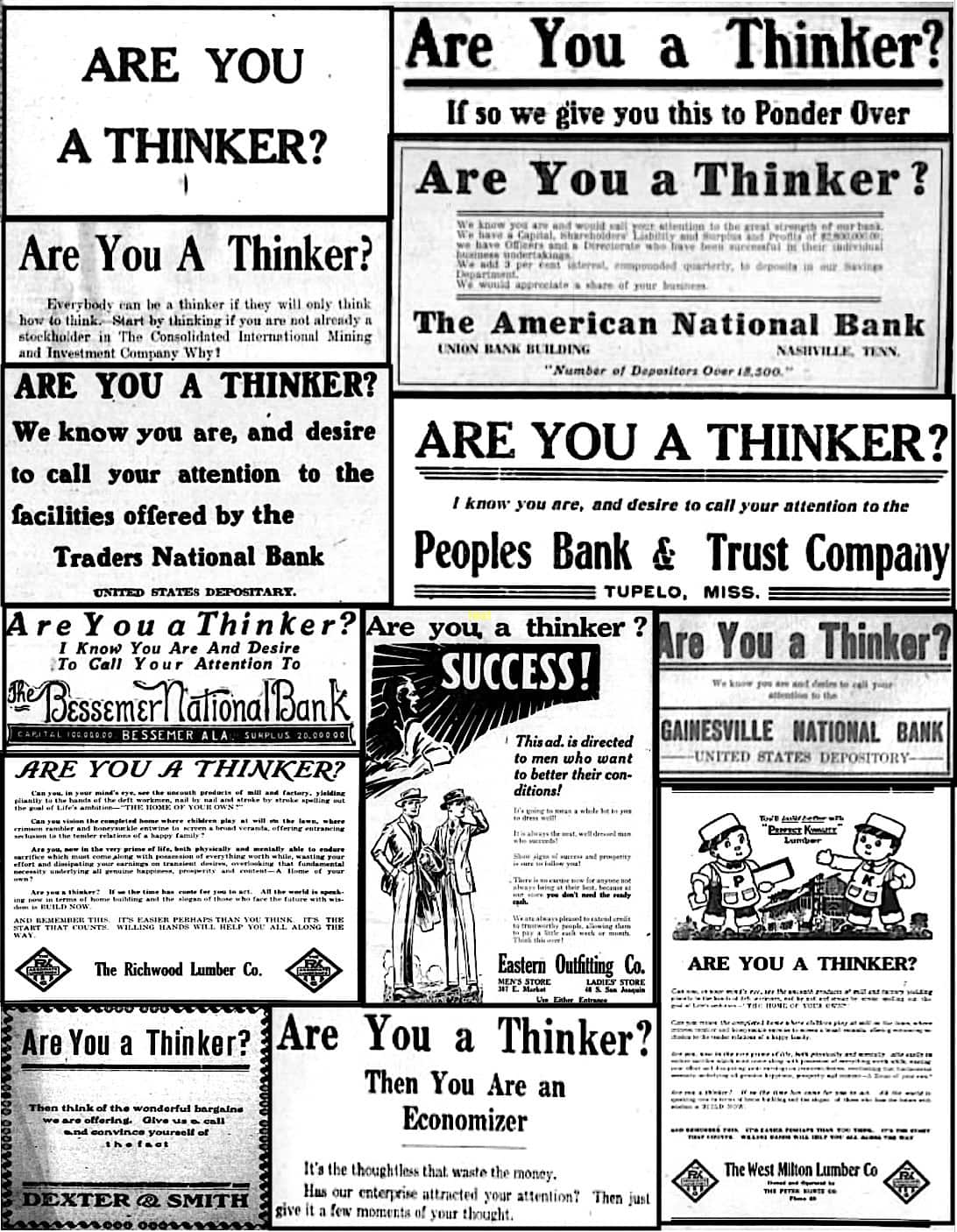
As early as the late 1890s, Parkyn began applying these ideas in collaboration with his “Brother Elk,” Charles B. Lahan, then president of the National Typographical Union. Dr. Parkyn introduced the science of suggestion to the world of advertising through the phrase “Are You a Thinker?” Leveraging Lahan’s connections in the printing and newspaper trades, the phrase was widely promoted as a psychological trigger in business ads. It marked a new strategy in commercial messaging of placing a bold, suggestive prompt at the start of an advertisement to capture attention and influence the reader’s state of mind before the message even began.
Some of the many samples of Dr. Parkyn’s suggestion, “Are you a Thinker?” in newspapers across the country.
Dr. Parkyn also capitalized on his, “Are you a thinker?” marketing campaign by branding Suggestion magazine as the publication for “Thinkers.” He referred to its readership collectively as the “League of Thinkers” and established a dedicated “Thinker” department within the magazine.
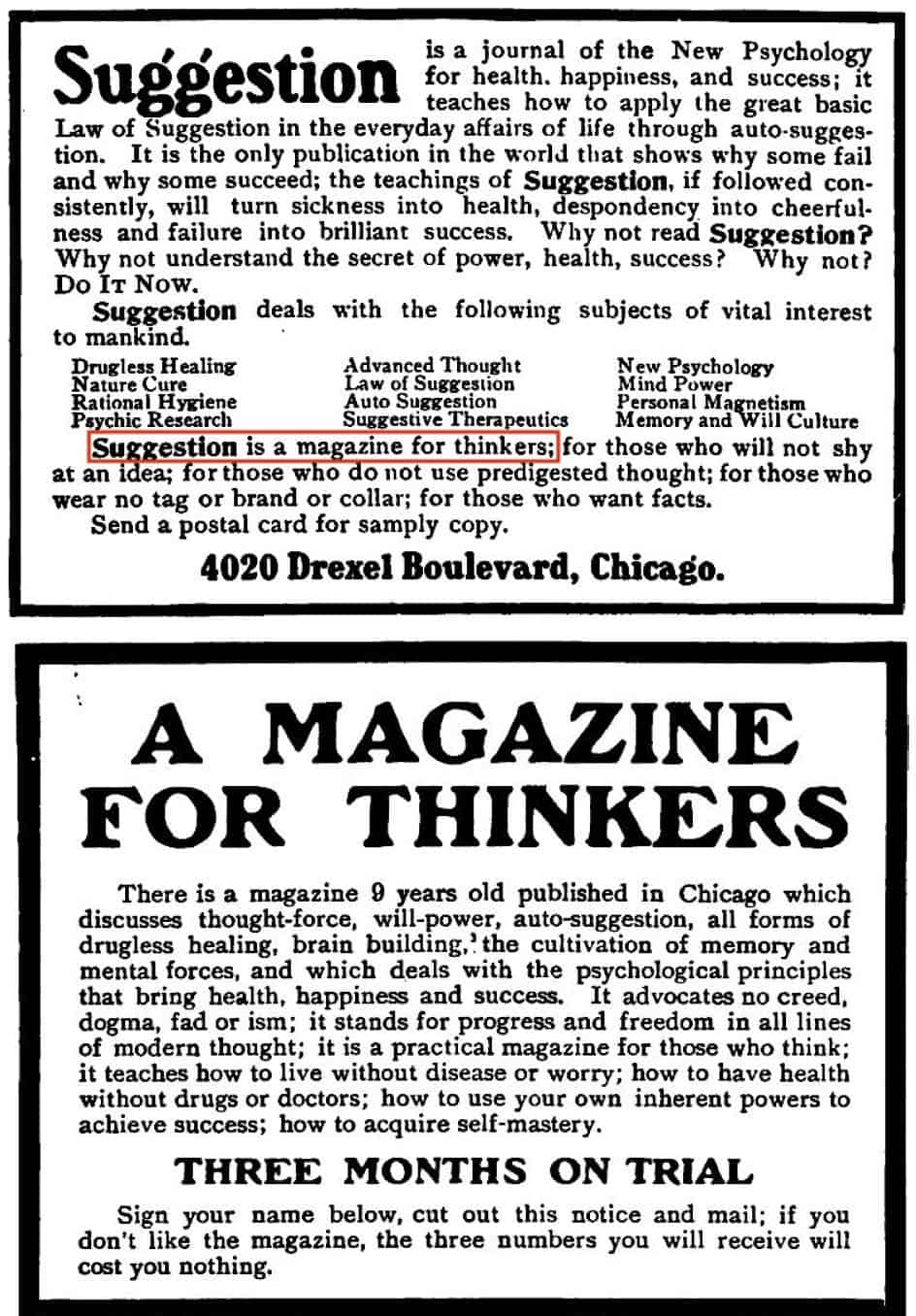
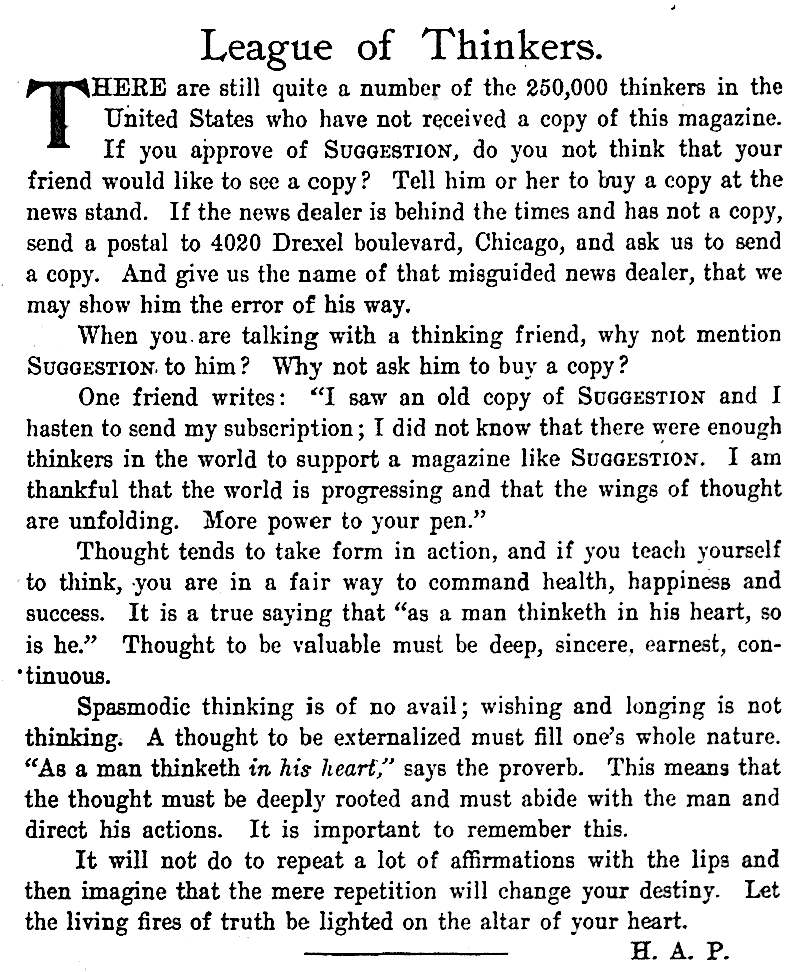
Dr. Parkyn’s definition of a “thinker”:
“A thinker wears no tag, collar or number; his opinions are not received from a newspaper, a book or a pulpit. He is not a parrot. “They say” has no terrors for him. He wants facts, and from these facts he builds his own ideas. And he reserves the right to change his opinions as new light is received. If you never change your opinions, you never think. Use your brain, and it will reveal to you new virtues. Thought is the only factor in evolution; thought is the only power that can regenerate mankind. Thought will kill ignorance, greed, and bring all elements into harmony with law. When this occurs evil will be unknown. Think first yourself; then be tolerant with others who think. Respect the opinions of others is the first rule of mortality.”
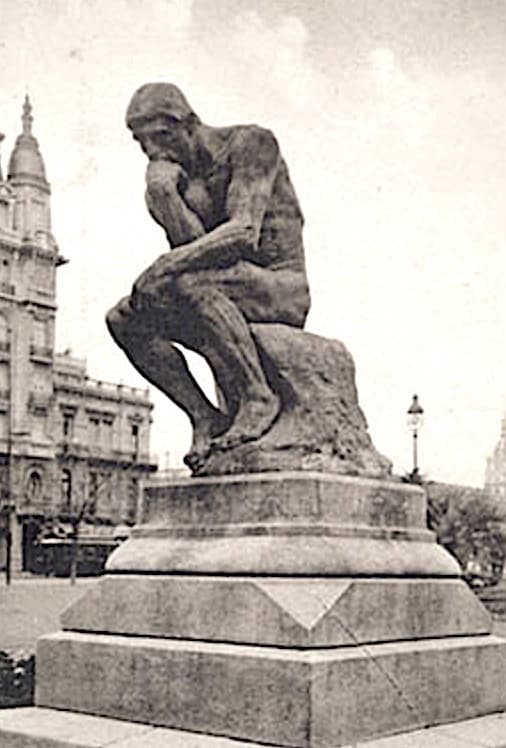
The Thinker, by Auguste Rodin
The Thinker by Auguste Rodin was originally titled The Poet, representing Dante in contemplation before the Gates of Hell. However, when it was completed in 1904, it was changed to The Thinker, influenced by the popularity of the term within the New Thought movement around the world.
“Do It Now!”
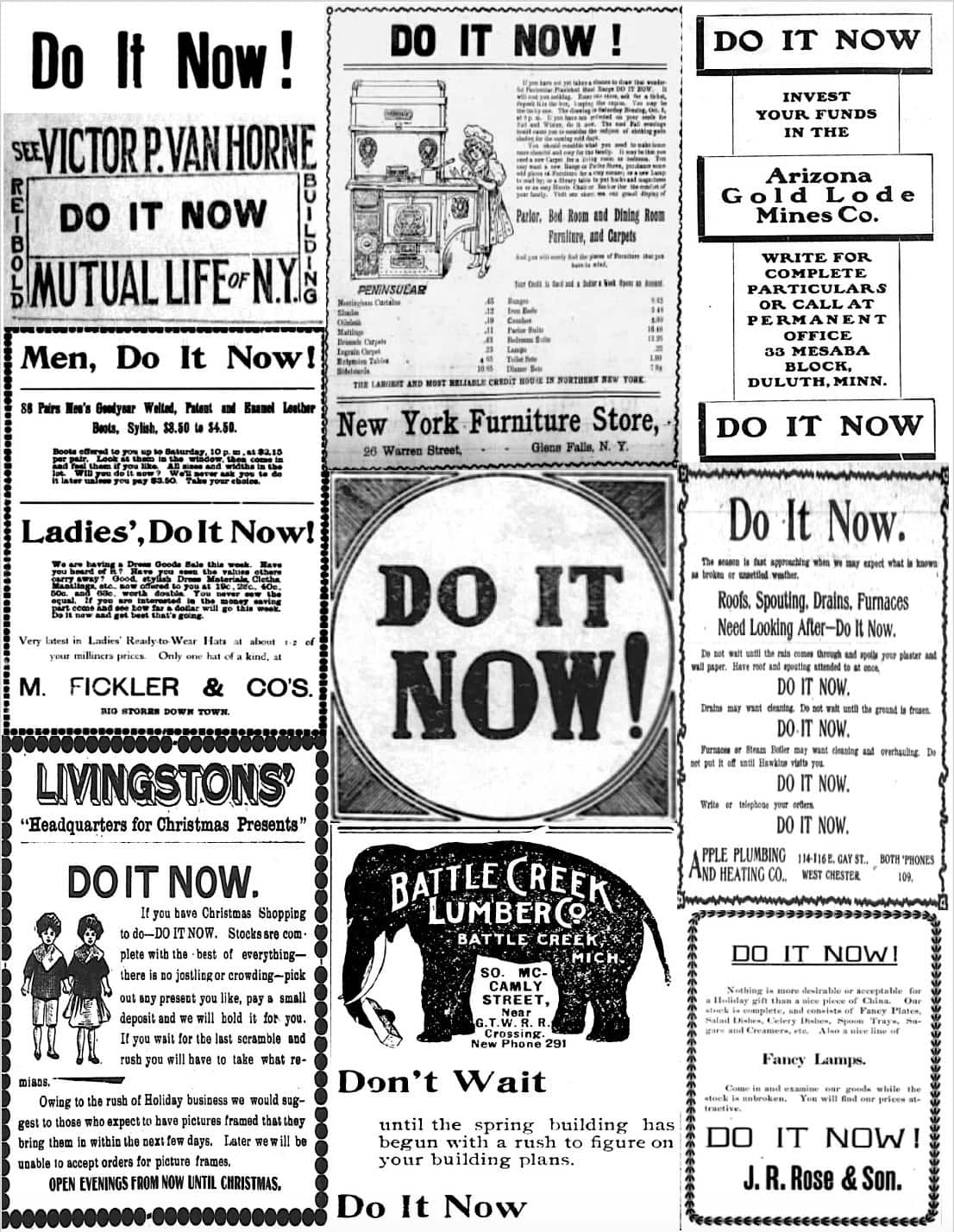
Following the success of the “Thinker” campaign and the strong response from the business community for more usable advertising suggestions, Dr. Herbert A. Parkyn introduced a new phrase: “Do It Now!” Unlike “Are You a Thinker?,” which appealed primarily to intellectuals, financial institutions and large business ventures, “Do It Now!” was designed for broad use across nearly every type of business. Its versatility made it an immediate favorite, and soon newspapers and magazines were filled with advertisements bearing the slogan.
The phrase quickly moved beyond print ads. It became a national motto, appearing on placards in offices, factories, and even under wall clocks as a constant reminder to act without delay. Businessmen placed the slogan on their desks, while advertising agencies and post office headquarters adopted it as part of their own motivational decor. Its influence reached the highest levels of public life, with President Theodore Roosevelt quoting it in speeches to rally national resolve, and Andrew Carnegie using it to urge wealthy industrialists to begin their philanthropic efforts during their lifetimes rather than waiting until after death.
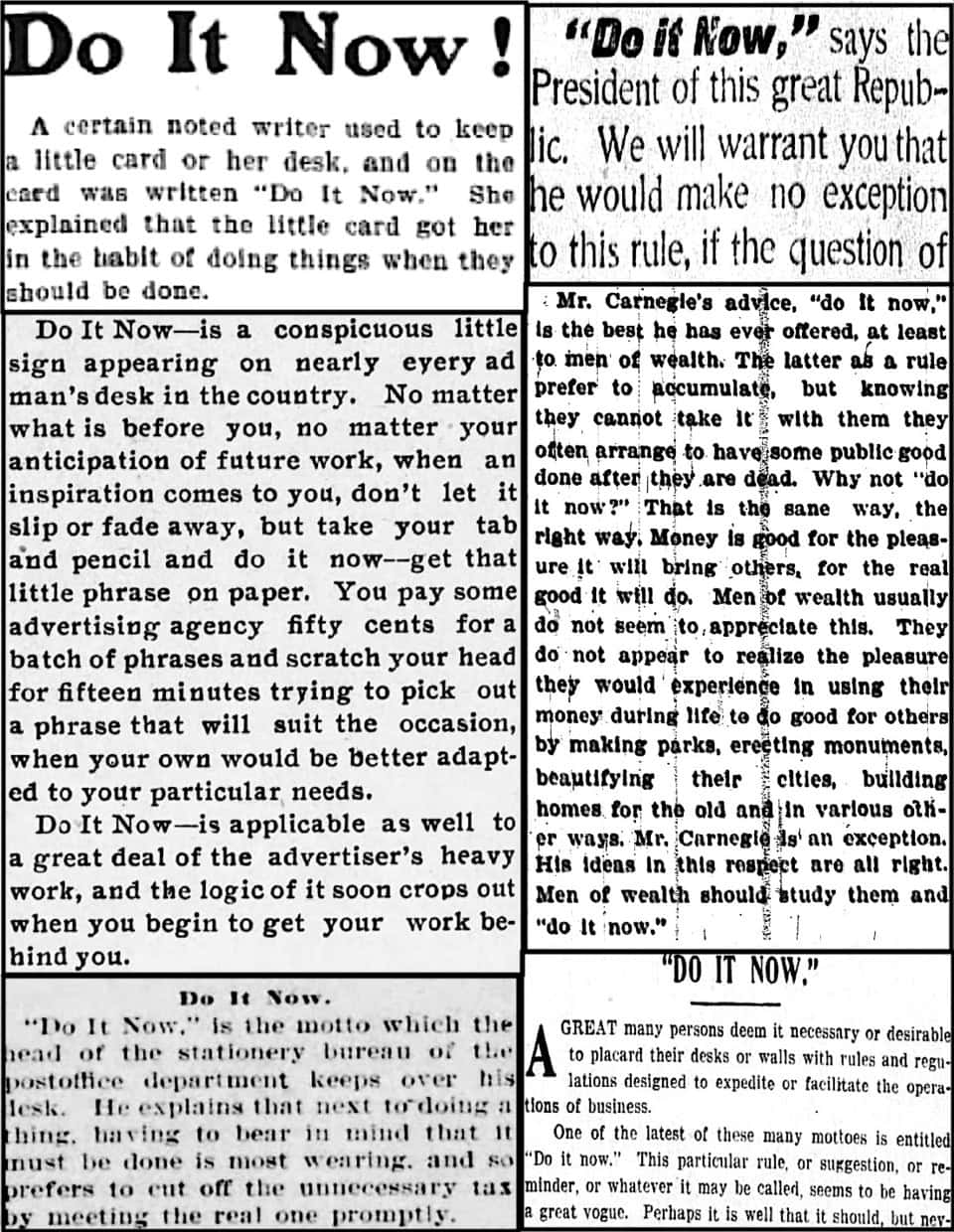
Some of the many samples of Dr. Parkyn’s suggestion, “Do It Now!” in newspapers ads across the country.
Some of the many articles on the “Do It Now!” fad that swept across the country
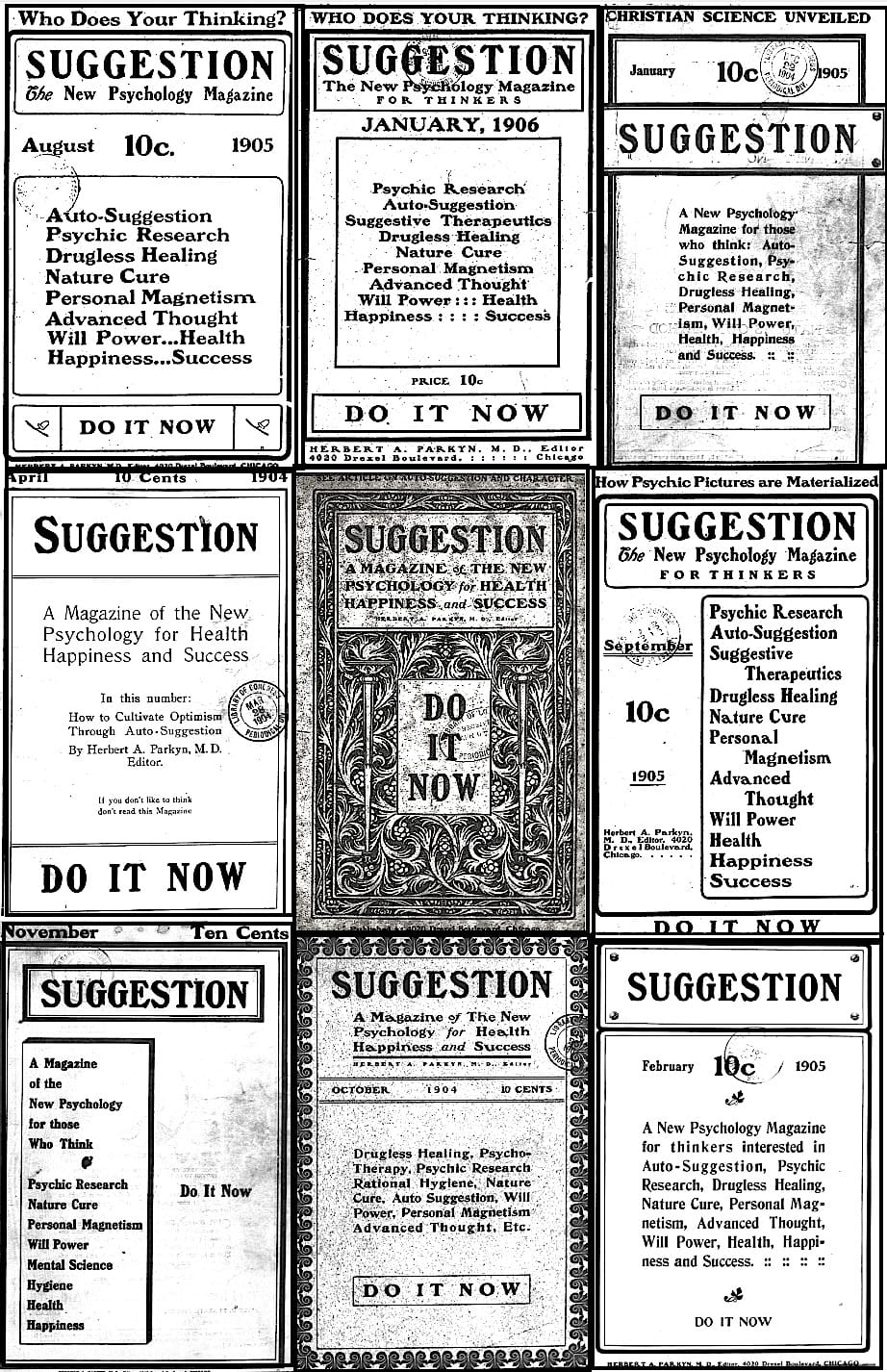
“Do It Now!” Is Used Throughout Dr. Parkyn’s Suggestion Magazine
Recognizing the widespread impact of the “Do It Now!” campaign, Dr. Parkyn made it a central feature of Suggestion magazine. The slogan appeared prominently on the cover, was declared the magazine’s official motto, and inspired the formation of a dedicated “Do It Now!” club and department. The magazine began publishing a series of “Do It Now!” poems, submitted by both readers and writers in support of the idea. Dr. Parkyn also took charge of distributing wall and desk ornaments featuring the motto, printed on granite paper and mounted with red borders, helping to further spread the message into offices and homes across the country.
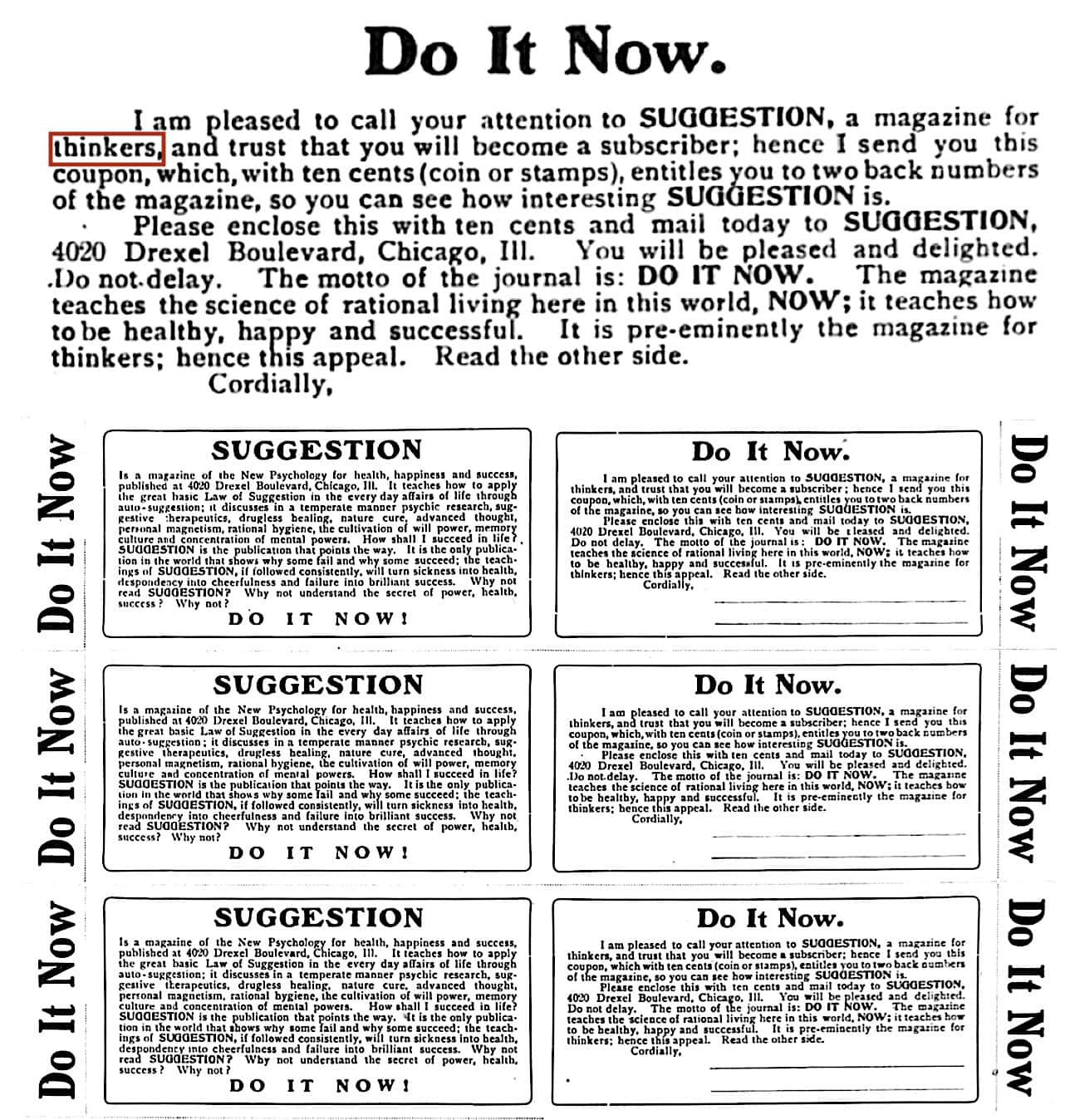
“Do It Now” tear-outs in Parkyn’s Suggestion magazine
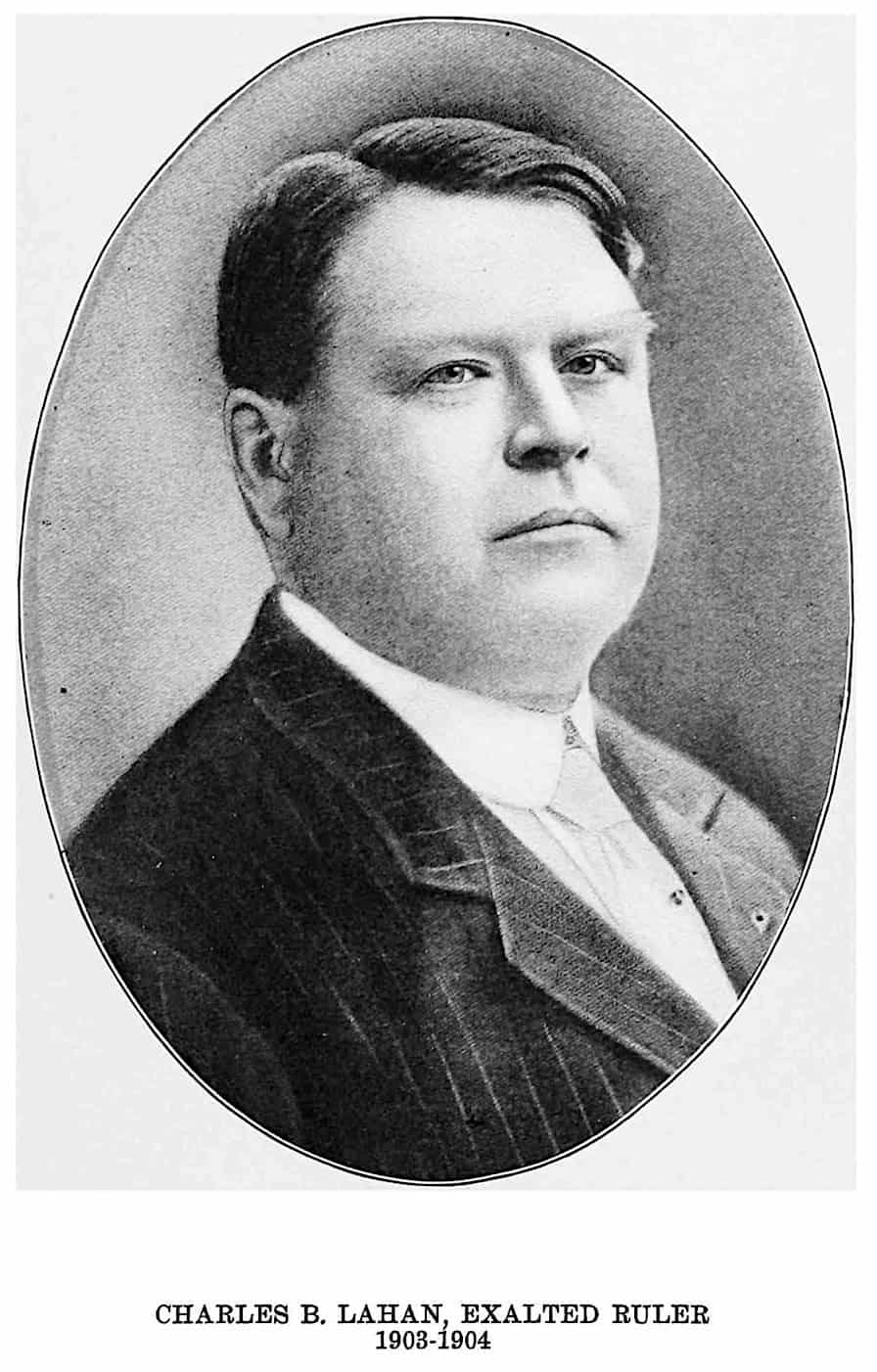
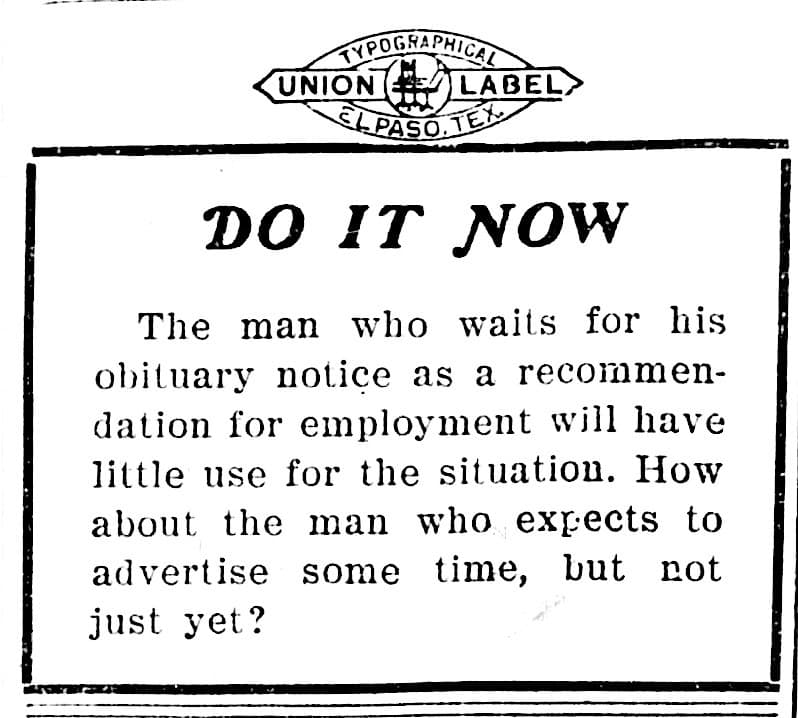
The National Typographical Union used Parkyn’s “Do it Now.” Parkyn’s close friend and collaborator, Charles B. Lahan, was president of the Union.
“Thought Takes Form in Action”
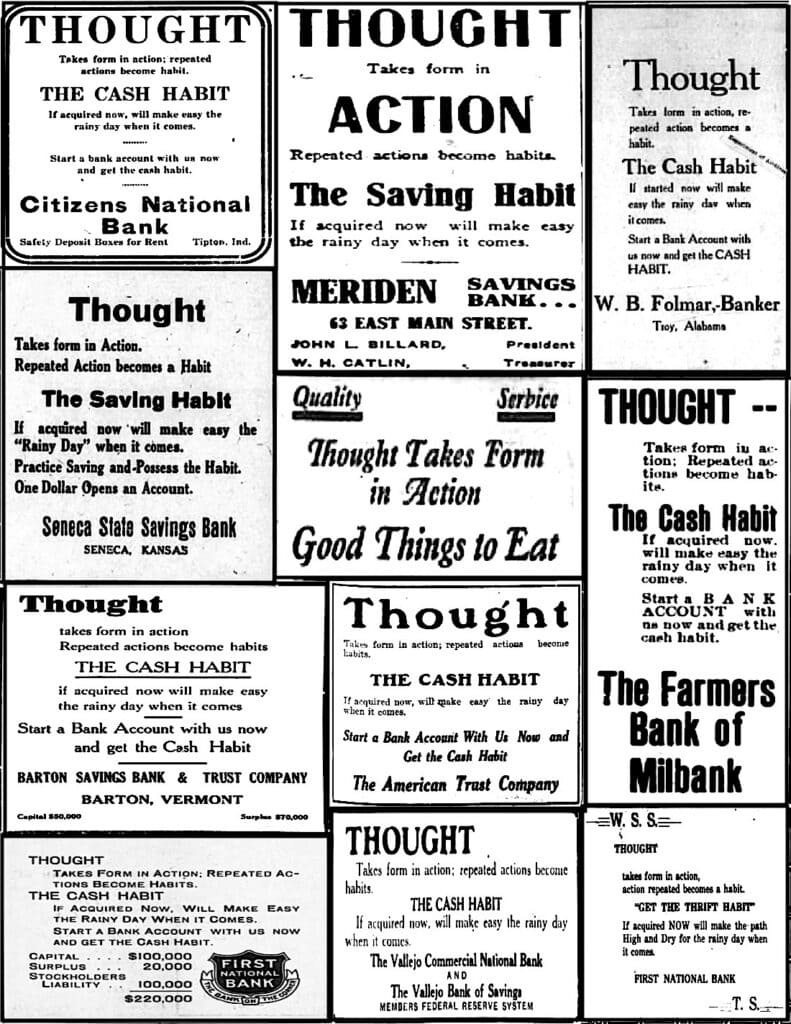
Dr. Parkyn adapted his most well-known quote, “Thought takes form in action; repeated actions become habits,” into a national marketing campaign for banks. The phrase was ideally suited to what was called the “savings” or “cash habit,” encouraging the public to develop the routine of opening and maintaining savings accounts.
Some of the many samples of Dr. Parkyn’s suggestion, “Thought Takes Form in Action,” in newspapers across the country.
“Health, Happiness, and Success”
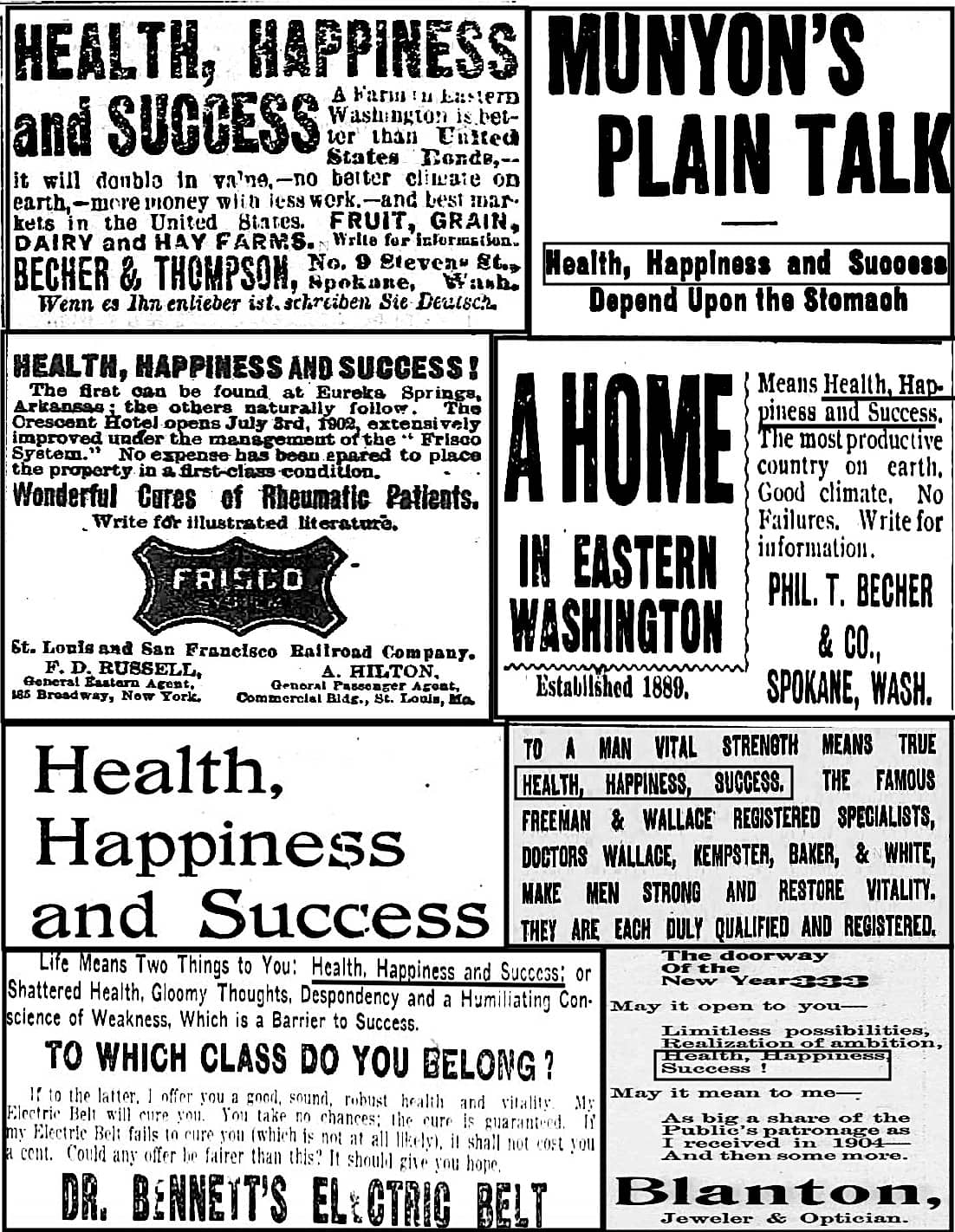
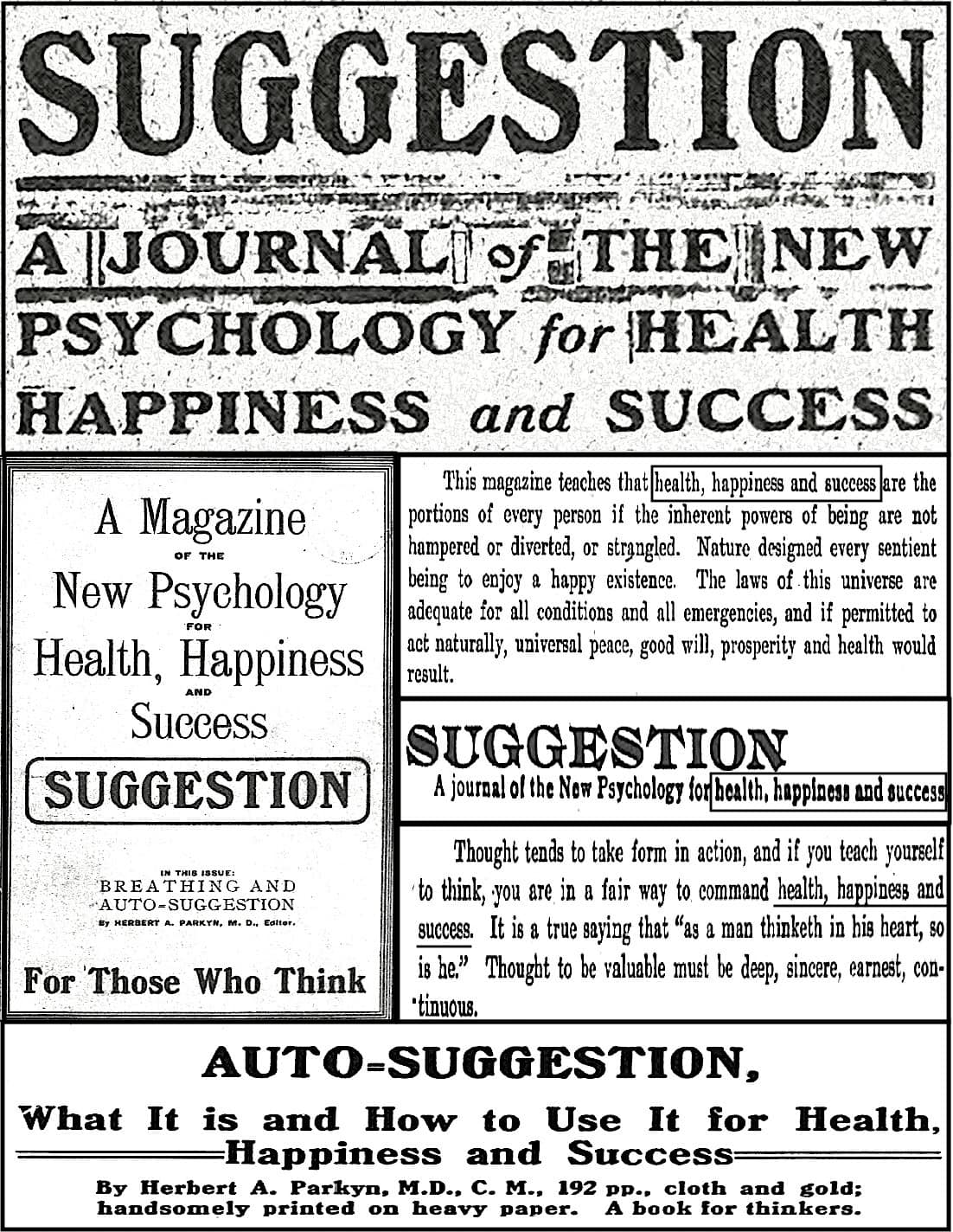
Dr. Herbert A. Parkyn formulated what he called the trinity of mankind’s demand, desire, and affirmation: Health, Happiness, and Success. He would use this phrase not only as a suggestion in advertisement campaigns but also as the primary branding slogan for his magazine Suggestion.
Some of the many samples of Dr. Parkyn’s suggestion, “Health, Happiness, and Success,” slogan used in newspaper ads.
“Health, Happiness and Success” slogan used by Herbert A. Parkyn in his Suggestion magazine and for his book Auto-Suggestion.
Dr. Parkyn’s Suggestive Phrases Become Slogans for the New Thought Movement
As one of the only fully accredited medical physicians from a leading school within the hierarchy of the New Thought movement, Dr. Herbert A. Parkyn was regarded as a natural leader by many of the movement’s more spiritual and metaphysical figures. While New Thought lecturers and writers often spoke compellingly about the transformative power of suggestion, their insights tended to remain within the realms of inspiration and spiritual philosophy. Few had the scientific training necessary to understand or explain how suggestion affected the physical body in measurable terms. That responsibility was deferred to professionally trained experts like Parkyn.
As Henry Harrison Brown, an elder statesman of the movement and editor of NOW magazine, had advised the New Thought community, “To deduce a philosophy or even to theorize upon the psychic phenomena requires time and growth… Let those who like Thomson Jay Hudson, Andrew Jackson Davis, and Dr. Herbert A. Parkyn, who have for years experimented, give us theories.”
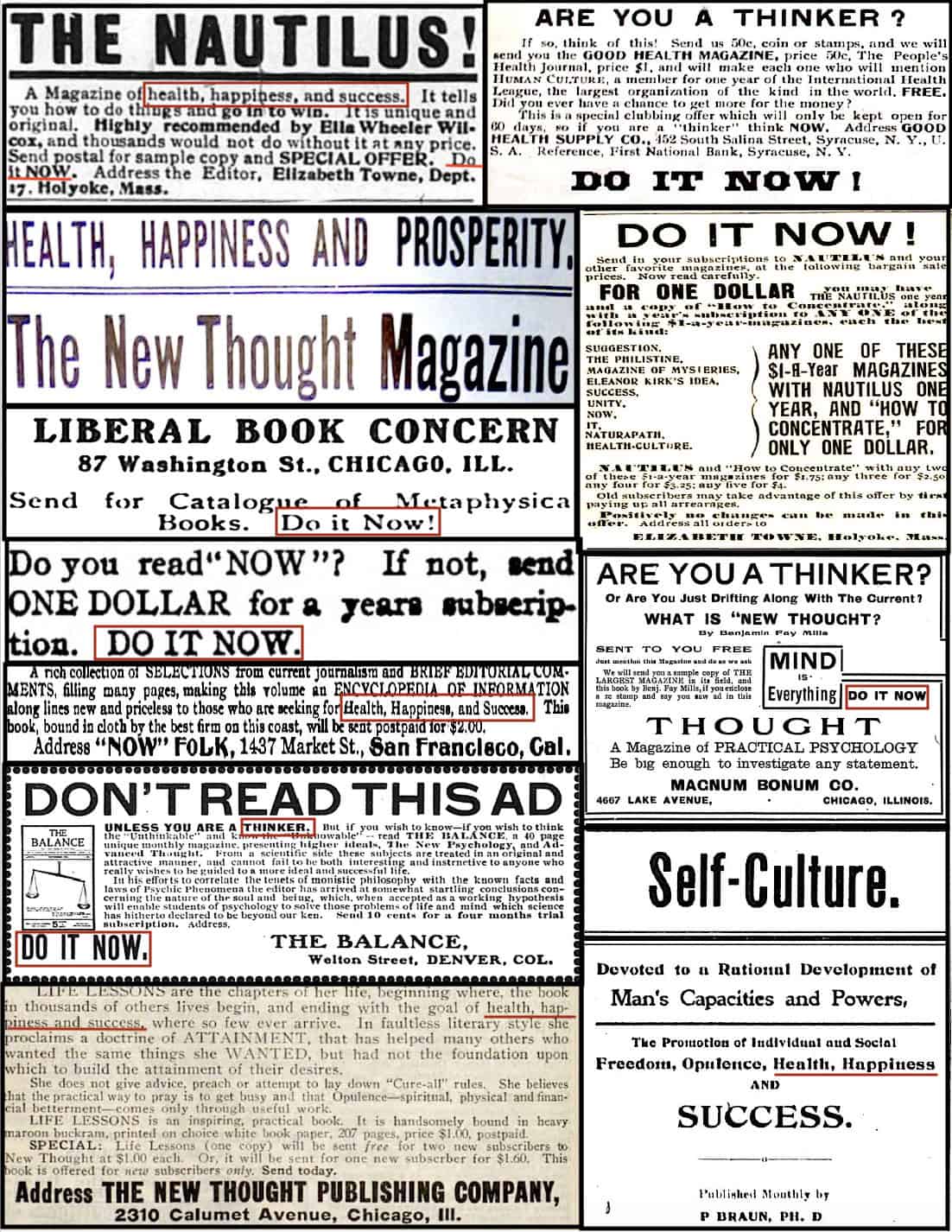
With the coming together of multiple organizations at the 1903 New Thought Convention in Chicago, Dr. Parkyn launched a campaign to unify the movement around the central principle of Suggestion as the foundational force underlying the various mental science teachings. As part of this effort, he encouraged periodicals and schools within the “Suggestion Family” to adopt shared phrases, signaling to readers that they belonged to a cohesive network grounded in the application of Suggestion. The phrases included those that Dr. Parkyn had prominently branded through his magazine Suggestion and made central to his teachings, including “Do it Now,” “Thinker,” and “Health, Happiness, and Success.” The initiative also formed part of a suggestive strategy devised by Dr. Parkyn, centered on the repeated use of focused affirmations that would suggest the idea of “thinking thoughts of health, happiness, and success, now.”
This campaign marked a continuation of a process Parkyn had begun years earlier, in which he had taken the technical teachings of suggestive therapeutics and synthesized them into short, potent suggestive phrases designed for mass distribution and public influence. Earlier examples of this included “I Can and I Will” and “Thought=Force,” which were widely promoted through Parkyn’s collaboration with his protégé, William Walker Atkinson.
The response to the campaign was immediate. New Thought publications and institutions across the country began incorporating Parkyn’s suggestive phrases into their editorial content, advertising, and branding. Many of these publications were operated by Parkyn’s former students or close collaborators. These included New Thought, The Nautilus, Now, Self-Culture, Thought, Unity, The Balance, Good Health, The Business Philosopher, The Segnogram, and Human Culture, among others. While New Thought magazine used Parkyn’s phrases within its editorial material, it adopted the slightly altered slogan “Health, Happiness, and Prosperity” as its formal branding, a strategic choice following earlier legal scrutiny and postal shutdowns related to its past collaboration with Parkyn.
With so many influential publications and writers adopting the same key phrases, they quickly became widespread slogans of the New Thought movement. They appeared not only in magazines but also in books, lectures, and advertisements nationwide, forming a unifying linguistic thread across the diverse strands of mental science and spiritual psychology then developing in the country.
Some of the many samples of Dr. Parkyn’s suggestive phrases being used throughout the New Thought community.
Sources & Citations
- PDF / Digital Archive. THE OFFICIAL HISTORY OF CHICAGO LODGE NO . 4, 1910
- Newspaper. "Charles B. Lahan, President of Union" . The Washington Post. 1903-08-09. p. 32. Retrieved 2025-07-16.
- PDF / Digital Archive. Suggestive Therapeutics magazine issue V8 N2 , February 1900
- PDF / Digital Archive. Suggestion V15 N5 , November 1905
- PDF / Digital Archive. Suggestion V14 N4 , April 1905
- PDF / Digital Archive. Suggestion magazine V14 N1 , January 1905
- Newspaper. "Do it now" . Orange Daily Tribune. 1903-11-02. p. 3. Retrieved 2025-07-18.
- Newspaper. "Andrew Carnegie says Do it now" . The South Bend Tribune. 1903-11-02. p. 4. Retrieved 2025-07-18.
- Newspaper. "Do it now" . The Brantford Daily Expositor. 1903-12-18. p. 4. Retrieved 2025-07-18.
- Newspaper. "Do it now sign on desks" . Asheville Citizen-Times. 1903-10-20. p. 4. Retrieved 2025-07-18.
- PDF / Digital Archive. Suggestion V17 N5 , November 1906
- Newspaper. ""Thought takes form in action ," the famous quote from Dr. Herbert A. Parkyn". The Journal. 1907-06-14. p. 11. Retrieved 2025-07-19.
- PDF / Digital Archive. Suggestion Magazine , 1898 to 1906, edited by Dr. Herbert A. Parkyn
- PDF / Digital Archive. Now magazine V1 N9 , by Henry Harrison Brown, November 1900
- PDF / Digital Archive. Suggestion Magazine year 1903
- PDF / Digital Archive. Suggestion magazine V12 N1 , January 1904
- PDF / Digital Archive. "New Thought [Chicago] (IAPSOP)" . iapsop.com.